
When Tradition Eclipses Torah
My Torah Portion Observation of the Week
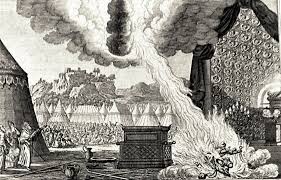
I was profoundly moved by the section of this week’s Torah portion that recorded what on the surface seemed the very harsh and violent encounter we had with YHVH. It was Parashah 26: Sh’mini, Eight and I wish to briefly reflect upon Leviticus 9:22-10:11. In this story we can see how the introduction of traditions and practices not sanctioned by the Almighty can eclipse and ultimately nullify Torah as taught to us by Master Yahoshua.
Aharon and Sons Trained in Proper Worship
Aharon and his sons (the select priests of Yah) were in the process of being trained in the ways of Yah as it related to conducting acceptable sin and burnt offerings to our Elohim (Lev. 9:6-21). Initially, it appeared as though the training went quite well as the presence of YHVH appeared to us all (Lev. 9:22, 23).
“Fire came forth from the presence of YHVH, consuming the burnt offering and the fat on the altar” (Lev. 9:24).
This demonstration of acceptance on the part of Yah resulted in our crying out in one loud voice and falling to the ground on our faces. Can you imagine some 1.5-million of us shouting aloud (whether in stark fear or in fearful adoration) before Yah in the Sinai desert as we witnessed this awesome event? The sight of the Father consuming our sacrifice coupled with our response to this must have been an indescribable sight indeed.
The Tragedy of Nadav and Avihu’s Unauthorized Form of Worship
However, the brilliance of this event was eclipsed by the foolishness of a couple of Aharon’s sons, Nadav and Avihu. Nadav and Avihu, for whatever reason, took it upon themselves to create their own method of YHVH worship by, what Torah describes as,
“…offering strange or unauthorized fire before YHVH, which Father had not instructed” (Lev. 10:1).
This seemingly innocent and innocuous stunt on the part of Nadav and Avihu cost them their lives. The same fire that consumed our sacrifice consumed them, resulting in their summary execution, right before our very eyes (Lev. 10:2).
Consequently, Moshe instructed Aharon and his two remaining sons to not display any semblance of mourning, but to remain at their post at the Tent of Meeting. We as a nation, however, were permitted to mourn their deaths, but Aharon would have to remain resolute in his purpose and position as Yah’s Cohen Gadol as he was not permitted to mourn or react to his sons’ sudden and violent deaths.
Looking at this Tragedy Through Our Western Sensibilities
To our western sensibilities, this historical story on the surface may appear terrible and completely senseless, especially on the part of YHVH. Certainly this story and others like it have been the alleged reason for many in our modern, so-called enlightened, western society, to reject YHVH. I recall hearing about and reading stories of individuals who categorically reject the so-called “God of the Old Testament” because He appeared to them to be this cold, callous and violent God. To these: how could anyone in their right mind choose to worship such an entity?
Enter Humanism to Explain this Senseless Execution
The sudden and violent deaths of Nadav and Avihu are indeed senseless, but senseless from what perspective? Our so-called civilized, western-moral values were shaped over the centuries by men who took the teachings of Yeshua and blindly fashioned them into the fundamental and foundational supports for modern humanism.
Google dictionary defines humanism as:
“An outlook or system of thought attaching prime importance to human rather than divine or supernatural matters. Humanist beliefs stress the potential value and goodness of human beings, emphasize common human needs and seek solely rational ways of solving human problems.”
Notice the first sentence of this definition: attaching prime importance to human rather than divine matters.
Notice that God is nowhere to be found in this concept.
The Danger of Dismissing Father’s Perspective in our Worldview
When we take Father’s perspective and sensibilities out of our “worldview” equation (if you will), we end up with a rather irrelevant worldview. Father’s worldview is the only thing that matters and the only thing that must matter if we are intent upon having any substantive relationship with the Most High. This is why denominationalism has fallen short in its purpose of being the True Faith once delivered. Denominationalism has taken select love-based teachings of Jesus Christ and made it the foundation upon which sola gratia was established. This sola gratia and “all you need is love” set of doctrines has gone a long way towards misrepresenting the True Person of YHVH and the true purpose and intent of Torah. Furthermore, this marginalizing, or better, demonizing of YHVH and His Torah, has resulted in the introduction of Humanism into the True Faith once delivered (Jude 4). Essentially, humanism has replaced the True Faith once delivered.
True Grace Seen in the Nadav and Avihu Tragedy
As strange and ridiculous as this may sound, the deaths of Nadav and Avihu were in a sense Abba’s grace being shed upon us and the future of the Body of Messiah. Essentially, if Abba were to have allowed the introduction of unauthorized worship practices into the ritual that He established through Moses’ instructions, over time, those unauthorized worship practices would lead to even more and worsening practices that would ultimately nullify Father’s overall instructions.
Blocking the Traditions of Men
By Father taking swift and decisive actions to nip in the bud the introduction of unauthorized teachings, practices and traditions into His Torah, we have available to us today the best representation possible, in His inspired Word—the Bible, what He expects of us as His chosen ones. That is, if we choose to consider the unadulterated Word and instruction of Torah as our instruction. Otherwise, we are prone to turn to the teachings, doctrines and traditions of men, the primary example seen during the ministry of our Master being Rabbinic Judaism. We see very clearly in Rabbinic Judaism that man made traditions, doctrines and teachings serve only to nullify the instructions of our Creator. Master highlighted this crucial truth when He was confronted by the religious leaders over His disciples not following the ceremonial traditions and instructions of the so-called sages:
“Then the Pharisees and scribes asked Him, Why walk not thy disciples according to the tradition of the elders, but eat bread with unwashen hands? He answered and said unto them, Well hath Esaias prophesied of you hypocrites, as it is written, This people honoureth me with their lips, but their heart is far from me. Howbeit in vain do they worship me, teaching for doctrines the commandments of men. For laying aside the commandment of YHVH, ye hold the tradition of men, as the washing of pots and cups: and many other such like things ye do. And He said unto them, Full well ye reject the commandment of YHVH, that ye may keep your own tradition” (Mark 7:5; KJV).
What Avihu and Nadav were attempting to do in a great sense was a foreshadow or precursor of what ultimately Yeshua had to deal with during the time of His earthly ministry. And to a great extent, this is what we are having to navigate through ourselves as we attempt to walk out this Faith of ours in the midst of so many teachings, doctrines and traditions that serve only to nullify the Torah of YHVH.
Whenever we come upon doctrines, traditions and teachings that urge us to go beyond what Father instructed us to do in His Torah, we really need to weigh and closely examine those things through the lens and weight of His eternal Word. If those doctrines, teachings and traditions are perhaps of pagan origin, then we need to run away from those types of worship and practices. I truly believe that what Nadav and Avihu were attempting to do was to introduce pagan rituals and practices into Father’s explicit worship rites. This could be why Abba responded to their offering so swiftly and violently.
Our Ways Not His Ways
Indeed, many in our 21st century western society see this incident as senseless and unwarranted on the part of Father, and thus, this plays into their rejection of Him and His Torah. Many contend that Father is a violent and war-mongering God who seeks nothing but to kill and destroy. (Interestingly, aren’t these the same descriptors we use to describe hasatan?)
Whereas there was a time when western cultures accepted the whole of the Bible as containing the Words of God, in recent decades, our so-called enlightened modern society has rejected the Person whom they identify as the God of the Old Testament for these stated reasons.
Well, if we view Father through the lenses of our corrupt nature, as strange as this may sound, yes, one would certainly see YHVH as a heartless, murderous and callous tyrant.
Interestingly, when we consider our Master’s (the Person who many refer to as the God of the New Testament who replaces the God of the Old Testament) perception of His Father and our Creator, He seems to not possess the same understanding of Him as most secular society does.
Of His Father, Master stated:
“…I am going away so that the world may know that I love the Father. Just as the Father commanded Me, so I do” (John 14:31; Holman CSB).
Now for someone who preached and spoke so much about love—love of Yah and for one’s fellow man—it doesn’t make sense that He would actually love the same Person who so many see as monstrous. Something just doesn’t jive here.
I submit that the Master’s love of Father was of such an indescribable degree was because Master sees and knows His Father for what He truly is. Master sees Father as the Holy Sovereign of heaven and earth:
“…if you will indeed obey my voice and keep my covenant, you shall be my treasured possession among all peoples, for ALL THE EARTH IS MINE” (Exodus 19:5; ESV).
“For the earth is YHVH’s and the fullness thereof” (I Corinthians 10:26; KJV)
So the truth of the matter is that Father has full authority to do whatever He chooses to do in heaven and on the earth because ALL THE EARTH BELONGS TO HIM as well as all that is contained within both those realms.
Father’s Thoughts and Ways Are Above Ours
But still some will contend that what Father did here in this passage was senseless and cruel and that certainly, Father could have found another way. Well, we must also understand this one crucial thing about Father before we start imposing our sense of morality (our Humanism) upon Him. Of Himself, Father revealed:
“For my thoughts are not your thoughts, neither are your ways (i.e., my “derek” or manner) my ways, saith YHVH. For as the heavens are higher than the earth, so are my ways (i.e., my manners) higher than your ways and my thoughts than your thoughts” (Isaiah 55:9, 10; KJV).
Therefore, no matter high and mighty we may see ourselves; no matter how far we believe we’ve arrived; we can never measure up to Father’s level of thinking nor match His ways of doing things.
The Mind of Christ
Unless…we adopt and possess the Mind of Christ (i.e., the Mind of Messiah) (I Corinthians 2:16). If we get to that place in our lives where we possess and exercise the Mind of Messiah, then we will begin to understand more and more of why Father does what He does. When we start possessing the Mind of Messiah, then we begin to think more along the same lines as our Heavenly Father does.
Well, you may question: how does having the mind of Messiah (i.e., Christ) cause us to understand why Father does the things He does or think along the same lines that He thinks? It’s simple. Master stated the reason:
“I and my Father are one” (John 10:30; KJV).
We must understand that although Yeshua and Father are two distinct Beings that reside in the throne room of heaven, they are one; that is, they are “eis,” that is united closely in will and in spirit and purpose (Thayer’s Greek Lexicon).
May we grow in our Faith and love of Father and His Son such that we become one with them. In so doing, we will begin to understand the ways of our Heavenly Father and appreciate all that He has, does and will do for us.
Mashiyach/Messiah ben David: The Convergence of Three Messianic Profiles in Yeshua
Mashiach ben David: The Convergence of Three Messianic Profiles in Yeshua Part 11 of the Melchizedek Series Greetings, beloved saints of the Most High Ahlohim. In this installment of the Messianic Torah Observer, we turn our attention to one of the most...
The Serpent’s Oldest Question: Genesis 3, October 7, and Beresheit Faith
The Serpent’s Oldest Question—and Why the World Gets to Start Over Shabbat Shalom, beloved, and welcome to another installment of the Messianic Torah Observer. In this teaching, we stand at a sobering and deeply meaningful intersection: the third anniversary of...
The Eighth Day: The Feast Nobody Leaves
Chag Sameach, beloved saints in training. In this installment of The Messianic Torah Observer, we turn our attention to Shemini Atzeret—the Eighth Day Assembly, otherwise known as the Last Great Day. It is the Feast that arrives after the seven days of Sukkot, when...
Every Nation Will Come: Sukkot, Zechariah 14, and Yeshua Tabernacling With Us
Episode Summary Chag Sameach Sukkot, beloved of the Most High. In this installment of The Messianic Torah Observer, we turn our attention to Sukkot, aka the Feast of Tabernacles; the Feast of Booths; and the Feast of Ingathering to consider what this appointed time...
Ha’azinu and Shabbat Shuva: The Song of Moses, Teshuvah, and Yom Kippur
Ha’azinu: The Song That Knew the Future—and the Shabbat That Stands Between You and Yom Kippur Greetings, Saints of the Most High Ahlohim, and welcome to another installment of The Messianic Torah Observer. In this teaching, we turn our attention to Parashat...
The Hidden Feast: Yom Teruah, the New Moon, Hannah’s Prayer, and the Return of the King
Beloved, in this installment of The Messianic Torah Observer, we turn our attention to one of the most mysterious and prophetically charged moedim on Yehovah’s sacred calendar: Yom Teruah, the Day of the Blowing of Trumpets. It is a feast that Father commanded, yet...
How Should We Evaluate Prophetic Voices? A Biblical Framework — With Jonathan Cahn as Our Starting Point
Opening This morning — Tuesday, September 8, 2026, the 25th day of the 6th Biblical Month, conceivably four or 5 days before Yom Teruah, a significant fact-checking analysis of Jonathan Cahn's prophetic claims was published. (Reference: “What Prophecies Has Jonathan...
The King Is in the Field: Elul, Yeshua, and the Meeting Your Jewish Cousins Are Still Waiting For?
Beloved, in this installment of The Messianic Torah Observer, we step into one of the most tender and spiritually rich traditions associated with the traditional Jewish month of Elul: the teaching that the King is in the field. Our Jewish cousins have long understood...
Yeshua and Ki Teitzei: The Torah Fulfilled Through Mercy
Episode Focus In this installment of the Messianic Torah Observer, I revisit this week’s Torah Reading, Ki Teitzei, and bring it into conversation with the words of our Master Yeshua in the Sermon on the Mount. And what we discover, Saints, is that Moshe and Yeshua...
What the Greek Mindset Stole from Our Bible Reading and How We Get It Back
Beloved, this teaching is about recovering the lens we were never supposed to lose. Most of us were discipled, trained, and conditioned to read a Hebrew Bible through a Greek and Hellenistic framework, and many of us never realized that this inherited lens was shaping...
0 Comments