Concerning the Treatment of Slaves by Hebrews
The first portion of this week’s Torah Reading deals with the issue of Hebrews owning slaves; particularly Hebrew slaves (Exo. 21:1-11) .
According to this passage, if a Hebrew acquires a Hebrew slave, they would serve that master for 6-years. In the 7th-year that slave would be freed. This is confirmed in Deuteronomy 15:12 which reads,
“And if thy brother, an Hebrew man, or a Hebrew woman, be sold unto thee, and serve thee six years; then in the seventh year thou shalt let him go free from thee” (KJV).
It would seem this ordinance involving the releasing of the Hebrew slave in the 7th month is not directly tied to the Shemitah.
It should be noted that the Hebrews failed to keep this ordinance according to Jeremiah 34:14.
Debt and Slavery
What would justify a Hebrew acquiring a Hebrew slave? The most likely reason is found in Matthew 18:25:
“But forasmuch as he had not to pay, his master commanded him to be sold, and his wife and children and all that he had and payment to be made” (KJV).
In this context, a Hebrew would acquire another Hebrew through unpaid debt.
Ancient Near Eastern custom facilitated that an individual who is in debt to another, be sold into slavery if that debtor is unable to pay off their debt. Torah, although not sanctioning or advocating the practice, established provisions for an individual who is in debt to another to be sold into slavery if the debtor is unable to pay his debt to the master.
Abba, in establishing ordinance regulating the treatment of Hebrew slaves, acknowledged the practice existed. However, Abba established time limits to the servitude. No Hebrew who was enslaved by another Hebrew could be forced into servitude for more than 6-years. That slave was to be released in the 7th year of their enslavement.
Yeshua Clarifies the Practice of Debt Slavery
Yeshua came to clarify Torah for us. In so doing, it was through parable that He taught that the debt owner always had the wherewithal and right to release or forgive his debtor’s debt (Matthew 18).
What Master’s parable teaches the Torah Observant Disciple of Yahoshua is that debt should ultimately be forgiven. No one who is indebted to us, as disciples, should be made to endure unending servitude or strung out debt to us. And this attitude should run across the board and be recognized by every disciple of Messiah.
More Than Material Debt and Slavery
Debt in this sense also transcends the material. Forgiveness is always a virtue that Father has shown to His beloved. The biggest and most pervasive debt we all owe is our sin debt. We are indebted to Father as a result of our sins. Yet Abba has provided a means whereby our debt can be forgiven. We in turn serve and obey Him for his forgiveness of our sin debt.
Likewise, we are compelled to forgive our fellow disciples any physical debts they owe us, as well as any trespasses committed against us by fellow believers.
Master instructed that we lend, hoping for nothing in return…(Luk. 6:35; NKJV).
If we harden our hearts towards those who owe us materially and on a relationship basis, then we stand the risk of not being forgiven by our Heavenly Father. In this regard, Yeshua in the Parable of the Unforgiving Servant stated:
“Then his lord (speaking of the master to the servant who refused to forgive his debtor), after that he had called him, said unto him, O thou wicked servant. I forgave thee all that debt, because thou desiredst me. Shouldest not thou also have had compassion on thy fellowservant, even as I had pity on thee? And his lord was wroth, and delivered him to the tormentors, till he should pay all that was due unto him. So likewise shall my heavenly Father do also unto you. If ye from your hearts forgive not every one his brother their trespasses” (Mat. 18:32-25; KJV).
The Making of a Bond Servant
Nevertheless, back to our Torah Reading passages: Father placed a provision in Torah whereby the servant who chooses to remain in permanent servitude to their master may willingly do so. Thus, the servant desiring bond servant status would be brought to the judgment-seat of God (according to the LXX) or to the judges (according to the KJV and other Authorized Versions) by that master. The purpose appears to be one of making the permanent servitude a publicly stated matter.
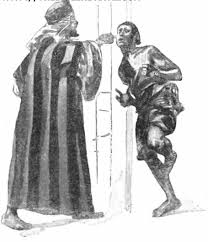
A Hebrew slave desiring to serve their master in perpetuity would undergo an ear piercing by an awl on that master’s doorpost.
Upon the conclusion of the proceeding at the judgment seat of God, the servant would then be brought to the door or door post of the master’s home. That servant’s ear would then be pierced by an awl (ie., a metal pointed tool used to punch holes in material like leather).
Thus, that servant would serve that master till the death of the master or of that of the servant (cf. Deu. 15:17).
A Shadow of Good Things to Come
This ordinance is clearly illustrated in our claiming perpetual servitude to YHVH our Elohim. Fortunate for us, Yahoshua Messiah was already pierced on our behalf having himself been judged on our behalf for our sins.
When Nations Tremble: The Prophetic Significance of the Unrest in the U.S., France, and Italy
🔥 When Nations Tremble: The Prophetic Significance of the Unrest in the U.S., France, and Italy A Messianic‑Hebraic Analysis of Global Birth Pangs in the 8th Biblical Month By Rod Thomas — The Messianic Torah Observer Yom Sheni — 7th Day of the 8th Biblical Month...
Mashiyach/Messiah ben David: The Convergence of Three Messianic Profiles in Yeshua
Mashiach ben David: The Convergence of Three Messianic Profiles in Yeshua Part 11 of the Melchizedek Series Greetings, beloved saints of the Most High Ahlohim. In this installment of the Messianic Torah Observer, we turn our attention to one of the most...
The Serpent’s Oldest Question: Genesis 3, October 7, and Beresheit Faith
The Serpent’s Oldest Question—and Why the World Gets to Start Over Shabbat Shalom, beloved, and welcome to another installment of the Messianic Torah Observer. In this teaching, we stand at a sobering and deeply meaningful intersection: the third anniversary of...
The Eighth Day: The Feast Nobody Leaves
Chag Sameach, beloved saints in training. In this installment of The Messianic Torah Observer, we turn our attention to Shemini Atzeret—the Eighth Day Assembly, otherwise known as the Last Great Day. It is the Feast that arrives after the seven days of Sukkot, when...
Every Nation Will Come: Sukkot, Zechariah 14, and Yeshua Tabernacling With Us
Episode Summary Chag Sameach Sukkot, beloved of the Most High. In this installment of The Messianic Torah Observer, we turn our attention to Sukkot, aka the Feast of Tabernacles; the Feast of Booths; and the Feast of Ingathering to consider what this appointed time...
Ha’azinu and Shabbat Shuva: The Song of Moses, Teshuvah, and Yom Kippur
Ha’azinu: The Song That Knew the Future—and the Shabbat That Stands Between You and Yom Kippur Greetings, Saints of the Most High Ahlohim, and welcome to another installment of The Messianic Torah Observer. In this teaching, we turn our attention to Parashat...
The Hidden Feast: Yom Teruah, the New Moon, Hannah’s Prayer, and the Return of the King
Beloved, in this installment of The Messianic Torah Observer, we turn our attention to one of the most mysterious and prophetically charged moedim on Yehovah’s sacred calendar: Yom Teruah, the Day of the Blowing of Trumpets. It is a feast that Father commanded, yet...
How Should We Evaluate Prophetic Voices? A Biblical Framework — With Jonathan Cahn as Our Starting Point
Opening This morning — Tuesday, September 8, 2026, the 25th day of the 6th Biblical Month, conceivably four or 5 days before Yom Teruah, a significant fact-checking analysis of Jonathan Cahn's prophetic claims was published. (Reference: “What Prophecies Has Jonathan...
The King Is in the Field: Elul, Yeshua, and the Meeting Your Jewish Cousins Are Still Waiting For?
Beloved, in this installment of The Messianic Torah Observer, we step into one of the most tender and spiritually rich traditions associated with the traditional Jewish month of Elul: the teaching that the King is in the field. Our Jewish cousins have long understood...
Yeshua and Ki Teitzei: The Torah Fulfilled Through Mercy
Episode Focus In this installment of the Messianic Torah Observer, I revisit this week’s Torah Reading, Ki Teitzei, and bring it into conversation with the words of our Master Yeshua in the Sermon on the Mount. And what we discover, Saints, is that Moshe and Yeshua...
0 Comments