Greetings saints of the Most High. Thank you for taking the time out of your busy schedules to fellowship with me here on this blessed day of rest in Yeshua Messiah. And as always, it is my hope, trust, and prayer that this installment of the Messianic Torah Observer finds you, your families, and your fellowships well and blessed.
As I am posting these thoughts and reflections, it is Preparation Day, A-gust 30, 2024.
These are my thoughts and reflections on Torah Reading 147. Our reading is found in Deuteronomy/Devarim 31.1-13; Isaiah 48.17-19; and 2 Timothy 3.12-17.
My apologies for not providing an audio recording of my thoughts and reflections for this reading as I do not have immediate access to my recording equipment. Abba willing, I plan to resume weekly audio posting next Shabbat.
Key Themes and Concepts Found in our Parashah this Week
Change in Leadership
Moshe cites he is a son of Yisrael at the ripe old age of 120-years at the time he was delivering this parashah. Let us bear in mind that Moshe was 80-years old when he, through Yehovah, led us out of Egypt. And now, some 40-years having passed, he points to his age being one of two mitigating factors in him not making it into the Land of Promise as our leader. The other contributing factor is that Abba Yah told him he could not enter the Land (31.1-2; a reference to 1.37; 3.27; 4.21-22).
No Need to Fear for Yehovah is With We Who Trust and Obey Him
In our being poised to receive the Land of Promise, Moshe declares two important realities to us that will profoundly affect our lives from now on: (1) We need not be afraid of the inhabitants of the Land of Promise because Yehovah our God was going before us to fight for us and help us take possession of the Land. (2) Since he, Moshe, would not be accompanying us into the Land, his able assistant Yahoshua/Joshua, son of Nun, would replace him as our political and military leader. No doubt the reality of Moshe not leading us to take possession of the Land would have been extremely concerning to us. Moshe had become the human bedrock and Yah appointed leader of our nation for over four-decades. We’d grown to trust him and fear him as Yah’s intercessor between us and Yehovah. Yes, we knew Joshua well. He had proven his metal throughout our nation’s wilderness sojourn. But for him to become Moshe’s replacement was going to be a significant paradigm shift for us as a nation (31.3).
Thus, Moshe reassures us — we being the second generation Exodus Hebrews — that there would be no need to fear the nations we were about to face in our taking possession of the Land. All we needed to do to ease our fears would be to hearken back in our minds to what Yah did to defeat Sihon and Og, former Amorite kings. In fact, all that would be required of them was to obey Yah’s instructions. And if they were indeed obedient to Yah’s instructions, Yah would destroy their enemies and deliver the Land of Promise into their hands (31.4-5).
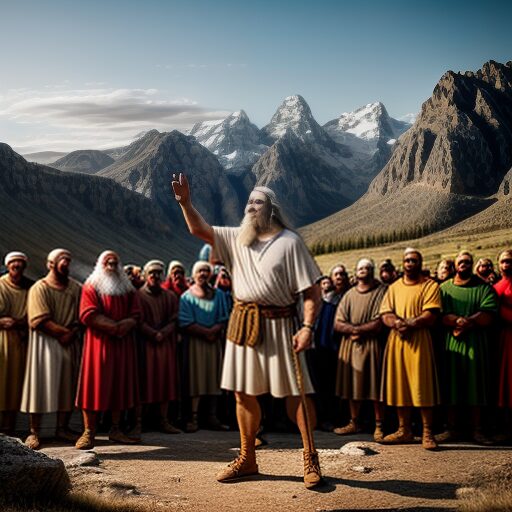
Amid him delivering to us Yah’s instructions in righteousness and updating us on the change in leadership for the nation, Moshe delivered to us one of the most enduring and poignant admonishments ever given to the people of Yehovah: “Be strong and be courageous...” (31.6). In so saying, Moshe circles back around to the central point of his teachings (that which he had given us in chapters 29 and 30): We did not need to fear the nations we were going to face in our taking possession of the Land of Promise. Our trusting, obedient faith in the Great I Am would guarantee His abiding presence and help in their midst. He would not leave nor forsake us (31.6). After Moshe’s admonishment to us as a nation to be strong and courageous, he then delivers this same admonishment to Joshua/Yahoshua in the nation’s sight (31.7-8).
And let’s be clear here: It is Yehovah whom we were to trust and obey. Yah was the one who was going to cross over before us. Yes, we were to accept Joshua as our leader, who was set to replace Moshe. But just as we revered Moshe as our human leader, it was always supposed to be Yehovah Whom we were to trust and Whose Words we were to obey first and foremost. And it is here where our Haftarah of Isaiah/YeshaYahu 48.17-19 comes into play:
17 Thus says Yahweh, your redeemer, the holy one of Israel:
“I am Yahweh your God, ⌊who teaches⌋ you to profit,
leads you in the way you should go.
18 O that you had listened attentively to my commandments!
Then your prosperity would have been like a river,
and your righteousness like the waves of the sea.
19 And your offspring would have been like the sand,
and the descendants of your ⌊body⌋ like its grains.
It would not be cut off, and its name would not be destroyed from my presence.”W. Hall Harris III et al., eds., The Lexham English Bible (Bellingham, WA: Lexham Press, 2012), Is 48:17–19.
Our destiny will always rest upon Yehovah and His Word. We prosper and succeed in this life only when we trust and obey Him. Without Him, no number of would be Moshes or Joshuas can save us. For its when we take our eyes off of Him we fail and are destroyed (Isa 48.19; LEB).
The Importance of Constancy in Receiving Yah’s Set-Apart Words that Lead to Life
Having completed his recording of Yah’s Torah (i.e. the oracles of Yah), Moshe handed it over to the Levitical priests for safekeeping and as the constitutional document from which the priests would teach us as Yah’s chosen people (31.9). In so handing this written Torah to the Levitical Priests, Moshe instructed them to read it to us during the pilgrimage feast of Sukkot every Sabbatical or Shmittah Year (31.10-11). In so doing, no Torah observant citizen of Yisra’el would be exempt from receiving Father’s instructions in righteousness, including every Yisra’elite man, woman, child and non-Hebrew Torah observant citizen of our nation. The aim of this regulation was to ensure that every citizen of Yisra’el would receive Yah’s instructions in righteousness on a recurring basis and learn to fear and obey Yah all the days of their lives in the Land (31.12-13). Let us not overlook the fact that we are abundantly blessed to have direct access to Yah’s instructions, whereas our ancient cousins had to receive instructions through Yah’s anointed and select priests at appointed times of Yah’s biblical calendar year.
And this is where our Apostolic Reading comes into play for this Sabbath. As Shaul writes to his young protege Timothy about his impending leadership role, we learn about the vital role of scripture in the life of every believer. The Apostle enlightens Timothy about the impending persecution of the Body of Mashiyach and the necessity of every believer remaining grounded in the Word. He reminds Timothy how much the scriptures meant to him as a child in that Timothy recognized that scripture made one wise unto salvation through faith in Messiah Yahoshua and that the Torah, the Prophets, and the Writings are profitable for teaching, reproof, correction, instruction in righteousness in the son and daughter of Yah may be competent and thoroughly equipped unto all good works (2 Tim 3.12-17).
Practical Messianic Halachah
Other than being a pivotal event in our nation’s history, what are we, the redeemed of Yah and set-apart disciples of Yahoshua, supposed to make of our parashah? Well, we are to make quite a bit out of this.
As members of the Body of Messiah, we will experience a periodic change in the leadership of our fellowships and congregation. We are to take such transitions, as painful and uncertain as they may seem to us at the time they occur, as God ordained and necessary in Yah’s grand plan of Salvation, Restoration, and Redemption. Nevertheless, it is not the person who Yah chooses to lead us whom we must set our eyes on. But rather, our eyes must remain steadfast upon Yah. It is Yehovah Whom we must trust and obey. For when we place all our chips on our human leaders, we are bound to at some point become disappointed and lose heart. But when we are steadfast in our hope and trust and obedience to Yah and His Word, we will never be disappointed nor lose heart. He will always be with us and fight for us through thick and thin. It is even more essential that we come to terms with this reality considering what the future holds for we who are the chosen and elect of Yah. Persecution and tribulation are coming and no human leader will match Yah’s abiding presence and guidance and deliverance. So, let us stay grounded in the Word, and let us be steadfast in our obedience and trusting faith in Yah. Now is the time, while it is still day, to strengthen our covenant relationship with Yehovah so that when the night cometh we will be able to stand against the wiles of the devil and withstand that evil day (Eph 6.11-13; KJV).
May you have a restful and blessed day of rest in Yeshua Messiah.
Faithfully,
Rod
6 Be strong and be courageous; you should not be afraid, and you ⌊should not be in dread from their presence⌋, for Yahweh your God is the one going with you; he will not leave you alone and he will not forsake you.” W. Hall Harris III et al., eds., The Lexham English Bible (Bellingham, WA: Lexham Press, 2012), Dt 31:5–6.
When Nations Tremble: The Prophetic Significance of the Unrest in the U.S., France, and Italy
🔥 When Nations Tremble: The Prophetic Significance of the Unrest in the U.S., France, and Italy A Messianic‑Hebraic Analysis of Global Birth Pangs in the 8th Biblical Month By Rod Thomas — The Messianic Torah Observer Yom Sheni — 7th Day of the 8th Biblical Month...
Mashiyach/Messiah ben David: The Convergence of Three Messianic Profiles in Yeshua
Mashiach ben David: The Convergence of Three Messianic Profiles in Yeshua Part 11 of the Melchizedek Series Greetings, beloved saints of the Most High Ahlohim. In this installment of the Messianic Torah Observer, we turn our attention to one of the most...
The Serpent’s Oldest Question: Genesis 3, October 7, and Beresheit Faith
The Serpent’s Oldest Question—and Why the World Gets to Start Over Shabbat Shalom, beloved, and welcome to another installment of the Messianic Torah Observer. In this teaching, we stand at a sobering and deeply meaningful intersection: the third anniversary of...
The Eighth Day: The Feast Nobody Leaves
Chag Sameach, beloved saints in training. In this installment of The Messianic Torah Observer, we turn our attention to Shemini Atzeret—the Eighth Day Assembly, otherwise known as the Last Great Day. It is the Feast that arrives after the seven days of Sukkot, when...
Every Nation Will Come: Sukkot, Zechariah 14, and Yeshua Tabernacling With Us
Episode Summary Chag Sameach Sukkot, beloved of the Most High. In this installment of The Messianic Torah Observer, we turn our attention to Sukkot, aka the Feast of Tabernacles; the Feast of Booths; and the Feast of Ingathering to consider what this appointed time...
Ha’azinu and Shabbat Shuva: The Song of Moses, Teshuvah, and Yom Kippur
Ha’azinu: The Song That Knew the Future—and the Shabbat That Stands Between You and Yom Kippur Greetings, Saints of the Most High Ahlohim, and welcome to another installment of The Messianic Torah Observer. In this teaching, we turn our attention to Parashat...
The Hidden Feast: Yom Teruah, the New Moon, Hannah’s Prayer, and the Return of the King
Beloved, in this installment of The Messianic Torah Observer, we turn our attention to one of the most mysterious and prophetically charged moedim on Yehovah’s sacred calendar: Yom Teruah, the Day of the Blowing of Trumpets. It is a feast that Father commanded, yet...
How Should We Evaluate Prophetic Voices? A Biblical Framework — With Jonathan Cahn as Our Starting Point
Opening This morning — Tuesday, September 8, 2026, the 25th day of the 6th Biblical Month, conceivably four or 5 days before Yom Teruah, a significant fact-checking analysis of Jonathan Cahn's prophetic claims was published. (Reference: “What Prophecies Has Jonathan...
The King Is in the Field: Elul, Yeshua, and the Meeting Your Jewish Cousins Are Still Waiting For?
Beloved, in this installment of The Messianic Torah Observer, we step into one of the most tender and spiritually rich traditions associated with the traditional Jewish month of Elul: the teaching that the King is in the field. Our Jewish cousins have long understood...
Yeshua and Ki Teitzei: The Torah Fulfilled Through Mercy
Episode Focus In this installment of the Messianic Torah Observer, I revisit this week’s Torah Reading, Ki Teitzei, and bring it into conversation with the words of our Master Yeshua in the Sermon on the Mount. And what we discover, Saints, is that Moshe and Yeshua...