by Rod Thomas | Feb 25, 2015 | Blog
Why Hebraic Roots
The Messianic/Hebraic Roots of the Christian Faith focuses on what the Father truly has to say to us. Thus, in order to understand what it is the Father has to say to us, it is vital that we somehow come to a place in our lives, existence, etc., where we can hear what the Father has to say to us without having the noise of the world distort or hinder what it is that the Father has to say. Have you ever been in a crowded forum or any place where there is a lot of noise and people activity, and someone is trying to talk to you about something that you’ve deemed is important to you; or talk to you about something that peaks your interest? With the surrounding noise and distractions, it is often difficult to gain a true understanding of what the other individual is saying to you. Often, throughout the course of the conversation, you may find yourself asking that individual to repeat him/herself. Furthermore, throughout the conversation, you may find that your focus is divided: instead of hearing every word that proceeds from that interesting person’s mouth, you hear something that pulls your attention over to what another person is saying; or someone walks by you and your eyes wonder away from the person of interest to follow that passing individual or even another set of conversations draws your attention from the individual you are conversing with. Thus the conversation becomes quite a disjointed mess and the fullness of content that you’d naturally gain from a private conversation with that individual of interest may be distorted, received and understood incorrectly by you, or the depth of the content missed entirely.
The Problem is Denominationalism
Denominational Christianity is somewhat similar to holding a conversation with the Almighty in the midst of a noisy gathering. The true believer (that is the individual whose heart is in the proper place and who truly seeks to know the Father’s will for their lives and is willing to do whatever is necessary to conform to the image of Yeshua Messiah), while trying to hold an honest conversation with the Father through the pages of their Bible, through prayer and meditation, is inhibited from gaining a true understanding of what the Bible (i.e., the Father) literally has to say to them. Why? Because the “noise” of denominationalism drowns out the truth. The mainstays (i.e., the doctrines, teachings, beliefs and traditions) of that believer’s denomination is always overshadowing him or her. Thus, everything that believer reads in his/her Bible is filtered through the lenses of his/her denomination. Not to mention the impediments that strongholds in the believer’s life may cause in the interpretation process (i.e., cultural, societal and sinful processes and fortresses that have developed in the believer’s life) will most certainly muddy the spiritual waters in a believer’s life even more. The only cure is for one to remove the denominational glasses from their eyes and with a willing heart, open mind and the leading of the Ruach Kodesh, find themselves in a quiet place in their lives where they can hear from the Father. It’s not easy, but it is more than doable. I’m speaking from experience, although from time-to-time I still struggle with the stronghold and denominational noises around me, but I’m slowly getting better at simply removing myself from the fray and seeking spiritual solitude. It’s all about getting down and dirty with the Hebraic Roots of the Christian Faith. Seeking out and walking this Faith in the purity and spirit of its first century manifestation. I love it beyond measure and my life has profoundly changed for the better. My relationship with the Father is markedly better than at any time in my life. I know that I am on the right path that leads to life. My concern and my sorrow, however, is for my brothers and sisters who are bound by the noise of the world, their denomination and the strongholds in their lives that prevent them from seeing the truth and having a true relationship with the Father. I will continue to do the work of the Gospel and advocate for every professing Christian’s adoption of the Hebraic Roots of the Faith. Will you join me?
by Rod Thomas | Feb 21, 2015 | Podcasts
- Calendar–February 21, 2015

This photo of the renewed moon was taken on 2/20/2015 in the land of Israel.
-
- Renewed moon was sighted over Israel–New moon sighted from Jerusalem on Feb 20, 2015 by Gil Ashendorf at 5:54pm and Devorah Levine at 5:57pm. The photo at the top of this message was taken by Devorah Levine from Jerusalem.We will be carrying out this year’s Aviv Search on March 19-20, at the end of the 12th Hebrew month. The new moon should be visible (barring clouds) on Shabbat March 21, 2015. If the barley is Aviv, then Chag HaMatzot (Feast of Unleavened Bread) will begin on Saturday night, April 4 and Shavuot will fall out 50 days later onSunday May 24, 2015. This will result in a rare convergence in which the Biblical Shavuot will coincide with the Rabbinical Shavuot and the Christian Pentecost. Of course, if we don’t find the Aviv by March 21, the Biblical dates will all be a month later.
- 1st Day of the 12th Biblical Month 6014 (aka: Shevat 5775)
- Upcoming Feasts and Messianic Celebrations
- Purim–Est. 03/06/2015 or 14th day of the 12th Biblical Month
- Biblical Rosh HaShanah or Head of the Biblical Year–Est. 03/22/2015 or 1st Day of 1st Biblical Month of the Aviv 6015
- Passover–Est. 04/04/2015 or 14th Day of the 1st Biblical Month
- Feast of Unleavened Bread–Est. 04/05-21/2015, or 15th through 21st day of 1st Biblical Month
- Firstfruits–Est. 04/12/2015, or 22nd Day of the 1st Biblical Month of Aviv
- Astronomically & Agriculturally Corrected Biblical Hebrew Calendar–Michael Rood
- Messianic Happenings
- A Rood Awakening–Michael Rood
- Michael requires bypass surgery. Surgery scheduled for Tuesday, 2/24/2015 in Charlotte
- 4/3-5/15-Rood Awakening Passover celebration in Charlotte North Carolina
- 4/19-5/1/15-Rood Tour of Israel
- Arthur Bailey Ministries and House of Israel
- Sabbath Services HOI (every Sabbath morning at 11 A.M. EST)
- Discipleship Training 101
- Arthur on Evangelistic Tour of Israel (2/26-3/11/2015)
- WildBranch Ministry–Brad Scott
- Fort Walton Beach, FL (March 7, 2015)
- Amarillo, TX (March 14 & 15, 2015)
- Abilene, TX (March 19, 2015)
- Midland, TX (March 20-22, 2015)
- Georgetown, TX (March 27, 2015)
- Jerrell, TX (March 28, 2015)
- League City, TX (March 29, 2015)
- Hebraic Roots Network–each Friday 7-8 P.M. (CST)
- Founded in Truth–Matthew Vander Els
- New DVD teachings include “The Church’s Curse,” “Holy War,” “Being the Image of God,” “Way of the King”
- Sabbath Services each Sabbath at Fort Mill Church of the Nazarene in Fort Mill S.C.
- Bulldozer Faith–Kenny Russell
- Speaking in California (February 21-23, 2015)
Dealing with Naysayers
Webster’s Dictionary:
one who denies, refuses, opposes, or is skeptical or cynical about something
- These individuals can bring about frustration, doubt, anger, unwarranted arguments, chaos,…..
- These individuals bring to our lives refinement whereby we learn patience, affirmation and understanding (i.e., why we believe the very thing we believe), the ability to love in the midst of adversity and opposition, reliance upon the Source of our being
- 2 Cor. 6:14–NAS 2 Corinthians 6:14 ¶ aDo not be 1bound together with bunbelievers; for what cpartnership have righteousness and lawlessness, or what fellowship has light with darkness? (2Co 6:14 NAS)
- What about those of us who are bound to naysayers: siblings, spouses, children and other relatives. Such dynamics can suck the wind out of one’s spiritual sails so to speak. How does on walk in accordance with his or her calling, yet deal with the distractions?
- The Holy Writ gives us clues on how to live righteously in the midst of naysayers in our families.
- Ephesians 4:25-6:9 seems to provide the believer in Yeshua Messiah with a prescription for righteous living, unparalleled in the rest of the Brit HaDashah
-
- We are encouraged to avoid entering into discussions and debates that may foster lies, but always speak truth (4:25)
- We will naturally be angry from time to time and that’s expected, but we must not sin. Shaul does not provide specifics on what he means, but directs that we do the right thing each and every time. Furthermore, we are to deal with the source of the anger promptly (4:26). Shaul specifically suggests taking care of the matter by sundown–in other words, don’t go into another day angry over the same lingering issue
- The enemy is constantly looking for opportunities to get into our situations and wreak havoc. Thus Shaul warns that we must not provide the opportunity to the Adversary (4:27)
- (4:29) This is probably the most compelling aspect of the whole “how to deal with naysayers” discussion: not allowing “unwholesome” (NAS/NIV), “harmful” (CJB), “corrupt” (DBY/KJV/YLT), “evil” (RSV), “foul” (NAB) language/or talk come from our mouths; only those words that “are helpful in meeting the need, words that will benefit those who hear them.” (CJB)
- Shaul instructs that we must not “grieve” the Ruach Kodesh (4:30)
-
- grieve=lupeo–meaning to pain, make sad; to cause someone to be sad, sorrowful or distressed; to make sad or sadden. As it relates to this passage, one is not to make Yehovah’s Ruach Kodesh sad; also means to irritate or offen, insult
- There is a Hebrew parallel for the term grieve–“Piel” used in Isa. 63:10 where it reads–“But they rebelled and grieved His Holy Spirit; therefore He turned Himself to become their enemy. He fought against them.
- Psm 78:40–speaks of the Children of Promise provoking the Father in the wilderness and thus grieving Yehovah. Luke speaks of the Jews being a stiffnecked and uncircumcised of heart and ears people who resist the Ruach Kodesh, as did their fathers in the desert. The Ruach Kodesh is placed in our lives for a reason–to direct our steps. When we ignore the Spirit’s direction, it only frustrates the Father. How often have we wanted a certain thing be done a certain way in our day-to-day lives, only to observe or learn that it was done in opposition to the instructions that we provided. It serves only to cause us sadness, frustration and even anger. It’s a form of idolatry to turn away from the leading of the Ruach towards our own way of handling things. It can only turn out bad
- Commentator Matthew Henry suggests that by our giving in to carnal behavior in response to such individuals who get our gourd, we stand the chance of that Spirit leaving us–not so much departing from our souls when we give in to the base, but the Spirit’s influence over our lives diminishing
- Shaul teaches these same Ephesian Saints that it is this same Ruach Kodesh that seals us and is the earnest or guarantee of our inheritance until we come into possession of it (Eph. 1:13, 14)
- It comes down to us simply giving in to the leading of the Ruach Kodesh in every aspect of our lives. Things are not always going to go our way and frankly, things shouldn’t necessarily always go our way. Our way is often self-serving and ill-advised. The Ruach’s influence in our lives will always lead us in the proper direction. When we ignore that direction, we frustrate that Spirit and after a time, we degrade that influence in our lives simply because we have taken control or taken over the driver’s seat and are now steering the bus. Isaiah recorded the fact that our example, the nation of Israel, vexed Yehovah’s Spirit on one too many occasions and it reached to such extents that Yehovah fought against them (Isaiah 63:10). I don’t interpret that Yehovah physically fought against His children, but fought against them in the sense that Yehovah lifted His eternal protection from them and withdrew the blessings that were inherent to Israel’s obedience of Torah (Deut. 28). What makes us think that we are any different? When we find ourselves in frustrating situations and we choose to handle them our own way, failing in the process to following the direction and leading of Ruach Hakodesh, we stand to lose the Ruach’s precious influence over our lives and the inherent blessings that come with having the Father’s Spirit in our lives. Oh how often I default to my own carnal nature to address the issues that crop up in my life, only to come to the end of the day realizing that I’ve frustrated the Spirit. I feel a let-down within my own spirit to such a degree that I’m embarrassed to acknowledge my stupidity before the Father. But our Father is long-suffering and our Mediator continues to advocate on our behalf. Thus, we pick ourselves up, dust ourselves off and start this walk all over again. But this time, a bit more wiser and hopefully a bit more cognizant that it’s His Ruach that must steer our life’s bus
-
- Shaul instructs that bitterness, bad tempers, angry dispositions, the propensity to shout and the tendency to use injurious language and spite be removed from our social make-up (4:31) as these appear to be common dispositions that we employ in response to those who frustrate and hinder us in our walk. For me, I struggle with anger and bitterness when it comes to those individuals in my life that seem to consistently cause me grief. These characteristics and behaviors are certainly not trademarks of the Ruach Kodesh and defaulting to these would clearly frustrate the working of the Ruach in our individual lives. We can not expect the Ruach to co-exist with elements that are contrary to its nature. It’s like oil and water–one must displace the other and vie for existence over the other. I struggle with individuals in my life who have history of Yehovah in their lives, yet they always default to these sorts of behavior whenever an issue erupts, especially when there is a disagreement over elements of our Faith. I’m not sure why we get angry when someone opposes us on issues of our Faith. We take things very personal and I certainly understand that our Faith is a very personal thing. But at the end of the day, it’s not about us individually is it? It’s about Him and how we can glorify Him in our lives, especially how we can glorify Him before others. When these negative emotional displays manifest, the witness we are supposed to have must vanish and we become no different than the world. These negative emotional displays are common traits of the world. Clearly these are issues that Shaul was being forced to deal with related to the Assembly in Ephesus. Theologians contend that Shaul spent a great deal of time in Ephesus, upwards of 3-years on his second visit (reference JFB–Acts 19:10; 20:31). Thus, Shaul was quite familiar with the make-up of the Ephesian Assembly to say the least. Thus Shaul’s admonishments here are pretty explicit and leave little room for conjecture. As with other regional assemblies, the Ephesus assembly was of heterogeneous make-up–Jew and Gentile (Acts 19:8-10). Ephesus was famed for being the primary locale for the temple of Artemis (aka: Diana). Thus there were idolatrous elements in the adherents’ lives that Shaul clearly realized must be purged if the Ephesian Church were to flourish and compete with the pagan-based make up of the region’s citizenry. This epistle was written to Ephesian adherents, addressing specific Ephesian assembly issues. It wasn’t written to us here in “Every Place” USA. Yet, the principles provided to the Ephesians are absolutely applicable to us today. These same issues are issues that I, in part, struggle with controlling, when dealing with the naysayers in my life. And I know there are others of you out there that struggle with the same Ephesian issues. It is so easy to default to these carnal behaviors when challenged and frustrated. It is indeed a challenge to override these default behaviors and employ the behaviors that Shaul suggests in the next verse (32): kindness, compassion, forgiveness–adopting the nature of Yehovah (5:1) and His Son Yeshua Hamaschiach (5:2). This will become my goal for today and the rest of my natural life. It won’t be easy. I’ll certainly have that tug within me to default to my old ways when challenged and frustrated by the naysayers in my life. But operating in the true Faith once delivered requires one to maintain at the forefront of their minds and heart that nothing is impossible with God (Luke 1:37). We can do this and do it well. It will only require that we surrender our spirit to the leading of His Ruach Kodesh. This is certainly something to strive for at all times and this is accomplished by taking every thought captive and making it obedient to Messiah (2 Corinthians 10:5). Thus, it may require us to simply shut the heck up and not respond or wait for the Ruach to direct our responses. Then and only then will we have accomplished the grand goal of being under the leading and direction of the Rauch Kodesh.
- Thus we must avoid giving in to the works of the flesh when dealing with naysayers (reference Galatians 5:19-21). The works of the flesh are manifested as:
-
- adultery
- fornication
- uncleanness
- lasciviousness
- idolatry
- witchcraft
- hatred
- variance (strife; contention)
- emulations (jealousy)
- wrath
- strife
- seditions (dissensions, division)
- heresies (sects, factions)
- envyings
- murders
- drunkeness
- revellings (orgies)
-
- These will not inherit the Kingdom of Yehovah (vs. 21)
- We must realize that giving in to these works of the flesh lead to a price that must be paid and that price is being denied admission into the Kingdom
- Unfortunately many erroneously believe that a loving God will accept them regardless of their shortcomings (Stern)
- Cf. 3:29-4:7
- The prescription for dealing with naysayers and the like:
-
- put away lying, but speak only truth (4:25)
- speak only those things that edify (4:29)
- listen to and follow the Ruach Kodesh (4:30)
- don’t give into bitterness, wrath, anger, clamour (aka-violent assertiveness), evil speaking or malice (4:31)
- be kind, tenderhearted and forgiving (4:32)
- walk in love using Yeshua as our example (5:2)
- be alight to the naysayers of this world (5:8)
- Shaul instructs that we not be pulled down into the “unfruitful works of darkness, but reprove them” (5:11)–Stern
-
- it’s so easy to simply give into the naysayer after a while or worse, sink down to their level
- we have been elevated to the status of light-bearers before the naysayers of this world (5:13, 14)
- Shaul instructs that we always walk circumspectly, always cognizant of the limited time we have in this life to make an impact on the naysayers of this world (5:15)
- 5:21-6:4 Shaul discusses the responsibilities of the family unit members. Individual family members can present for us the greatest bastion of naysayers on the planet
-
- wives are advised to submit themselves to their husbands; to reverence them
- husbands are instructed to love their wives
- children are instructed to obey their parents as well as honor them (cf. Exodus 20:12; Deuteronomy 27:16)
- parents are warned not to provoke their children to wrath, but instead to nurture and raise them in the admonition of the Lord
- Lastly, Shaul encourages us to put on the amour of God in order that we may endure the world (6:10-20)
- In 2 Corinthians 6:14, Shaul instructs us to not be unequally yoked with other believers
-
- Christianity has applied this instruction to marriages. There is certainly merit in this such that marriages that exists in the midst of variances in Faith amongst the couple can create tremendous upheaval. Certainly, when only one of the two in the marriage comes to the true Faith once delivered (i.e., Hebraic Roots/Messianic Faith), there emerges a strain in the relationship that can often lead to irreparable damage to the marriage. Stern in his commentary asserts that Shaul was not speaking to marriage when he instructs believers to not be unequally yoked with unbelievers. But I believe we should keep in mind that in Shaul’s day, which ever way the head of the household goes regarding a religion or faith, it is that direction in which the whole family goes without question. It is only in our western culture that families go separate ways depending upon individual preferences and convictions. So Shaul’s admonishment that individuals not be unequally yoked with unbelievers certainly applied more so to potential relationships outside the realm of marriage. However, Shaul did enjoin widows not to marry an unbeliever (I Corinthians 7:39)–Stern
Call to action
- Support this ministry by opting in to our email list, subscribing to our podcast feed, and following us on social media
- Leave us comments and questions utilizing the comment box that proceeds this post or email us at perceptionwp@gmail.com
- Consider donating to Michael’s lifesaving surgery fund
by Rod Thomas | Feb 19, 2015 | Blog
Don’t cause grief to God’s Ruach HaKodesh, for he has stamped you as his property until the day of final redemption. (Eph 4:30 CJB)
It comes down to us simply giving in to the leading of the Ruach Kodesh in every aspect of our lives. Things are not always going to go our way and frankly, things shouldn’t necessarily always go our way. Our way is often self-serving and ill-advised. The Ruach’s influence in our lives will always lead us in the proper direction. When we ignore that direction, we frustrate that Spirit and after a time, we degrade that influence in our lives simply because we have taken control or taken over the driver’s seat and are now steering the bus. Isaiah recorded the fact that our example, the nation of Israel, vexed Yehovah’s Spirit on one too many occasions and it reached to such extents that Yehovah fought against them (Isaiah 63:10). I don’t interpret that Yehovah physically fought against His children, but fought against them in the sense that Yehovah lifted His eternal protection from them and withdrew the blessings that were inherent to Israel’s obedience of Torah (Deut. 28). What makes us think that we are any different? When we find ourselves in frustrating situations and we choose to handle them our own way, failing in the process to following the direction and leading of Ruach Hakodesh, we stand to lose the Ruach’s precious influence over our lives and the inherent blessings that come with having the Father’s Spirit in our lives. Oh how often I default to my own carnal nature to address the issues that crop up in my life, only to come to the end of the day realizing that I’ve frustrated the Spirit. I feel a let-down within my own spirit to such a degree that I’m embarrassed to acknowledge my stupidity before the Father. But our Father is long-suffering and our Mediator continues to advocate on our behalf. Thus, we pick ourselves up, dust ourselves off and start this walk all over again. But this time, a bit more wiser and hopefully a bit more cognizant that it’s His Ruach that must steer our life’s bus.
by Rod Thomas | Feb 17, 2015 | Blog
Doctrine of Baptisms
Having just posted the latest episode of Sabbath Thoughts and Reflections where my focus was on baptism or the Doctrine of Baptisms as mentioned in Hebrews 6, a full day later I’m just as fired up about this topic as I was when I recorded and posted it yesterday. I just can’t get past this inkling that there is more to this foundational part of our Faith. The simple fact that Yeshua, having no sin whatsoever in his life and thus having no conceivable need or requirement to be baptized (or as many of the Messianics call it–mikvehed), humbled Himself nonetheless and went through with this most personal and solemn rite of our Faith. Which for me speaks ever so loudly that if the Master felt such a compulsion to be baptized (or mikvehed) by Yochanan, as the Ethiopian Eunuch said to Phillip on the road leading from Yerushalayim to Gaza, “here’s some water! Is there any reason why I shouldn’t be immersed?” (Act 8:36 CJB)

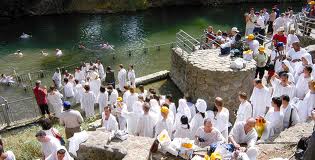
Baptisms on the Jordan River
Certainly, traditional Christianity has formed much of our understanding and individual perspectives on the subject of baptism. I would venture to guess that the vast majority of traditional Christians out there if asked about baptism would contend that baptism is a one-time deal that must be done at the outset of one’s conversion experience and entering into Christianity. Heck, I once held such a staunch view up to recently (oh, about a year or so now). It wasn’t until I heard teachings from Arthur Bailey and Michael Rood that my understanding and perspective on subject of baptism was changed. Who knew? I never took into consideration the possible reasons behind Yochanan ben Zecharyah’s (John’s the Immerser’s) employment of immersion people in water for the purpose of addressing sin in their lives. I always thought that Yochanan was the brain-child behind this “sacrament” of the “church” that Jesus and His disciples (soon to be apostles) would adopt and carry on to its fullest employment and ultimate meaning in the Faith. But like everything else I’ve experienced since transitioning over to the Hebraic Roots of the Christian Faith, everything has a Hebraic origin and there is always a rich and beautiful meaning behind the things we often take for granted in our Faith. Baptism (or as Michael often calls it–Mikveh) is simply one more example of this broader background contained in the Hebraic Roots of the Faith.
The Doctrine of Baptisms Examined
So baptism, the practice employed by Yochanan at the Yarden (aka the Jordan) and later Yeshua’s disciples and apostles, seemed to focus on the immersion of one into water for the remission of sins. By virtue of who was conducting the baptisms at the time, those adherents became identified with that baptizer or immerser. Thus, hundreds of adherents became identified with Yochanan and later even hundreds more became identified with the Master. Ultimately, it became the practice of baptizing adherent in the name of Yeshua and thus all adherents would ultimately be identified with Yeshua Hamaschiach. But there was an even greater nexus involved in the practice of baptisms in the first-century church, with the same ramifications for us today. Along with the baptism new adherents experienced related to the remission of sins and repentance and identification with the Master, by virtue of their identifying with Yeshua, there was almost certain suffering to be had by all involved. Fox’s Book of Martyrs is a classic and heart wrenching compendium documenting the sufferings of the first-century Saints. These, simply by virtue of their conviction and identification with the Messiah, upcoming coming out of the water, had their individual fates sealed in blood. These would endure unimaginable sufferings and deaths at the hands of unrepenting Jews and Romans. This is a baptism that for the millions of Christian adherents in the world today reject. Why? Because the doctrine, belief and teachings on a secret rapture that is coming to sweep the believer away to paradise cannot possibly contain any hint of suffering, tribulation or persecution. Sadly, these same millions, looking into the skies for the return of Yeshua and their swift snatching away from this earth, will be in for a “Rood Awakening.”
I am appalled and ashamed that churchianity has so blinded the masses to think that they are immune to tribulation, persecution and martyrdom, primarily in the West. The Holy Writ no where documents a promise that the redeemed of the Most High will escape the baptism of suffering that is promised and inherited by all believers in Yeshua Messiah. How dare we take on such a pompous attitude and belief that we are somehow greater than the Saints of the first-century church and that we are immune to persecution, tribulation and martyrdom. What makes us think we are so much more privileged than these? This is even more aggravating when we consider that the nominal Christian of today lives their lives more so in the world than they do in the Faith. The nominal Christian of today has no problem going to their respective churches on Sunday morning and then returning to a life of carnality and secularism, even on their way home from the service. For the majority of us, there is no baptism of suffering to be imagined, to say the least, no baptism of identification with Yeshua. It’s a fools game believers are playing in the 21st-century. There is coming a baptism of suffering that all would-be believers in Christ must endure, unless these elect to turn in their Christianity in exchange for protection and safety from the tribulations to come.
The true believer in Yeshua Messiah, by virtue of undergoing a baptism of repentance and identification and present and future suffering, will experience a baptism of fire. It is us who are experiencing, through daily prayer, meditation, study, fasting and obedience to the Torah Lifestyle, that those areas of our life that inhibit or damage our relationship with the Father are purged and cut away from us; and these none fruit producing areas of our lives are tossed into the unquenchable fire by Ruach Hakodesh. It is this baptism of fire that purifies us from all unrighteousness and we become as pure gold in the sight of the Creator. This is a unique baptism that Christianity has relocated to a simple imputation and not so much a process. This erroneous ideology is one of the reasons why Christians are so prone to hold on to their secular lives and reject Torah. Torah living, by nature, requires a total surrender to the Father and a subsequent make-over, in part by imputation, but also through the working of the Ruach Kodesh in our lives to assist us in living Torah and living holy lives, acceptable to the Father in Heaven. This baptism is the most enriching as well as one of the most painful experiences that any believer will experience. This couples with the baptism of the Ruach Kodesh, that helps us live Torah the way Yeshua Hamaschiach taught to live. It is this baptism that brings all that we learn through the Father’s anointed teachers and from our study of the Bible to our thoughts and memory when necessary. It is this baptism that gives each of us the courage to proclaim the Master’s message of repentance and the Message of the Kingdom to a dying and lost world without hesitation, trepidation, fear or confusion. The televangelists have hijacked this baptism to sway the minds of would be contributors that they will be healed and gain riches by simply sending them money. These same televangelists will put on quite a show and call upon the Holy Spirit to move the hearts of all to send in money to support their operations and of course many heed this call. These millions are duped into thinking that they can not harvest the power and might of the Ruach for themselves and realize and experience the exploits spoken of by the Master Himself to His chosen apostles. We’ve remained babies, unable to provide and care for ourselves, requiring God’s so-called anointed to pray and intercede for us. We are hopeless. But this is one of the greatest tricks of the enemy; to blind us into thinking that the baptism of the Ruach Kodesh is for us and the power of the Spirit is at our disposal.
Then it is our direct relationship with the Father that should cause us to always be concerned about our state of being before Him. Are we, as stipulated in Torah, in a perpetual state of purity and holiness; acceptable to the Father? Or have we by our own negligence or simply because of life’s situations, entered into a state of impurity. Simply because Yeshua, who was without sin, died for each of us and that act nullified the penalty of death that would be levied upon us because of our sin, doesn’t change the simple fact that we continue to sin and we often enter into states of impurity that the Father has indicated that He does not accept. If we know better, shouldn’t we do better? Is there a baptism of purification that is efficacious for each of us? Is there a way that we can emerge from an impure state to one of purity and acceptability before the Father. Could the fact, in part, that traditional believers hold to a one-time fits all mentality related to baptism be the reason why believers have no qualms holding so tightly to the world? Simply look at the movies and television shows we watch; the social activities we participate in; the books we read; the conversations we enter into; the things we do that are in opposition to Torah (i.e., adultery, idolatry, fornication, lying, stealing, etc.)–all these things put us into a state of impurity (although those acts that diametrically oppose Torah such as idolatry, adultery, murder and the like must be addressed from a full-on repentance standpoint and not just from a purity standpoint).
Where Do You Stand on the Subject?
So I ask you, as I’ve asked myself throughout this past week: what significance does baptism (or mikveh) hold for the true believer in Yeshua Messiah? Well, I ultimately answered my own question from the reasoning I just completed. Indeed, baptism is everything to the believer. Yeshua, who was without sin, chose to be baptized. What reason did He give Yochanan for submitting to baptism? The Master saw baptism as a righteous act. And being a righteous act, it seemed to Him reason enough that He be a part of it. Which stands further reason that if the Master stands behind and supports the doctrine of baptisms, who are we then to think otherwise?
Be most blessed fellow Saints in Training. Shalom.
by Rod Thomas | Feb 15, 2015 | Podcasts
Sabbath Thoughts #2–Baptism and Teachers
- Calendar–February 14, 2015–the West is celebrating St. Valentine’s Day
- 24th Day of the 11th Biblical Month 6014 (aka: Shevat 5775)
- Upcoming Feasts and Messianic Celebrations
- Purim–Est. 03/06/2015 or 14th day of the 12th Biblical Month
- Biblical Rosh HaShanah or Head of the Biblical Year–Est. 03/22/2015 or 1st Day of 1st Biblical Month of the Aviv 6015
- Passover–Est. 04/04/2015 or 14th Day of the 1st Biblical Month
- Feast of Unleavened Bread–Est. 04/05-21/2015, or 15th through 21st day of 1st Biblical Month
- Firstfruits–Est. 04/12/2015, or 22nd Day of the 1st Biblical Month of Aviv
- Astronomically & Agriculturally Corrected Biblical Hebrew Calendar–Michael Rood
- Messianic Happenings
- A Rood Awakening–Michael Rood
- Arthur Bailey Ministries and House of Israel
- Sabbath Services HOI (every Sabbath morning at 11 A.M. EST)
- Discipleship Training 101
- Arthur on Evangelistic Tour of Israel (2/26-3/11/2015)
- WildBranch Ministry–Brad Scott
- Fort Walton Beach, FL (March 7, 2015)
- Amarillo, TX (March 14 & 15, 2015)
- Abilene, TX (March 19, 2015)
- Midland, TX (March 20-22, 2015)
- Georgetown, TX (March 27, 2015)
- Jerrell, TX (March 28, 2015)
- League City, TX (March 29, 2015)
- Hebraic Roots Network–each Friday 7-8 P.M. (CST)
- Founded in Truth–Matthew Vander Els
- New DVD teachings include “The Church’s Curse,” “Holy War,” “Being the Image of God,” “Way of the King”
- Sabbath Services each Sabbath at Fort Mill Church of the Nazarene in Fort Mill S.C.
- Bulldozer Faith–Kenny Russell
- Speaking in California (February 21-23, 2015)
- News Relevant to the Messianic/Hebraic Roots Community
- Pray for the Safety, Protection and Peace of the State of Israel
- In an article written in the Washington Post by William Booth dated today, by all indications, Hamas appears to be gearing up for war against the state of Israel. This comes barely 6-months after the cease fire began between Israel and Hamas in the Gaza Strip
- What remains from last summer’s conflict between Hamas and Israel is utter devastation, poverty, lack of financial and humanitarian assistance for the Palestinian people in the Gaza Strip. Some have dubbed this as a humanitarian crisis that may lead to the social collapse of Gaza
- 100K Palestinians were displaced by last year’s conflict. People in the affected region continue to sleep in the open air because their home had been destroyed and there has been no compensation and repairs
- Hamas controls the Gaza Strip
- It has been estimated that some 2,100 Palestinians (Israel contends these to be Hamas militants) died in the conflict and 72 Israeli’s (mostly members of the IDF) had been killed
- Last month Hamas held a training camp for some 17K Palestinian youths in preparation for an upcoming conflict with Israel
- Israeli intelligence contends that Hamas is manufacturing rockets as fast as they can. The Israeli Navy intercepted 3-Hamas affiliates trying to smuggle rocket-making materials from Egypt by sea just this week
- A couple weeks ago, Messianic Evangelist Kenny Russell warned of an coming upheaval in the land of Israel (although he failed to provide specifics or any discernible hint as to what this upheaval may be or what may cause the upheaval)
- Pray for the residents of New England as they brace for a dangerous winter blizzard promising to dump an additional 2′ of snow to the already snow laden region, damaging snow-gusts and sub-zero temperatures. As of this post, a storm is rapidly forming and intensifying off the New England coast, heading toward the equivalent of a category-2 hurricane
-
Main Content–Baptism and Teachers
Baptisms on the Jordan River
Baptism or as Michael Rood has coined, the Mikveh. Based upon events 31-33 in the Chronological Gospels, corresponding to February 10, 2015 or Sunday, February 16, 27 CE (Note: you can purchase the Kindle Edition of The Chronological Gospels by using our Amazon Affiliate Link found on this website.)
- Why did the master humble Himself to be baptized?
- Yochanan adopts an old practice of immersion for purity, now used in a new context for purposes of cleansing one from a life-pattern of sin as so aptly stated by Mr. Stern
- Yeshua countered Yochanan’s hesitancy to baptize Him by stating that they, in particular Yeshua, should do everything that righteousness requires
- What does His example mean for us today?
- Mustn’t we do everything that righteousness requires–of us as individuals and of the Faith?
- Mustn’t we imitate Yeshua?
- What are the Hebraic Roots of baptism
- Torah provides a number of passages where Father directed individuals who for whatever reason enters into impure states to bathe, wash, be restored back to a pure state
- Exo. 19:10; 29:4; 30; Lev. 14:1-8; 15; 16; 17; Num. 19
- Heb. 10: 22
-
19 ¶ Since therefore, brethren, we ahave confidence to benter the holy place by the blood of Jesus,
20 by aa new and living way which He inaugurated for us through bthe veil, that is, His flesh,
21 and since we have aa great priest bover the house of God,
22 let us adraw near with a 1sincere heart in bfull assurance of faith, having our hearts c sprinkled clean from an evil conscience and our bodies dwashed with pure water.
23 Let us hold fast the aconfession of our bhope without wavering, for cHe who promised is faithful;
24 and let us consider how a to stimulate one another to love and bgood deeds,
25 not forsaking our own aassembling together, as is the habit of some, but bencouraging one another; and all the more, as you see c the day drawing near. (Heb 10:19-25 NAS)
This sort of takes the wind out of the old Christian song “Just As I Am.”
-
-
- From Torah, like very thing else, during the 2nd Temple period, Rabbinic Judaism appears to have taken over and put a number of rules around the practice of baptism or immersion (aka Tavila). Mikvaot had to be constructed and be made to hold certain amounts of water and be connected to a living source of water
- There were 100’s of mikvaot in and around the Temple Mount that served the purity needs of the thousands of Jewish residents and pilgrims coming to worship at the Temple
- Mikvaot have also been discovered in remains of private residents and on Masada
-
- Repentance–the baptism performed by Yochanan and Yeshua’s disciples during Yeshua’s ministry
- Identification--various incidents of baptisms accomplished in the name of Yeshua by the Apostles (Act. 2:38; 8:16, 26-40; 10; 16:6-13, 16-34; 19:5). These examples were immersions in conjunction with immersions for repentance
- The story of Cornelius is a monumental example of the promise being passed on to the Gentile where Cornelius and family received the baptism of not only identification but also the Ruach Kodesh
- Purification–Sha’ul shows his devotion to Torah by participating in a purification rite on the Temple Mount, as urged and suggested by James (Act. 21:17-26)
-
Suffering–those who would be baptized in repentance and identification with Yeshua Messiah and in Ruach Hakodesh would suffer for their Faith–Fox’s Book of Martyrs (Note: You can purchase Fox’s Book of Martyrs using our Amazon Affiliate Link found on this website)
NAS Romans 12:1 ¶ aI urge you therefore, brethren, by the mercies of God, to bpresent your bodies a living and holy sacrifice, 1acceptable to God, which is your 2 spiritual service of worship.
2 And do not abe conformed to bthis 1 world, but be transformed by the crenewing of your mind, that you may dprove what the will of God is, that which is good and 2acceptable and perfect. (Rom 12:1-2 NAS)
-
-
- Ruach Hakodesh–Act 2–Pentecost and in most cases of Gentile converts being baptized in identification with Yeshua Messiah
- Fire
15 ¶ “Beware of the a false prophets, who come to you in sheep’s clothing, but inwardly are bravenous wolves.
16 “You will 1aknow them by their fruits. 2Grapes are not gathered from thorn bushes, nor figs from thistles, are they?
17 “Even so, aevery good tree bears good fruit; but the bad tree bears bad fruit.
18 “A good tree cannot produce bad fruit, nor can a bad tree produce good fruit.
19 a“Every tree that does not bear good fruit is cut down and thrown into the fire.
20 “So then, you will 1 know them aby their fruits. (Mat 7:15-20 NAS)
- Personal experiences with baptism. Thoughts and reflections
- Christians see baptism as a one time deal–as part of their initiation into the Christian Faith
- Adherents are baptized into denominations
- Infusion of Greek philosophy into the doctrine of baptisms
- My experiences with baptism
- Should we rely solely upon Yehovah’s anointed teachers or conduct our own research? Are we qualified to conduct our own research?
- We may occasionally come across errors in the teachings of some of Yehovah’ s annointed teachers. What should we do?
- Should we conduct our own studies on topics or simply take in and trust Yah’s anointed to pass on His truth error free?
- What then is our responsibility when we come across an error in one’s teachings?
- Call to action
- Support this ministry by opting in to our email list, subscribing to our podcast feed, and following us on social media
- Leave us comments and questions utilizing the comment box that proceeds this post or email us at perceptionwp@gmail.com
- Get a hold of Michael Rood’ s teaching on the mikveh and if you are so led get mikvehed at your next opportunity