No Results Found
The page you requested could not be found. Try refining your search, or use the navigation above to locate the post.
Today we’re going to briefly examine this week’s Torah Portion/Reading—#26—which is entitled: “Sh’mini—Eighth.” I went ahead and added a tag to this title: “Irresistible Holiness.”
The text is taken from Leviticus 9:1-11:47, with a Haftarah reading taken from 2 Samuel 6:1-7:17.
This week’s Torah Reading can be broken into three specific event categories:
1. The inauguration of Aharon and his sons into the service of the Levitical Priesthood (Leviticus 9).
2. The Nadab and Abihu Tragedy (Leviticus 10).
3. A delineation of what constitutes clean and unclean foods (Leviticus 11).
I could certainly go on for hours just expounding on each of these three-event categories, but I won’t.
Today I want to focus only on the second event: that of The Nadab and Abihu Tragedy which is contained in the 10th chapter of Leviticus. And of that event, I specifically want to drill down to the underlying principle that drove this tragedy (what I call a tragedy), which is found in Leviticus 10:3. But before we examine this verse in some detail, allow me, if you would, to summarize the event.
The Nadab and Abihu tragedy follow on the heels of the grand inauguration of Aaron and his son (ie., Leviticus 9). As part of the inauguration event, Father ordered that precise sacrifices and offerings be made unto him and that Aaron and his sons undergo a consecration ceremony and a seven-day period of consecration within the confines of the Tabernacle.
And, oh, by the way? YHVH was coming to visit! So preparations were made to get the men and the people to not only receive into service their new priesthood, but to also receive the presence of YHVH. This was to be a really big deal for the nation. It was historic and it was to rank right up there with some of the other great moments in the nation’s post-exodus history.
So all the preparations and provisions were completed. In the presence and witness of the nation, all the sacrifices and offerings were made precisely as Father prescribed. The ceremony was completed with Aaron blessing the people (Lev. 9:23).
And then the irresistible presence of YHVH (described as the glory of YHVH) descends upon the camp and fire comes forth from His presence and consumes the remains of the sacrifices and offerings on the Altar of Burnt Offerings (Lev. 9:24).
The sight was so indescribable and terrible that all the people could do in response was shout and fall prostrate upon the ground beneath them.
Then, for whatever reason, two of Aaron’s sons, Nadab and Abihu, decided to grab their censers (or fire pans that held burning incense; made of brass (2 Chr. 16:39), placed fire in incense in them, and then offered unauthorized fire before YHVH, which was something that Father had not instructed them to do (Lev. 10:1).
And we don’t really know how many seconds or minutes elapsed during this felonious act, but Father’s response was quick and terribly fatal as Leviticus 10:2 records:
“…and fire came forth from YHVH and devoured them, and they died before YHVH” (LXX, adjusted).
Needless to say, Nadab and Abihu’s actions completely destroyed the solemnity of this historic event. But, their actions also underscored an undeniable spiritual principle that cannot be overstated by any would be child of the Most High. And we’ll get into the particulars of this principle in just a moment. For now, let’s finish the story and examine what could have happened.
Aaron and his remaining sons, Eleazer and Ithamar were forbidden to respond in grief nor were they allowed to mourn. In order not to further enrage YHVH, Moses permitted only the people of the nation to mourn for Nadab and Abihu. Furthermore, Aaron and sons were restricted from leaving the entrance to the Tent of Meeting as they were still in a state of consecration for their priestly service.
As it relates to Father’s prohibition against Aaron and sons mourning, Moses relayed to Aaron what I see as a major element of the spiritual principle I just mentioned. It is recorded in verse 3 of this same chapter:
“I will be sanctified through those who come near to me, and before all the people I will be glorified” (QBE)to the Tent of Meeting.
What in the world does that mean you might ask. Well, we’ll look at that when we discuss further this spiritual principle that is underscored in this amazing, but tragic story.
Well, the charred remains of Nadab and Abihu were removed from the camp by their cousins.
And after all this, Father delivers directly to Aaron the following command:
“Do not drink any wine or strong drink, neither you nor your sons with you, when you go into the tent of meeting, that you might not die; it shall be a statute forever throughout your generations; and that you may make a distinction between the holy and the common, and between the unclean and the clean; and that you might teach the children of Israel all the statutes which YHVH has spoken to them by Moses” (Lev. 10:9-11; QBE; adjusted).
I believe that this commandment that was given to Aaron is a follow-up to what Nadab and Abihu did that ended up getting them executed by YHVH.
So what was it exactly that Nadab and Abihu did to warrant them being summarily executed by the Almighty?
Scholars and Bible teachers and preachers are heavily divided on the question of what exactly Nadab and Abihu did to warrant their execution; or what constituted in the eyes of YHVH, the offering of “unauthorized” or “strange” fire before YHVH.
Instead of me prolonging this teaching by examining each of these debated theories, I will simply give you what I believe to be actions behind the crime committed by the brothers, based upon my read of linked Scriptural passages.
To begin with, the only other place in Scripture where “unauthorized” or “strange fire” is alluded to in the form of a commandment or instruction is found in Exodus 30:9, which reads:
“And thou shalt not offer strange incense upon it (ie., the Altar of Incense), nor an offering made by fire, nor a sacrifice; and thou shalt not pour a drink-offering upon it”(LXX).
Now, the brass censers of the priests would be used to transport burning embers from the Altar of Burnt Offerings outside the Tent of Meeting into the Holy Place and use those burning embers to ignite and burn incense upon the Golden Altar of Incense that was located just before the veil separating the Holy Place from the Holy of Holies. And one of the duties or responsibilities of the priest on duty at any given day was to burn incense upon the Golden Altar of Incense every morning and evening in perpetuity (Exo. 30:7,8).
The thing to keep in mind here is that the priests were forbidden from burning strange incense upon that altar. Furthermore, there were time constraints for burning incense upon the Golden Altar of Incense—once in the morning and once in the evening. Also, the fire that would be used to burn the incense on the Altar of Incense had to come from a holy source and that source was the Altar of Burnt Offerings. Also bear in mind that Father ignited the fire on the Altar of Burnt Offering as recorded in Leviticus 9:24 and He instructed that that fire continue to burn in perpetuity.
Next, we read that Father commands Aaron that neither he nor his sons were ever permitted to “drink any wine or strong drink” whenever they went into the Tent of Meeting; otherwise they stood a good chance of dying (Lev. 10:9).
The last thing I want to bring up here is that censers were common elements of pagan worship as evidenced in Ezekiel 8:11 and 12 which reads:
“And seventy men of the elders of the house of Israel, and Jechonias the son of Saphan stood in their presence in the midst of them and each one held his censer in his hand; and the smoke of the incense went up. And He said to me, ‘Thou hast seen, son of man, what the elders of the house of Israel do, each one of them in their secret chamber: because they have said, YHVH see not; YHVH has forsaken the earth” (LXX).
So for me, I think we have assembled before us enough of the elements of the crime to put together somewhat of a cogent story. Seems to me that Nadab and Abihu decided, probably in excitement over the festivities that was occurring all around them, to act a fool and grab themselves a little taste of something—ie., drink some liquor; get tipsy; get drunk.
Feeling the effects of the alcohol, which we know from scientific research, and for many of us from first hand knowledge, lowers one’s inhibitions, get the lamebrain idea of grabbing their brazen censers, taking burning embers –probably from the Altar of Burnt Offering—proceed into the Holy Place—unauthorized—and proceed to burn incense upon the Golden Altar of Incense—as the text states “before YHVH.” And they do this while Father’s presence is before the nation. Of course, Father sees all and He responds to this unauthorized—ritual (that for all we know may have pagan links—its uncertain; but we know they came out of Egypt and they probably learned such things from the Egyptians—maybe—maybe not) by burning the men up.
You know, we could speculate till the cows come home as to what exactly Nadab and Abihu did to warrant their summary execution by the hand of Almighty YHVH. But at the end of the day, the specifics of the crime are irrelevant. For Father gave us, through Moses, all the information He felt important for us to have to drive home a crucial lesson that He requires all of His children to understand. That lesson I believe, in great part, is contained in verse 3 of chapter 10 of Leviticus—which we read earlier:
“…Among those who are near me I will be sanctified, and before all the people I will be glorified…” (ESV).
Ironically, Nadab and Abihu were in the process of being consecrated as priests in the service of YHVH. And Father commanded of His priesthood:
Exo. 19:22—”Let the priests who come near to YHVH sanctify themselves, lest YHVH break forth upon them” (KJV).
Regarding the particulars of this incident, Matthew Henry in his Commentary on the Whole Bible writes: “Indeed, the whole scope and tenor of His Law spoke this, that being a holy God, and a sovereign Master, He must always be worshiped with holiness and reverence, and exactly according to His own appointment; and, if any jest with Him, it is at their peril.”
He continues:
“Whenever we worship YHVH, we come nigh unto Him, as spiritual priests. This consideration ought to make us very reverent and serious in all acts of devotion, that in them we approach to God, and present ourselves before Him…It concerns us all, when we come nigh to YHVH, to sanctify Him, that is, to give Him the praise of His holiness, to perform every religious exercise as those who believe that the God with whom we have to do is a holy God, a God of spotless purity and transcendent perfection.”
This is verified quite succinctly by the Prophet Isaiah who wrote:
“But YHVH of hosts, Him you shall honor as holy. Let Him be your fear, and let Him be your dread” (Isa. 8:13; ESV).
Henry continues:
“When we sanctify YHVH we glorify Him, for His holiness; and when we sanctify Him in our solemn assemblies, we glorify Him before all people, confessing our own belief of His glory and desiring that others also may be affected with it…If YHVH be not sanctified and glorified by us, He will be sanctified and glorified upon us. He will take vengeance on those that profane His sacred Name by trifling with Him.”
What happened to Nadab and Abihu was that they were cut off from the people because “they did not sanctify and glorify YHVH. Thus, the acts of necessary justice, how hard soever they may seem to bear upon the persons concerned, are not to be complained of, but submitted to” (Henry).
Moses said all this to Aharon “to quiet and humble him under the mighty hand of YHVH” (Gill’s Bible Commentary).
The priests in conducting their rituals of worship (ie., offering sacrifices and offerings), were NOT making YHVH Holy, for He is by default holy. The priests efforts were instead designed to declare the holiness of YHVH. And when the priests follow YHVH’s ordinances and commands to the letter, in fear and in faith, they were declaring YHVH holy and sanctifying (transcending YHVH above all that has been created) Him before the people.
And when the people fail to properly sanctify and declare YHVH as holy, Father will effectively declare Himself as holy and righteous. Thus, since Nadab and Abihu failed to properly humble themselves and glorify YHVH; declare YHVH’s holiness and sanctify Him before the people as prescribed by YHVH to them beforehand, He glorified Himself in their punishment.
Of this critical verse, he Jewish Commentator J. H. Hertz, in his Torah and Haftarah wrote:
“In sharp contrast to the common view that highly-placed or gifted men may disregard the laws of morality, Judaism teaches that the greater a man’s knowledge or position, the stricter the standard by which he is to be judged, and the greater the consequent guilt and punishment, if there is a falling away from that standard” (S. R. Hirsch).
The question facing us as Yeshua-centric Torah Observant disciples of Messiah is one of “holiness.” Essentially, how do we as flawed, depraved, sinful beings effectively commune with a Holy God? A God that demands to be treated as holy? And a God that demands that every created being that aligns with Him also be holy?
And I have to say that for me, I don’t see a lot in the way of teaching and emphasis on the topic and issue of holiness; especially holiness as it relates to our worship of YHVH.
So what exactly do we mean by holy. We serve a holy God who demands that His people be holy. And if we claim to be YHVH’s child, we have to figure out what it means to be holy. Right?
Let’s first gain an understanding of the definition of holy and the Hebrew term in question here is qadosh–(adjective). The Hebrew root signifies something or someone that is “pure” and devoted. (As an aside, the term holiness describes a situation or an abstract such as “the most holy or most pure.” It is found some 116 times in the authorized version of the Bible (ie., the KJV), the first occurrence found in Exodus 19:6:
“You shall be to me a kingdom of priests and a holy nation…”
Thus, when the Hebrew term qadosh is used, it describes an object or place or day to be holy, indicating that that object, place or day is devoted or dedicated to a particular purpose. For us, the day of the week that has the most significance in terms of being devoted or dedicated for a particular purpose is the Sabbath. The Sabbath was deemed holy by YHVH (Isa. 58:13,14)—devoted or dedicated as a day of rest (Num. 5:17).
We find that Israel, by virtue of her adopted relationship to The Holy YHVH, was dedicated or deemed as holy by YHVH. Although Father dedicated or deemed ancient Israel as holy, it didn’t mean that our individual forefathers were holy, for they were in more cases than not, NOT holy. Nevertheless, Abba dedicated and deemed the nation holy with the intent of using her to be a royal priesthood among and to the nations (Exo. 19:6).
And it is here—at this nexus—that we find ourselves in this discussion regarding holiness. For YHVH is undeniably holy (Isa. 1:4; 5;16; 40:25). Even His Name—YHVH—is holy (Isa. 57:15).
Consequently, YHVH defines what holiness is. Thus, YHVH by default being holy, requires all who are aligned with Him to be holy. But when it came to our Hebrew forefathers, Abba recognized that He had to essentially train and mold them to become holy individuals in order to fulfill His purpose of establishing a holy nation among all the nations of the earth. Thus, He started the transformation process by selecting Aaron and his sons to serve as priests—intermediaries between YHVH and the people. Thus, they were dedicated and deemed as holy unto YHVH. Of Aaron and sons, YHVH stated:
“They shall be holy to their God and not profane the name of their God. For they offer YHVH’s food offerings, the bread of their God; therefore they shall be holy. They shall not marry a prostitute or a woman who has been defiled, neither shall they marry a woman divorced from her husband, for the priest is holy to his God. You shall sanctify him, for he offers the bread of your God. He shall be holy to you, for I, YHVH, who sanctify you, am holy” (Lev. 21:6-8; ESV; adjusted).
For those of us who have been in the Hebrew Roots or Messianic circle for any appreciable length of time, we may be more familiar with a similar Hebrew term for holy: that being “qodesh.” Many of us state or write of it quite regularly when we reference YHVH’s Spirit that interacts with us: the Ruach HaKodesh.
It’s easy to get “qodesh” confused with the Hebrew term “qadosh.” And the easiest way to keep these two easily confused terms separated in our minds is to remember that “qodesh” is a noun—that is a person, place or thing is actually holy (eg., Ruach HaKodesh; the sanctuary was holy-Exo.36:4) while “qadosh” describes a person, place, thing or day as being holy.
And if that’s not confusing enough, there is yet another Hebrew word that signifies holiness and that term is “qadesh.” Qadesh is the verb form of holy, and simply means the act of being holy; to be sanctified; to be holy (Exo. 29:37; Lev. 6:18).
Having established what it means to be holy, I want to bring us back to the story of Nadab and Abihu. The principle that I want to establish here for you is a crucial one. And I believe this crucial principle may explain—at least in part–why so many of us in our walk with Messiah are not living the abundant life that our Master Yahoshua promised us (Joh. 10:10). And I would appeal to you to take what I’m about to lay out to you to heart, especially those of you who may be going through an especially difficult time in your walk.
Recall that after Nadab and Abihu were summarily executed by the hand of YHVH, in order to get in front of what would be a display of grief and mourning on the part of Aaron over the loss of his two sons, Moses put their deaths in perspective for Aaron—and dare I say, Moses put their deaths in perspective for us as well.
Earlier in this teaching, I explained to you what YHVH meant when Moses relayed to Aaron: “Among those who are near me I will be sanctified, and before all the people I will be glorified” (Lev. 10:3; ESV).
In other words, Aaron and his sons were selected—deemed and devoted to be holy—for the purpose of not only teaching the people how to distinguish the holy from the common and the clean from the unclean, but also to extol—to demonstrate—to proclaim to the nation and ultimately the people of the world, the virtues of YHVH’s holiness and to glorify His Name. And the only way the priests could do that is that they themselves had to be holy.
So how then were the priests to be holy other than YHVH saying to the nation that they were holy to Him. Well, quite simply, they were holy by virtue of their precise obedience to YHVH’s Torah and instructions. And the moment they were not obedient to YHVH’s Torah and instructions, they were no longer holy and Father would ultimately cut them off—maybe even executed as we saw happen to Nadab and Abihu (Exo. 19:22).
What Father is essentially saying here to us through this shadow picture—this lesson—this Torah Portion—is, “Look, I’m going to get the glory and my holiness is going to be proclaimed and demonstrated to all the world. Now this can be done by and through your actions of obedience and worship of me. And if you choose to glorify me and extol the virtues of my holiness to the world, you’re going to have to do it my way. For if you don’t choose to do it my way, then I’m still going to get the glory and my holiness will be demonstrated and manifested through my chastising of you. You see, it’s going to be done my way; or it’s going to be done my way. Either way, I’m going to be glorified and deemed holy to all the world.”
As a clan, the Levitical priesthood was deemed holy by YHVH as His instrument for declaring and demonstrating his holiness to the people and glorifying His Name. Individually, the priests were holy only when they conformed to the precise instructions of YHVH. Otherwise, they were no longer deemed as holy by Father.
Thus the priests had to perform certain duties and carry out assigned responsibilities precisely as YHVH commanded. They had to behave in precise ways as commanded by YHVH; wear certain garments while dispensing their duties and responsibilities; eat only that which Father designated for them to eat. The priests had to be in a perpetual state of ritual purity or cleanliness in order to serve in the Sanctuary. And they had to teach the people Torah.
In speaking to the priesthood, YHVH commanded:
Leviticus 11:44—”For I am YHVH your Elohim; and ye shall be sanctified, and ye shall be holy, because I YHVH your Elohim am holy; and ye shall not defile your souls…” (ESV; adjusted).
So fast forward some 3500-years or so to today. We find that the Levitical Priesthood is no longer in operation. The Sanctuary; the Tent of Meeting; the Temple is no longer in existence nor operational in any form.
Under the renewed covenant, the Levitical Priesthood has been replaced by the Melchizedekian Priesthood, the High Priest—the Cohen Gadol—being Yahoshua our Messiah.
We have been, by virtue of us becoming true disciples of Yeshua Messiah, priests unto YHVH, answerable to our High Priest Yeshua Messiah.
The Apostle Peter described us accordingly:
1 Peter 2:9—”You are a chosen race, a royal priesthood, a holy nation, a people for His own possession, that you may proclaim the excellencies of Him who called you out of darkness into His marvelous light” (cf. Exo. 19:6; ESV).
In other words, we are taking over from that which the Levitical Priests ultimately failed to do. And in so doing, does it make any sense to think that we will be held to any lesser standard than they in terms of our commitment to living holy lives and proclaiming and declaring the holiness of our God to the world in all that we do?
Yahoshua said to the Samaritan woman at Jacob’s Well:
“But the hour is coming, and is now here, when the true worshipers will worship the Father in spirit and truth—praise Yah, we’re living this today!–for the Father is seeking such people to worship Him. YHVH is spirit, and those who worship Him must worship in spirit and truth” (Joh. 4:23,24; ESV; adjusted).
Isn’t this a fantastic thing?! To be a priest of the Most High God. In the service of YHVH. To extol His holiness to the world and to glorify Him and His Name to all the world is an honor that I fear too many of us take for granted.
Unfortunately, we run the risk of dereliction of duty when we fail to be holy. Remember that a Levitical Priest could not extol the holiness of YHVH to the nation unless they themselves were holy and behaving in a holy and obedient manner. Well, does that same principle apply to us today?
Christianity would say it does and it doesn’t. It does in the sense that we are required to be holy before a holy God. However, it is naturally impossible for us to be holy. Thus, holiness is imputed unto us through the agency and spilled blood of Yeshua Messiah. Thus, being holy in the way we conduct our lives is NOT a requirement of service as was pictured through the example of the Levitical Priesthood back in the day.
But is Christianity’s perspective on the importance of holiness in a disciple of Yeshua Messiah’s life biblical? I believe it is not.
We see throughout much of the New Testament where Paul, who has been falsely accused by millions throughout the centuries, of rejecting Torah and teaching the assemblies he oversaw that Torah was done away with by the sacrifice of Yeshua Messiah, teaches that in order for us to be of service in the kingdom, believers must be holy.
1 Cor. 3:16,17—”Do you not realize that you are God’s temple and that God’s Spirit dwells in you? If anyone destroys God’s temple, God will destroy that person, because God’s temple is holy, and you are that temple.” (ESV).
Ephesians 1:4—”Blessed be the God and Father of our Master Yahoshua Messiah, who has blessed us in Messiah with every spiritual blessing in the heavenly places, even as He (speaking of YHVH) chose us in Him before the foundation of the world, that we should be holy and blameless before Him” (ESV; adjusted).
Ephesians 4:19-24—”They have become callous and have given themselves up to sensuality, greedy to practice every kind of impurity. But that is not the way you learned Messiah; assuming that you have heard about Him and were taught in Him, as the truth is in Yahoshua: to put off your old self, which belongs to your former manner of life and is corrupt through deceitful desires, and to be renewed in the spirit of your minds; and to put on the new self, created after the likeness of God in true righteousness and holiness.
Folks, we have to get rid of our old, carnal nature if we’re going to make it out of here. That old carnal nature—you know, the baggage you and I dragged into this Faith when we converted—has NO place in how we carry ourselves in our day-to-day walk with Yahoshua Messiah. It especially has no place in our worship of the Creator of the Universe.
Ephesians 5:25-27—”Husbands, love your wives, as Messiah loved the church (ie., the ekklesia) and gave Himself up for her that He might sanctify her, having cleansed her by the washing of water with the Word—Do you see that the Word, His Torah and the teachings of Yeshua cleanses us—by the washing of water with the Word so that He might present the church (ie., the ekklesia) to Himself in splendor, without spot or wrinkle or any such thing, that she might be holy and without blemish” (ESV; adjusted).
1 Thessalonians 4:7—”For YHVH has not called us for impurity, but in holiness” (ESV; adjusted).
When expounding upon the qualifications of an overseer of the assemblies of Messiah, Paul wrote:
“For an overseer, as God’s steward, must be above reproach. He must not be arrogant or quick-tempered or a drunkard or violent or greedy for gain, but hospitable, a lover of good, self-controlled, upright, holy, and disciplined” (Tit. 1:7-8; ESV).
The Apostle Peter also spoke on the importance of holiness in a believer’s life:
1 Pet. 1:14-16—”As obedient children, do not be conformed to the passions of your former ignorance, but as He (ie., YHVH) who called you is holy, you also be holy in all your conduct since it is written, “You shall be holy, for I am holy”” (cf. Lev. 11:44,45; 19:2; Lev. 20:7).
If all that was required for a disciple of Yeshua to function as a priest under the conventions of the renewed covenant is an imputed holiness, why then did Paul and Peter spend so much precious parchment space in their epistles on this issue of living holy lives ?
These anointed men of YHVH were trying to get across to their readers that when we fail to be holy—that is, when we fail to do the things that take us into the realm of being holy—spelled out in YHVH’s Torah and the teachings of Yeshua our Messiah—we by default fail to honor and demonstrate and proclaim the holiness of our God, and we fail to glorify the Name of our God to the world. And when we don’t do what we’re supposed to do in carrying out our duties as priests unto YHVH; when we profane those things that Father has deemed and designated as holy; when we live lives that place us into the realm of being “unholy,” then we stand the risk of judgment.
We see this brilliantly explained by Paul in his letter to the Assembly of Messianic Believers in Corinth. Paul writes of a peculiar practice ongoing in the assembly that is causing some to become sick and some to even die. Paul writes:
1 Corinthians 11:27-33—”Whoever, therefore, eats the bread or drinks the cup of the Master in an unworthy manner will be guilty concerning the body and blood of the Master. Let a person examine himself, then, and so eat of the bread and drink of the cup. For anyone who eats and drinks without discerning the body eats and drinks judgment on himself. That is why many of you are weak and ill, and some have died. But if we judge ourselves truly, we would not be judged. But when we are judged by the Master, we are disciplined so that we may not be condemned along with the world” (ESV; adjusted).
So then, if we are going through a prolonged, and difficult time of trials and tribulations in our lives, it is wise to seek Father’s revelation as to what is going on. That is, seek Father’s revelation if we are unaware of what is going on. A lot of the time, when things go south for us spiritually and physically, we probably have a good idea of what the problem is. And that’s why the example I sighted here is so important. For Paul points out that a number of the Corinthians were sick and dying or dead because of their mistreatment of a holy thing such as the Master’s Supper. Thus, Paul instructs the Corinthians that before they partake in a holy thing such as the Master’s Supper, that they “examine themselves.” The point is that partaking in a holy thing such as the Master’s Supper in an unworthy manner will ultimately lead to serious problems. And if YHVH is gracious to us and chooses to punish us as opposed to breaking out against us and cutting us off (ie., killing us) when we mistreat that which He deems as holy, then we have a chance to make the proper correction before it’s too late.
As Paul stated, it’s better to be judged now by Master than to be condemned along with the rest of the unbelieving world.
Folks, this is normative stuff we’re talking about here. And what I mean by that is that this principle applies to everything that is deemed holy by YHVH—across the board in our Faith. And we are going to be held accountable for ensuring that we glorify Father and declare His holiness in all that we do. We’ve been called to be priests unto YHVH and our responsibilities as priests under the Melchizedkian Priesthood is certainly higher than those of our cousins who made up the Levitical Priesthood. For we have been called to a much higher standard than they.
Are we glorifying YHVH and declaring His holiness in all that we do? Are we living holy and righteous lives? Are we pure? Are we obedient? Is our focus on Father as opposed to ourselves? Do we have the right intentions driving everything we do in life? These are the things we must always be asking ourselves. Fortunately, we have the tragic example of Nadab and Abihu to give us cause to pause and to analyze how we are conducting our worship of YHVH in our lives?
So I end this with two questions and a call to action for each of us:
Are we offering unauthorized fire unto YHVH? Are we conducting regular examinations of ourselves and if found wanting, are we reconciling with our God so that we may get back to being holy unto YHVH? Let us constantly examine ourselves to determine whether or not we’re holy unto YHVH. And we know that we are holy unto Father when we are obedient to His Torah and to the teachings of Yeshua Messiah and our hearts are pure.
Shabbat Shalom; Shavu’tov; Until next time, take care and be abundantly blessed.
The page you requested could not be found. Try refining your search, or use the navigation above to locate the post.
This weeks Torah Reading (aka Torah Portion) is entitled “Give an Order.” It is contained in Leviticus 6:1(8) through 8:36. There’s a Haftarah Reading as well found in Jeremiah 7:21-8:3; 9:22(23)-23(24).
To be frank, its one of those readings that one would like to quickly get through for a variety of reasons:
—It’s laborious as it instructs on the intricacies of animal sacrifices and the various types of offerings.
—The instructions on the surface have no obvious, direct bearing on us who are under the renewed covenant and under the Melchizedekian Priesthood.
Despite the laboriousness and lack of obvious direct bearing upon the lives of disciples of Y’shua Messiah today, when one gives themselves over to really studying these instructions, an amazing shadow picture in Y’shua Messiah opens up to them.
The author of the Book of Hebrews wrote:
“For the Torah has in it a shadow of the good things to come, but not the actual manifestation of the originals…” (10:1; CJB).
“But when the Messiah appeared as Cohen Gadol of the good things that are happening already…” (9:11; CJB).
Torah Portions should be viewed as an opportunity for worship and to apply the spirit of its observance to our day-to-day walk with Messiah.
And this is the approach or mindset that I’ve personally adopted in my weekly Torah studies: searching out the shadows of the renewed covenant under the Melchizedekian Priesthood. Otherwise, what I’ve found is that the readings fall short. Without a proper spiritual worldview, we essentially place our attention and dare I say align our obedience with the defunct Levitical Priesthood.
And that’s not a good place to find one’s self in. Oh, one’s heart may be in the right place—that is, desiring to commune with YHVH through the obedient reading of His Torah. However, at the risk of alienating some of you who are fervent Torah fan, reading the weekly Torah Portions just for the sake of reading them—let’s say for “tradition” sake—is spiritually pointless.
So I highly encourage all to continue with the weekly Torah Readings, but do not quash the leading of the Holy Spirit in those readings. Allow the Holy Spirit to guide your reading and reveal the eternal Truths contained therein. That’s the Holy Spirit’s job.
Of the work of the Holy Spirit, Master Y’shua taught:
“When the Spirit of truth comes, He will guide you into all the truth, for He will speak on His own authority, but whatever He hears He will speak, and He will declare to you the things that are to come” (Joh. 6:13; ESV).
This week’s reading was really about worship of our great and loving Elohim, YHVH.
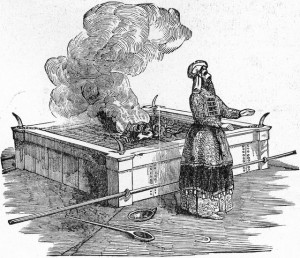
Sacrifices and Offerings as described in this Torah Portion foreshadowed our worship of Father in Spirit and in Truth.
Typically, when we think about sacrifices and offerings made on YHVH’s altar, we think about atonement of sins.
But the focus of most of the offerings in this reading, with the exception of the “Sin Offering” (for sins committed in ignorance), were to provide the people opportunities to worship and commune with the Creator of the Universe. And that understanding cannot be understated.
Communing—establishing and maintaining a substantive and loving relationship–with YHVH is the ultimate goal of every child of YHVH. At least it should be!
And the whole idea behind Abba instituting these sacrifices and offerings was to afford His people the opportunity to commune and love Him freely—on their own accord. But they had to do it on Father’s terms. Thus, the intricacies of these various sacrifices required the attention of both priests and the offerer to follow Father’s established narrow path. For if we are willing to endure the intricacies of Father’s instructions that He had passed down to us for purposes of communing with Him, and our hearts are in the right place, then He will sup with us and do His part to grow the relationship.
So going through these readings and sorting out the various sacrifices and offerings I feel is an uber important part of the Torah Observant Disciple of Y’shua Messiah. And the point is not to just have some head knowledge of our heritage so that we can parrot it out to anyone who may ask us about such things. More so, it’s really about applying the spirit of these forms of worship to our day-to-day walk with Messiah in an effort to grow our relationship with the Almighty.
The following offerings and sacrifices, along with a brief description were highlighted in this week’s Torah Reading:
Offered:
1. For sins of ignorance
2. At the consecration of priests
3. At the consecration of Levites
4. At the expiration of a Nazarite Vow
5. On the day of atonement
A Most Holy Sacrifice
Consisted of:
1. A young bullock for priests
2. A young bullock or he-goat for the congregation
3. A male kid for a ruler
4. A female kid or female lamb for a private person
The offerer who partakes and eats of the peace offering was to be in a state of ceremonial purity. Failure to be in a state of ritual purity would cause the offerer to be “cut off from his people or as the LXX states: that soul shall perish from his people.
According to ESV Study Bible, these are subdivided into 3-types according to their associated motivations:
1. Thanksgiving—that which is in response to YHVH’s favor toward the offerer. This is also eaten by the offerer before YHVH and none of it was to be left until morning.
2. A Vow—that which is offered in fulfillment of a vow. This too the offerer was to partake in eating and it could be consumed even through the next day. By the 3rd day, the flesh of the sacrifice was to be consumed with fire.
3. A Freewill—that which there is no specific obligation to make an offering.
Thanksgiving or “todah” ((vss. 12-15)which was to include a Thanksgiving Sacrifice of Fellowship consisting of (1) unleavened cakes with oil which belonged to the officiating priests; (2) the offerer actually partook in eating the meat, which had to be entirely consumed by the next day, either wise, what remained had to be entirely burned. Thanksgiving offerings were made in response to answered prayer; attested to the goodness of YHVH; allowed the offerer to partake in the celebration whereby family and friends could also partake; was accompanied with a grain offering.
Vow (vss. 16-18): The offerer may consume the meat over the course of 2-days. On the 3rd day the remainder was to be burned. Vow offerings were emblematic of the offerer’s grateful response to the completion of a vow.
Freewill (vss. 16-18): Freewill offerings were emblematic of an expression of joyful thanksgiving—praise offerings (Psm. 54:6; 119:108).
Meat Sacrifices could not come into contact with any unclean things and the offerer had to be in a state of ritual cleanness.
CSB notes: “The clean must eat only clean meat, or the consequences were severe.”
To be “cut off” meant either the offender is excommunicated from worship (22:3) or premature death through the intervention of YHVH (17:4).
This same principle applies to worship via The Master’s Supper, whereby Paul writes to the Corinthian Assembly:
“Wherefore whosoever shall eat this bread, and drink this cup of the Master, unworthily, shall be guilty of the body and blood of the Master. But let a man examine himself, and so let him eat of that bread and drink of that cup. For he that eateth and drinketh unworthily, eateth and drinketh damnation to himself, not discerning the Master’s body. For this cause many are weak and sickly among you, and many slepp. For if we would just ourselves, we should not be judged. But when we are judged, we are chastened of the Master, that we should not be condemned with the world” (1 Cor. 11:27-32; KJV).
Of course the fat belonged to YHVH in all sacrifices. However, “the breast of the animal was to be presented as a presentation offering—ie., a wave offering or a tenuphah offering. Rather than waving the offering, the worshiper presented it as a dedicatory gift to YHVH. Ultimately, the breast was to be given to the priests collectively (symbolizing that the sacrifice had been accepted by YHVH)” (CSB Study Bible Commentary). Also, the officiating priest received the right thigh.
As an aside, the breast and thigh were meaty portions of the sacrificed animal that provided the priests and their families perpetual sustenance. Father made provision in His Torah to take care of His priesthood. We know that the priesthood could not own property or have businesses. Their entire sustenance came from provisions made by YHVH.
It began with the men being washed with water (8:6). The washing with water symbolized sanctification and justification. For water purifies and cleans and makes one acceptable for service. The Ruach HaKodesh also is part of that whole sanctification and justification process:
“…but ye are washed, but ye are sanctified, but ye are justified in the name of Master Y’shua, and by the Ruach of our Elohim” (1 Cor. 6:11; KJV, adjusted).
Also, the Word of Yah washes, sanctifies and cleanses us:
“That He might sanctify and cleanse it (speaking of the Body of Messiah) with the washing of water by the word” (Eph. 5:26; KJV).
Why? Because when we hear and obey our Master’s teachings, it leads us to live set-apart, holy, sanctified lives in His service.
Moshe then clothed the men with the set-apart garments, made according to the specifications given by YHVH. This is in a wide-sense the believer putting on the Whole Armor of YHVH, whereby Paul instructs us to put on the belt of truth; a breastplate of righteousness; our feet covered by the readiness of the gospel of peace; taking hold a shield of faith; along with the helmet of salvation and the sword of the Spirit (Eph. 6:14-17).
Aharon was adorned with a beautiful breastpiece that “gave him glory and beauty in the eyes of the congregation” (CSB Study Bible). This of course symbolized his role as a mediator for the nation. Today, being under the Melchizedekian Priesthood (Heb. 4:14; 5:6,10; 6:20) such accessories have passed away; giving way to the perfected state and nature of our Master Y’shua Messiah who reflects and is the very essence of His Father YHVH our Elohim.
“For there is one God, and there is one mediator between God and men, the man Messiah Y’shua, who gave Himself as a ransom for all, which is the testimony given at the proper time” (1 Tim. 2:5,6; ESV).
“Since then we have a great high priest who has passed through the heavens, Y’shua, the Son of Elohim, let us hold fast our confession” (Heb. 4:14; ESV).
Then Moshe anointed Aharon, the tabernacle and all the implements with anointing oil. This served to sanctify Aharon and the Tabernacle for service. Given that our bodies are now the tabernacle of the Living YHVH under the renewed covenant and under the Melchizedekian Priesthood, the blood of Y’shua and Father’s Holy Spirit anoints our hearts and minds for service as well as it marks and seals us (2 Cor. 1:21,22; Col. 1:20).
Then Moshe brought forth the sin-offering calf, the head of which Aharon and his sons laid their hands. Moshe followed the provisions for the sin offering on behalf of Aharon and Aharon’s sons. Then a ram was presented as a whole burnt offering according to the provisions of Lev. 1:8. However, some of the ram’s blood was placed upon the tip of Aharon’s right ear, his right thumb, and on the great toe of his right foot. According to CSB, this symbolized “the total cleansing of the priests. The ear indicated hearing the confessions of the people, the hand represented the touching and handling of the offerings and the foot represented the holy courtyard and tent in which they served.”
Then Moshe to an unleavened loaf, one loaf made with oil and one cake from the basket of consecration and placed them with the fat and the right shoulder of the animal sacrifice. These items were waved before YHVH and then burned on the altar. Officiating as priest during this induction, Moshe took the alloted portion of the ram offering, waved them before YHVH.
Then Moshe took anointing oil and the blood that was on the altar and sprinkled Aharon and his sons with them. This was an act symbolizing sanctification or consecration (qaddesh), whereby they were separated exclusively for the service of YHVH.
Remember that all this was being witnessed by the entire nation which served to instill a sense of validation and confidence and acceptance.
Lastly, Aharon and his sons ate the ordination meal at the Tent of Meeting as a sin of their communion with YHVH and that their consecration was accepted by YHVH. Within the Tent of Meeting they ate their consecration meal and were commanded not to leave the Tent of Meeting for 7 as a mandated consecration period.
Of course, Israel failed to keep YHVH’s commandments regarding sacrifices. Instead, they burned their sons and daughter in the fires of Topheth—Molech—in the Ben-Hinnom Valley. Topheth appears to be another name for Baal (Jer. 32:35).
Yet Jeremiah foretold of a coming time when the sacrifices of the nation’s children would cease in that region and the place become a cemetery of sorts.
What we see being played out here in this Torah Reading are a great many things. And what we can choose to take away from it is our own business—based upon our own maturity level—our own personal relationship with the Creator of the Universe—our own level of indwelling of the Holy Spirit—our own desire to see beyond the written Word.
But I would suggest that a couple of the many take-aways we have with this Reading is relationship.
Establishing and fostering a relationship with the Almighty is accomplished through a few methods. And I would suggest that this Torah Reading is one of those methods for establishing and fostering a relationship with Father: that being through “worship.”
We find here where Father had already revealed Himself to Moses and the Mixed Multitude that came out of Egypt. Father introduced Himself to the mixed multitude through indescribable and indisputable signs and wonders.
He had already established a relationship with Moses—that relationship being one of the most unique ever to be described in human history—YHVH spoke to Moses as one speaks to his/her friend:
“Thus YHVH used to speak to Moses face to face, as a man speaks to his friend…” (Exo. 33:11; ESV).
A personal relationship with the Creator was partly extended to the Levites and the priesthood that would emerge from that tribe.
Then we get to this juncture of history whereby Abba now extends the opportunity for the everyday Israelite to have a personal relationship with YHVH. Essentially, this was an open invitation for the everyday soul to have an opportunity to commune with the Almighty through worship.
As with most things Father instituted by putting forth these instructions, He began this communing with baby steps. And what better way than through freewill offerings, intermediated by a priest.
And throughout the whole of this instruction, never did Father force Himself upon His people. These were freewill forms of worship. And of course, it remains the same today—our worship of YHVH today is entirely freewill based.
Except today, we worship YHVH in Spirit and in Truth. The instructions that make up this week’s Torah Reading were for all intents and purposes training wheels for the people of YHVH. And we are the beneficiaries of our forefathers’ often feeble attempts to commune with the Creator of the Universe. Through their stiff-necked nature and refusal to obey Father’s instructions, we have an opportunity to understand what He likes and dislikes; what He requires of us, not just from our actions, but from the standpoint of our willing hearts.
Today, instead of relying upon specific instructions on how to commune with the Almighty through a human priesthood, we now can go into the deep end of the spiritual poor and commune directly with the Almighty—Face-to-Face as Moses did, because Y’shua carved and open up the pathway for us to do so.
Many in churchianity are taken aback when they come across Torah Observant Disciples of Y’shua, accusing us of keeping the Law in order to purchase our salvation. But we keep Torah in Spirit and in Truth.
This is all important stuff to consider when we enter into worship of YHVH. If we are NOT spiritually clean, Abba may NOT accept our service nor our worship.
Our heart influences our thoughts, which influences our actions in many instances. And we these things are inconsistent with the holiness that Abba requires of us, we find ourselves in a state of uncleanness.
What constitutes worship for us in this age of Spirit and Truth worship and under the Renewed Covenant?
1. Fruit of our lips.
2. Giving of financial and other material gifts.
3. Obedience to Yah’s instructions.
The portions of sacrifice rendered unto the priests foreshadowed our present day support of those who labor in the gospel.
May you have a blessed Sabbath and time of communion with the King of Kings and Master of Masters. Shalom!
The page you requested could not be found. Try refining your search, or use the navigation above to locate the post.
In part-6 we posed the question of whether Paul was a subjugator of women, based upon some of the things he wrote. We learned that neither Paul, YHVH nor Yahoshua were subjugators of women as popularly alluded to by some people within and without our Faith Community. Instead, Paul was in lock-step with the Creator and Master Yahoshua in Emancipating women of Faith.
In part-7 we looked at what I called the un-silenced women leaders of the Old Testament (ie., the Tanakh) on up to the conversion of Paul. We found that these women were prophets, judges and disciples of Yeshua Messiah.
Then in part-8 we celebrated and highlighted the many un-silenced women leaders who were associated with Paul’s ministry. In that installment we learned that these women defied the erroneous concept of women being subject to the rule of men and being in a perpetual state of silence in the body and assemblies of Messiah. These women were disciples of Yeshua, prophets, teachers, preachers, matrons, home fellowship leaders and even apostles.
Today, this being part-9 of our Paul and Hebrew Roots series, I want to bring this whole question of women being silent and subject to men in the church to a much deserved head (so to speak). In other words, I want to finally nail down what I Corinthians 14:34, 35 truly means for the Body and Assemblies of Messiah.
“For God is not a God of confusion but of peace. As in all the churches of the saints, the women should keep silent in the churches. For they are not permitted to speak, but should be in submission, as the Law also says. If there is anything they desire to learn, let them ask their husbands at home. For it is shameful for a woman to speak in church” (1 Cor. 14:33-35; ESV).
Why would Paul write such an instruction given what we know about women leaders, not only of the Tanakh (ie., the Old Testament), the Way Movement, and even of Paul’s ministry, who could not possibly have been silent in order to fulfill their calling and leadership roles in the Body and Assemblies of Messiah?
Corinth was a prosperous commercial center for sea trade. She was the capital city of the province of Achaia and happened to be the central seat of Roman government in that region. (Achaia was the largest territory in Greece.)
Biannually, Corinth hosted the Isthmian Games. This was a festival that featured music and athletic competitions. Most notably, Poseidon, god of the sea, was honored (pg. 86). Consequently, scholars have estimated that at any given time, the population of Corinth contracted and expanded between 100K to 600K (86).
Other pagan gods worshiped in the region included: Ashtarte; Ba’al of the Canaanites; Bacchus (fertility and wine god); Cybele (mother goddess).
The mountain “Acrocorinth” hosted a temple dedicated to the worship of Aphrodite, goddess of love and the Temple of Melicertes, the patron goddess of sailors. It has been estimated by some archaeologists expert in the area that some 1,000 Aphrodite Temple prostitutes held residence and worked out of that temple. These were called “hetairai”.
In her book “The Handmaidens Conspiracy, Donna Howell points out that it was at this time in history that paganism was experiencing a revival of sorts and these temples and festivities were generating quite a bit of interest among many in the region. Could this resurgence be in response to the recent death and resurrection of Y’shua Messiah in Judea? Were the powers of darkness responding to this great spiritual event?
Naturally, Corinth would be a tough spiritual “nut” to crack, given the large number of voyagers and holidaymakers coming and going in Corinth, bringing with them new religions and the popularity and reverence afforded the temple prostitution cult.
Returning to the Aphrodite cult headquartered in Corinth, we find that the hetairai were a class of sex-workers viewed in Corinthian secular society above the regular “pornai” prostitutes the city also held claim to. Like modern day prostitutes working in major cities of any western city, pornai were known to serve patrons in an indiscriminate matter. Hetairai, on the other hand, tended to maintain a set list of the influential, wealthy, elite male clients of the region (compare to the workings of the infamous madams that made headlines in this country in past years).
From a religio-paganistic perspective, the body of a hetairai was considered a conduit by which Aphrodite was worshiped and honored (Howell, pg. 87).
Consequently, the hetairai prostitute cult drove much of the socio-economic engine of Corinth. What is that saying of a few years ago that seems to hold ever so true in this particular case: “Sex Sells.”
Community-wise, the typical Corinthian-hetairai were generally well educated. They had a demonstrated reputation of being “richly dressed, articulate, heavily painted, schooled in oratory skills and rhetoric, and every hair was in the right place as they flitted about society and owned every room they entered” (Howell, pg. 87). Hetairai were considered and treated in Corinthian society as a higher-class citizen. Interestingly, “unlike the Jewish women of surrounding regions that held the patriarchal traditions of society firm, the sophisticated hetairai were often welcome to share their thoughts and opinions regarding spirituality or theology, especially in the presence of men who were awed by them” (Howell, pg. 87). Now, this is an important element to keep in mind as we delve into deeper into I Corinthians 14:34, 35 in our attempt to discover why Paul wrote what he did here, and what he meant by wrote.
Despite all the hooplah that seems to be played up here related to the hetairai, it should not be construed that the hetairai were worshiped in any way. They were still subject to the laws that governed the role and behavior of women in everyday Corinthian society (Howell, pg. 87 with Rod’s personal embellishments). In fact, despite their elevated status in Corinthian society, hetairai were often considered property (Howell, pg. 87).
Naturally, various religions were being infused into the Corinthian Assembly, often referred to as “syncretism” (Howell, pg. 86, 88).
According to John Temple Bristow in his book Paul, Women and Church, so-called Christian Gnostics were openly engaging in intercourse, publicly, at wedding parties (pg. 51).
Corinth had a terrible reputation as it related to sexual perversion. In fact, D. H. Madvig, in his article on Corinth, printed in “The International Standard Bible Encyclopedia, pg. 773, “any woman (in surrounding regions of Achaia) known for her loose behavior would be referred to as a “Corinthian girl.””
Therefore, according to William Barclay, in his book entitled “The Letters to the Corinthians,” the basic Corinthian audience was that of a “mongrel and heterogeneous population of Greek adventurers and Roman bourgeois, with a tainting infusion of Phoencians; this mass of Jews, ex-soldiers, philosophers, merchants, sailors, freedmen, slaves, trades-people, hucksters and agents of every form of vice…without aristocracy, without traditions and without well-established citizens.”
In order to arrive at the most accurate understanding of what Paul meant in I Corinthians 14:34, 35, there are a few critical things we must first keep in mind:
1. I Corinthians is actually II Corinthians and II Corinthians is actually III Corinthians. In our current version of I Corinthians, Paul was actually responding to the assembly members’ reactions to a previous letter he had written to them and responding to questions and statements that were posed to him as a result of that previous letter.
2. We must absolutely get rid of this concept of modern day churches and church buildings when reading I Corinthians, or any of Paul’s other writings. When Paul mentions the term church in his writings, he’s really writing about a rather informal, intimate gathering of men and women in someone’s home. Church buildings and edifices as we identify churches to be today did not start to come on line until some 2-centuries (ie., 200-years) after Paul died. So no, women and men did not sit on separate sides of a church building.
3. I Corinthians, contrary to the teaching of the so-called Churches of God and other such organizations and even some Hebrew Roots/Messianic groups, is not a “book” about men and women roles in the church. In fact, the term roles does not even show up in any bible passage whatsoever.
But I Corinthians is a response to various behavioral issues that were brought to Paul’s attention via Chloe’s people and by individuals in the assembly who responded to specific points of Paul’s true first letter to the Corinthian Assembly.
The behavioral issues Paul addressed in our present I Corinthians (what we call I Corinthians in our Bibles today) range from the petty (eg., judging one another; cliques; and self-aggrandizement); to the worrisome (eg., suing one another in pagan-civil-courts; self indulgences leading to sinful behavior as a result of a “libertine-gnostic mindset”); to the extreme (eg., a man sleeping with his mother-in-law and certain men of the assembly patronizing Corinth’s robust and out-in-the-open prostitution services).
Essentially, Paul was faced with an almost impossible situation. For all intents and purposes, Corinth’s Messianic Assembly was in crisis and on the cusp of fracturing (ie., splitting or completely falling apart). It was being overrun by:
The intense influence of the sex-culture and trade of the region;
Syncretism (ie., the fusion of paganism and other religious traditions and practices into the Messianic Faith);
Competing cliques with competing interests;
Clashing error-ridden doctrines;
A worrisome lack of discipline in light of the assembly members’ new-found freedoms in Messiah;
An absence of discipline in members exercising their spiritual gifts; etc.
Other than Rome, I can’t imagine a more challenging place for Paul to plant a congregation. (Well, on second thought, maybe Jerusalem would tie Corinth.) But the intense pagan culture and expansive socio-economic system of Corinth made it as much a fertile city to evangelize as it was a nightmare to manage its members’ behavior.
What churchianity has failed to do in educating her members is to make Scripture real to them. The Bible is more than a book of wise anecdotes (ie., wise sayings and moral principles) in which church organizations are to use to create doctrinal structures from. But the Bible is much more than doctrinal sound-bites for church leaders to use to control and manipulate their members. The Bible is a living, breathing document that contains the Word of the Almighty and is “profitable for reproof; for correction; for instruction in righteousness; that the man and woman of YHVH may be perfect; thoroughly furnished unto all good work” (2 Tim. 3:17).
Thus the Bible that we have collecting dust on our home bookshelves was written by and documents the stories and situations surrounding flesh and blood human beings—in most cases just like you and me. In the case of I Corinthians, we actually gain an expansive snapshot of a home church composed of all types of would-be believers in Y’shua Messiah.
Yet Paul planted churches—assemblies–in these unimaginably pagan-rich cities—drawing a rich but sketchy cadre of would-be believers in Messiah as those assemblies’ members. Certainly Paul recognized the intense spiritual risks inherent in planting an assembly in such an challenging city. And the problems that Paul sought to address and fix is evident in his letter to the Corinthian Assembly. For the Assembly itself is not the problem, but the people that make up that assembly create the problems. It goes without saying that sin-prone people—human beings—make up the assemblies of Messiah. And each of those assembly members had the potential of bringing with them into the assembly baggage—be that baggage past unresolved sin; prejudices; challenging personalities; biased worldviews based upon their respective upbringing, personal beliefs and experiences; personal dispositions; etc. And it appears that as much as one would want to think that people will inherently practice “Kingdom behavior” in the assemblies when they come to Faith, at the end of the day, people tend to cling to certain base behaviors (ie., sinful, nasty, inappropriate, selfish, foolish, immature, etc.).
One of the things that I don’t see addressed much as it relates to the Corinthian situation is the apparent absence of sound leadership over the assembly. Paul was having to remotely deal with behavioral issues that if a strong leader was present, would not be an issue. Not sure what was going on there. But I believe this is a lesson to any of us who lead fellowships that we are capable of leading and that we do not tolerate any behavior that is less than Kingdom behavior. Otherwise, chaos will reign. Sin will reign. And as Paul so aptly stated, even a little leaven leavens the whole lump (1 Cor. 5:6).
Thank YHVH for Chloe, an obviously strong woman of Faith. It’s quite conceivable that Chloe sought to get the behavioral issues of Corinth addressed and fixed at the local assembly levels and her efforts to correct the problems crashed and burned. So she turned to the only person she knew would have the gravitas—the street creds—to correct the cited problems before it was too late. And this is what 1 Corinthians is really about. It is about proper behavior—Kingdom behavior—in the assembly—and by extension—the Body of Messiah.
Some of the instructions and principles Paul provided to the Corinthians are “absolute” and “normative”—that is, those instructions and principles, without question, should be followed by every believer in the Body and Assemblies of Messiah.
Then there are the other instructions and principles that Paul provided to the Corinthians that are “relative”—that is, those instructions and principles tend to apply only to the situation—the place, time and group—that Paul was addressing in his letter. Relative Pauline instructions and principles can of course be adopted by assemblies. But those adopted instructions and principles should never be given the same status as the absolute and normative ones. These must be adopted by the leadership of assemblies with much prayer and fasting and through the guidance of the Holy Spirit.
But this question of absolute/normative versus relative instruction from Paul is going to come up again once we begin to unpack 1 Corinthians 14:34-35; as well as later on when we get around to discussing 1 Timothy 2:11 and 12.
Another thing for us to keep in mind regarding Paul and his various instructions and admonishments is the source by which he has received the given instructions. What I mean by this is: is the instruction or admonishment that Paul is giving coming from Torah, Y’shua or the Holy Spirit? Or is the admonishment and instruction Paul’s own experiences, opinions or preferences on the matter in question?
And I get the natural tendency of some to revere Paul to such a place that everything he has ever written is viewed by them as an absolute or normative commandment. Some in churchianity have gone so far as to put Paul’s writings on par with the teachings of our Master Y’shua and with Torah. And that, my friend, is a most dangerous perspective for anyone to have about Paul and his writings and teachings.
For me, Paul’s apostleship is indisputable. His writings and teachings, however, must be taken within proper context with the rest of Scripture, especially in context with Torah and Master Y’shua’s teachings. Doing otherwise places Paul ahead of the One Who all of this that we’re doing in our Day-to-Day walk is all about: YHVH our Elohim.
Let’s do a quick survey of 1 Corinthians leading up to chapter 14:34 and 34. This is NOT meant, of course, to be an exhaustive survey of the book.
Chapter 1. Paul Validates His Apostolic Authority.
Chapter 2. Paul Invalidates The Wisdom of Man and Elevates the The Perfect Wisdom of God.
Chapter 3. Divisions-Rivalries-Jealousies-Quarrels
Chapter 4. Paul Counsels on the Dangers Associated With Judging Others.
Chapter 5. Paul Addresses The Horrendous Sin of the Certain Corinthians Indulging In and the Assembly’s Tolerance of Sexual Perversion.
Chapter 6. Paul Addresses the Embarrassing Matter of Corinthians Suing One Another—Libertine Gnosticism—Non-Kingdom Behavior.
Chapter 7. Paul Addresses Questions Related to Being a Messianic and Being Celibate.
Chapter 8. Paul Provides a Proper Perspective on Hotbed Question of Messianics Consuming Versus Not Consuming Meats Sacrificed to Idols.
Chapter 9. Paul Addresses the Efficacy of Assemblies Financially Supporting Workers in the Faith.
Chapter 10. Paul Defines For The Corinthians Their Purpose in Messiah.
Chapter 11. Paul Instructs The Corinthians on Proper Kingdom Deportment During Assembly Gatherings.
Chapter 12. Paul Instructs The Corinthians on the Proper Exercising of Spiritual Gifts and Delineates The Order of Offices in the Body of Messiah.
Chapter 13. Paul Expounds on the Greatest Gift and Trait of All in the Body of Messiah-Love.
Chapter 14. Paul Instructs on the Proper Exercising of the Gift of Tongues.
It is in the second-half of this chapter (ie., chapter 14) that out of nowhere Paul springs forth with this seemingly terse admonishment that women are to be quiet or silent in the Assemblies of Messiah. And it is this passage—verses 34 and 35—that is the focus of our teaching today.
So what do you say we break down this passage and figure out just what Paul meant by his admonishment?
Paul discusses with the Corinthians what constituted proper worship conduct or behavior in their assembly gatherings.
Comparatively speaking, this is a pretty lengthy chapter. Interestingly, however, Paul really only covers two behavioral issues that the Corinthians were attempting to work through with the apostle’s guidance. Verses 1-25 deal with the Corinthians’ exercising of the ecstatic gifts of prophecy and tongues during their gatherings. Then in verses 26-40 Paul instructs the Corinthians on the elements of proper conduct during their worship gatherings.
Stepping back to the beginning of the chapter, we find Paul encouraging the assembly members to pursue love first and foremost. With love as their guiding light (or let’s say, their primary concern), the Corinthians’ pursuit and exercising of the spiritual, ecstatic gifts—in particular the gifts of prophecy and tongues—during their gatherings would ultimately benefit the whole assembly as opposed to benefiting just the one speaker.
If we think about the method to Paul’s madness here, we see, contextually speaking that is, that Paul was laying the groundwork whereby the Corinthians could exercise their various spiritual gifts during assembly gatherings without offending or overstepping the exercising of those same gifts by their fellow assembly members. In so doing, the member exercising their gift during the gathering is blessed/edified as well as the whole congregation is blessed/edified.
And we will see that it is this whole idea of the constant pursuit of “love” and “respect” for every person in the assembly gathering that is behind Paul’s admonishment to the women in the Corinthian Assembly to be in silence. But not in the way that so many are either literally or doctrinally led to believe.
With love as the foundation upon which the believer is to exercise their spiritual gifts, Paul lays out for the Corinthians what speaking in ecstatic tongues is really all about. He informs the Corinthians that “speaking in tongues” is not performed for the benefit of the people who may happen to hear it.
Paul explains that speaking in tongues is really a form of worshiping YHVH. He explains that no one can understand ecstatic tongues, since the person who is giving forth the utterance is really uttering mysteries through the agency and power of the Spirit and no person understands it on their own accord (14:2).
Paul explains, comparatively, that when one exercises the gift of prophecy, he or she is speaking directly to the people in the assembly; edifying, encouraging and comforting them (14:3).
Thus, according to Paul, speaking in tongues benefits the person speaking in tongues while prophesying benefits the congregation (vs. 4). Paul concludes that for him, it was preferable that the assembly members prophesy so that the entire congregation may be edified (vs. 5). For the gift of prophesy provides revelation, knowledge, foretelling and instruction while speaking in tongues provides for only the speaker who is communing with YHVH (vs. 6).
The text contextually suggests the Corinthians had placed a great deal of emphasis on speaking in tongues and Paul was trying to get them to see that it was more important to focus on those things—those gifts–that benefited and edified the entire body/congregation.
Paul does not altogether dismiss the importance of speaking in tongues in assembly gatherings. For he instructs that if any should pursue and seek to exercise their gift of tongues in the assembly gatherings, he or she should pray for the gift of interpretation to accompany that gift (vs. 13).
Interestingly, Paul approaches the subject of speaking in tongues from the perspective of intellect—so to speak. He stresses the importance of incorporating one’s mind in every aspect of worship (vs. 16). Consequently, the mind of the one speaking in tongues is not employed in the experience.
Interestingly, Paul goes on to use himself as an example. He cites that he would rather edify the assembly with mindful words than speaking in tongues where his mind is not employed and there is no instruction (vs. 19).
Paul also looks at another aspect of tongues where by he explains to the Corinthians that tongues is a sign for non-believers while prophecy is for believers (vs. 22).
Bottom line as it relates to tongues is that order in the assemblies of YHVH is essential (vs. 25). If one or more members is moved to speak in tongues, no more than two or three should exercise their gift at any given time. And in so limiting the number of utterances to two or three at any given time, each must then speak in order—not over one another-as seems to have been the norm prompting Paul’s instruction here.
An interpreter should be present and willing to interpret the utterances. However, if there is no interpreter, the speakers should remain silent (vs. 28).
In terms of prophecies, Paul prescribes the same controls: no more than two or three at any given session; the utterances must be rendered in order. And in following his insistence that the congregation, more than the prophet alone benefits in the utterance, Paul recommends that those in attendance weigh in on the messages that are rendered (vs. 29).
Thus, as it related to order in assembly gatherings, it all came down to member-self-control (vss. 32, 33). And this my friend, is what we will see is at the heart of Paul’s directive that women be in silence in the assemblies.
It cannot be understated here that in no areas of his commentary on the gifts does Paul instill gender restrictions.
And then the reader suddenly comes to the passage in question; seemingly out of any sensible context; popping up in the text out of nowhere; totally foreign to the literary flow of the chapter or even the entire letter for that matter; and frankly, foreign to what one would recognize as Paul’s writing style.
Let’s take a look at these two critical verses:
“Let your women keep silence in the churches: for it is not permitted unto them to speak; but they are commanded to be under obedience, as also saith the law. And if they will learn anything, let them ask their husbands at home: for it is a shame for women to speak in the church” (14:34,35; KJV).
Now, before we disassemble and then reassemble this passage so that we can arrive at the best interpretation of this passage that we possibly can, allow me first to quickly mention a couple proposals that some scholars have put forth to explain these two verses.
To explain the awkwardness of this passage, some bible scholars have postulated the theory that these two verses were actually inserted by a lone copyist (maybe a cabal of copyists) who inserted his or their misogynistic bias into the body of the earliest manuscript texts. I guess the thinking behind this is that the copyist(s) knew he’d ultimately have a captive audience in the form of those who would, in time, read his version of First Corinthians. And certainly by the time this particular letter would have been copied, any vestiges of female leadership in the early assemblies would have likely begun to draw down and be usurped by ambitious men who saw Christianity as a corporation, and for them as individuals, a means to gain power, authority, wealth and notoriety.
Now, when I first ran across this theory, I became very intrigued. As I previously stated, these two verses, at least to me, read as though someone other than Paul wrote them. The word choices and order, as well as the curtness and tone of the instruction seem contrary to Paul’s admonishment that the Corinthian Assembly members factor love into everything they do. Well, one has to ask, where’s the love to be found in these two verses?
Phrases like: “women keep silence in the churches;” not permitted unto them to speak;” “they are commanded to be under obedience;” and “it is a shame for women to speak in church;” all seem to suggest Paul, assuming he did indeed write this passage, was instituting some type of gender-specific “police state” in not just the Corinthian, but every assembly he oversaw.
Dr. Eddie L. Hyatt, in his book, “Paul, Women and Church” highlighted this theory as a possible explanation for the “out of placeness” of the passage. He notes the following inherent problems with the passage, which in a sense, gives credence to the “copyist” theory:
(1) This passage is clearly out of character with what we know of Paul from Acts and Paul’s other letters regarding women (especially female leaders) in the assemblies and Body of Messiah.
(2) We found earlier that women were allowed to pray and prophesy in the assemblies if they followed cultural head covering conventions (1 Cor. 11:13).
And (3), what law is Paul referring to in this passage, given that there is no Torah law that commanded women be silent in the assemblies?
Hyatt also writes of this passage in relation to the “copyist” theory:
So out of character is that passage, that some scholars have concluded that Paul did not write these verses. Case in point is Dr. Gordon Fee. Fee suggests that an early scribe/copyist intentionally added these verses to the overall text. (Reference: Gordon Fee, “The First Epistle to the Corinthians;” Grand Rapids; Eerdmans; 1987; pgs. 699-708.)
As much as I tend to agree with Fee’s, and especially Hyatt’s contentions here, apart from these verses appearing out of context and character, there is no literary or physical proof that these passages were either tampered with or actually inserted into the body of the text by a scribe or copyist. Verses 34 and 35 are found WITHOUT any significant variance in every single extant Greek manuscript that contains 1 Corinthians 14:34,35.
According to Wikipedia, there are some 5,800 complete or fragmented Greek manuscripts cataloged to date.
I guess one could say that the insertions were older than the oldest existing Greek manuscript. And for me, that’s certainly not beyond the realm of possibility. However, since we try to be as spiritually pragmatic as we possibly can on this program, we’ll leave this “copyist” theory for others to contemplate and research further for now.
And then we have the segregation of women from men in assemblies theory.
Some scholars have suggested that Paul may have been addressing the Jewish synagogue practice of segregating men from women in assembly services, such that men and women would be seated on opposite sides of the building. In such an orientation, according to this theology, wives would be prone to call over to their husbands on the other side of the building for the purpose of getting clarification of that which was being taught at the time.
The problem with such a theory is pretty simple: assemblies of Messiah during the first-century C.E. were home fellowships. So-called church edifices did not come on line until roughly 2-centuries later.
The key here is that the so-called church, especially the so-called church of the first-century, was not expressive of any type of edifice or building. Instead, the concept of a so-called church was the gathering of the saints together in one place—primarily in those days, someone’s home. We know that these gatherings were generally “personal and informal” as noted by Paul himself when he wrote:
“…When you come together each of you brings a psalm or some instruction or a revelation or speaks in a tongue or gives an interpretation. Let all these things be done in a way that will build up the community” (14:26; NJB).
Consequently, in Paul’s suggestion that “each” of the Corinthian Assembly members brings a psalm or SOME INSTRUCTION or revelation or speaks in a tongue or gives an interpretation, we should note closely that he was NOT gender specific. In fact, this suggestion is posed to the “adelphos,” which can mean specifically men or brothers, as well as it can mean brothers and sister or even fellow countrymen or nationals. And given the context and tone in which the previous 14-chapters was written, Paul was clearly targeting both men and women.
Additionally, our U.S. city Philadelphia derives half her name from the Greek term “adelphos,” that being the city of “brotherly—love.” Certainly, the city Philadelphia did not come to be known exclusively for its male population back in the early days of this republic.
Thus the idea that women might be calling out to their husbands across a massive church aisle during services is based upon historical, cultural and biblical ignorance and such a theory does not work at all to explain 1 Corinthians 14:34,35.
But wait! There’s yet another theory that is popular among some bible scholars.
In “Paul, Women and Church,” Dr. Eddie L. Hyatt takes somewhat of an ancient Greek literary approach to explain what Paul truly meant in verses 34 and 35. His contention rests entirely upon one simple Greek word (heh???), which, according to Cunningham and David J. Hamilton, is sometimes used in Greek as “an expletive of disassociation, such as the English term, Nonsense! Or Rubbish! Or Certainly not!” (Reference: Cunningham and David J. Hamilton, “Why Not women;” Seattle; YWAM, 2000; pg. 190.)
The Greek term “heh” was commonly used in ancient Greek literature and was used a handful of times by Paul in his writings. Yet in our English Bibles, the translators “either left the term untranslated or translated the term by a simple “or,” which serves to diminish the forceful manner in which Paul is using it” (Hyatt).
Examples include:
6:1,2—”When one of you has a grievance against another, does he dare go to law before the unrighteous instead of the saints? (Nonsense!) Do you not know that the saints will judge the world? And if the world is to be judged by you, are you incompetent to try trivial cases” (ESV)?
9:8,9—”Do I say these things on human authority? (Nonsense!) Does not the Law say the same? For it is written in the Law of Moses, ‘You shall not muzzle an ox when it treads out the grain.’ Is it for oxen that God is concerned” (ESV)”
Of Paul’s use of the term “heh” in I Corinthians, Dr. Gilbert Bilezikian writes:
“In most cases cited above, the pattern is similar. A proposition is presented in the form of a rhetorical question or a declarative statement containing an element of incongruity. It is followed by the particle “heh” which is used to introduce the counter-statement in the form of a question. As indicated above, the consistent use of “heh” in each of these ten instances could be accurately rendered by substituting an indignant “nonsense”” (Beyond Sex Roles; Grand Rapids Baker, 1985; pg. 288).
Thus the ancient Greek term “heh” was often used by Greek writers to refute a previous statement. This is confirmed by Liddell and Scott in their Greek-English Lexicon, where they define the term as “an exclamation expressing disapproval.”
So what does all this mean for I Corinthians 14:34,35? Simply this according to Dr. Hyatt:
“Paul is quoting what the Corinthians have said about women being silent and then replies with “an exclamation expressing disapproval.” He says, “heh,” meaning “Nonsense” (Hyatt)!
The key point is somewhat driven home in verse 36 of the same chapter, where Paul writes:
“(Nonsense!) Was it from you that the word of God came? (Absolutely not! A second time) Are you the only ones it has reached” (ESV)
Thus Paul uses “heh” a second time in verse 36 showing his outrage over the Corinthians’ misrepresentation of what he had written to them in that previous letter.
Well, the “heh” theory certainly has more credibility to it than the “men being segregated from the women” and the “copyist insertion” theories, if you ask me. However, when you actually put Cunningham’s and Hamilton’s “heh” theory to the test, suggesting that Paul used verses 34 and 35 as sort of a set-up, so to speak, to dispute the claim or suggestion that women be silent in the assemblies, the “heh” of verse 36 just comes across as somewhat clunky in its refutation of the previous two verses:
“What? Was it from you that the word of God went forth? (”heh” or “Nonsense!” Or) came it unto you alone? If any man think himself to be a prophet, (”heh” or “Nonsense!) Or spiritual (seems as though “or” is grammatically more appropriate here), let him acknowledge that the things I write unto you are the commandments of the Lord” (verse 36,37; KJV).
Despite its chunkiness, however, this theory does seem to have some level of credibility. And I would place this theory over the other two without question. However, in order for this theory to actually be a valid one, it must be freely presumed that someone in the assembly questioned or proposed to Paul, beforehand, the wisdom of denying women the opportunity to speak, communicate or interact during assembly gatherings (verses 34 and 35). And it would also be presumed that Paul responds to the individual(s) question or proposal in verse 36 (maybe continued on in verse 37) with something akin to “where’d you get that idea? That’s absolute nonsense!” And if this is indeed the case, then a plain read of verses 34 and 35 would be in order.
However, I do believe there is a much clearer explanation that either rivals or exceeds the “heh” theory. And I’ll now present that to you.
I Corinthians 14:34,35 follows Paul’s admonishment throughout his letter that the Corinthian’s gatherings should be peaceful and orderly; that they should NOT be chaotic or confusing.
Instead of trying to explain away Paul’s admonishment that the women of the Corinthian Assembly keep silence in their gatherings, what if there was a problem with the women of that assembly; at least, with some of the women?
This admonishment that women keep silence in the assembly is crammed right in the middle of Paul’s instructions that order be established and kept in the Corinthians’ assembly gatherings.
Could it have been that certain women or classes of women were contributing to the chaos and confusion that was gripping the Corinthian Assembly and Paul was addressing the situation here in this particular section of his letter?
What do we know about the women of the Corinthian Assembly? Well, essentially nothing. We can surmise that the women of the assembly was comprised primarily of Gentiles. It’s possible that some were indeed Messianic Jews.
We know that, despite the rather dubious reputation and nature of Corinthian society, there were still social norms that both men and women were expected to conform to. For instance, we can surmise from bible scholars and from 1 Corinthians 11, that the conservative husband and wife structure of a typical family home was indeed the norm—ie., the husband being the head of the household and the wife in charge of taking care of home and children. (Of course, this did not preclude women from being successful in business or even leaders in societies.) In public, wives were expected to wear their hair tied up and their heads covered as a sign of respect for their husband and family structure. They were expected to be clean and attired conservatively, bringing again, a degree of respect for her husband and her family. Conversely, husbands would NOT go about the community with their heads covered, which was a sign that the man was up to something bad, part of something untoward or simply he could not be trusted; maybe viewed as a criminal. He was to conduct himself decently such as would bring respect to him and his family.
Remember earlier on in this teaching, I brought up the class of Corinthian prostitutes infamously known as the “hetairai.” Now, the “hetairai,” if you recall, were afforded quite a bit of latitude in Corinthian society. They were permitted to go unaccompanied anywhere they chose to go in the community. The “hetairai,” most being educated and knowledgeable of a great many things, routinely engaged groups of men in conversations and discussions. They clearly stood out in Corinthian society.
However, when a “hetairai” walked into a room, she walked into a room. Heads would turn toward them and they became the center of attention in any type of gathering. All conservative social norms that were generally followed by non-hetairai women seemingly did not apply to them. They went about town dressed in such a manner to gain the attention of men. Hetairai were known to wear their hair down and did not cover their heads. They tended, of course, to be quite vocal—maybe even vulgar to some extent. The hetairai were of such a carnal reputation that any woman who carried themselves in a “loose” way or defied the norms for women in any of the surrounding cities to Corinth were referred to as “Corinthian Girls.”
So picture this: we have wives coming to Faith along with their husbands (or without their husbands). They ultimately attach themselves to the Corinthian Assembly which is a home church. These brand new women of faith, prior to their conversion were no doubt conforming to the conservative, standard norms of the region, generally spending all of their time taking care of their families in their homes. Thus, they were generally not afforded the experience of interacting with others in a large group. Their husbands, on the other hand, most likely were better versed in proper social conduct and interaction.
These newly converted wives come into the assembly empowered to converse and interact with other wives and unmarried women, as well as men other than their husbands. They witness the chaos going on around them and the lack of order in the assembly. They’re also hearing teachings about things they’ve never heard before. They are being taught that they have freedom in Messiah, suggesting to the uninitiated that they can do whatever they feel like doing. Some go so far as dressing provocatively in the assembly gatherings, spurred on to some degree by the appearance and influence of the city’s hetairai. That same mindset then bleeds over into expressing their thoughts and questioning out loud some of the teachings during the gatherings. At times, their chattering or even outbursts disrupt the proceedings.
Granted, this is all supposition. But it’s supposition based upon the overall context of Paul’s letter to the Corinthians and a breakdown of the two-key verses of our study here.
The Greek term “Sigao,” means silence that is demanded in the midst of disorder. Essentially, “sigao” denotes simply a demand that someone or someones shut up; stop talking; quiet down; stop the chatter. And this is the form of silence that Paul was demanding of the women of the Corinthian Assembly.
Now, if Paul desired that the Corinthian women not talk at all during assembly gatherings, he would most likely have used the Greek term “laleo,” which denotes a complete silencing of an individual for an indeterminable amount of time.
So we have before us a matter of word choice. And to the Corinthians, they would have absolutely no problem understanding what Paul meant in his word choice of “gune en tais ekklesias sigao.” Women in the assembly, stop talking.
We’ve all had the experience of being in some form of public gathering such as a church service, a seminar, or convention, where certain individuals are engaged in intense chatter while a moderator or teacher is trying to get on with his or her presentation. Usually that teacher or moderator will admonish those talking to quiet down or stop talking. Now, those who happen to have been doing the talking would know, without any uncertainty, that the moderator or teacher was attempting to reestablish order in the proceedings and that it was time for them to be quiet and not disrupt the proceedings. They knew that at the end of the presentation, they could resume their chattering if they so chose.
But for our particular study, we have to keep going back to the key issues Paul was addressing in this letter—confusion; chaos; tumult; disorder; discord during the worship services. Within that framework, did Paul tell the congregation that women were not to “laleo”—that is, not to utter a sound in assembly gatherings? Not at all.
Remember that Paul had no problem whatsoever with women praying and prophesying during gatherings; that they were one, equal members of the Body, regardless of their gender, culture or race.
And let us not overlook one of the big reasons behind some of the disorderliness taking place in the Corinthian Assembly gatherings: gender equality. These women, according to John Temple Bristow, “were unaccustomed to listening to public speakers or to participating in public worship. To such women, Paul said, “Hush up” (What Paul Really Said About Women). To me, this would imply that this new found freedom on the part of the women was creating a lot of confusion and chaos in the gatherings whereby the women were untying their hair and remaining uncovered, despite them being married in most cases (women covered their heads in public as a sign that they were married; analogous to the wearing of wedding bands today); and speaking out of turn; chit chatting. Men, being used to public assemblies, knew how to conduct themselves and were more disciplined. However, the assembly members were most likely too hesitant to tell the women to back off a bit in their freedom and exercise some sense of decorum in their behavior during fellowship gatherings.
Now don’t get me wrong. The men of the Corinthian Assembly had their fair share of problems that added to the chaos—suing one another; fornicating and adulterating; contradicting one another; and creating division in the assembly by creating spiritual cliques, just to name a few offenses.
So it was indeed a mess. And Paul had to clean-up this mess in absentia—which would be terribly difficult to do in a place like first-century CE Corinth. And telling women to stop talking in the middle of assembly gatherings was one of those things that he had to put a stop to if he were to gain any semblance of order. His wording seems extremely harsh to our western, politically correct ears. But it really was about establishing order and cutting off excuses.
“But I don’t understand what is being taught. So I’m asking my husband to explain to me what is being said.”
Paul simply says: “Look, I get that. But you know what? You can ask your husband to explain to you what was being said or taught in the gathering proceedings when you get home. Because it’s disruptive when you are jabbering or speaking out of turn in the middle of services. It only adds to the chaos. It’s not appropriate behavior to act in such a brash and disrespectful manner.” And so on.
So it would seem that this understanding lines up well with the context of the whole 14th chapter, whereby Paul is imploring the Corinthians to exercise love first and foremost and to maintain order in the assembly. And certainly, women (or even men for that matter) speaking out of turn in assembly proceedings is unacceptable behavior that cannot be tolerated.
So, what did Paul mean regarding “as also the Law says?” According to John Temple Bristow, this has caused a lot of scratched heads among bible scholars throughout the centuries for obvious reasons. We see this manifested by some translations having law with a capital L and others with a lower case l. But anyone who has read through Torah, as I have, clearly knows that there is no Torah command for women to be silent during worship proceedings. Furthermore, there was no such law known to exist in Corinth civil and criminal laws, especially when we factor in the common practices of the hetairai in Corinth society.
Bristow offers that the answer to this conundrum can be found in the word “hupotassomai.” This ancient Greek term is “a voluntary attitude of being responsive to the needs of others” (Bristow). In other words, it fell upon the Corinthian women to be quiet, subject to the needs of all to hear that which was being said in the gathering services. That love, according to Bristow, was the “code or the Golden Rule” (Bristow).
Bristow continues: “In a situation where worship was tumultuous with the chattering of women unaccustomed to listening quietly to others, Paul was simply applying a principle he wrote in his letter to the Ephesians: ‘Be subject (hupotassomai) to one another, out of reverence for Christ’” (Eph. 5:21).
Contextually speaking, Mr. Bristow’s hypothesis is good an hypothesis as any I’ve come across in my studies. I’m not in love with his hypothesis, but I can’t dismiss it either. So until I come across a better explanation of this statement, I’ll go with it for now.
So Paul wrote to Corinthians regarding “akatastasia,” disruption; confusion; chaos in their gathering. Paul was not writing to Corinthians regarding whether or not women were permitted to preach or teach aloud in their midst. Instead, Paul was addressing aggressors or agitators within the Corinthian Assembly who were disrupting the gathering services. In this particular case, the agitators or aggressors, so to speak, were wives of male assembly attendees who were speaking out of turn during gatherings. Paul here is essentially telling the wives to “stop humiliating your husbands with outbursts, chatter, questions, and speaking in tongues in the middle of service.”
According to Donna Howell, the question was “not whether Paul was condemning women from speaking in the assembly”…but rather”WHEN such an occasion could be carried out appropriately in order to avoid the chaos he condemns through this entire letter!”
Paul sandwiches this note between “God is not the author of confusion” and “Let all things be done decently and in order” as found in 14:40.
Contextually speaking, any honest student of the Bible will acknowledge that Paul supported women having a voice (ie., speaking) in the assemblies he oversaw as evidenced by the following:
(1) He acknowledged the gifts of the Spirit were poured upon both men and women of the Body of Messiah.
(2) Paul acknowledged that each of the gifts were to be exercised in the assembly proceedings in a decent fashion.
(3) The Apostle provided for women leading corporate prayer in gatherings as long as they were following proper cultural decency norms (11:5).
In all cases of exercising gifts and offices of the Body of Messiah and Assemblies, Paul was gender inclusive.
For all intents and purposes, the Messianic Assembly of Corinth was in crisis and on the cusp of annihilation. It was being overrun by:
1. The intense influence of the sex-culture and trade of the region.
2. By syncretism (ie., the fusion of paganism and other religious traditions and practices into the Messianic Faith). Of special mention was the whole libertine gnosticism that was confusing true Messianic freedom with the outright practice of debauchery.
3. Confused and conflicted cliques—religious and class cliques.
4. Clashing error-ridden doctrines that in many cases outright contradicted the teachings of Y’shua and Paul.
5. An almost total lack of personal discipline among members of the assembly, especially in light of the assembly members’ new-found freedoms in Messiah.
6. A lack of spiritual discipline in the exercising of the members’ spiritual gifts during assembly gatherings.
Other than Rome, I can’t imagine any more challenging a locale for a thriving Messianic Community to have to overcome. We saw how the Messianic Assembly in Rome in the first half of the first century was exiled along with the Rabbinic Jewish Community, simply for political reasons. Yet Paul planted churches—assemblies–in these unimaginably pagan-rich cities—drawing a rich but sketchy cadre of would-be believers in Messiah to make up it’s assemblies. He had to recognize the intense spiritual risks inherent in planting an assembly that would draw such an eclectic menagerie of individuals—each searching for truth in their individual way, but collectively searching out truth to bring about a collective, unified Body in Messiah. Each bringing into the assembly personal baggage (ie., past pagan beliefs; incomplete understanding of the Gospel; personal cultural and racial biases; troublesome personalities; evil personal agendas; etc.) that if left unchecked or uncontrolled, threatened to create much conflict during and after gatherings.
Who knows how many people made up Corinth’s Messianic Assembly. But it obviously was significant enough to cause Paul consternation and fear for the overall wellbeing of the assembly. Thus, he responded/commented so vociferously and comprehensively on so many problem areas common to the Corinthian Assembly. Consequently, Paul’s addressing of these problem areas in Corinth provide us opportunities to establish harmony and order in the fellowships and congregations each of us attends today.
Yes, some of the solutions Paul gave to the Corinthians in response to their common problems are “normative”—that is Paul’s instructions apply to those of us attending fellowships or congregations today such as:
-Not tolerating ongoing, overt sin in our midst.
-Practicing and maintaining personal decency such as in our appearance and behavior in public.
-Resolving personal disputes within the confines of the assembly and not airing our dirty laundry out in the secular world, bringing shame to the reputation of the Faith.
-Respect for order in assembly proceedings.
Yet, there are aspects of Paul’s letter to the Corinthians that are relative and should be kept within the context of present day norms and practicalities (eg., women wearing head coverings in assembly gatherings).
As it relates to our focus passage whereby Paul admonishes women (or even men for that matter) observe the order of service, not disrupt the proceedings with unchecked chattering, and not disrespect their spouses in public, it is safe to conclude that such instruction is indeed normative. Maintaining order in Master’s assemblies is non-negotiable. In fact, Paul himself made note:
“For God is not a God of confusion but of peace. As in all the churches of the saints…” (1 Cor. 14:33; ESV).
From a biblically and historically contextual standpoint, 1 Corinthians 14:34,35 is not instructing assemblies to silence their women; to marginalize their women; to subjugate their women; or even to assign them secondary and tertiary roles in the assemblies and body of Messiah. It’s about exercising respect and maintaining order in the Body and Assemblies of Messiah.
The page you requested could not be found. Try refining your search, or use the navigation above to locate the post.
I became a fan of filmmaker Tim Mahoney’s work in 2014 when I stumbled upon his monumental documentary: Patterns of Evidence Exodus.
In that film, Mr. Mahoney explained to his audience how a “crisis of faith” drove him to make the movie. For he had learned that a great many so-called scholars and bible experts rejected the Exodus story, citing the absence of any credible evidence that it ever happened.
Thus Patterns of Evidence Exodus documents his journey to answer the critical question of whether the Great Exodus as described in the Book of Exodus actually took place as it is described in the text.
What Mahoney found and pointed out in the film was a series of archaeological and textual proofs that he called patterns of evidence, that ultimately affirmed for him (and hopefully the film-watcher) that the Exodus actually did take place as the text described.
If you’ve not already done so and are interested, I would highly encourage you to see this movie. As a Messianic, the movie was a testimony of YHVH’s greatness and to the Truth of YHVH’s Word.
The film won critical acclaim in a great many faith-based and secular award bodies. If you’re interested in checking those things out I would encourage you to go on over to https://patternsofevidence.com for the details.
Tim Mahoney’s Patterns of Evidence series documents his search for Truth as he addressed his “crisis of Faith.”
Tim Mahoney asks the question: did Moses write the Torah?
Mahoney continued his search for truth—sort of a left over from his last film—which he referenced quite a bit in this film—still working to overturn his stated “crisis of faith.”
This film focused on what he entitled, The Moses Controversy.
Without divulging the content of the film, suffice to say that Mahoney goes on a journey to prove that Moses wrote the Torah.
In establishing his coined phrase “patterns of evidence” by which he would attempt to prove or disprove that Moses wrote Torah, he employed the expertise and talents of experts such as:
And a host of other equally qualified and accomplished experts.
The film was nothing short of quality. It was first rate and very professionally done, especially considering that it was a faith-based piece of work.
Mahoney used graphics and special effects in the film that I would describe as nothing short of astounding.
It appears that Mahoney spared no expense in traveling to whatever location on the planet he deemed necessary to establish patterns of evidence.
As I just pointed out, the caliber of experts he interviewed were more than well qualified.
1. For me, the central question of the film was never answered: that being, “Did Moses write the Torah.” In a sense the patterns of evidence that Mahoney established throughout the film strongly supported Mosaic authorship of Torah. However, I would agree with my daughter’s assessment that the patterns of evidence Mahoney established in the film was more conjecture than proof that Moses penned Torah.
2. I found the film a bit long and slow in parts. Many of the established patterns of evidence tended to be repeated to ad nauseum, which to me, only served to drag the film out longer than it should be.
3. I feel the premise of the film was somewhat wasted. Although Mahoney was able to establish some very interesting patterns of evidence, those patterns of evidence in reality never came close to answering the question whether Moses wrote Torah or not.
I believe the answer to any question of authorship for any of the books of the Bible is one of faith, for it is impossible to prove authorship beyond that which is attested in the body of the texts. So all that we the viewer was left with in terms of the patterns of evidence was no evidence of authorship whatsoever.
I already stated some aspects of the film that I felt were excellent. But the one thing that stood out most in this film for me was the revelation of an overall “Crisis of Faith” that has engulfed the Christian Faith in the last century or so.
Mahoney expertly showed just how atheistic and agnostic many so-called theologians and bible scholars of our present age are. These are a most pathetic lot. Most started out their academic careers as self-proclaimed, bible believing, born-again believers. Most of these, after being exposed to the liberalities of their chosen academic institutions of higher learning and established archaeological and religious paradigms and affiliations, out right lost their faith. And sadly, none of these lamented their loss of faith. Instead, they held even tighter to their denial of biblical truths and their abandonment of Faith altogether.
Despite my stated negatives on the film, I still highly recommend it. It’s a little over 2-hours run time. But overall, I think it’s time well spent.
Tim Mahoney’s Pattern of Evidence series is a fantastic documentary series that is extremely well done. However, it can never serve any true disciple of Y’shua Messiah as a replacement for outright, die-hard, unshakable Faith in the primacy of Scripture.
In many ways the film is an excellent witness and having those witnesses played out for us from time-to-time is a good thing I think.
However, we should never find ourselves in a place in our walk that we require hard facts to support our Faith.
Faith is paramount to our walk in Messiah. The writer of Hebrews penned:
“Without faith it is impossible to please Him; for he that cometh to God must believe that He is, and that He is a rewarder of them that diligently seek Him” (Heb. 11:6; KJV).
The same writer defined what true faith consists of:
“Faith is the substance (ie., “hupostasis” or foundation) of things hoped for, the evidence of things not seen” (Heb. 11:1).
It’s one thing for us to seek after evidence of specific things related to our living and walking out our Faith, such as how we are to keep certain elements of Torah. But it’s an entirely different thing when we come to a place in our journey that we doubt that which is contained in the pages of our bible to the point that we even start to doubt the existence of YHVH and our Master Y’shua Messiah.
And as Mahoney showed in his two films, it doesn’t take much for one to fall into such a trap. It can start off with someone who we believe is an bible expert emphatically tells us that the Exodus of Hebrews from Egypt never happened and that Moses could not have possibly penned Torah.
And as enticing as convincing as some of these so-called experts and scholars may appear to us from time to time, we must always be weary of the tricks of the enemy.
We’ve placed more “trust” in the wisdom of man than we do in the existence of God.
Concerning faith, Paul counseled the Corinthian Assembly:
“That you faith should not stand in the wisdom of men, but in the power of God” (1 Cor. 2:5; KJV).
I know it’s very difficult to trust in God over that which men who we might happen to trust say from time to time. But we have to always remember that our walk is based on faith. Granted, it’s not a blind faith. It’s a faith that is confirmed through the bible and the work of the Holy Spirit operating in our lives.
Because without faith, we cannot do the works of YHVH (Mar. 16:17,18; Joh. 14:12)!
For it will be those who lack true Faith who will fall for the Lie in the End Times. Paul wrote to the Thessalonians:
“Even him, whose coming is after the working of Satan with all power and signs and lying wonders, and with all deceivableness of unrighteousness in them that perish; because they received not the love of the truth, that they might be saved. And for this cause God shall send them strong delusion, that they should believe a lie: that they all might be damned who believed not the truth, but had pleasure in unrighteousness” (2 The. 2:9-12; KJV).
Now is the time that we must strengthen our Faith. In in strengthening our Faith, we strengthen our resolve to see this thing out to the end. Because, it appears that by the time Master returns, true Faith will be a rare thing in the world. Master asked:
“When the Son of Man cometh, shall He find faith on the earth” (Luk. 18:8; KJV)?
Let us remain strong in our conviction and in our Faith as we anticipate the return of our Master Y’shua Messiah in the ahead.
The page you requested could not be found. Try refining your search, or use the navigation above to locate the post.
This week’s Torah Reading entitled Pedudei (ie., Accounting Of) focused on worship. The reading consisted of Leviticus 1:1 to Lev. 5:6:7. The Haftorah consisted of Isaiah 43:21-44:23.
That which was given to us by Abba related to worship of Him was specific and intentional. It differed from the worship rituals of the peoples of the Ancient Near East. The prescription for our worship came directly from YHVH. This ran contrary to pagan worship that was derived and contrived by the wicked and depraved hearts of men. Here, in the Book of Leviticus (ie., Vayyikra), Father essentially told us: “As my people, this is the way you will worship Me from here on out–or at least until I tell you to stop.”
Although we no longer have at our disposal the Temple in Jerusalem or the Tent of Meeting/Sanctuary in which to offer these prescribed sacrifices as a means of worship, the message of Pedudei should resonate with each disciple of Y’shua Messiah. For Torah and the precepts contained therein are “a shadow of good things to come” (Heb. 10:1).
Therefore, when we read and study Torah, as so many of us do in our weekly Torah Readings or Torah Portions, we must look to the Holy Spirit (ie., the Ruach HaKadosh) to reveal to us those good things–those better things–contained in each commandment. For should never fall for the false teaching of some who contend that Torah is irrelevant to us today or is only for the Jews. Such an evil mindset serves only to deprive the Truth-seeking Child of the Most High of an accurate understanding of the Person of YHVH our Elohim.
In this week’s reading, we were introduced to a series of sacrifices that we were given the option to make for a various worship opportunities. They included:
Burnt Offerings (offering=”korban”) were freewill offerings that symbolized our “total surrender” to YHVH’s perfect will. This was THE PREMIER, YHVH sanctioned means of worship for us back in the day. For freely rendered burnt offerings were a manifestation of our love and devotion toward YHVH our Elohim.
From a dollar and cent standpoint, burnt offerings were the most costly offering prescribed by YHVH. When we made burnt offerings unto YHVH, the entire animal was burned with the exception of the hide, which the priests could keep.
YHVH especially appreciated these heart-felt offerings and He described them as “a gift of a soothing aroma” to Him.
Burnt offerings were meant to cost us something. It wasn’t meant to be like a dollar that one would customarily throw into an offering plate on Sunday mornings. It involved giving our best to YHVH without reservation and freely. That’s the reason these were called sacrifices. We give up something of value because of our love for YHVH and out of obedience to His instructions.
Burnt offerings could also include the means by which atonement for sins could be made. Grain offerings could also substitute for animal sacrifices.
Burnt offerings had to be made in a precise manner and could only be facilitated by a Levitical Priest. The animal offerings had to be of either the herd or the flock: an unblemished male. The sacrifice had to be offered at the Tabernacle and performed by a Levitical Priest. The priest had to perform the sacrifice in a precise method and manner in order for it to be accepted by YHVH. Everyone could participate in worship, even the poor. Father made provision for those with little to no means. He would accept bird offerings consisting of turtledoves or young pigeons.
In fact, this was the very type of sacrifice offered by Yosef and Miriam at the birth of Y’shua:
And to offer a sacrifice according to that which is said in the Law of YHVH: a pair of turtledoves or two young pigeons” (Luk. 2:24).
These were known as offerings for the poor. Paul wrote of this in 2 Corinthians 8:12:
“For if there be first a willing mind, it is accepted according to that a man hath, and not according to that he hath not” (KJV).
The grain offering according to the NET generally accompanied a burnt or peace offering to supplement the meat with bread. Later on we would learn about the libation to include drink (Num. 15:1-10). What was being assembled here was “complete meal offering.” It made atonement along with the burnt offering or when given alone a sin offering for the poor as described in 5:11-13.
Peace offerings symbolized the giver’s gratitude for YHVH’s bounties and mercies. This is a THANKSGIVING OFFERING. According to the NET Bible, was a form of communion between YHVH and His people. The worshiper took partook of the meat of the sacrificed animal. The ESV depicts the Peace Offering from the standpoint of it being fellowship between YHVH and the offerer as well as it represented a state of peace between YHVH and the offerer. It is a communion meal between the offerer, the officiating priest and YHVH.
According to ESV Study Bible, the peace offering sacrifice was the only sacrifice in which the offerer was permitted to partake in consuming it. However, in verse 17 of the 3rd chapter, the offerer and the priests were forbidden to consume the blood (the life of the animal) and the fat (the best part of the animal).
This offering represents the affirmation of the covenant relationship we are supposed to have with YHVH (cf. 1 Cor. 10:16-18; 11:23-26).
Sin offerings symbolized the giver’s sorrow at having erred from the way of YHVH and the resolve to be reconciled with Him.
According to the ESV Study Bible, the sin offering was about “making amends for one’s broken relationship with YHVH caused either by unintentionally violating Torah or by failing to do something that one was required to do.”
Sin must not remain in the Body of Messiah. Blood must be offered to atone for the sin, but the body of the animal on which the sin was transferred must be removed from the assembly and burned/destroyed. The Sin Offering was never to be burned unto YHVH.
These were gifts of the heart. (That heart thing keeps creeping up in virtually every aspect of our relationship with the Almighty.)
Of course, we are no longer operating under the Levitical Priesthood today. Praise YHVH, we are now under the Melchizedekian Priesthood and our High Priest (ie., our Cohen Gadol) is Y’shua HaMashiyach (Heb. 5:6,10; 6:20; 7:11,17,21).
Back in the day, we had a prescribed method of worship and the various offerings described in this week’s Torah Reading clearly demonstrated this.
But Y’shua told the Samaritan woman at Jacob’s well that such forms of worship would be replaced by a very different form of worship. He described that form of worship to the woman as follows:
“Woman, believe me, the hour cometh, when ye shall neither in this mountain, nor yet in Jerusalem, worship the Father. Ye worship ye know not what: we know what we worship: for salvation is of the Jews. But the hour cometh, and now is, when the true worshippers shall worship the Father in spirit and in truth: for the Father seeketh such to worship Him. God is a Spirit: and they that worship Him must worship Him in spirit and in truth” (Joh. 4:21-24; KJV).
Although we now worship the Father in Spirit and in Truth which can take many different forms according to the leading of the Holy Spirit, there still remains only One Way to YHVH. That One Way is through none other than Y’shua HaMashiyach.
Master taught about the doorway to the sheep being of one access point:
“Verily, verily, I say unto you: I am the door of the sheep…I am the door: by Me if any man enter in, he shall be saved; and shall go in and out, and find pasture” (Joh. 10:7-9).
Paul spoke about a single access point:
“For through Him we both have access by one Spirit unto the Father” (Eph. 2:18).
The recurring theme of the Hebrews throughout the Old Testament account was their stiff-neckness; their refusal to keep Torah; and their affinity for paganism. The Haftorah Reading this week gave us a peek into this reality.
We find here there Isaiah that the people of Israel strayed away from the various sacrifices and offerings as given in this Torah Reading. Yet Father reminds Israel that He had made provision for the sins of the people to be forgiven. The people brazenly stood before YHVH in a perpetual sinful state.
“I, even I, am He that blots out thy transgressions for mine own sake, and thy sins no longer” (Isa. 43:25; LXX).
Thus YHVH deposed the sanctuary officials and delivered Jacob to curse.
Then a most amazing prophecy ensues beginning verse 3 of Isaiah 44. The prophets reveals that despite Israel’s refusal to keep His Torah, He will “pour water upon the dry, thirsty land”—He will pour out His Spirit on their descendants (cf. Joe. 2:28). And the Israelite’s progeny will prosper.
And here’s the spine tingling aspect of this whole prophecy:
“This one will say, ‘I belong to Yahweh,’ another will call himself by Jacob’s name. On his hand another will write ‘Yahweh’s and be surnamed Israel” (44:5; NJB).
The rest of the prophecy brings up a very interesting principle having to do with the foolishness of man. Whereby Abba provides the wood from trees that He planted and watered and nourished. Man cuts down those trees and warms himself; cooks; and fashions for himself idols and calls upon those idols to deliver them and to act as their god. Man’s rationale is totally insane. And Father points out the reason for man’s insanity:
“They know not, nor do they discern, for he has shut their eyes, so that they cannot see and their hearts, so that they cannot understand” (44:18; ESV).
Yet man’s heart prevents him from recognize the source of their sustenance and warmth and idol—YHVH.
YHVH then reminds Israel who He is to them—that it was He that formed them to be His servants (44:21).
So YHVH gives Israel a chance to turn from her pending destruction. All they had to do was resume the keeping of Torah and turn their hearts to YHVH. And Father begs them:
“…Turn to me and I will redeem thee” (44:22; LXX).
Indeed, physical Israel will eventually be saved (44:23).
Of this amazing situation Paul wrote to the Messianics of Rome:
“And so all Israel shall be saved: as it is written, ‘There shall come out of Sion the Deliverer, and shall turn away ungodliness from Jacob. For this is the covenant unto them, when I shall take away their sins” (Rom. 11:26, 27; KJV).
It hurts me to my core when I hear such hateful words uttered and written about modern day, physical Israel. How they are devils; impostors; etc. And the folks that are proliferating such hatred are those in our Faith who hold themselves up as paragons of holiness and omniscience. These spout evils from their mouths and fingers tapping out to the airwaves hatred and bitterness towards a nation and people they know little about, other than what has been told to them.
The people of Israel are not the government of Israel. Just like the Messianic Believer is not the corrupt, liberal government headquartered in Washington DC. YHVH has His remnant in place in the Land of Israel just as He has them in place here in the United States. His true people are not to be identified by the corruptness and agenda-driven nature of the government in which they currently reside. Father identifies His people by the state and content of their heart and who are called by His Name through their obedience to His Word.
And I’m not even talking about every so-called practicing Jews that resides in the Modern State of Israel (or for that matter anywhere in the world).
Paul eloquently defined what a true Jew is:
“For no one is a Jew who is merely one outwardly, nor is circumcision outward and physical. But a Jew is one inwardly, and circumcision is a matter of the heart, by the Spirit, not by the letter. His praise is not from man but from God” (Rom. 2:28, 29; ESV).
I don’t know how YHVH is ultimately going to do it, but I firmly trust the prophecies of Isaiah and Paul that foretell of the salvation of all Jews. I further believe that we who are YHVH’s elect—who keep the commandments of YHVH and have the testimony of Y’shua HaMashiyach are Jeshurun—the upright and just and straight of the Almighty (Deu. 32:15; 33:5; 33;26; 44:2). We will ultimately return to the Land of Israel (ie., the modern state and land of Israel) and be united with the true physical Jews who are Yah’s chosen and who keep His commandments and who will have the scales dropped from the eyes and they through some miracle claim Y’shua HaMashiyach as their Messiah. We will comprise the two-witnesses foretold in the Book of Revelation (Rev. 11:1-14).
Now, I’m not dogmatic about my interpretation of Revelations and the two-witnesses. I know that the more widely accepted belief is that the two-witnesses will be two-men. But for reasons I won’t go into here (because it really will take us off course from the core point of this post), I will only ask you to, before you completely dismiss this idea from your head, that you give it some thought; that you read and re-read the Book of Revelation and gain as much of an understanding of who the True Israelites are now and who they will be in the End Times. I think your understanding of these things just may be wonderfully expanded.
Physical Israel must serve as our example of what to do, as well as what NOT to do!
Our forefathers were given the gift of Torah back in the day. A remnant kept Torah to the best of their ability, while most did not.
It falls to us to learn from our forefather’s successes in Torah, as well as their horrific failures in Torah.
But we have a tremendous advantage over them. We have the teachings of our Master Y’shua Messiah, as well as the indwelling and leading of the Holy Spirit to assist us in living out the spirit of Torah to the best of our ability.
In that advantage over our forefathers, let us not fall into the traps they fell into. Let us stay close to YHVH and walk in His Ways without fail. And let us celebrate and revere the gift of Torah that has been bestowed upon each of us who call ourselves YHVH’s child.
This week’s Torah Reading reminds us to celebrate these things through our worship of YHVH in Spirit and in Truth. The writer of Hebrews penned the following:
“By Him therefore let us offer the sacrifice of praise to YHVH continually, that is, the fruit of our lips giving thanks to His Name. But to do good and to communicate forget not: for with such sacrifices YHVH is well pleased” (Heb. 13:15,16; ESV).
Shabbat Shalom Dear Saint and Child of the Most High Elohim.
Faithfully Yours,
Rod Thomas
The page you requested could not be found. Try refining your search, or use the navigation above to locate the post.