Thoughts and Reflections on Torah Reading Vayeshev-And He Settled: Lessons from the Life of Joseph Ben Israel

This is Thoughts and Reflections on Torah Reading Vayeshev or And He Settled: Lessons From the Life of Joseph Ben Israel. Our parshah is contained in Genesis 37:1-36, focusing on the life and story of Yosef (Joseph), son of Ya’achov (Jacob), and its prophetic and spiritual significance. It explores the patriarchal sojourning in the promised land, the familial dynamics, and the parallels between Yosef’s experiences and the life and ministry of Yahoshua Messiah (Jesus).

Patriarchal Sojourners in the Promised Land

Ya’achov settles in the land of Canaan, the land promised by Yehovah, continuing the pattern of the patriarchs sojourning in the promised land without fully possessing it, as noted in Hebrews 11:8-10. Ya’achov returns to Hebron, the home of his father Yitschaq, who never left this place.

The Story of Yosef as the Story of Ya’achov

The narrative shifts from Ya’achov to his son Yosef, whose story is central to the continuation of the covenant promises. Yehovah chose Yosef as a vessel to preserve Yisra’el, even though his brothers rejected and persecuted him. His life is a prophetic shadow of Yahoshua Messiah.

Family Dynamics and Yosef’s Role

Yosef, at 17 years old, is shepherding his brothers’ flocks and assumed to be the “Son of the Covenant.” His favored status with Ya’achov and his unique character set him apart. The Hebrew term for “tended” implies Yosef shepherded his brothers, especially those of Bilhah and Zilpah’s sons. Reuben, the eldest, though complicit in Yosef’s near enslavement, intervenes to save his life, unknowingly cooperating with Yah’s plan.

Ya’achov’s Love and the Birthright Question

Ya’achov’s love for Yosef, his son of old age and Rachel’s firstborn, causes jealousy among the brothers. Yosef receives a special garment, the “ketonet passim,” often interpreted as a long-sleeved or multi-colored tunic symbolizing his favored status and possibly his appointment as clan leader, replacing Reuben because of his transgression.

Brothers’ Hatred and Rejection of Yosef

The brothers’ hatred stems from Ya’achov’s love for Yosef and Yosef’s role as a family tattler. Their rejection of Yosef reflects a rejection of their father and Yehovah. This familial rejection parallels how Yeshua was rejected by Judah for being beloved by His Father.

Yosef’s Prophetic Dreams and Their Impact

Yosef shares two prophetic dreams symbolizing his future authority over his brothers. The first involves sheaves of grain bowing to his sheaf, and the second depicts the sun, moon, and eleven stars bowing to him, representing his family. These dreams intensify the brothers’ hatred, though Ya’achov ponders their meaning carefully. These dreams foreshadow Yosef’s exaltation in Egypt and reflect a common ancient Near Eastern motif of paired dreams.

Preparation for Yosef’s Trials and Glorification

Like Yeshua Messiah, who foretold the hardships His disciples would face, Yosef’s journey towards exaltation involves trials and refining. Yosef’s obedience to his father’s mission parallels Yeshua’s obedience to His Heavenly Father’s will.

Yosef’s Mission to Find His Brothers

Ya’achov sends Yosef to check on his brothers pasturing in Shechem, a dangerous area with a troubled family history. Yosef’s persistence in seeking his brothers despite challenges parallels Yeshua’s mission to save the lost. A mysterious man redirects Yosef to Dothan, possibly an angelic figure, highlighting divine guidance in fulfilling Yah’s plan .

The Brothers’ Conspiracy and Reuben’s Intervention

The brothers plot to kill Yosef, but Reuben intervenes, forbidding bloodshed and planning to rescue Yosef later. Reuben’s actions reflect a complex family dynamic and his attempt to restore his first-born responsibilities despite past failings.

Yosef’s Humiliation and Sale into Slavery

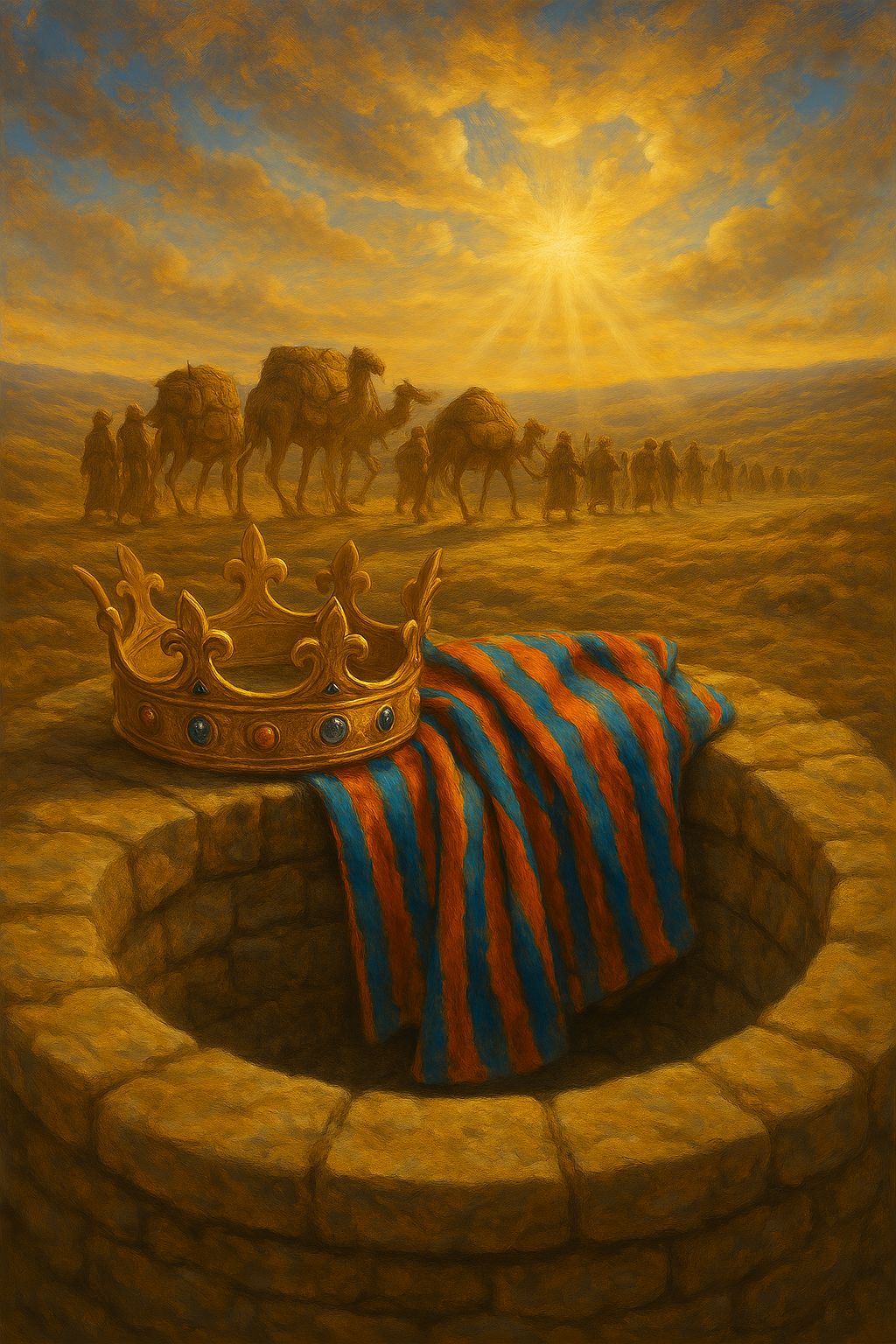
When they met Yosef, the brothers stripped him of his special robe, symbolically removing his dignity, mirroring how they stripped Yeshua before crucifixion. They cast Yosef into a cistern and later sell him to Ishmaelite merchants for twenty pieces of silver. This act, intended to destroy Yosef, ultimately fulfills Yah’s plan for salvation.

The Brothers’ Deception and Ya’achov’s Grief

The brothers deceive Ya’achov by presenting Yosef’s bloodied robe, claiming a wild animal killed him. Ya’achov mourns deeply, rending his clothes and refusing to be comforted, expressing his profound loss and grief.

Yosef’s Journey in Egypt

Yosef’s sale to Potiphar, an Egyptian official, marks the beginning of his rise in Egypt and the unfolding of Yah’s providential plan.

Spiritual Reflections on Dreams and Prophecy

The document reflects on the significance of dreams as divine communication in the Hebrew tradition, noting that prophets often received messages through dreams. Yosef is a prophet whose dreams reveal Yah’s Will. The symbolism in Yosef’s dreams connects to broader prophetic imagery, including the woman clothed with the sun in Revelation 12, representing Yisra’el.

Messianic Parallels Between Yosef and Yeshua

The narrative draws extensive parallels between Yosef and Yeshua Messiah:

  • Both are beloved sons of their fathers.
  • Both are appointed to shepherd Yisra’el.
  • Both face rejection and hatred from their brethren.
  • Both suffer humiliation and are ultimately exalted.
  • Both serve as instruments of salvation for Yisra’el and the nations.
  • Both experiences demonstrate how divine plans prevail despite human evil.

Rod concludes this teaching by emphasizing that Torah readings like this one serve as shadows of greater spiritual realities to come and encourages readers to find further Messianic insights within the text. More so, these Words of Life from our Heavenly Father teach us about the Person and Ministries of Yahoshua HaMashiyach. And it is the Person and Ministries of Yeshua that we, Yah’s chosen and elect, must ultimately emulate if we are going to receive and enter His glorious Kingdom to come. Amein. Amein.


The Covenant Connection: Unveiling the Heart of the Nazarene-Messianic Faith – Part 1 in our Covenant Series

Shalom Truth-Seekers in Yeshua Messiah.

This is the first installment in a series of detailed teaching on the Hebrew concept of “covenant” (or “Berit”) and its foundational role in the faith and salvation of God’s (i.e. Yehovah’s) chosen ones. In this installment we introduce the Hebrew concept of covenant by exploring the term’s meaning. We also emphasize its significance as a sacred, legally binding relationship between Yehovah (God) and His chosen people, Yisra’el/Yasharal, with its physical and spiritual implications for all humanity. The teaching critiques denominational misunderstandings and highlights covenant’s Torah roots and its wider scriptural (i.e. both Tanach and Brit HaDashah) importance.

Introduction to the Covenant Series

We begin by recalling a previous post on Genesis 12:3. The title of that post is: Does “I Will Bless Those Who Bless and Curse Those Who Curse,” Apply to the Modern Nation of Israel? (If you’ve not had the opportunity to listen to or read that post, we humbly invite you to do so by clicking this link https://www.themessianictorahobserver.org/2025/06/28/does-i-will-bless-those-who-bless-and-curse-those-who-curse-apply-to-the-modern-nation-of-israel/) In that post we clarified that the verse is not a command to bless the modern nation-state of Israel. But rather the verse is a prescriptive covenant provision. This provision states that those who treat God’s chosen people, according to Torah principles, receive Yah’s favor, while those who mistreat them face divine harm. And thus, covenant is central to God’s relationship with His covenant people, Israel/Yisra’el/Yasharal. And it was that post that has prompted this covenant teaching series. In this series, we will explore the refined and broader principles of covenant that link it to God’s/Yah’s Grand Plan of Salvation, Restoration, and Redemption through the Person and Ministries of Yeshua HaMashiyach.

Also in this post, we stress that denominational Christianity often fails to grasp the true Hebrew concept of covenant’s significance because of their overall rejection of Torah and Hebraic principles. Because of denominationalism’s wholesale rejection of Torah and Hebraic principles, they fail to recognize that the covenant is the sole pathway to a true relationship with God/Yehovah. That God-human relationship was established originally with Abraham and came to its fullest realization in the Person and Ministries of Yeshua Messiah. We will see that faithfulness to Torah and covenant obedience are essential for salvation and entry into the Kingdom of Heaven (Mat 7.22-23).

Understanding the Hebrew Concept of Covenant

Covenant, or “Berit” (in Hebrew), is a set apart, legally binding relational agreement between God/Yehovah and His chosen people. (Later on in this series we will see that Yah’s chosen people are not limited to just the biological descendants of Avraham, Yitschaq, and Ya’achov.) But covenant frames the established relationship between God and His chosen ones with rules/behavioral expectations, obligations, and promises. Secularists may view a covenant much like a contract. But we will see as we delve deeper into the covenant Yah established/cut with His chosen ones that the concept of covenant is deeper. It’s akin to a marriage-like partnership that is characterized by love, grace, and mercy. Both parties of the relational covenant agreement are bound to uphold the tenets of the established covenant. But God’s faithfulness ensures the covenant’s integrity, even when the covenant’s human-signatory to the covenant, fail to keep their end of the covenant agreement. This faithfulness on God’s/Yehovah’s part is an immutable trait of God. Moseh described this character trait accordingly:

 “Yehovah/God is not a man that He should lie, nor a son of man (i.e. a human being) that He should repent (i.e. change His mind). Has He said and will He not do it? Or has He spoken, and will He not establish it?” (Numbers 23:19; LSB)

The covenant (sometimes referred to as a blood covenant) is solemnly “cut” or established through an ancient middle eastern ritual that involves animal sacrifices. This bloody, solemn act symbolizes the serious and binding nature of the agreement (Gen 15).

The Hebrew word “Berit” pictographically combines elements representing family, leadership, work, and consent. These elements underscore the covenant’s relational and purposeful dimensions.

Key Biblical Covenants

We furthermore outline the five major expansions of Yah’s covenant with His chosen ones:

  • The Noahic Covenant (Genesis 6 and 9)
  • The Patriarchal Covenant with Abraham and his descendants (Genesis 12, 15, 17)
  • The National Covenant given through Moses at Sinai (Exodus 19-24)
  • The Davidic Covenant with King David (2 Chronicles, Psalms, Isaiah)
  • The New or Renewed Covenant prophesied by Jeremiah and Ezekiel (Jeremiah 31:31-34; Ezekiel 36:26-38)

Each covenant expansion reveals aspects of God’s/Yah’s immutable character and the love He has for His set apart people. These expansions include expectations Yah for His covenant people. These expansions of covenant shape Israel’s identity and sacred mission on the earth.

The Commonness and Uniqueness of Covenants

While covenants were common in the ancient Near East, often understood by scholars as treaties that various kings established with their vassals, the Hebrew covenant is unique. For we find that it is initiated solely by God acting from a position of sovereignty. God/Yah offers to His chosen ones a non-negotiable invitation to enter into a relationship with Him that is based on grace and love. Humans may accept or reject that invitation, but they cannot alter the terms of that covenant. Why? Because it is God/Yah Who carries the covenant’s weight. Not from a position of subjugating His people, but from an expression of His desire for loving communion with His people. The covenant is thus a sacred bond with rules that both parties must honor. Those who accept the terms of the covenant commit to loving God (and loving God/Yah comes through faithful obedience to Him) and loving one another (Luk 10:27).

The prophet Jeremiah’s words to the Babylonian captives illustrate God’s faithfulness to His covenant despite Israel’s failures (chapter 29). Because of Yah’s steadfastness to His Covenant, He promises Judah restoration and a future of peace.

Greek Understanding of Covenant and Terminology

In this teaching we also contrast the Hebrew “Berit” with the Greek “diatheke” that is used in the New Testament and in the LXX/Septuagint. While “diatheke” can refer to a “will” or “testament,” the Greek version of covenant does not capture the rich spiritual depth of the Hebrew, which involves an enduring, intimate relationship that has far-reaching implications for humanity’s salvation.

Varying Definitions of Covenant

We list several scholarly definitions for covenant, some of which emphasize covenant as an alliance, compact, treaty, or sacred kinship bonds. The Hebrew understanding of covenant, however, centers on relationship, promises, and expectations established uniquely by God/Yehovah with Israel/Yisra’el/Yasharal.

Conclusion

We conclude our discussion by emphasizing the necessity of understanding covenant from a Hebrew perspective that is rooted in Torah, the Prophets, and the Writings. A Greek-only or New Testament-only view limits comprehension of this critical concept and the one that embraces it from that Greek perspective risks missing the covenant’s full significance for individual believers and the collective identity of Israel. The covenant remains the foundation for humanity’s salvation and our entry into the Kingdom of God (i.e. the Malchut Ahlohim).


Does “I Will Bless Those Who Bless and Curse Those Who Curse” Apply to the Modern Nation of Israel?

As I am publishing this discussion, it is the 2nd day of the 4th Month 6025, which translates to June 28, 2025.


Today I am led to discuss a key passage of Torah that has lately received a good amount of attention from the American public on the heels of the Israel-Iran-Hamas-Hezbollah-Houthi conflicts. At question is whether America is commanded to stand with the nation state of Israel as she battles against her enemies in light of what Yehovah declared unto Avraham in Genesis 12:3: “I will bless them that bless thee — Yah speaking to Avram — and curse him that curseth thee…” (KJV).


The United States is already divided as it relates to what her position should be towards Israel as Israel wars with Iran and the various Arab factions challenging her right to exist; lay claim to the Land upon which she dwells, and her treatment of the so-called Palestinians and the various terrorist organizations that claim to have the Palestinians’ best interests at heart.


Recently, a well-known U.S. Senator in an interview with a well-known conservative reporter, declared that he supports the nation state of Israel from a moral, financial, and military standpoint, because he believes the Bible commands all believers to stand with Israel. The senator referenced Genesis/Beresheit 12:3a as the basis for his position. Needless to say, the senator’s declaration received much support from the pro-Israel community of the Conservative parties of this county. But his words also drew ire and criticism from not only from the anti-Israel, liberal people of this country, but even from some anti-Israel conservatives who criticized the senator’s interpretation of Genesis 12:3a.


I have been intrigued by this story since it aired last week. And despite my continued support for the modern state of Israel because I believe the state is home to true-remnant Israelites, I question the senator’s interpretation of Genesis 12:3a. I question whether, indeed, Genesis 12:3a is a commandment to God’s people to bless Israel and to not curse Israel; or is it something else?


I’ve chosen to title this discussion: Does “I Will Bless Those Who Bless and Curse Those Who Curse” Apply to the Modern Nation of Israel? This will be Part 6 of our “Israel’s Inextricable Link to our Salvation Series.”

The Scriptural Reference

As just mentioned, the scriptural reference the senator was referring in his response to a reporter’s question regarding why he supports Israel in their war against Iran is found in various places throughout scripture. But for our purposes today, I want to focus on Genesis/Beresheit 12: 3. For context, let’s read verses one, two, and three of this chapter:

(1) And Yehovah said to Avram, “Go yourself out of your land, from your relatives and from your father’s house, to a land which I show you. (2) And I shall make you a great nation, and bless you and make your name great, and you shall be a blessing! (3) And I shall bless those who bless you, and curse him who curses you. And in you all the clans of the earth shall be blessed.” (The Scriptures ISR)

Genesis 12:3a is not a commandment, but a prescription: a “chiastic” or “chiasmus.” Yah says to His covenant people that those who do good to them will be blessed by Him. And those that do evil to them will be cursed by Him. It’s a statement of reality, based on the covenant relationship Yehovah shares with Yisra’el.


“The structure of this verse is that of a “chiasmus”: I will bless (i.e. barak) they that bless you — they that curse (i.e. a’ror) you I shall curse” (Kenneth A. Matthews; New American Commentary). Thus, what we have here in this “chiasmus” or “chiastic” could be viewed as two sides of a single coin: “Those that do good toward you and your descendants will have good done to them. But also, those that mistreat you, I will mistreat them as well.


The Hebrew term “barak,” which we understand in English to be “bless” is the act of bestowing favor and goodness upon another. In the case of Yehovah, when He blesses an individual, He is enacting divine favor and fortune upon the object of His blessing.


Conversely, the Hebrew terms “key-lel” and “a-ror,” which we both understand to be a curse in English, is the act of bestowing harm or evil upon someone or something. Of course, as it relates to Ahlohim, it is the actions taken by Abba Yah that will result in harm or evil upon the object of His ire or anger.


The Hebraic concepts of blessings and curses is a whole in-depth study in and of itself, much less that which we’re discussing here today regarding Genesis/Beresheit 12:3. But for our purposes today, suffice to understand blessing as honoring another; showing another support; or showing and giving favor to another. Conversely, let us understand curse or “key-lel” as to disrespect, dishonor, and belittle another, while curse as “a-ror” denotes Yehovah invoking divine judgment or misfortune upon the object of His anger.


So, instead of the senator understanding or calling Genesis/Beresheit 12:3 (and all the parallel verses to this chiastic) a commandment that he has chosen to follow because he’s a Christian or believer in Jesus, he would have been better served to have said that he has chosen to be on the right side — the blessing side — of this covenant-based equation. For history has indeed shown this prescriptive covenant provision to be reliable and accurate. The United States’ (and certain other nations’) support of Yisra’el has no doubt contributed to their wellbeing and blessing since Yisra’el became a nation state in 1948.

What is Covenant and What Role Does Covenant Play in Yah’s Declaration to Avraham?

At issue here is the foundational element of “covenant.” In Hebrew it is “b’rit;” in Greek it is “dia-the-ken.”


The prescription that Yah places before Avraham and Moshe’s readers here must be understood within the framework of the “covenant” He establishes or cuts with Avraham. For it is only with a firm grasp of what the Almighty was working out through Avram here in this story that begins in verse 1 of this chapter that we can truly understand or interpret this “chiastic” (i.e. the literary mirrored concepts and actions) relating to blessings resulting in blessings and curses bringing forth curses in relation to Avraham and his descendants.


A covenant/b’rit is “a solemn agreement between two parties providing sanctions in the event of non-compliance” (Speiser, E.A.; Genesis: Introduction, Translation and Notes). A fancy way of saying that a covenant is a legally binding agreement between two parties. And so, as it relates to our focus passage of Genesis/Beresheit 12:1-3, we’re talking about the provisions of a binding, legal agreement between Yehovah, Creator of the Universe, and Abraham and his descendants.


Generally, the concept of covenant is specific to a relationship between the Creator of the Universe and His human creation. Yes, covenants were quite common between men. But from the perspective of Genesis/Beresheit 12:1-3, and throughout most of the remainder of Torah, covenant is about the relationship that exists between Yehovah and His “chosen ones.” And of course, who the said “chosen ones” are today is up for debate and interpretation, depending upon one’s religious or doctrinal orientation. Some see the expansive covenant contained in Torah as involving Yehovah and the Jewish people, while others see it as involving Christians, who see themselves as “spiritual Israelites.” But if we simply stick to the context scripture here, the covenant Yehovah is establishing/cutting is between Himself and Avram/Avraham, and the tenets or terms of that covenant or agreement extend to Avram’s/Avraham’s descendants. And we will touch upon who those descendants include later on in our discussion.


The covenant relationship Avraham enjoyed with Yehovah would be passed down and perpetuated to and through Avraham’s descendants. That same covenant relationship is still in effect today. But through the Person and ministries of Yeshua Messiah, the binding tenets and benefits of the covenant that Yah established with Avraham is not only a birthright of every biological Jew and Hebrew (i.e. of the 10-tribes), but is also accessible to every non-Jew and non-Hebrew who enters a covenant relationship with Yehovah and who abide by the tenets of the covenant as spelled out in the Moshe and Yeshua extensions of the Original Avrahamic covenant.


Indeed, the Hebraic concept of covenant is extremely broad. It not only identifies the relationship Yah has with certain groups of individuals, but it also determines the make-up or composition of the rules that govern Yah’s relationship with His chosen ones.


But because the concept of covenant is such a massive topic and subject that cannot receive the full attention it deserves in just this single post, Abba willing, I will do a teaching on it at a later date. But for our purposes today, specific to Genesis 12:3, I simply want us to recognize that without a modicum of understanding of covenant — the relationship agreement Yah established with the patriarchs and their descendants, we cannot truly — accurately — understand Genesis/Beresheit 12:3. For the blessings and curses Yah mentions here are governed by the covenant relationship He established/cut with Yisra’el/Yasharal.

To Whom Is Yah Addressing this Prescriptive Provision, If Anyone?

Here in these covenant provisions, Avram is informed by Yah that He, Yah, will be the One taking action on his, Avram’s, behalf. For “Yah is the dispenser of blessing for the nations” (Kenneth A. Matthews; New American Commentary). Avram, therefore, cannot lay exclusive claim to Yah’s [covenant] blessings. Why? Because Avram, and the covenant Yah establishes/cuts with him, belongs to Yah. And the simple byproduct of this unique relationship that exists between Yehovah and Avram is that Yah blesses His beloved, including any who would come after Avram and enter into the same faithful-obedient relationship with His Ahlohim Yehovah.


This is the framework by which things work in the Kingdom economy: We enter into a special relationship with Yah (i.e. a covenant relationship). And by virtue of being in that special relationship with Yehovah, He blesses and curses wherever and whenever He deems is appropriate and necessary.


The principle of blessings and curses that Yehovah levies upon individuals and nations/groups is illustrated and explained through the covenant relationship that exists between Yah and Avram — and by extension Avram’s descendants. Curses come to those who transgress Yah’s Torah — Yah’s “loving instructions.” Blessings, on the other hand, are lavished upon and maintained upon those who operate — walk — within the boundaries of Yah’s Torah. Thus, as it relates to Avraham, blessings or favor come to those who treat Avraham — Yisra’el — according to the provisions that are outlined in Torah. Curses, on the other hand, fall upon those that choose to treat Avraham contrary to the principles Yah outlined in His Torah. The blessings and curses prescription that come upon the nations are not based upon the person of Avraham, and by extension the whole of Yasharal/Yisra’el that bears the name and possesses Avraham’s heritage. But rather, the blessings and curses prescription are brought upon the nations in response to how they treat the relationship that exists between Avraham — and by extension Yisra’el — and Yehovah. Why? Because Avraham — Yisra’el — belongs to Yehovah. Thus, those that treat Yisra’el properly, in accordance with the principles spelled out in Yah’s Torah for the proper treatment of Yah’s people, they honor Avraham’s God, Yehovah. And Yah will bless such individuals and nations. Conversely, those that mistreat Yisra’el in contradiction to the principles of proper treatment of Yah’s people as outlined/spelled out in Torah, they offend Yah and bring curses upon themselves.


The Chiasmus of Genesis 12:3 is a Tenet of Abba’s Plan of Salvation, Redemption, and Restoration


The covenant that Yah presents to Avram here in Genesis 12 is described by Torah Resource’s Tim Hegg as “the unfolding revelation of Yah’s plan to bless mankind through the family of Avraham” (Studies in the Torah — Genesis, p. 81). The blessings and curses element of this passage is a stark reality of what happens to those individuals who get on-board with the covenant Yah establishes with Avraham, and those who for whatever reason choose to challenge or harm the covenant relationship along with the Will and Plans of Yah.


Within this ever-expanding covenant that Abba Yah establishes/cuts with Yisrael are the essential provisions for humanity’s salvation. Unbeknown to millions of self-professing Christians around the world, however, is this seldom mentioned reality that anyone who truly desires to receive the salvation that Yah is offering humanity, and enter into His coming Kingdom, they themselves must enter an obedient, faith-based covenant relationship with Yehovah alongside their Hebrew cousins. For Yah made just one covenant with humanity. And that one covenant is the one He cut with Avraham and Avraham’s descendants.


Shaul, Paul, fully recognized the reality of this in his correspondences to the Messianic Assemblies in Galatia and Rome:


Romans 4:11-12. (11) And he (i.e. Avraham) received the sign of circumcision, a seal of the righteousness of the faith which he had while uncircumcised, so that he might be the father of all who believe without being circumcised, that righteousness might be counted to them, (12) and the father of circumcision to those who not only are of the circumcision, but who also follow in the steps of the faith of our father Avraham which he had while uncircumcised. (LSB).


Galatians 3:29. “And if you belong to Messiah, then you are Avraham’s seed, heirs according to promise” (LSB).


Thus, we are justified and imputed righteousness by the Court of Heaven, by virtue of Yahoshua’s atoning sacrifice and our faith in His Person and ministries. And so, we are blessed of Yah out of all of humanity, not just because we are being saved, but also because we have been grafted into the commonwealth of Yisra’el/Yasharal and are in a covenant relationship with the Creator of the Universe. In every sense, this is Good News and the fulfillment of the last sentence of Genesis/Beresheit 12:3: “And all families of the earth will be blessed in you” (LEB).


In accordance with Yah’s plan and will, Yah took the promise of a Messiah Who would undo what the enemy and Adam did in the Garden — known by scholars as the “Protoevangelion” in Genesis 3:15 — and chose Avraham and his seed to bring this promise to fruition. For indeed it would be that in you, Avraham, “All the families of the earth shall be blessed” (12:3b).


Now, I’ve sought over the course of many discussions/teachings on this platform to hammer home the stark reality that Yah chose just the one man and his descendants from all of humanity throughout human history to establish/cut a covenant with. And this covenant would not only be about a people and their relationship with the Creator of the Universe, and the Land that Creator promised His covenant people, but also would also result in many sons and daughters coming into a relationship with their Creator and receiving His glorious Kingdom. And that one man is none other than Avraham. Furthermore, Yah chose one Man to facilitate or mediate the covenant’s redemptive, salvific, restorative promises through. And that one Man is none other than Yahoshua Messiah.


The “chiasmus”/”chiastic” of Genesis 12:3 can be viewed as sort of an insurance policy or security system for the maintenance and integrity of the covenant Yah established with Avraham and his descendants. And we, of course, are included in that covenant. For indeed, Yah is zealous for His elect and will do whatever it takes to back and perpetuate the covenant, His Plan, and His Will in the earth. In other words, the world is wise to respect the covenant, plan and will of the Almighty, for those that do so will be favored of Yah. But those that disrespect the covenant, plan and will of the Almighty will find themselves on the wrong side of history.

So What is the Bottom-line when it Comes to This Prescriptive Covenant Provision? How Should We Interpret It and What Should We Make of It?

People who have personal issues regarding the modern state of Israel or even the Jewish people of this world, in all reality, have an adverse personal issue with the God of Avraham, Yitschaq, and Ya’achov.

How so, you may ask. Well, Yah loves Yisra’el. Yehovah has and continues to be, for the better part of four-millennia, been in an unbreakable covenant-relationship with her. Be it the Jewish people who live and operate in ha-e-retz Yisra’el; Jews, be they secular or religious, living throughout the world; Messianic Jews; Nazarene Yisra’elites; or what have you — Yah maintains the same covenant relationship with them that He established with Avraham and his descendants back in Genesis 12. And despite Yisra’el’s many faults and her rejection of Yeshua as her Messiah, as in the case of secular and religious Jews, and of which scripture informs us they will ultimately accept Yeshua as their King and Mashiyach, they remain beloved of Yehovah (1 Kin 10:9; 2 Chr 9:8 Hos 3:1; 11:1; Rom 11:26). And Yah has always maintained His love for Yisra’el because of His covenant relationship with Avraham, who Yah referred to as His friend forever (2 Chr 20:7; Isa 41:8; Jas 2:23). Yet today we have a great many “newspaper eschatologists” (to borrow this title from Messianic Apologetics’ J.K. McKee) and not a few armchair, self-righteous, secularists who’ve made it their business to interpret and teach scripture to we who are Yah’s chosen ones, insisting that the Jews of today are not the descendants of the Jews and Hebrews of our bibles. These naysayers have no covenant relationship with the God of Avraham, Yitschaq, and Ya’achov. Nor is Yah’s indwelling Spirit/Ruach operating within them. Thus, these lost souls have nothing of any value to say to us. We are therefore best served to place our trust upon the sure foundation of Yeshua Messiah and Yah’s eternal and holy Word of Truth.


As disciples of Yahoshua, we are to love what Yehovah loves, and hate what Yehovah hates (Amo 5:15; Heb 1:9). And if Yah loves Israel or Judah as scripture clearly denotes, we as well must love Judah. Now, how that love is manifested by us is certainly debatable. One could certainly argue that loving or blessing Yisra’el means standing by and supporting the nation state of Yisra’el morally, financially, prayerfully, and even militarily. Conversely, one could argue that loving Yisra’el, while remaining within the realm of the covenant Yisra’el has with Yehovah, could mean simply interceding, financially supporting, and spiritually backing our Jewish cousins who are either living in Yisra’el proper or anywhere else in the world.


Now, loving and supporting Yisra’el/Yasharal doesn’t have to mean that we must agree with and morally support everything Yisra’eli PM Netanyahu and his secular government do and say. But our love and support of Yisra’el must, at the very least, be done in accordance with Yah’s Torah instructions and the teachings and example of Yeshua our Messiah. For it all comes down to loving our Ahlohim/Elohim with our whole being and loving our neighbor, in this case Yisra’el/Yasharal, as much as we love ourselves. Master stated that “on these two commandments hang all the law and the prophets” (Mat 22:40).

So, we as the elect of Yah must approach our blessing of Yisra’el through the paradigm of covenant; the specifics of which are contained in Torah and the teachings of our Master Yeshua. Yah and Yeshua instruct us on how we are to treat our neighbor, even Yisra’el.

Concluding Thoughts and Reflections

In conclusion: Genesis/Beresheit 12:3 is so much more than pro-Israel conservatives standing in support of the modern nation of Israel; whether that support comes in the form of prayers/intercessions on Yisra’el’s behalf; verbal, moral affirmations in their existential struggles against the enemies of Yah and of His people; and or sending financial and material support to Yisra’el by America’s government or supportive individuals and non-profit organizations. These are certainly noble efforts and actions. And such supportive actions may indeed be deemed acts of “blessing” or “barak” Yisra’el by the court of heaven. But this prescriptive covenant principle/provision of Genesis/Beresheit 12:3 is more about treating all of Yah’s chosen and loved ones in accordance with Yah’s Torah instructions. Yah, in His Torah, instructs His people how they are to treat — bless — one another. And so, it comes down to doing the right thing and doing that which Yehovah expects us to do.


But at the end of the day, beloved, Genesis 12:3 is not in and of itself a commandment to support the modern state of Israel as some have stated. Genesis 12:3 is simply a prescriptive reality of the covenant relationship Yisra’el — Judah — Nazarenes — any who belong to Yah via the auspices of the Avrahamic, Mosaic, Davidic, and Renewed Covenants, possess and walk in. Simply put: Obey Yah’s Torah and be blessed… disobey Yah’s Torah and be cursed (Deu 28-30). This prescription applies to those operating within Yah’s covenant, and those outside the covenant. Again, history bears out that all who have come against the covenant Yah has with His chosen ones ultimately come to a bitter end.


So, does the prescriptive covenant provision of Genesis 12:3 apply to the modern nation state of Israel? Yes. But, it’s the bigger picture involving covenant, Torah, salvation, redemption, and restoration that Yah wants us to grasp here. It not only applies to the modern nation state of Yisra’el, but to every soul who is of the commonwealth of Yisra’el. These all come under the provision of Yah’s covenant with Avraham, and most importantly, are all beloved of Yehovah.


Shabbat Shalom — Shavu’atov — Until next time, beloved, take care.

Messianic Reflections in the Life of Yosef Ben Yisrael- Thoughts & Reflections on Torah Reading 34


Patriarchal Sojourners of the Land Despite the Covenant Promises


37:1. Ya’achov/Jacob settles — “ye-shab” — inhabits the Land — “ha-e-retz” — of the temporary — sojourning — “ma-gor” — of his father in Canaan.

Recall in Reading 33, we addressed the concept of the patriarchs of our beloved Faith sojourning in the very Land that Yehovah promised them in the covenant He cut with them.

The writer of the Book of Hebrews notes this reality:

     8 By faith Abraham, when he was called, obeyed by going out to a place which he was to receive for an inheritance; and he went out, not knowing where he was going. 9   By faith, he sojourned in the land of promise, as in a foreign land, dwelling in tents with Isaac and Jacob, fellow heirs of the same promise, 10 for he was looking for the city which has foundations, whose architect and builder is God. (Heb 11; LSB)


The third patriarch finally settles in back home, where he was always covenanted to be — Canaan — Hebron/Chevron — the home of his father Yitschaq. Of the three patriarchs, Yitschaq was the only one to have never left Hebron.

The Story of the Son Becomes the Story of the Father


37:2. Scholars refer to the phrase “these are the generations [of Ya’achov]” as a “toledot,” the wording generally used in the Hebrew scriptures to alert the reader that what precedes or proceeds it is a generational listing. But in this case, Ya’achov’s so-called generations have shifted into the purview or storyline of his beloved son Yosef. For Yosef’s story is Yisra’el’s/Yasharal’s saving grace, through the Will and Plans of Yehovah. Yosef would be the vessel by which Yah’s covenant with the patriarchs Avraham, Yitschaq, and Ya’achov would continue in perpetuity. Yosef preserves Yisra’el/Yasharal, despite being rejected, persecuted, maligned, assaulted, and sold into slavery by Yisra’el/Yasharal. He is, as we shall soon discuss, a type of Yahoshua Messiah.


It should be noted that the remaining chapters of Genesis/Beresheit chronicles Ya’achov’s life through the life of Joseph/Yosef. Arnold G. Fruchtenbaum writes:


“The story of Joseph completes the story of Jacob” (Ariel’s Bible Commentary).


The Ya’achovs — Somewhat of a Dysfunctional Family


We begin the story of Yosef — Ya’achov’s son of 17-years — shepherding the family’s flocks — sheep and goats — with his brothers. Or so it would seem from most of our English translations.


Jewish tradition holds that Yosef’s age of 17 would have put him at the age common for marriage in those days. This then hints at, according to Moshe’s narrative here, Yosef assuming the role of the “Son of the Covenant.” No other son of Ya’achov, at this juncture of Hebrew history, seemed to have the unique character to assume the Son of the Covenant role. Which is not saying a lot since Yah does the choosing who the succeeding sons of the covenant are to be. But we will see evidence that Yosef ideally became the “Son of the Covenant” by the various Yah-ordained events that peppered his young life (e.g. his dreams; being beloved by daddy Ya’achov; his ascendancy to Egyptian-rulership; etc.). Not only will Yosef, through the wisdom gifted to him by Yehovah, save Yisra’el/Yasharal, but most of the nations in the Sinai peninsula.


The Hebrew term “tended” as used here in this verse is “ro-‘eh-‘et” — which also suggests Yosef shepherded his brothers.


The text denotes that Yosef was a helper of the sons of Bilhah and Zilpah, which the JPS Torah Commentary explains as Yosef primarily “fraternized… with Dan, Naphtali, Gad, and Asher.”


It should be noted that Reuben, despite being complicit in his brother Yosef’s impending enslavement, saves Yosef’s life, and “unconsciously cooperates with Yah’s purpose” regarding Yosef and ultimately the nation of Yisra’el/Yasharal.


Furthermore, it should be noted: The question at this juncture of Moshe’s chronology is, who of Ya’achov’s sons will receive the birthright from Ya’achov, and who will become the son of the covenant? Two realities weight upon this determination here: (1) Reuben, Ya’achov’s oldest son, and by familial and patriarchal tradition the son who would be in line to receive the birthright and become the son of the covenant, violates his father Ya’achov’s marital bed by engaging in sexual relations with Ya’achov’s concubine, Bilhah. And (2), Ya’achov adored Yosef above all his sons.


Yosef reports to his father Ya’achov that his brothers were up to no good. This becomes the first of at least three incidents that would put Yosef at extreme enmity with his brothers. That which Yosef’s brothers had gotten themselves into that was of such ill-repute is not mentioned in the text.


In essence, Yosef was the family tattler, which, given that the tattle he reported to his father was true, would not make Yosef evil.


Questions Arise About Who is Ya’achov’s Firstborn — Will Love Overrule Chronology?


37:3. The love Ya’achov has for and displays towards Yosef does not work in Yosef’s favor as it relates to his relationship with his brothers. Moshe declares the reason Ya’achov adored Yosef above all of his sons was that Yosef was “a son of his old age.”


Despite Benjamin/Benyamin being younger than Yosef, Yosef was Rachel’s — Ya’achov’s true love — as though he were his firstborn son. Thus, Yosef was special to Ya’achov in this sense.


Arnold Fruchtenbaum suggests it is Yosef’s firstborn sonship to Rachel that, in Ya’achov’s mind at least, makes him Ya’achov’s firstborn, worthy to receive the birthright.


As a token of Ya’achov’s love for Yosef, Ya’achov makes his beloved son “a robe with long sleeves” — a “ketonet passim.


E.A. Speiser, in his book Genesis: Introduction, Translation, and Notes, describes Yosef’s long-sleeve garment or robe as “an ornamented tunic.” Conversely, Nahum M. Sarna, in his article in the JPS Torah Commentary, suggests that the meaning of “Ketonet passim” is unclear. But the Septuagint (the Greek translation of the Old Testament) and the Latin Vulgate render “Ketonet passim” as “a robe of many colors,” no doubt connecting this garment — in type — to the distinctive vesture worn by the “virgin daughters of Hebrew-royalty” as recorded in 2 Samuel 13:18-19. Turns out that certain ancient pieces of Egyptian and Syrian art depict what appears to be Hebrew figures attired in elaborately designed, multi-colored robes, which seems to support Yosef’s “ketonet passim” being an elongated, technicolored robe or tunic — to borrow from the title of a popular 1980s Broadway play entitled Joseph and the Amazing Technicolor Dream Coat.


Thus, this robe Yosef receives from his father would have been a glaring indication of such firstborn or royal treatment to his brothers. Which sort of begs the question: Was this a visual notice that Yosef was to be Reuben’s replacement? Was Yosef’s “ketonet passim” a brutal, in your face, response to Reuben’s transgression? Was this in line with an ancient near eastern practice, maybe, of Yosef being appointed by Ya’achov as his clan’s future leader?


Regardless of the specific nuances at play here, the loudness of Yosef’s technicolored dream coat would have been a constant reminder and source of anger, hatred, and jealousy for his brothers to draw from.


Disdain Abounds for the Beloved Son


37:4. Moshe hangs this hatred, anger, and jealousy that the brethren have towards their younger brother on the fact that their father, Ya’achov, loves Yosef more than he loves them. Consequently, the brothers share no harmonious relationship with Yosef, according to the text.


So, what this verse is saying to us is that every attempt by Yosef to socialize with his brethren is rejected by them (reference: Nahum A. Sarna; JPS Torah Commentary). And that’s how much Yosef’s brothers despise him. What a terrible situation for any of them to have to live in.


The brethren’s rejection of Yosef was in effect a rejection of Ya’achov, their father, and Yehovah, their father’s sovereign.


Indeed, Yeshua was rejected by most of Judah because He, like Yosef, was beloved of His Father.

The Son Dreams Dreams of Prophetic Implications


37:5-6. After setting the base foundation for the brothers’ disdain towards Yosef (i.e. Ya’achov’s overriding love for Yosef, particularly as displayed in the “ketonet passim” Ya’achov makes for him, Moshe reveals the “straw that breaks the camel’s back” that will lead to the brothers physically accosting Yosef.


Yosef dreams a dream — “halom” — a prophetic dream. A dream whereby Yehovah reveals to Yosef an event that will occur sometime in the future. Yah’s communication with Yosef is not direct, but is rendered in symbols.


Dreams during those days were invariably viewed as divine communications with humanity. Thus, when Yosef recounts his dream to his them — this first dream — the brethren take the dream and its meaning quite seriously. Thus, they do not discount or reject the dream. But as we will soon see, they instead reject Yosef’s projected role in the dream. Yosef’s brothers blame him for the dream because they bitterly viewed him as being obnoxious — essentially full of himself.


37:7-8. In this first dream — yes, there is another dream coming — Yosef describes to his brethren the story of the sons of Ya’achov binding/bundling sheaves of grain amid a field. At some point, Yosef’s bundle/sheaf stands itself up, or it rises above his brothers’ sheaves. And Yosef’s tall-standing sheaf/bundle remains standing as his brothers’ lesser bundles/sheaves gather round-about or encircle his sheaf and their sheafs bow down or prostrate down before his sheaf. The brothers correctly interpret the dream as they, at some point in the future, submitting themselves and paying homage to the one they despised the most: Yosef. The brethren recognize the dream is telling them that some day Yosef will assume eminent authority and power over them, of which they would submit themselves to.


And so, Yosef’s brethren respond to Yosef’s telling of this dream with a simple: “Will you really or truly reign — rule over us?”


Yosef’s brethren clearly understood the symbolism of this dream, which, as Moshe describes, drives them to despise their brother Yosef even more.


The very recitation of the dream by Yosef — Yosef’s words — added fuel to the fire of the hate-fest that his brothers have going on within them. And there is an increase of hostility towards Yosef.


Yeshua’ brethren — Judah — hated Him similarly because of the Words — His Father’s words actually — that He spoke to them.


37:9. After the brethren’s question is posed to Yosef regarding his prophesied reign over them, Moshe takes us immediately into the beloved son’s second dream recitation. This one is similar to the first, but this, instead of agriculture being key symbols of the dream, its the heavenly/celestial bodies: The sun. The Moon. And the stars.


And again, Yosef calls his brothers to attend to the recitation of his dream. But this recitation, Yosef recites in the hearing of his father Ya’achov.

Here, the sun — “ha-shemes;” the moon — “ya-rayeh;” and eleven stars — “ko-havim” are all prostrating/bowing down before him — “mish-ta-hawim” — in a sense, paying homage to him; submitting to his authority and name. Even worshiping him.


Near Eastern traditions contend that it is common for dreams of similar meaning to come to the dreamer in pairs, as is the case of young Yosef here.


This dream, however, takes on a grander scale in terms of its symbolism — the symbolism being a prophetic shadow picture of the exalted Yosef in Egypt/Mitsrayim.


The sun represents daddy Ya’achov. The moon mother Rachel, although Rachel is dead at this point in our story chronology, some have speculated the moon here represents Bilhah, who would be Yosef’s stepmother. And the eleven stars symbolize Yosef’s brothers.


37:10-11. Upon hearing the dream, daddy Ya’achov, according to the text, “rebukes” — “ga-har” —severely censures Yosef. In this censure, Ya’achov questions Yosef as to the meaning of his dream, although the dream’s meaning should not have been a mystery to him or anyone else for that matter. And Ya’achov cuts to the heart of the matter here by asking Yosef, “who in the world do you think you are? Are we all, who are your seniors in more ways than one, meant to submit ourselves to you?”


The fallout of Yosef’s telling of this second dream, as it relates to his brothers, is expected: more jealousy — “ke-nay.” But Yosef’s dad, instead of being insulted and angry with Yosef, like Miryam/Miriam regarding Yeshua’s many acts (Luke 2:19, 51), kept — guarded — pondered — “sha-mar” Yosef’s words in his mind. Ya’achov, on second thought, realizes that, just maybe, there is something to take note of in Yosef’s dream.


Beyond the hint of some obnoxiousness inherent in Yosef’s character, Moshe does not indicate that Yosef was anything but righteous. And it was Yosef’s righteousness that caused his brethren to despise him all the more (Hegg, T., Studies in the Torah — Genesis; p. 275).


Yosef’s brethren were so blinded by their hatred of him they could not recognize the divine work being done in their young brother’s life. It wouldn’t be till they came crawling to Yosef, as he sat on his throne in Egypt, for life saving sustenance. Only he, Yosef, a type of Mashiyach, had been granted the power and authority to save Yisra’el/Yasharal.


Setting the Stage for the Son’s Glorification


37:12-14. With Moshe’s documentation of Yosef Dreams and the sour relationship our young patriarch has with his brethren, the stage is now set for his exultation which will lead to Israel’s salvation. But that exultation will not come without years of trials and tribulations for Yosef. A molding and a refining of this brash favored one of the Most High.


Our coming glorification in Yeshua Messiah, just as with our master’s glorification (i.e. we shall see Yahoshua as He presently is, and be like Him — 1 John 3:2 — will not come without the refining fire of trials, tribulations, and persecution. (Proof of this is found in the Master’s Beatitudes in Matthew chapter 5).

Recall the story of the sons of Zebedee. These approached the Master requesting of him they be granted the privilege of one of them sitting on His right and the other on His left in the Master’s glory. But Yeshua responded to their naïve request with a sobering reality check:


“Ye know not what ye ask. Can ye drink of the cup that I drink of? And be baptized with the baptism that I am baptized with” (Mat 20:22; KJV)?


No doubt embarrassed by their Master’s stark response, but having gone this far with their foolish request, they could not walk it back. So, they, of course, declared to the Master that they could indeed endure the baptism and drink of the cup that He was destined to drink from.

The Master did not challenge James’ and John’s commitment to endure the trials, tribulations, and even martyrdom Yeshua was making reference to. But rather, the Master prophetically acknowledged to them:


“Ye shall indeed drink of the cup that I drink of; and with the baptism that I am baptized…” (Mat 20:23; KJV).


And of course, history bears out that James, John, and all the other disciples/taught ones, turned apostles or sent ones, would endure great persecution, trials, and tribulations for the sake of the Gospel and the Name of Yahoshua HaMashiyach.


The Father Calls the Son to a Mission


At what will be a most fateful time in Yosef’s life, daddy Ya’achov calls him to go in search of his brethren — go out to where they were pasturing/grazing the family’s flocks in Shechem, check on their wellbeing, and return to Him with a report. And Yosef willingly avails himself to embark upon this mission simply by responding to his father with: “Hinneni.”

It’s interesting that the sons of Ya’achov would be pasturing the family’s flocks in Shechem, given the family’s tragic history there (reference back to 34:30).

And as before, knowing how much mischief his sons routinely got themselves into, Ya’achov employs his son Yosef to look in on their activities and report back to him.

In my mind, it is the inherent dangers associated with the brothers’ operating in Shechem and their propensity to get into mischief that prompts daddy Ya’achov to send Yosef to check on sons’ wellbeing.

The prophetic shadow picture of Yehovah calling upon His beloved Son, Yeshua, to go to His sons — bene Yisra’el/Yasharal — in order to bring them back to covenant and in alignment with Him is hauntingly, but beautifully depicted here in our Reading.

When the Canaanite woman begs Master Yeshua to deliver her demon-possessed daughter, He responds to the moment by declaring to His taught ones:


“I am not sent but unto the lost sheep of the House of Yisra’el/Yasharal” (Mat 15:24; KJV).


Abba Yah declared to Yasharal/Yisra’el, through Moshe, that He would raise up unto them a prophet (i.e. that prophet would be Yeshua) from their midst, like unto them, that they must hearken. Yah — symbolized here in our reading as Ya’achov — would put His Words in His prophet’s (i.e. here represented by Yosef’s) mouth. And this prophet — Yeshua — fulfillment of Yosef — shall speak unto the nation Yasharal as His Father commands Him (Deu 18:15-18).

And like Yosef, Yeshua is instructed to go to his brethren who are pasturing in the dangerous city of Shechem — symbolic of the world — check on their wellbeing — their “shalom” or “davar” and return and report back to Him of their situation.

Like Yosef before him, Yahoshua came to His own who received Him not (Joh 1:11). Describing Himself before synagogue attendees in Nazareth one Shabbat, the Master recites a portion of Isaiah/Yeshayahu 61:1-2:


“The Spirit of Yehovah is upon Me, because He hath anointed Me to preach the Gospel to the poor; He hath sent Me to heal the broken hearted, to preach deliverance to the captives, and recovering of sight to the blind. To set at liberty them that are bruised. To preach the acceptable year of Yehovah.” (Luk 4:18-19; KJV).


Thus, the “shalom” or “davar” of Yisra’el/Yasharal is symbolized in Yosef being sent to see to the wellbeing of the sons of Yisra’el and his father’s flocks.

Upon preparing to meet His “passion” and be exalted unto His Father, Yeshua reports to Father Yah, all that He’s accomplished out of obedience to His instructions, as recorded in John 17:1-26.

This is a partial fulfillment of our prophetically oriented Torah Reading today.


It should be noted that Yosef would embark upon a 50-mile journey to Shechem from Hebron. Thus, Ya’achov sending his beloved son, as did Abba Yah, to Yeshua, such a distance, unaccompanied, over dangerous territory, would be a most risky proposition and task. But Yosef gladly obeys and embarks upon this deadly mission. Isn’t this exactly what our Master did? Praise Yah that Yeshua accepted and successfully completed the mission and task set before Him, just as His predecessor Yosef did.


The Son’s Searching For His Brothers in a Dangerous Land


37:15-17. The text informs us that upon Yosef’s arriving in the area of Shechem, the area where it was believed by daddy Ya’achov, his brothers were pasturing the family’s flocks, the brothers were nowhere to be found. Thus, Yosef is left to wander about searching for them.

Yeshua described Himself as the Son of Man who came to “seek and save those who are lost” (Luk 19:10). Beloved, the spiritual and prophetic parallels in our reading are too rich to overlook.

Continuing: It is not until a mysterious “man” — “ish” — stumbles upon Yosef wandering about the land that Yosef is redirected to the brothers’ new grazing location in Dothan — a town about 13 miles northwest of Shechem.


The Son’s Persistence in Seeking Out His Brethren


We see the persistence of Yosef in his search for the brethren and the family flocks, as instructed by daddy Ya’achov, clearly played out here. Even after completing the no doubt arduous 50-mile trek from his home base in Hebron to Shechem, and then not finding his brethren there, the text notes that Yosef wanders about Shechem — how long he wanders is not mentioned in our text — searching for his brethren. And he persists in his search for them until he is pointed to their new location in Dothan.

How picturesque is this in terms of our Master Yahoshua, Who obediently came to Roman-occupied Judea/Yehudah, to seek and to save that which was lost? Indeed, Master Yeshua would not be deterred from His mission, just as His predecessor Yosef would not be deterred from his.

Who the mysterious man was that steered Yosef to his brethren in Dothan is not revealed in our text. But given the necessity — spiritually speaking — for Yosef to find his brethren and then be subject to their assaults and then sold into slavery, it is possible the man was an angel who appears as a man. Certain Rabbinic sages identify this mystery man as Gabriel/Gavriel, who is endeared as being the “guardian” — “mal-akh” — of Yisra’el/Yasharal.

And so, when it comes to fulfilling His Will and Plans, Yah will use whomever and whatever is available to Him to do so:


“For as the heavens are higher than the earth, so are My ways higher than yours. And My thoughts than your thoughts” (Isa 55:9; KJV).


The Conspiracy to Murder the Son


37:18-20. As the brethren see their brother Yosef approach them at their Dothan grazing location, the text states that “they conspired or plotted against him to kill him” (vs. 18; LEB). Apart from this, where have we come across such rhetoric in scripture?


“And consulted that they — the Jerusalem/Yerushalayim religious leaders — that they might take Yahoshua… and kill Him” (Mat 26:4; KJV).


“And the chief priests and scribes sought how they might kill Him — Him being Yahoshua…” (Luk 22:2; KJV).


“… the Jews — that being the religious leaders — took counsel to kill Him — the Him being Yeshua of course” (Joh 7:1; KJV).


Before Yosef reaches the brethren, they conspire to destroy him, tempering and justifying their thoughts of him by awarding him the title of “Master of Dreams.”

Recall that as part of their torment of Him, Master Yeshua’s tormentors musingly referred to Him as “King of the Jews” verbally, via a placard they placed above Him on His execution stake, and in their placing upon His head a crown of thorns.


Returning to our reading: The brothers devise a plot to murder Yosef and dispose of his remains by throwing it into one of the pits — “bo-rot” — cisterns that littered the area they were temporarily dwelling in (vs. 20). A “bo-rot” or cistern is a hole that the ancient natives of the Land would dig out in either the ground or a rock to capture rain for drinking water. And upon discarding Yosef’s remains, the brethren would tell their father Ya’achov that Yosef was “killed and devoured” by a wild animal.

These are driven, not only by their hatred and jealousy of Yosef, but to ensure that Yosef would not achieve the authority and eminence over them that his dreams seemed to suggest. They say to one another: “Then we will see what his dreams become” (vs. 20). In other words, let’s stop the Yosef train before it’s too late.


Isn’t this what the enemy sought to do regarding Yeshua? The enemy in having Yeshua crucified? Sought to stymie the plans of Yehovah and foil the arrival of the Malchut Elohim/Ahlohim — The Kingdom of Yah?


The Brethren’s plot would inflict upon Yosef and his memory the greatest indignity as Yosef’s body would be indiscriminately tossed into a pit, hopefully never to be recovered and given a respectable burial.


Reuben’s Interference in the Murder Plot Furthers Yehovah’s Plan and Will


37:21-22. Our text then describes Ruben’s intervention on Yosef’s behalf. Being the oldest of all of Ya’achov’s sons, Ruben’s words — his esteem as the oldest son — would stymie or alter the conceived murder plot leveled at his younger brother. Moshe records two imperatives from Ruben: (1) the Brethren will not murder Yosef; and (2) the Brethren will not harm or shed Yosef’s blood. 


But all indications are that Ruben has other plans for Yosef, which if they come to fruition, might restore his first born status in the sight of his father. Remember, Ruben made the immoral, knuckle-headed error of having a sexual relationship with his father’s concubine Bilhah. That transgression led to his diminished position as his father’s eldest son. But we see here in verse 22 Ruben working up a plan to rescue Yosef from the Brethren and restore him unharmed to Daddy Ya’achov. In Reuben’s mind, this would certainly bolster his position in the family hierarchy in his daddy’s eyes. This is my opinion. Nevertheless, Reuben “fulfilled some first born responsibilities by stopping the plan of the brethren to destroy Yosef” (Fruchtenbaum, A.G., The Book of Genesis).


The Sons of Yisra’el Attempt to Destroy the Father’s Beloved — But Unbeknown to them, They are Fulfilling the Will and Plans of Yah


37:23-24. So, upon Yosef coming into his brother’s presence, the first thing they do is strip him of the ornamented robe or tunic his father Ya’achov gave him. This techni-color dream coat that Yosef wore serves as a visual trigger to the brethren’s jealousy and hatred. This loudly tangible object of daddy Ya’achov’s love for Yosef had to first be removed from Yosef. The object of the father’s love for his son would become the object of grief for the father. Additionally, the robe/tunic provided a degree of dignity to Yosef. Thus, the brethren strip Yosef of his dignity first and foremost.


What did our masters tormentors and executioners do? They stripped him of his dignity for all the world to see; to, in effect, discredit Him.

Moshe at this juncture in our story gives us no sign of what Yosef is thinking or feeling. How is he responding to this assault? Moshe doesn’t even tell us if Yosef struggles against the actions taken against him by his brothers. That is, not till Genesis/Beresheit 42:21, where Yosef’s response to this violent assault is revealed:


Then each said to his brother, ‘Surely we are guilty on account of our brother when we saw the anguish of his soul when he pleaded for mercy to us and we would not listen…’” (LEB).


37:25. The coldness — Callousness of Yosef’s brethren is highlighted by them sitting down to enjoy a meal as their younger brother languishes in a dark, dry cistern. No doubt Yosef was terrified and utterly beside himself. Interestingly, Reuben was not a party to this meal. He’s apparently absent. Beyond knowing that his brother Yosef was languishing in the cistern he, along with his brethren, tossed him into, he would not be privy to his brother’s plans to entirely rid themselves of Yosef given the chance.


So, as the brethren eat, they spot an Ishmaelites Merchant Caravan heading towards Egypt or Mitsrayim.

Turns out an ancient trade route ran through Dothan. 


The Sons of Yisra’el Rid Themselves of the Father’s Beloved Son


37:26-27. Judah/Yehudah comes up with the idea of once and for all ridding themselves of Yosef while also making some scratch/some cash in the process by selling his brother to the Ishmaelite/Midianite merchants. No muss — no fuss. Clean and efficient. And there would be no blood on their hands, so to speak. Of course, all the brethren agree to this plan, with the sole exception being Reuben, who is still absent at this juncture of the story. Why is Reuben absent? The text does not say. Could be that he had a falling out with his brothers over what they should do with Yosef.


37:28-30. Thus, the brethren, still absent of Ruben, Pull Yosef up out of the cistern and hand him over to the merchants — Ishmaelites/Midianites — these were combined tribes of people — for twenty-pieces of silver. In those days, two pieces of silver was the going price for a slave in those days.


Little did the brethren realize at this juncture that their respective acts — Reuben stopping the brethren from murdering Yosef, and the remaining brethren agreeing to sell Yosef into slavery — were essentially bringing salvation to Yisra’el. These were fulfilling the Will, Purpose, and Plans of the Creator of the Universe — El Elyon — Al Alyon:


“O the depths of the riches both of the wisdom and knowledge of Yah! How unsearchable are His judgments, and His ways past finding out” (Rom 11:33; KJV)!


Reuben reappears after the brethren sell Yosef to the Egyptian-bound merchants, oblivious to what has become of his younger brother. Having checked the pit or cistern and not finding Yosef, Reuben goes sideways: Fearing the worse has befallen Yosef: “the boy — Yosef — is gone,” Reuben cries. That being, Yosef is no more. “Now I, Reuben bemoans, what can I do” (i.e. as for me, whither do I go to escape the grief that is sure to grip our father. Reuben feels responsible for this situation and he realizes he has feloniously failed in his responsibilities as the firstborn of Yisra’el/Yasharal (reference Fruchtenbaum).


The Sons of Yisra’el Cover-up Their Crime


37:31-35. Reuben’s lament is abruptly cut off by a description of the brethren’s cover-up of the situation. These slaughter a goat and dip Yosef’s robe/tunic in the slain animal’s blood, giving the false impression that Yosef has fallen victim to a wild animal that tragically took his life.

Moshe here does not reveal to us whether the brethren inform Reuben of what they did to Yosef. Seems these kept Reuben in the dark. But for the sake of getting past this tragedy, they all — all the brethren — participate and perpetuate the cover-up by sending ahead of themselves the tainted garment to their father Ya’achov back in Hebron (vs. 32).

Once the brethren arrive back home, no doubt having solidified their cover-up story among themselves by this time, they ask their father to identify who the blood-soaked tunic/robe might belong to. And playing the role of innocent informants, they ask their father leading questions in order to advance and cement their cover-up in the mind of their father:


“We found this… please examine it… Is it the robe of your son or not” (vs. 33).


Of course, these all knew their father would identify the tainted robe as belonging to Yosef:


“The robe — “ha-ke-to-net” — of my son! A wild animal has devoured him! Yosef is surely torn to pieces!”


Beyond asking their father to identify the owner of the ornamented robe, the brethren need not risk incriminating themselves in this heinous cover up any further. For their father, Ya’achov, puts the pieces to this contrived crime together in his own mind and his own utterances of extreme grief.


And as common among the ancient Semites in these days upon learning of a tragedy such as the death of a loved one, Ya’achov rents the very clothes he is wearing, adorns sackcloth about his hips/loins, and engages in several days of mourning over the loss of his beloved son (vs. 34).

Ya’achov is inconsolable. So much so that he declares he will accompany his son Yosef in death (vs. 35). No doubt the patriarch felt responsible for Yosef’s presumed death, having sent him out in search of his brethren and the flocks, alone, out into dangerous lands.


The Son Begins His Journey Towards Fulfilling the Will of His Heavenly Father


37:36. And immediately, Moshe shifts over to Yosef’s real time situation: The Midianites sell Yosef to an Egyptian by the name of Potiphar (i.e. “The Gift of Ra”), whom the text describes as a court official of Pharaoh and a commander of the guard — i.e. the Chief of the Executioners.


Spiritual Applications and Closing Thoughts and Reflections


On the subject of dreams and Hebrew dreamers, Fruchtenbaum in his commentary on Genesis/Beresheit, notes that Yah frequently spoke to His people through dreams as mentioned in Numbers 12:6:


“And He — Yah — said, ‘Hear now My Words: If there be a prophet among you, I YHVH, will… speak unto him in a dream’” (KJV).


Indeed, in a broad sense here, Yosef would be a prophet. And because Yehovah is often revealing to His dreamers His Will and Plans, within Hebrew society, there would be no need for an interpreter of said dreams. Such as the case here in our reading.

Secondly, Yah employs Hebrews to interpret the dreams of non-Hebrews as noted in various historic scriptural passages such as Yosef to Egyptian rulers and Daniel to Babylonian officials and rulers.

And thirdly, Yah through various means, including dreams, reveals Himself, His Will, and His plans to His people, who are then meant to reveal those received revelations to the world.


“YHVH, Who at sundry times and in divers manners — including dreams — spake in time past unto the fathers by the prophets” (Heb 1:1; KJV)


“What advantage then hath the Jew?… Much every way: Chiefly, because that unto them, were committed the oracles of Yah” (Rom 3:1-2; KJV).


Then we have this prophetic passage, the content of which is clearly linked to the reading before us today:


“And there appeared a great wonder in heaven: a woman, clothed with the sun, and the moon under her feet, and upon her head a crown of twelve-stars: (2) And she being with child cried, travailing in birth, and pained to be delivered.” (Rev 12:1-2; KJV)


This is a fulfillment of the prophetic shadow that is depicted here in Yosef’s second dream. But the Revelation symbolism here is distilled down to the woman being Yisra’el/Yasharal, as the nation is often depicted as Yehovah’s wife.


Our Torah Reading provides us with a rich Messianic prophetic shadow picture. Virtually every aspect of the Yosef story as depicted in our reading is reflective of the Person and Ministry of Yeshua Messiah.


  • Like Yosef, Yahoshua was beloved by His Father Yehovah (Mat 3:17; 17:5)
  • Like Ya’achov did to Yosef, Yehovah appointed Yeshua to shepherd Yisra’el (Mar 6:34).
  • Yosef was destined to become royalty. Yeshua was and remains as royalty. And there’s coming a day, as occurred when Yosef ruled in Egypt, when every knee will bow and every tongue confess that He is Master to the glory of Yehovah (Philippians 2:10-11).
  • As Yosef eventually ruled over his brethren from his throne in Egypt, eventually Judah will receive Yeshua as her Mashiyach (Zec 12).
  • Yahoshua’s brethren despised Him for the Words He spoke; the Words that came, not from Him alone, but from His heavenly Father. Nevertheless, like Yosef experience whereby his brothers rejected him and sought to rid themselves of him, Yeshua’s brethren also rejected Him (Joh 11).
  • Like his predecessor Yosef, Yeshua would be killed by His brethren: The very ones He was sent to redeem and minister to. (Luk 19:10) He was thrown into Sheol — like the cistern that Yosef was thrown into by His brethren. But in the end, He, like Yosef, was raised from death and would be exalted on high by Yehovah Sabaoth. (Psa 110)
  • Often that which man tends for evil, Yah uses for good (Gen 50:20). In the case of Yosef, his brethren intended to rid themselves of him. But Yah exalted Yosef to the throne of Egypt and Yisra’el would be saved from the devastating famine. In the case of Yeshua, the enemy attempted to stymie the Will and Plans of Yah by crucifying Him. But Yah’s Plan of Salvation, Redemption, and Restoration was gloriously worked through the evil actions of the Enemy. Praise Yah.
  • The Gospel of the Kingdom is played out in grandeur in our Torah Reading.
  • Yehovah knows the end from the beginning (Isa 46:10). Thus, Torah Readings such as the one we studied today are indeed shadows of good things to come (Heb 10:1).

When we Look in the Mirror of Scripture we will see that we are all Jacobs-Thoughts & Reflections on Torah Reading 33

This reading is contained in Genesis/Beresheit 35:9-36:43. I’ve been led to title this discussion “When we Look in the Mirror of Scripture, we see we are all Jacobs.

Yehovah Appears Again to Ya’achov and Reaffirms to him that He is the Son of the Covenant

Our Reading this Shabbat is a continuation of the story of Jacob or Ya’achov, who’d previously worked for Laban, his uncle, living in Paddan Aram, for 20-years, in exchange for Laban’s daughter Rebekah to become his wife. And so, while Laban was away, Ya’achov packed up his wives and servants, as well as his cattle and flocks, and set out on the long journey back to Canaan to be reunited with his parents. Along the way, he is confronted by his uncle Laban because he abruptly left Paddan Aram with his daughters without giving him notice. As well as meets up with his once outraged brother Esau, who he tricked out of his birthright. Both encounters Yah miraculously resolved peacefully on Ya’achov’s behalf. Also, during his journey back home, Ya’achov wrestles with an unnamed divine entity. That interaction set into motion a renewal of the covenant between Yah and Ya’achov.

Upon his arrival in Shechem, his only daughter of record, Dinah, is raped by one of the patriarchs of that city. This tragic incident led to the slaughter of every male of Shechem at the hands of Simeon and Levi. The slaughter of the men of Shechem led to Ya’achov and his family’s rapid departure. The family would settle in Bethel for a period.

Moshe records here in our reading that Yehovah (1) appears to Ya’achov upon his arrival at Bethel, and (2) Yah blesses Ya’achov by reaffirming him to be the son of the covenant (35:9). So, the immediate questions that come to my mind about this verse are: (A) How did Yehovah appear to Ya’achov? and (B) how did Yah bless Ya’achov?

Scholars refer to physical and visual manifestations of Yehovah to His people as “theophanies.” A theophany, according to the Oxford Dictionary, is a visible manifestation of God to humankind. Unfortunately, our text does not describe how Yah appeared to Ya’achov. What specifically those previous theophanies might have looked like is subject to interpretation and speculation. Regardless, because Yah inspired Moshe to write, despite our not knowing all the nuances he has been led to mention in his narrative, we must accept it at face value unless otherwise noted. But it is a likely bet that Yah appeared to Ya’achov in human form. Yah can do those sorts of things, you know.

Well, Moshe indicates that Ya’achov witnessed and experienced at least one previous theophany. Could Moshe be alluding to the wrestling encounter Ya’achov had with the divine being back in 32:28-29. Or could Moshe be referring to the conversation Ya’achov had with Yah when he had the vision of angels ascending and descending on a ladder in 28:10-22? The Jewish sage Rashi states that “God appeared again to Jacob for a second time in the same location (i.e. Bethel), once when he left (i.e. during the time he was fleeing from the face of his brother Esau) and now, again, when he returns to Bethel. Nevertheless, this encounter with the Creator of the Universe was greater in significance than any previous encounter he’d had with the Great I Am.

The Pinnacle of Ya’achov’s Life: Yah Reaffirms and Confers His Covenant Blessing Upon Ya’achov

Yah identifies himself to Ya’achov as El-Shaddai (aka Yah Almighty) and officially changes his name to Yisra’el. And then the Almighty renews and reiterates Yisra’el’s rightful place within the framework of the Abrahamic/Avrahamic Covenant (35:10-12) which certified that: (1) He and his descendants would be fruitful and multiplied; (2) he would become a nation as well as an assemblage of nations from which kings would emerge from his loins; (3) and Yisra’el would inherit the same Land that Yah promised Avraham and Yitschaq. Here, Yisra’el is confirmed as the true son and perpetuator of the [Avrahamic] Covenant or Promise. No longer was Ya’achov to be identified as the trickster he once was in his younger days, but rather, Yisra’el, as “the one blessed of Yehovah” (Matthews, Kenneth A., NAC Commentary on Genesis). With this name change, Yehovah confers upon Ya’achov a national identity as well as a royal pedigree. Halleluyah!


Many have embarked upon extensive studies into the potential meaning of Yisra’el/Yasharal. Unfortunately, there is little to hang our intellectual or spiritual hat on as it relates to the meaning of Israel. Thus, we will not consider aspects of its meaning here today.


The Scriptural Concept of Blessings

Scripturally speaking, humans may confer blessings upon another human. In such cases, blessings comprise “wishes; verbal or actionable expressions; or [material] gifts” of some type; all of which are meant for the wellbeing of the one receiving the blessing (Logos Cultural Concepts). However, in cases of “Divine Blessings” or of “Yehovah” blessing His people, they are acts of divine favor that are directed towards and conferred upon the receiver of those blessings. Ya’achov, in the reading before us, received Yah’s glorious favor, a favor that extended beyond his own life to his 12 sons and ultimately to all humanity through Yeshua Messiah’s person and ministries.

This is the blessing that Yah confers upon Ya’achov. And Yah confers this blessing upon Ya’achov face-to-face. In Person as El or Al Shaddai. Thus, Yah reiterates to Ya’achov the elements of the original Avrahamic Covenant and the irrevocable promises that are embedded in that covenant.

We who belong to Yahoshua Messiah are blessed — favored of Yah — in that we are privy to the same covenant promises that were lavished upon the patriarchs of old. Through the auspices of Yah’s renewed covenant and the work of Yahoshua our Mashiyach, we are engrafted into the commonwealth of Yisra’el/Yasharal, whereby we have the divine opportunities to receive the inheritance, the salvation, the shalom, the royal and priestly partnership that is embodied in the covenant Yah cut with Ya’achov (Romans 11).

Two Historical Events of Consequence

Two historic events occurred after Yehovah affirmed His covenant promises with Ya’achov (aka Yisra’el): (1) Rachel dies after delivering Ya’achov’s youngest son, Benyamin/Benjamin, and (2) Rueben, Ya’achov’s oldest, has sexual relations with Bilhah, one of his father’s two concubines (35:16-22). Ya’achov realized this at some point. But our text does not reveal nor describe how Ya’achov reacted to this serious infraction. But the incident between Rueben and Bilhah, however, would ultimately lead to Reuben losing his birthright at the end of Ya’achov’s life (Gen 49:3-4).


The Nation of Yisrael/Yasharal

In chapter 35, beginning at verse 22, Moshe lists the sons – soon to be tribes of Yisra’el: ( (22) Now the sons of Ya’achov were twelve: (23) The sons of Leah: Reuven, Ya’achov’s bachor (i.e. Ya’achov’s firstborn), and Shimon or Simeon, and Lewi/Levi, and Yahudah/Judah and Yissachar and Zevulon; (24) The sons of Rachel: Yoseph and Benyamin: (25) And the sons of Bilhah, Rachel’s handmaid: Dan and Naphtali: (26) And the sons of Zilpah, Leah’s handmaid: Gad and Asher: these are the sons of Ya’achov, who were born to him in Padan-Aram. (RSTNE)


Record of the Death of Yitschaq — Ya’achov’s Father

The remaining 3-verses of chapter 35 briefly describe the end of Yitschaq’s life. Within the storyline of our reading today, ultimately, Ya’achov and his troupe arrive and settle in Mamre or Kiriath-Arba, all of which are early names for the city of Hebron. Here, Ya’achov returns to his home and the home of his Grandfather Avraham and Father Yitschaq. Yah indeed kept His promise to Ya’achov that He would return him to his father’s house (28:15-21). Moshe makes a point to mention that both Avraham and Yitschaq were both “aliens” or “ger” in the Land. This Hebrew term “ger” is also rendered as “sojourners” in some English translations. The concept of Yah’s chosen ones being sojourners/aliens/ger in a Land that Yah promised they would possess is significant. For each of them died without ever truly realizing this covenant land promise (26:3).

It wasn’t that Yehovah failed to deliver on His promise to the patriarchs. But rather, the promise of taking physical possession of the Land was to be realized by their descendants centuries later. However, each of the patriarchs possessed the Land in essence during their lifetime as each one of them was exceptionally prospered in the Land despite their alien/sojourner/ger status. In fact, the patriarchs were prospered beyond any of the natives of the Land. They may not have held physical possession of the Land during their lifetimes, but the natives of the Land viewed them with awe, and they were acutely aware that they were exceptionally blessed servants of El Elyon/Al Alyon.

Nevertheless, when Sarah died, Avraham purchased a field and a burying place from the sons of Heth in Hebron (Gen 23 & 25), which would serve “as the center of the family’s heritage and claim on the land” (Matthews, Kenneth A., NAC Commentary on Genesis). Yet despite each patriarch’s alien status during the time they dwelt in the Land, Yah blessed and prospered them exceptionally. And they all lived full lives. In fact, our text informs us that Yitschaq lived 180 years of age and “was gathered to his people, old and full of days,” having both his sons, Esau and Ya’achov, there to bury him (35:28-29).

Spiritually speaking, we who are beloved and disciples of Mashiyach, are currently “ger” in the land in which we dwell. We should not consider the countries, cities, states, and such that we presently dwell in as our home. For, as Shaul wrote to the Messianic Assembly in Corinth:

“For we know that if our earthly house of this tabernacle were dissolved, we have a building of God, an house not made with hands, eternal in the heavens” (2 Cor 5:1; KJV).

Master Yahoshua declared unto us through His disciples turned apostles that in His Father’s house are many dwelling places, of which He would go and prepare such a place for us (Joh 14:2).

We are destined for the Kingdom, which will be headquartered in the Land of Promise – Yisra’el. The final redemption of Yasharal will include her receiving and dwelling in peace in the Land of promise once and for all. And we who are His will also share in the promises contained in the original covenant.


Jubilee’s Account of our Reading Specific to Ya’achov’s Interaction with His Father Isaac/Yitschaq

If the Book of Jubilees is to be believed, we find a little more details added to the story of Ya’achov returning to his father Yitschaq’s and mother Rivkah’s home in the Book of Jubilees. According to the Jubilee(s) authors, upon Ya’achov arriving at his parents’ home, Ya’achov took Levi and Yahudah with him to meet his mother Rivkah/Rebecca and father Yitschaq/Isaac (Jub 31).

At this meeting, Yitschaq kisses and embraces Ya’achov, Judah, and Levi. In particular, the Jubilee text notes that Yitschaq hung tightly to Ya’achov’s neck and wept.

The text furthermore notes that a “Spirit/Ruach of Prophecy” came down into Isaac’s/Yitschaq’s mouth as he took Levi and Yahudah/Judah by their respective hands. And Yitschaq/Isaac then blesses both of Ya’achov’s sons. He foretells of Levi, assuming a priestly role over Yisra’el/Yasharal. As for Yahudah/Judah, Yitschaq/Isaac foretells that through Yahudah would come the Yeshua (i.e.the salvation of Yisra’el/Yasharal). Yahudah’s seed would be that of royalty. And the Holy One that would emerge from his loins would bring great peace for all the sons of the beloved.


After this blessing event, Ya’achov, along with his two sons, and his mother Rivkah, depart Hebron for Ya’achov’s home-base of Bethel. Ya’achov was intent on sacrificing and worshiping Yehovah at the altar/pillar he’d erected there. His father, Yitschaq/Isaac, declined to accompany his son and grandsons back to Bethel because of his advanced age and lack of stamina. But upon arriving back in Bethel, Levi has a dream. He learns from that dream that he was to be ordained and made a priest unto El Elyon. He and his sons, forever (Jub 32).

And so, as Ya’achov proceeded with giving a tithe of all he possessed unto Yah, according to the Jubilees text, Levi fell to that portion belonging to Yehovah. Thus, Ya’achov clothed Levi in priestly garments and filled Levi’s hands (i.e. Ya’achov gave Levi a full slate of tasks to perform as a priest unto Yehovah on behalf of Yisra’el).

Spiritual Take-Aways to our Reading

Many of us have this almost mythological perspective that the patriarchs were, from the start, these paragons of virtue, righteousness, and holiness. But if there is anything to be recognized from our reading, it’s the fact that the patriarchs were anything but these things. In fact, Ya’achov was a felonious “trickster” who seemed to always be on the lookout for ways to get over on the people in his life. Turns out that Ya’achov was self-absorbed and somewhat selfish. For a time, he permitted his household to maintain their idolatrous ways despite knowing better. He possessed a felonious lack of control over his children in that his only recorded daughter ventured out into Shechem unchaperoned, probably looking for a good time, and was raped as a result. His sons, seeking to avenge their sister’s rape, not only murdered the rapist and his father, but all the men of Shechem. As Torah teacher and author Tim Hegg of Torah Resources so astutely notes in his commentary on this passage, Ya’achov, despite being the son of the covenant, he and his family were transgressors of Torah. Sure, Torah had not been codified in Ya’achov’s day. But if the apocryphal book of Jubilees is to be believed, Torah mandates were known, and for the most part, followed by Yah’s people well before the Sinai Revelation. Yah’s ways and His Words were passed down from father-to-son. At the very least, Avraham would have schooled Yitschaq/Isaac, and Yitschaq/Isaac would have schooled Ya’achov in the ways of the Almighty.

But the point to be made here as it relates to the patriarchs’ personal flaws is that Yah did not withdraw Himself, nor did He annul the covenant He’d cut with them. Despite their misgivings, Yah reached out to each patriarch, verbally and personally, and certified His covenant with them. And He blessed each of them abundantly.


Yah Does the Choosing and the Using

The other thing to glean from our reading is that Yehovah unilaterally intervened into the affairs of man at this juncture of human history. Men did not coax Yehovah into engaging with them. Yah unilaterally sought to work out His redemptive and Kingdom plans through the individuals He chose. It wasn’t the man who sought Him out. And this is the way it has been since the “Great Fall.” And it then falls to Yah’s human target to respond, either in a positive or negative manner. As it relates to the reading that is before us today, Yah approaches Ya’achov to affirm the continuance of the covenant He’d previously cut with Avraham and Yitschaq/Isaac. And in response to Yah’s call and affirmation, Ya’achov says yes and he obeys Yah by returning to the Land of Promise.

Yah, through His Son Yahoshua, called, and continues to call us even today to offer us a stake in His coming Kingdom. And it then behooves us to positively respond to His call by unmitigated obedience.

Ya’achov, of course, was undeserved of the glorious privilege that the Creator of the Universe put before him. Yet, despite his many faults, Yah persisted in his intention to perpetuate His redemptive and Kingdom rule through flawed Ya’achov.

Is not Ya’achov, then, like most of us? I, of anyone, flawed beyond reason I might add, would not be before you today, beloved, if Yah did not persist in His investment in me to do my part in the Master’s Great Commission: To allow His Spirit/His Ruach to transform me into the image of Master Yahoshua so that I may image Him — YHVH — wherever I may go on this earth. To walk in the very same covenant calling that He — Yah — passed on to Ya’achov in our Reading today.

Yes. Yah rescued me from the sinking sand that once defined my life. He rescued me from the muck and mire that I allowed myself to wallow in for much of my adult life. And He placed me on a firm, solid, and eternal foundation or bedrock that is Yahoshua HaMashiyach.

What about you, beloved? Are we not all, in a sense, Ya’achovs/Jacobs?

Despite his many deficits, Yah, for whatever reason, chose Ya’achov, before him Yitschaq/Isaac, before Him Avraham, from all the souls to have inhabited this earth, to perpetuate His redemptive and Kingdom plans. Ya’achov was His man, flaws and all. There was no one else He wanted for the job. And that speaks volumes for each of us. Once Yah has chosen us, we can rest in His investment in us. We are His, and He becomes ours. Praise Yah from Whom all blessings flow! There was and is no one else He wants for the job.

For as far as the Almighty was concerned, He was intent on doing a great transformative work in the life of Ya’achov, just as He is doing in us today through the transformative work of His Ruach HaQodesh operating within each of us. He would take the raw material that was Ya’achov, which if we were in Yah’s shoes, we likely would discard, and make him into that paragon of virtue, righteousness, and holiness He desires of His elect ones. Yah was, and still is today, happy to do the heavy lifting in the life of His chosen ones.

Thus, Yah renews the covenant He cut with Avraham, with Ya’achov. And He extends those same covenant promises to bene Yasharal — the sons and daughters of Yasharal. That includes you and me, beloved. For we, through the Person and ministries of Yahoshua, are engrafted into the commonwealth of Yisra’el (Rom 11). And we stand to inherit all of the promises contained within the covenants Yah cut with each of the patriarchs of our illustrious Faith. Halleluyah.

Yah’s Persistent Keeping of Covenant Despite our Failures is not Indicative of His Tolerance for Lawlessness

Given all that we just discussed as it relates to Yah doing His transformative work within the patriarch Ya’achov, we should not presume that Yah is okay with His people continuing to operate outside Yah’s expectations for righteousness, holiness/set apartness, and obedience to His voice/Words/instructions. Absolutely not.

Truth be told, beloved: Yah wholly expects and requires His elect ones to fear and obey Him (Ecc 12:13). Failure to comply with this whole duty of man in relation to the Creator of the Universe, will ultimately result in curses overtaking the chosen one’s life and potentially the lives of their family members, as detailed in Deuteronomy/Devarim 27 and 28.

And so, at some point in our persistent disobedient state, just as was the case with Ya’achov, Yehovah is going to get our attention. And if we are indeed in a true covenant relationship with Yehovah, He won’t abandon us. But rather, our resistance will incite challenges to erupt throughout our lives until we straighten up and fly right.

When we say “yes” to Him, as Ya’achov did, and we obey the terms of the covenant we have with Him, and we obey His Word, Yah will do the heavy lifting on our behalf and His spirit that is operating within us will transform us, over time, into the image of our Master Yahoshua (Rom 12:1-2):

I call upon you, therefore, brothers, through the compassion of Elohim, to present your bodies a living offering—set-apart, well-pleasing to Elohim—your reasonable worship. (2) And do not be conformed to this world, but be transformed by the renewing of your mind, so that you prove what is that good and well-pleasing and perfect desire of Elohim. (The Scriptures, 3rd edition; Northriding: Institute for Scripture Research, 2009).

18And we all, as with unveiled face we see as in a mirror the esteem of יהוה, are being transformed into the same likeness from esteem to esteem, as from יהוה, the Spirit (The Scriptures, 3rd edition Northriding: Institute for Scripture Research, 2009, 2 Co 3:18).

6being persuaded of this, that He who has begun a good work in you shall perfect it until the day of יהושׁע Messiah (The Scriptures, 3rd edition; Northriding: Institute for Scripture Research, 2009, Php 1:6.).

29“Take My yoke upon you and learn from Me, for I am meek and humble in heart, and you shall find rest for your beings. 30“For My yoke is gentle and My burden is light.” (The Scriptures, 3rd edition Northriding: Institute for Scripture Research, 2009, Mt 11:29–30)

The Start of Something New

Ya’achov’s spiritual transformation at this juncture of his life was marked by (1) Yah changing his name from that of Ya’achov to that of Yisra’el/Yasharal. And (2), his returning to Canaan — specifically to Bethel — as well as to his father’s house in Hebron. This has and continues to be about a select people, a covenant, and a Land. These actions, as Tim Hegg described, “mark the Divine acts of election” (Hegg, Tim; Commentary on Genesis; Torah Resource; p. 264).

At this juncture, Ya’achov has become a new man — the true son of the covenant — which the prophet brilliantly captures as such:

Ephrayim is feeding on wind, and pursuing an east wind. All the day he increases falsehood and ruin. And they make a covenant with Ashshur, and oil is sent to Mitsrayim. 2And יהוה has a controversy with Yehuḏah, to punish Ya‛aqoḇ according to his ways, to repay him according to his deeds. 3He (Ya’achov) took his brother by the heel in the womb, and in his strength he strove with Elohim. 4He strove with the Messenger and overcame, he wept and sought His favour. He found Him in Běyth Ěl… (The Scriptures, 3rd edition, Northriding: Institute for Scripture Research, 2009, Hos 12)

Ya’achov’s journey and transformation serves as the planned means by which Yehovah would extend and perpetuate His eternal Kingdom here on earth. This through one man who started off as a “supplanter” and transitioning to a “prince” of “uprightness and integrity before Yehovah” (Hegg, Tim; Commentary on Genesis; Torah Resource; p. 265)

Thus, we add to our prayers each day: “May Your Kingdom come; Your Will be done; [here in our lives] and here on this earth, as it is in heaven” (Mat 6:10).


Ya’achov’s Worship Points us to our Worship of Yehovah Today

Ya’achov responded to Yah’s call and renewal of the covenant in and through his erecting “a pillar at the place where Yah had spoken with him” (35:14) — i.e. Bethel. And upon that pillar, Ya’achov poured out a drink offering and anointed it with oil (35:14).

Upon fleeing before the face of his brother Esau many years prior, Ya’achov took the stone upon which he’d rested his head in the same place of Bethel — where he dreamed of a stairway that touched earth and extended up to heaven, having Yah’s holy angels ascending and descending upon it — and placed it upon a pillar he’d erected. And upon this stone structure he poured oil (Gen 28:12-22).

Of course, Ya’achov’s libation/drink offering and anointing the erected pillar with oil in our present reading carries with it interesting spiritual applications such as the libation/drink  offering representing the joy Ya’achov now possessed in his renewed relationship with Yehovah.

The oil application could be an act of “consecration and memorialization” according to Tim Hegg. The pillar and its location would be considered holy — set apart — sacred. The pillar would have become a sacred monument. Of course, the oil also represents Yah’s Spirit/His Ruach — His abiding presence in the life of the elect one. Thus, Ya’achov’s naming of the place as Bethel is most fitting here: that being “House of God.”

These all were solemn and acceptable acts of Yah-worship. (Watch or listen to my teaching on True Biblical worship According to the Original Covenant.) And so, what these worshipful acts possibly indicate was Ya’achov submitting himself to Yah and acknowledging Yah’s sovereignty over his life and him recognizing that Yah is the source of his happiness; his wellbeing; and his prosperity. Ya’achov in this worshipful act recognizes/acknowledges before the court of heaven that Yah is his everlasting portion — Yah being the fount from which all of his life flowed.

Despite Having Joy in Yehovah, the Chosen One will Invariably Endure Sorrow

Despite this being a season of shalom and joy for this juncture of Ya’achov’s life, the patriarch’s life would continue to be punctuated by a series of challenges and tragedies. In fact, soon after his joyous, covenant affirming encounter with Yehovah, Ya’achov would lose his beloved wife Rachel (35:16-22). Later on, Ya’achov would face even more life challenges, including the death of his father Yitschaq/Isaac (35:25-29) and of course, he would face additional family strife and hardships in his later years.


The Descendants of Esau and the Kings of Edom

Chapter 36 details the descendants of Esau and the Kings of Edom. Given the difficult history and strife that has always existed between us and Esau and Edom, why would Yah devote an entire chapter to their descendants?

This thorough coverage of Esau’s posterity — his descendants — by Moshe here in our reading shows how Yah deals justly and righteously with even those souls who fall outside the boundaries of the covenant He’s established with His chosen ones. Just as He chose to be in covenant with Ya’achov, Yah chose to prosper his wayward brother Esau in accordance with Yah’s Will and Purpose.

This says to us that despite our being in covenant with the Creator of the Universe and receiving all of the blessings that are inherent with that covenant relationship, it is not our place to criticize Yah about or concern ourselves with the prosperity that our enemies may receive in this life. You see, Yah often operates at levels beyond our wherewithal to comprehend. He knows what He’s doing at all times. At times, Yah’s treatment of the unrighteous defies righteous sensibility. But In the end, Yah will be justified and He will receive the glory, honor, and praise He so just deserves.

In Closing

So, in closing beloved: We are most blessed of Yehovah that He’s given us His Torah and the history contained therein, to learn from and to help inform our upright walk in Yeshua Messiah. Of Torah, the apostle wrote:

11 Now all these things happened unto them for ensamples: and they are written for our admonition, upon whom the ends of the world are come. 12 Wherefore let him that thinketh he standeth take heed lest he fall. 13 There hath no temptation taken you but such as is common to man: but God is faithful, who will not suffer you to be tempted above that ye are able; but will with the temptation also make a way to escape, that ye may be able to bear it. 14 Wherefore, my dearly beloved, flee from idolatry. 15 I speak as to wise men; judge ye what I say. (The Holy Bible: King James Version, Electronic Edition of the 1900 Authorized Version. Bellingham, WA: Logos Research Systems, Inc., 2009, 1 Co 10:11–15)

Let us use that which is contained in our weekly Torah Readings to correct our faults and order our walk in Messiah. May this and all of the other readings Yah has gifted us serve as mirrors, in that we see ourselves and see just how far we’re missing the mark of the high calling in Messiah. But more importantly, to correct our faults and to operate in covenant in an upright and holy manner as we await our Master’s glorious return.

Of this very thing the apostle wrote to the Messianic Assembly in Philippi:

I even consider all things to be loss because of the surpassing greatness of the knowledge of Christ Jesus my Lord, for the sake of whom I have suffered the loss of all things, and consider them dung, in order that I may gain Christ 9 and may be found in him, not having my righteousness which is from the law, but which is through faith in Christ, the righteousness from God on the basis of faith, 10 so that I may know him and the power of his resurrection and the fellowship of his sufferings, being conformed to his death, 11 if somehow I may attain to the resurrection from the dead. 12 Not that I have already received this, or have already been made perfect, but I press on if indeed I may lay hold of that for which also I was laid hold of by Christ. 13 Brothers, I do not consider myself to have laid hold of it. But I do one thing, forgetting the things behind and straining toward the things ahead, 14 I press on toward the goal for the prize of the upward call of God in Christ Jesus. (W. Hall Harris III et al., eds., The Lexham English Bible (Bellingham, WA: Lexham Press, 2012), Php 3:8–14)