The Sacred Convergence of the Three Jewish Messiahs and How Yeshua Embodies Them All
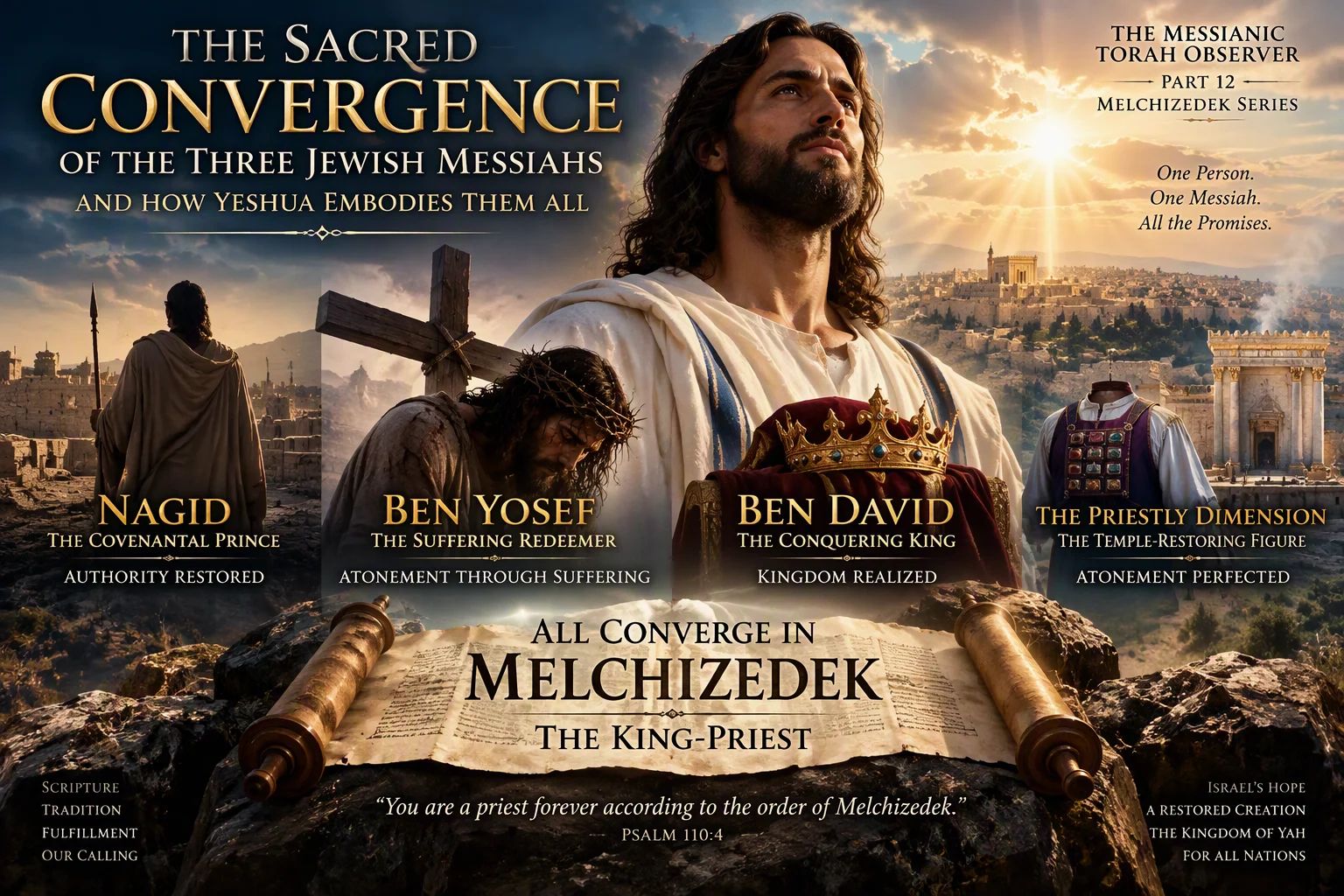
Greetings, Saints of the Most High Ahlohim. Beloved, in this installment I invite us to gather the prophetic threads and consider the fullness of our glorious Master, Yeshua HaMashiyach. My central argument is that the Covenantal Prince, the suffering Redeemer, and the righteous Davidic King illuminate complementary dimensions of His mission. Alongside those three profiles, I consider the priestly dimension and its convergence in the Melchizedek King-Priest framework. One Person. One Mashiyach. A multifaceted calling. These notes follow my teaching and distinguish my interpretive conclusions from the passages and traditions I reference.
The Gospel of the Kingdom: Restoration, Not Merely a Collection of Titles
What is the destination of these prophetic streams, beloved? In this discussion, I bring them back to the coming Kingdom of Yehovah and the reign of His appointed Son. I frame redemption within the larger hope of restored Creation, righteous governance, the removal of death, and Yah dwelling among His people. My emphasis is not simply on identifying titles, but on understanding the restoration those titles point toward. The opening Scripture readings correspond to Isaiah 25:7–9 and Revelation 21:3–4. The production notes also direct us to Isaiah 9:6–7; 11:1–10; Jeremiah 23:5–6; and Ezekiel 37:24–25.
Mashiyach Nagid: The Covenantal Prince
I begin with the question of authority. Nagid can communicate leader, ruler, prince, chief, or an appointed official, depending on context. The lexical reference cited in my script is Warren Baker and Eugene E. Carpenter, The Complete Word Study Dictionary: Old Testament, page 705. Daniel 9:24–27 supplies the prophetic passage I examine. I distinguish the anointed leader from the coming leader whose people destroy the city and sanctuary; the title itself does not establish the moral character of its bearer. My interpretive emphasis is covenantal leadership: authority that serves Yehovah’s purposes rather than exploitation or oppression. In my convergence framework, Nagid supplies the princely dimension, while the Melchizedek pattern brings kingship and priesthood together.
The Priestly Dimension: A Necessary Part of the Picture
Beloved, I organize this episode around three named profiles, but I also discuss the expectation of priestly restoration. The resulting four functions are princely authority, redemptive suffering, Davidic kingship, and priestly ministry. My aim is not to claim that every Jewish tradition holds an identical classification. I consider the priestly dimension in connection with atonement, purification, the sanctuary, and Yehovah’s presence among His people. Sources named in the script include the Community Rule, 1QS 9:11; the Rule of the Congregation, 1QSa; and an attribution to Targum Jonathan on Zechariah 4:14. The precise Targum wording and attribution require source checking before being repeated as a verified quotation. Within my teaching, this priestly dimension finds its unifying home in the Melchizedek King-Priest framework.
Mashiyach ben Yosef and Mashiyach ben David: Suffering and Righteous Reign
I revisit Mashiyach ben Yosef as the suffering-deliverer profile explored in Part 10. In my presentation, this figure confronts Israel’s enemies, suffers, is expected to die, and prepares the way for redemption. I then return to Mashiyach ben David as the righteous King who gathers the exiles, restores the kingdom, and establishes justice. The distinction matters: suffering and reigning glory need not be competing portraits within my reading of Yeshua’s mission. I see His suffering, obedience, exaltation, and anticipated reign as connected dimensions of that mission. Hebrews 1:3 is explicitly cited in the script’s discussion of His exaltation. Additional passages listed for study include Psalm 22; Isaiah 52:13–53:12; Zechariah 12:10; 2 Samuel 7:12–16; Luke 1:32–33; Acts 2:29–36; and Romans 1:3–4. Sukkah 52a is among the Jewish sources listed in the production notes.
Melchizedek: The King-Priest and the Convergence in Yeshua
Here is the heart of my discussion, beloved. Melchizedek is presented as king of Salem and priest of El Elyon in Genesis 14:18–20. Psalm 110:1–4 supplies the enthronement and enduring-priesthood language at the center of this series. I approach Melchizedek as the prototype and Yeshua as the fulfillment of that King-Priest pattern. In my framework, Nagid illuminates restored authority; ben Yosef illuminates redemptive suffering; ben David illuminates righteous kingship; and the priestly dimension illuminates atonement and intercession. The production notes direct us to Hebrews 4:14–16; 5:5–10; 7; and 9 for further examination. My next planned installment will take up the writer of Hebrews’ perspective more directly.
Three Honest Objections: An Invitation to Read Carefully
Must Mashiyach rebuild the Temple? I acknowledge the expectation cited from Maimonides, Mishneh Torah, Hilchot Melachim 11–12. My answer distinguishes redemption already inaugurated from restoration not yet consummated. I also distinguish the present sanctuary and living-Temple themes from the future restoration question. I personally believe Yeshua will oversee a restored Yerushalayim Mikdash, but I explicitly acknowledge that I cannot emphatically prove that particular conclusion from Scripture. Acts 3:19–21 is the restoration passage quoted in this portion of the script. I also reference Ephesians 1:10; Colossians 1:20; Revelation 21; Isaiah 65; Matthew 19:28; Romans 8:21; Isaiah 25:8; and Isaiah 11. These passages form the script’s wider restoration discussion; they should not be treated as identical statements about a rebuilt earthly Temple.
Must Mashiyach bring universal peace? Yes, the promise of peace and righteousness is part of the prophetic hope I discuss. Yet the continuing brokenness of the world prompts an honest question about fulfillment. My response is the Kingdom that is already, but not yet: inaugurated redemption is real, while its full public consummation remains ahead. I use the Exodus and wilderness journey as an illustration of deliverance experienced before the fullness of rest. In my reading, Yeshua’s first coming and anticipated return connect suffering with reigning glory. Isaiah 11:1–10 is a principal passage for the peace and restored-Creation imagery in this discussion.
Does Isaiah 53 refer to Israel rather than Mashiyach? I acknowledge the collective-Israel interpretation and explain why I also consider an individual Messianic reading. My discussion brings Isaiah 52:13–53:12 alongside Psalm 22, Zechariah 12:10, the story of Yosef, and Yeshua’s suffering. I name Targum Jonathan, Sanhedrin 98b, and Rabbi Moshe Cohen ibn Crispin as references in the interpretive discussion. For reference accuracy, Sanhedrin 98b belongs to the Babylonian Talmud, not the Mishnah; the passage range ends at Isaiah 53:12, not 53:13. The precise wording and interpretive scope of the Targum and ibn Crispin references still require checking against identified editions. My conclusion is an invitation to examine the texts carefully, not to treat honest questions as enemies of faith.
Questions for Personal Study and Fellowship
- When I consider Yeshua, do I give adequate attention to authority, suffering, kingship, and priestly ministry—or emphasize one while overlooking the others?
- What does Daniel 9:24–27 actually say, and where does my interpretation begin?
- How do Genesis 14:18–20 and Psalm 110:1–4 inform my understanding of the King-Priest pattern?
- How does the Gospel of the Kingdom connect personal redemption with the restoration of Creation?
- Can I distinguish a promise already inaugurated from a promise not yet brought to fullness?
- Am I careful to distinguish Scriptural statements, historical traditions, and personal convictions when discussing Temple restoration?
- How can I approach differing readings of Isaiah 53 with conviction and respect, while examining each source in context?
Complete Scripture Reference Guide
Beloved, the following guide gathers the passages explicitly named or quoted in the script together with those supplied in its production notes. Listing a passage here does not mean I expounded every verse in the episode. Unnumbered Scripture quotations have been identified where their passage correspondence is clear; wider chapter references remain as supplied.
Tanakh: Genesis 14:18–20; 49:10; Leviticus 8:12; 16; Deuteronomy 6:4; 18:15; 1 Samuel 16:13; 2 Samuel 7:12–16; Psalm 22; 110:1–4; Daniel 9:24–27; Isaiah 9:6–7; 11:1–10 (the wider chapter is also named); 25:7–9 (including the separately cited 25:8); 52:13–53:12; 61:1–2; 65 (with verses 17 and the new-Creation theme highlighted in the script); Jeremiah 23:5–6; Ezekiel 37:24–25; Micah 5:2; Zechariah 4:14; 9:9; 12:10. The narrative of Yosef is invoked without a specific chapter-and-verse citation.
Brit Hadasha: Matthew 1:1–17; 3:16–17; 19:28; 21:1–11; 26–28; Luke 1:32–33; 3:23–38; 4:18–21; 24:27, 32; John 17; 19:23; Acts 2:29–36; 3:19–21; Romans 1:3–4; 8:21; Ephesians 1:10; Colossians 1:20; Hebrews 1:3; 4:14–16; 5:5–10; 7; 9; Revelation 21 (especially 21:3–5). The living-Temple theme is discussed without a specific verse citation in that paragraph of the script.
Jewish, Second Temple, and Lexical References
- Community Rule, 1QS 9:11: Listed in the production notes and referenced in the priestly and royal expectation discussion.
- Rule of the Congregation, 1QSa: Referenced with the Community Rule; the script does not supply a more precise passage locator.
- 11QMelchizedek, 11Q13: Included in the production notes for the wider Melchizedek study.
- Targum Jonathan on Zechariah 4:14: An attribution made in the script. The proposed identification and quotation should be verified against an identified text before publication as a direct quotation.
- Targum Jonathan on Isaiah 52:13–53:12: Named in the Isaiah 53 discussion and production notes. The wording and scope of its Messianic interpretation have not been independently verified for these notes.
- Babylonian Talmud, Sanhedrin 98a–99a, especially 98b: Listed in the production notes; 98b is specifically invoked in the discussion of a suffering or wounded Messiah.
- Babylonian Talmud, Sukkah 52a: Listed among the Jewish references for the wider Messianic-profile discussion.
- Maimonides, Mishneh Torah, Hilchot Melachim 11–12: Cited in connection with expected Messianic works, including Temple restoration.
- Rabbi Moshe Cohen ibn Crispin, commentary on Isaiah 53: Named in the script. No edition, translator, page number, or full bibliographic identification is supplied.
- Warren Baker and Eugene E. Carpenter, The Complete Word Study Dictionary: Old Testament (Chattanooga, TN: AMG Publishers, 2003), p. 705: The lexical source cited for nagid. Lexical reference supplied in the script.
Selected Modern Works Listed in the Script
- Michael L. Brown, Answering Jewish Objections to Jesus, volumes 2 and 3.
- Alfred Edersheim, The Life and Times of Jesus the Messiah.
- Raphael Patai, The Messiah Texts.
- David H. Stern, Jewish New Testament Commentary.
- James C. VanderKam, The Dead Sea Scrolls Today.
These works are reproduced from the script’s selected-reading list. The script does not provide edition details or page-specific citations for them, so I have not invented those particulars or attributed specific statements to unverified pages.
Companion Episodes and Ministry Contact
- The Suffering Warrior: Unveiling Judah’s Mashiyach ben Joseph and the Messianic Mystery — Part 10.
- Mashiach ben David: How Yeshua Fulfills the Royal, Suffering, and Priestly Messiah. The opening of this script identifies the preceding ben David discussion as Part 11; a later paragraph labels it Part 10. The original script has been left unchanged.
- Questions and fellowship: notasyouperceive@gmail.com.
Beloved, thank you for taking this journey with me. My prayer is that this discussion encourages us to search the Scriptures, consider the fullness of Yeshua’s calling, and deepen our covenant walk with Yehovah. Let us gather the threads with care, humility, and conviction. Shabbat shalom, Shavuatov, and until next time, take care, Saints in Training.
Understanding our Melchizedekian Priestly Pedigree-Part 2 : Abram’s Melchizedek
This is "Understanding our Melchizedekian Priestly Pedigree Part 2: Avram’s Melchizedek.” Rehash of Part 1: The Royal Priesthood: Exploring the Historical, Spiritual, and Eschatological Roles of Melchizedek - Part 1 In part one of this...
Divine Judgment and Mercy and Righteousness: The Story of Sodom and Lot – Thoughts and Reflections on Torah Reading 16
Lot’s Privileged Life in Sodom Lot, Abraham's nephew, sits at Sodom's gate (19:1). What is the significance of Lot being seated at Sodom's gate? It’s likely that Avraham’s victory over Chedorlaomer’s and three other powerful Mesopotamian kings’ assault on the city...
Unveiling the Truth-Yeshua’s Prohibition Against Titles in Matthew 23:8-12-Part 2
Greetings and Introduction Greetings saints of the Most High. Welcome to another installment of the Messianic Torah Observer. Rod Thomas coming to you on a beautifully mild Preparation Day here in the DFW. Thank you for taking the time out of your busy schedules to...
Living in Yah’s Presence: The Call to Holistic Righteousness
Greetings and Shalom to you saints of the Most High. I went through some of this past Sabbath’s Torah Reading (i.e. Torah Reading 14 of Yah’s 3-year Torah Reading Cycle). And in my reading of this parshah, I became captivated by just the first three-verses of the...
Unveiling the Truth-Yeshua’s Prohibition Against Titles in Matthew 23:8-12-Part 1
Introduction Greetings saints of the Most High. Welcome to another installment of the Messianic Torah Observer. Rod Thomas coming to you on a gorgeous winter Preparation Day here in the DFW. Thank you for taking the time out of your busy schedules to fellowship...
The Ineffable Name Controversy — Breaking Traditions: The Controversy of God’s Name
The Ineffable Name Controversy: Breaking Traditions and Unveiling Truth Introduction: In the realm of faith, the Name of Yehovah holds profound significance. However, the tradition of not uttering or writing this sacred name has sparked controversy and debate. This...
The Royal Priesthood: Exploring the Historical, Spiritual, and Eschatological Roles of Melchizedek-Part 1
The Royal Priesthood: Exploring the Historical, Spiritual, and Eschatological Roles of Melchizedek - Part 1 Greetings, saints of the Most High! Welcome to another installment of the Messianic Torah Observer. I'm Rod Thomas, coming to you on a wintry Preparation Day in...
Exploring the Historical and Theological Aspects of Noahide Laws – Part 2
Exploring the Historical and Theological Aspects of Noahide Laws - Part 2 Greetings, saints of the Most High! Welcome to another installment of the Messianic Torah Observer. Today, we delve into the second part of our discussion on the Noahide Laws, a concept...
Trusting in the Divine Plan-The Significance of Avraham’s Covenant with Yehovah — Thoughts and Reflections on Torah Reading 10
Greetings, saints of the Most High! Welcome to another installment of the Messianic Torah Observer. I'm Rod Thomas, coming to you on a very dreary Preparation Day in the DFW. Thank you for taking the time out of your busy schedules to fellowship with me. As always, it...
Noahide Laws-A Historical and Theological Exploration Part 1
Greetings, saints of the Most High! Welcome to another installment of the Messianic Torah Observer. Today, we delve into the fascinating topic of the Noahide Laws, exploring their origins, development, and implications for both Jews and Gentiles. Introduction to...