No Results Found
The page you requested could not be found. Try refining your search, or use the navigation above to locate the post.
This is “First-Timothy—Paul’s Inconsistencies—Myths-Tales-Torah—Part-13 of the Paul and Hebrew Roots Series.”ng Part 12—Is 1 Timothy 2:9-15 Internally Consistent?
Donna Howell in her landmark book on the subject of un-silencing women of Faith (i.e., “The Handmaiden’s Conspiracy), points to “internal consistency” as the basis upon which the true purpose and content of 1 Timothy was written. Therefore, by Ms. Howell pointing to the existence of “internal consistency” in Paul’s writings, she is saying that one must give full respect and acceptance to a presumption that Paul was not contradicting himself at any point in his letter.

1 Timothy is about Torah teaching and the myths, tales and Jewish Gnosticism that threatened that teaching.
Internal consistency is a commonly accepted concept in nominal-Christianity. It is the accepted belief that there are no inconsistencies or contradictions in the content of Paul’s first-letter to Timothy. This concept would, of course, apply to all the other Pauline writings as well.
In general, biblical internal consistency, according to Wikipedia, is about the coherence and textual integrity of the bible. The Wikipedia article contends that [perceived] biblical inconsistencies or contradictions have the great potential of challenging one’s belief in the integrity of scripture. Such [perceived] inconsistencies therefore cast doubts that certain books of the bible are truly inspired. This is one of the reasons some question Paul’s writings. These see the perceived lack or absence of internal consistency in some of his letters as a basis to question the authenticity of his writings.
In a sense, throughout this series, we have touched upon internal consistency as it relates to Paul’s writings. We have looked specifically at the perceived understanding that Paul did not support women holding leadership positions in the Body of Messiah in some portions of his writings, while in other places he extolled the virtues and works of many women leaders in the various assemblies that he oversaw. These women, if you will recall, included the likes of Phoebe; Junia; Priscilla; Lydia; Synthyche, Euodia, and Tabitha to name a few.
This obvious inconsistency is explained away by those who hold to a belief in Paul’s body of writings being internally consistent with desperate claims that the women leaders under Paul’s oversight were exceptions to Paul’s rules that prohibited women from teaching, preaching, leading corporate prayer and prophesying in the Assemblies of Messiah.
Do I believe the bible is internally consistent? Well, yes and no. It depends. I would say in most places yes. In other places, I would say not so much. Allow me to explain.
I take somewhat of an opposing position to that of Donna Howell that our focus passage of 1 Timothy 2:9-15 is internally consistent with the whole of 1 Timothy as well as with the whole Pauline canon of writings. As I see it, 1 Timothy 2:9-15, when read in the overwhelming majority of English renderings, is internally inconsistent with the rest of 1 Timothy.

Donna Howell’s The Handmaiden’s Conspiracy highlights the erroneous understanding many have of 1 Timothy 2:9-15, resulting in the silencing of women of Faith.
Think about what we have looked at regarding this focus passage: Paul is confronting Jewish Gnosticism in the Ephesian Assemblies and he sends his young apprentice Timothy to Ephesus to take care of the problem. In so doing, Paul sends Timothy this letter of encouragement with explicit instructions on how he (Paul) wanted Timothy to confront the Gnostic problem.
So 1 Timothy goes along just fine for the first chapter and eight verses. However, just as we witnessed in 1 Corinthians 14, out of nowhere, in 1 Timothy 2:9, after having instructed Timothy to have the men pray in their assemblies for all people lifting up holy hands, Paul brings up women specific issues. And instead of discussing women from the perspective of consistency with the previous content of his letter, he launches into a discussion on their dress; their appearance; their deportment; their learning of Torah; their teaching of Torah and the Gospel; their authority over men—presumably in the capacity of teaching in the assemblies; and their place in the natural, creative order.
So if we are honest with ourselves and we look at this thing from a Truth-seeking perspective, we are forced into asking ourselves (and by default asking Paul posthumously) what he is really addressing in his letter to Timothy.
Let’s look at this inconsistency in the text for clarification sake:
“(8) I desire then that in every place the men should pray, lifting holy hands without anger or quarreling…(9) likewise also that women should adorn themselves in respectable apparel, with modesty and self-control, not with braided hair and gold or pearls or costly attire…” (1 Timothy 2:8, 9; ESV).
Thus, according to a plain read of these two-verses, Paul is writing Timothy expressing his desire for the “men” (i.e., the “aner” according to the Greek, specific to males) in “every place” (presumably in every assembly gathering in Ephesus) engage in corporate prayer. And the prayers that Paul desired the men of the assemblies engage in would not be defiled by anger or quarreling.
The stated “anger and quarrels” appear to have been brought on by disagreements over unstated things. Those unstated things were likely the false teachers and their false teachings. Regarding those false teachings, Paul wrote in 1:3 and 4:
“[they] promoted speculations (ie., the Greek being “zetesis;” referring to matters of controversy or debate) rather than stewardship (ie., the Greek being “oikodomia;” that is Godly edifying and building up of the Body) from YHVH that is by faith” (ESV).
Then out of nowhere Paul brings up the whole issue of women’s appearance, attire and deportment.
What is happening here? Did Paul inadvertently leave out something that would connect verse 8 to verses 9 and 10, that would explain why he chose to slam the Ephesian assembly women’s appearance and deportment at this point in his letter? Where is the so-called internal consistency that Pauline scholars contend exists?
Moreover, if that weren’t enough, why Paul launch into what appears to be restrictions on Ephesian assembly women learning of Torah and prohibitions against women teachers (and presumably preaching) in verses 11 and 12?
I contend that “internal consistency” must not be presumed in any of Paul’s writings. To presume and accept that Paul’s writings are internally and externally consistent without committing one’s self to deep study and truth searching, in my mind, potentially leads one to misinterpret some of Paul’s most difficult to understand writings.
It is not that Paul’s writings are internally inconsistent in places. I believe the problem rests with the writer himself. For we a case of a hard-to-read; hard to understand; and often impossible to accurately interpret, writer. We talked at length in the first two to three installments of this series about the man and his work; that he was a brilliant former pharisee, Jewish apologist, and Torah scholar. Moreover, I will add to this portrait of the man Paul, that he was a gifted writer who had a tendency of leaving some vitally important information out of his writings.
Consequently, it is this nagging tendency of Paul leaving important information out of his writings that has led us to the place we are today. And because important elements and issues are left out of his writings, many of us are inclined to blindly accept what is written and not seek to fill in the missing pieces which comes only through intense research and contextual studies.
Never let us forget that it was the Apostle Peter who wrote of Paul:
“And count the patience of our Lord as salvation, just as our beloved brother Paul wrote to you according to the wisdom given him, as he does in all his letters when he speaks in them of these matters. There are some things in them that are hard to understand, which the ignorant and unstable twist to their own destruction, as they do the other Scriptures” (2 Pet. 3:15, 16; ESV).
Questioning what is printed on the pages of our bibles is never a bad thing. Questioning that which is printed on the pages of our bibles becomes a bad thing, however, when our hearts are not right; when our intent is to ignore the contextual and obvious scriptural Truth (i.e., keep God’s commandments; love one another; etc.) that is contained therein.
So, I assert that it is this blind acceptance of biblical internal consistency, that has been tempered with certain established male-dominated Church doctrines and traditions that has led many within and without our Faith to buy into lies and false teachings that women cannot serve as leaders in the Body of Messiah.
And I believe it is the rare, pure of heart truth-seeker who is able to clearly identify those apparent “inconsistencies” in many of Paul’s letters and cause us to consider whether we’re dealing with “Truth” or “tradition” in our understanding of key Pauline texts.
Now, allow me do an about face here and assert that there is an internal consistency associated with Scripture. But that consistency is found only in the original autographs or manuscripts of the books of the bible, and in the Spirit-led intentions of the original writers of scripture.
I believe Paul’s writing style and the questionable hearts and works of various translators, scribes, scholars and teachers all worked together to bring us to where we are today in our discussion of Paul’s most difficult to understand works. Thus to me, it is not a question of 1 Timothy’s genuineness nor of contradictions in Paul’s writings. For it all points back to Paul’s writing style and his Spirit-led intent. His writing style is difficult in that he left out key information. And his Spirit-led intent is clearly spelled out in the first chapter and a half of 1 Timothy.
What we will find as we continue on in our study of verses 9-15 of 1 Timothy 2 is that our focus passage has little to nothing to do with women roles in the so-called “church.” For what we have in these 7-verses is more of a laundry list of proper-behavior and applied conduct intended to restore some semblance of order to the Ephesian assemblies.
The cause for the disorder was false teachers and their false teachings. Let us keep this fundamental element to this story at forefront of our minds. Furthermore, we must give some attention to prevailing Ephesian cultural and religious influences as part of the reason Paul called out the women of the assemblies on their attire, appearance and behavior. Recall that we addressed this very thing in our previous installment to this series.
In case you don’t have the time right now to read or listen to Part 12 of this series but you just want to continue on with our present discussion, allow me to quickly summarize 1 Timothy 2:9 and 10 for you.
The CEB translation of these verses reads as follows:
“In the same way, I want women to enhance their appearance with clothing that is modest and sensible, not with elaborate hairstyles, gold, pearls, or expensive clothes. They should make themselves attractive by doing good, which is appropriate for women who claim to honor God.”
Bottom line: verses 9 and 10 are Pauline instructions that the Ephesian women dress and carry themselves in a Godly manner (vss. 9, 10; CEB).
However, this admonishment of women moderating their appearance and deportment was to dissuade them from mimicking the fashion styles and behaviors of secular Ephesian women—in particular the flamboyant Artemis/Diana Temple prostitutes. Either-wise referred to as “bees,” this class of women had significant fashion and deportment influence throughout Ephesus.
Paul’s admonishments regarding the Ephesian women’s attire and deportment in the text were preceded by the Greek phrase–“houstos kai,” which we translate in English to mean “in the same way” or “in like manner.”
The phrase “houstos kai” demands we step back a verse or two prior to verse 9 to find out what the women are supposed to do in the same way or in like manner. And we came to understand that by our going all the way back to verse one of chapter two that Paul was encouraging the men of the Ephesian Assemblies to pray publicly for all people throughout the known world without anger or quarreling. Thus, the “like manner” that Paul prefaces his attire and deportment instructions to, must reasonably be linked to Paul’s instructions to the men of the assemblies to pray. In other words, Paul was telling the women to also pray publicly, in their assemblies, for people every–just like their Ephesian male counterparts. However, in his admonishing the women to involve themselves in public assembly prayer, he proceeds to admonish them in regards to their attire and behavior.
Now, having said all this, I want to take us into a rather controversial realm understanding whereby we ask the question:
The one safe way to look at this passage is for us to look at it from a “cause and effect” perspective. What I mean by this is that Paul did not just wake up one day and decide to write a letter to Timothy for the purposes of picking on the Ephesian Assembly women. Given what we already know about Paul’s admiration for certain female leaders of his evangelistic team, one is forced to question why he would lash out, so to speak, at the Ephesian Assembly women’s appearance.
Now, we have discussed the background and likely reason to these seeming hits on the women of the Ephesian and Corinthian assemblies. And the reasons we came up with in both cases were in response to a “cause;” that is, something that prompted Paul to address the women of both assemblies in the manner in which he did.
Given Paul’s lofty position in the Body of Messiah during that time, and given the high-stakes that would be at play whenever he wrote or spoke to assembly members throughout the Roman Empire, it makes logical sense that Paul was responding to something that he felt needed to be addressed in the Ephesian Assemblies. It is an almost certainty that Paul was not writing to Timothy to share some unbridled misogynistic viewpoints about women that he happened to have tucked away in his conscience.
Having a “cause and effect” mindset is crucial to our being able to interpret and understand many of Paul’s most challenging writings. In other words, instead of just reading over those difficult passages and accepting the plain English-language rendering of his difficult passages, it is imperative that we ask ourselves: why did, or why would Paul write such a thing? What thing(s) or what issue(s) or what circumstance(s) prompted Paul to write what he wrote.
Let us not be snookered into thinking that Paul wrote the things he wrote in a vacuum. Paul received data or questions from various sources related to certain issues ongoing in the assemblies he oversaw. And he responded to that data and answered those questions accordingly, just as any experienced and competent administrator would do in his/her running of an organization.
Dr. Eddie L. Hyatt, in his book entitled, “Paul, Women and Church,” seems to agree with this logical approach to understanding Paul’s writings. Hyatt presumes that our focus passage (ie., 1 Timothy 2:9-12) is (1) “addressing a specific situation in Ephesus that is having a particular effect on the women” of the assembly; and (2) “he may also be addressing a particular woman (who may be representative of a company of women) who is propagating the “other doctrine” about which he is so concerned” (pg. 91).

In his book Paul, Women and Church, Dr. Hyatt comments extensively on Lydia and the Macedonian female Faith leaders.
Now, to me, Hyatt’s first presumption is obvious. However, his second presumption is most fascinating and something that I do not believe we should overlook or dismiss, despite possible conflicts with convention.
Nevertheless, Dr. Hyatt’s suggestion that Paul was addressing a specific woman is, in my opinion, not only fascinating, but also controversial and speculative. For nowhere do we find mention by name this supposed “particular woman.” And we know that Paul does not seem overtly opposed to naming names in some of his writings, as he did in another part of this letter and in a later letter to Timothy where he singles out individuals by name, such as Hymenaeus, Alexander, and Philetus (1 Tim. 1:20; 2 Tim. 2:17).
Beyond these stated individuals, Paul in his 1 Timothy letter is pretty general in his addressees, sticking simply to general descriptors and terms when addressing specific topics of discussion. Nevertheless, it would not be beyond the realm of possibility that Paul is in fact addressing a specific woman in our focus passage.
Indeed, it is possible that Paul simply did not know the name of the specific woman in question, or that he simply wanted to spare the woman in question embarrassment by keeping her name out of the conversation. It is impossible to be certain either way.
It is extremely difficult to get past the English translations’ conventional use of “women” (plural) in virtually all English Bible translations of verses 9 and 11).
In my BibleWorks software compilation of some 20-English translations (there are others, but I’ve chosen 20 English translations for my desktop workspace), every single translation of verse 9 uses the term “women” as opposed to “woman.”
In looking further into the Koine Greek term used for “woman” or “women,” which is “gune-aikos,” the common definition in the handful of Greek-English Lexicons I referenced is that of “a woman of any age, whether a virgin, or married, or a widow; a wife or betrothed woman; an adult female person of marriageable age; as a form of address in speaking politely to a female person” (Louw-Nida Lexicon). Consequently, the lexicons do not discern between the term being plural or singular, which suggests to me that the Greek term was used in both the plural and singular sense and it was up to the receiver to discern the context therein.
So, it may be difficult to agree to Dr. Hyatt’s assertion that Paul is addressing a specific, unnamed woman in verses 9 and 10 just by simple assertion. However, verses 11 and 12 in my opinion provide him the greatest support for his “single woman” contention.
The passage reads:
“Let THE woman learn in silence with all subjection. But I suffer not a woman to teach, nor to usurp authority over the man, but to be in silence” (KJV).
Interestingly, only the Douay-Rheims translation of verse 11 is the only other English Bible translation I’ve come across, beside the KJV, that uses the phrase, “Let THE woman learn…” Otherwise, all the other English translations seem to stick to women in general.
So what we have in verse 12 in light of Dr. Hyatt’s contention is what appears to be Paul making a command decision to restrict THE woman’s (i.e., the woman in question) teaching at that particular time.
The verse reads “I do not permit,” which is a present tense phrase in the Greek denoting “I am not permitting at this time” (ibn; pg. 9) this particular woman to teach. Or if we put aside Hyatt’s “the single woman” assertion, but rather stick to the convention that Paul is addressing all the Ephesian assembly women, Paul would be saying “I am not permitting, at this time, the Ephesian assembly women to teach.”
If this is indeed the case: that Paul is placing a temporary moratorium on this one woman’s teaching practices, then his prohibition is not gender-focused. In other words, Paul’s concern, based upon the premise of the letter, was not the woman’s sex, but the content of her teaching. And it would be because of her teachings that from that point forward, she would not be permitted to teach in the Ephesian Assembly; at least not until she changed course; got some learning and understanding under her belt; and showed true competence in her ability to teach the Word of Truth.
Now, none of this is to say that the women of Ephesus were the only ones passing on false doctrine to the assemblies. The men were equally participatory in this spiritual crime. Let us not overlook two men who Paul named as being especially active in disseminating false teachings—Hymenaeus and Alexander. Paul describes these two men as “having rejected faith and a good conscience;” and in so doing made a “shipwreck” of the Faith in the assemblies (ibn; pg. 92; 1 Tim. 1:19, 20). So damaging was the work of these two men that Paul informed Timothy:
“…I have delivered unto Satan (ie., Hymenaeus and Alexander) that they may learn not to blaspheme” (1:19, 20).
Whoever this female false teacher may have been (assuming Hyatt is correct in his contention), it stands to reason, at least in Paul’s mind , that she had not been given the opportunity to learn the Truth. Thus, in our cause and effect filtering of Paul’s writings, it became Paul’s instruction to Timothy that “the woman learn in silence with all submission” (2:11).
If this is indeed true about the single woman being put into a “teaching time out” (so to speak) because she had not been afforded the opportunity to learn the Truth, Paul’s instruction that she be afforded the opportunity learn showed forth the special love and admiration he had for the women of the assemblies of Messiah.
This all being the case, in bringing this issue of women being temporarily barred from teaching in the Ephesian assembles because they’d not been properly taught, it would seem reasonable to conclude that the two-men condemned by Paul to hasatan knew the full Truth (that is they had been formerly trained or taught) and that they had willfully abandoned that Truth for the lie of Jewish Gnosticism or the fusing of paganism with Torah and or the True Faith.
Paul had no pity for these two men. On the other hand, however, it seems Paul sympathized with the knowledge deficient women or the woman of Ephesus. Thus, Paul lovingly sought to give the women—or the woman—the opportunity to learn the Truth.
Myths as Part of the Ephesian Problem
Before digging deeper into our focus passage, we must first touch briefly upon these “myths” that were being spread around by various individuals in the Ephesian Assemblies. The responsible person could possibly have been “the woman” that Dr. Eddie Hyatt alluded to in his discussion of our focus passage. Unfortunately, we just don’t know the full extent of the players associated with the stated proliferation of myths in the Ephesian assemblies.
These myths were no doubt linked or associated with the twisting of Torah to a greater or lesser extent. The problem associated with the proliferation of these myths in and through the Ephesian assemblies was that they had the tendency of diverting the hearers from the Truth (Richard and Catherine Kroeger; “I Suffer Not a Woman”).
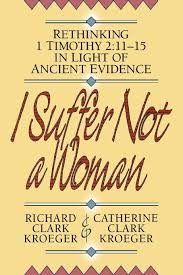
Richard and Catherine Kroeger meticulously examine in their book the various Gnostic and mythological influences adversely affecting the Ephesian Assemblies.
It is easy to conflate myths and Gnosticism. And as possible as it may have been for the Jewish Gnosticism and the Jewish Myths that Paul and Timothy were combating to have been one and the same things, it’s a better than average chance that they were actually two separate issues.
Paul singled out Gnosticism in his letter:
“O Timothy, guard the deposit entrusted to you. Avoid the irreverent babble and contradictions of what is falsely called “knowledge (gnosis=science in KJV)” (1 Tim. 6:20; ESV).
However in 1 Timothy 1:3-7 instruction Timothy regarding myths:
“They (i.e., members of the Ephesian Assembly) shouldn’t pay attention to myths and endless genealogies. Their teaching only causes useless guessing games instead of faithfulness to God’s way of doing things” (CEB).
The Cretan Assemblies were undergoing a similar problem and Paul writes in Titus 1:14:
“They (i.e., members of the assembly) shouldn’t pay attention to Jewish myths and commands from people who reject the Truth” (CEB).
What do we know about Jewish myths at the time of Paul? The mythologizing of the “Creation and Fall” stories were in wide circulation in the first century C.E. Obviously, these myths worked hand-in-hand with the whole Jewish Gnosticism that had also taken hold in Ephesus, likely prior to the establishment of the assemblies there.
It is evident in other portions of Paul’s letter that some in the Ephesian Assembly forbade marriage (1 Tim. 4:3). Paul, in trying to work through the obvious problems associated with his opponents’ position on marriage, insisted that the younger widows of the assemblies—choice prey for these bootleg women passing on their myths and tales door-to-door—”marry, bear children, rule the household and give no opportunity for slander to the opponent” (1 Tim. 5:14; Kroegers).
Indeed, there is a companion passage in Titus where Paul instructed the older Cretan assembly women to encourage the young women of the assembly to give themselves over to domestic responsibilities “so that the Word of God would not be slandered” (Tit. 2:2-5; ibn; 172). These were slandered through the application of ongoing myths and tales.
Opposition to Moshe
Mention is made of Jannes and Jambres in the Timothy letter. Allegedly, these two Egyptian magicians opposed Moshe before Pharaoh. (Exo. 7:9-13). According to the Kroegers, Jannes and Jambres were considered“magicians par excellence” in both pagan and Jewish sources (ibn; 63). In fact, Pliny the Elder (i.e., a first-century Roman author, naturalist and philosopher and friend of Roman Emperor Vespasian) made notes in his writings of a certain Jewish sect that practiced magic and believed itself as having actually originated from Moses and Jannes (Pliny the Elder Natural History 30.2.11 (ibn; 63)).
Paul counsels Timothy to have nothing to do with these individuals who were perpetrating myths—who twisted Torah and Tanakh stories into tales that warped the Truth of God’s Word:
“But stay away from the Godless myths that are passed down from the older women. Train yourself for a holy life” (1 Tim. 4:7; CSB).
Richard and Cagthleen Kroeger point out that many English translations of this verse purposely leave out “from the older women,” which in the Greek is “graodeis,” an adjective (normal accusative masculine plural) that is characteristic of elderly women (ibn; 64).
The Kroegers go on to explain that in the ancient near east, certain older women were renowned for their storytelling acumen or talents. At times, the stories they told “put the gods in outrageous light” (ibn; 64). These kept alive the myths of old and these myths were described as “bebelos;” that is, they were opposed to God (ref. 1 Tim. 4:7). Yet most translators in their English translations downplay the significant threat these myths or tales posed to the Faith. Yet we can see clear evidence in these Pauline Pastorals that Paul took these tales or myths quite seriously.
The Overall Involvement of Women in the Poliferation of Myths in Ephesus
Sadly, certain Ephesian women—or in Dr. Eddie Hyatt’s thinking a particular woman—were behind the proliferation of myths in the assemblies.
Regarding women being behind the scourge of Jewish myths in the Ephesian assemblies Paul wrote:
“But refuse to enroll younger widows, for when they are drawn away from Christ by desire, they want to marry and will therefore receive condemnation because they have renounced their original pledge. At the same time, they also learn to be idle, going from house to house; they are not only idle, but are also gossips and busybodies, saying things they should not say. Therefore, I want younger women to marry, have children, manage their households, and give the adversary no opportunity to accuse us. For some have already turned away to follow Satan” (1 Tim. 5:11-15; CSB).
It seems obvious that for the most part women or a particular woman was behind the destructive heresies, false teachings and spreading of tales and myths in Ephesus, supposedly spreading them house-to-house. The Kroegers suggests (which I think is a good call on their part) that many of the homes either these women or the woman visited actually hosted some of the home fellowships or assemblies in that region (ibn; 62).
This being the case, of course, made the spreading of these myths and tales existential threats to the individual assemblies in Ephesus. If you have these women (or the woman) spreading these tales and myths to the unwitting and ignorant hosts of the various home fellowships of Ephesus—and doing so door-to-door–it would not be too much of a stretch to think that on any given Shabbat, the teaching of false doctrines would easily spread through each fellowship and create complete and utter chaos, leading dozens, if not hundreds, astray.
The Kroegers make note of Gordon D. Fee’s work as it relates to these meddlesome women:
“It seems certain from 2:9-15, 5:11-15, and 2 Timothy 3:6, 7 that these [false teachers] have had considerable influence among some women, especially some younger widows, who according to 2 Timothy 3:6,7 have opened their homes to these teachings, and according to 1 Timothy 5:13 have themselves become propagators of the new teachings” (ibn; 61, 62).
An ancient Greek, extra-biblical literary piece—”Menander the Charioteer”—made note of the manner in which the priests of Cybele routinely drew women into their religion by going house-to-house as Paul mentioned above (ibn; 63). Therefore, an extra-biblical piece of literature testifies to that which Paul was writing to Timothy about. Our bible is Truth and we are wise to heed its Truths.
The Kroegers suggests also that some of these “busybody” women–likely satanists–likely involved themselves in the region’s age-old magic cults, which they no doubt blended with Gnosticism. It seems that certain sects of Gnosticism dabbled in the occult and in magic. These busy bodies, according to Paul, were speaking things they should not be saying. Could these unspeakable things be magical incantations or even curses? This is a good question. The blending of myths and Gnosticism with magic would be a most virulent prescription for spiritual disaster, which could have spelled the end of the Ephesian Assembly if Paul did not take the corrective actions he took.
One God and One Mediator
The last thing I’ll mention regarding the dangerous myths and tales that were being spread throughout the Ephesian assemblies by these meddlesome women (or by Hyatt’s lone-woman) is Paul having to reassert to the Ephesian assembly members a central truth of our Faith. That central Truth being that YHVH is the sole Creator of the Universe and Yahoshua is the sole Mediator between God and mankind. This central Truth of Faith seems to have been challenged by the proliferation of these myths and Gnostic teachings and tales in and around the assemblies.
Of course, this should not be at all surprising. For in a region and culture that revered a pantheon of gods and hunreds if not thousands of mediators between the pagan gods and man, Paul understood that it was critical that he set the record straight regarding there being one God (1 Tim. 2:7) and one Mediator between YHVH (i.e., God) and man (i.e., mankind).
Paul wrote:
“There is one God and one mediator between God and humanity, the human Christ Jesus” (CEB).
It appears that certain sects of Gnosticism recognized as many as 365 “celestial beings” who possessed certain ranks in the celestial being order. In at least one sect of Gnosticism, YHVH, being the craftsman of the universe, ranked in the middle of the celestial order (Epiphanius Panarion 33.7.2). And it is with this type pagan-religious foolishness in mind that Paul asserts the Truth of there being one God.
We have to take a step back and revisit the issue of the “hetairai” in order to address the issue of “mediator.” It appears, according to Richard and Catherine Kroeger, that the Diana/Artemis cult had three ranks of priestesses: the honeybees (or postulants); the priestesses; and senior priestesses Kroegers; 71). In fact, images of bees were carved into the statute of Artemis.
It appears that by the first-century C.E., priestesses all but entirely replaced priests in the various pagan religious cults. Thus, women of these cults were viewed as “mediators” of the gods. In fact, women were credited with introducing the mysteries of Dionysius—Greek god of wine and the grape harvest—into the Greek and Roman pantheon (Koegers; pg. 71).
Additionally, we must not overlook the story of the oracles at Delphi, Dodona and Didyma. These oracles, all women, served as the so-called mouthpieces of the gods (ibn; 72). For it was widely accepted throughout the region, “only through them was the will of Zeus and Apollo revealed. For they alone could serve the Fates and Furies” (ibn; 71).
Gnosticism, we have come to learn, placed as much emphasis on women being mediators in their religion . In one Gnostic text we find the following interesting tidbit:
“Peter said to Mary, “Sister, we understand that the Savior loved you more than the rest of the women. Speak to us the words of the Savior which you recollect, those which you know and we do not, nor have we heard them” And Mary answering said, “I shall explain to you what has been hidden from you,” and she began to speak to them” (”the Gospel of Mary 10.1-8; Papyrus Berolinensis 8502.1).
Ultimately, adherents to the Gnostic religion believed that the hidden knowledge could only be revealed to men from woman. Thus, women became the default, defacto mediator between pagan gods and mankind. (Can you now see more clearly the significance of the mention of the Adam and Eve story in 1 Timothy 2:12-15?)
It should be mentioned that in the Gnostic tradition, “Mary of Bethany, Mariamne, the sister of the apostle James, Philoumene, Sophia, and Eve, all served as mediators of truth” (ibn; 72).
These twists to the Truth of God’s word; the meddlesome works of these women (or the woman) going door-to-door peddling myths and tales; the growing Jewish Gnostic threat to the true Faith once delivered, either individually or collectively, played havoc with operation of the Ephesian Assemblies and Paul sent Timothy to reverse this existential threat to the Faith there in Ephesus.
Friends, can you see that the situation as it was on the ground there in Ephesus was no simple matter of women speaking out of turn and trying to take over from men. In fact, it involved so much more. It was indeed a complex set of circumstances, centered primarily upon false teachers and false teachings. However, the false teachers and their teachers were just the tools by which the enemy was waging a spiritual war against the Ephesian Assembly of Messianic Believers. And it would be Paul, through Timothy and the work of the Holy Spirit, who would reverse the enemy’s assault on the people of God there in Ephesus. This is truly a story bigger than life that few people of Faith have actually come to understand in its fullest.
We have a lot more to discuss regarding our focus passage of 1 Timothy 2:9-15. We’ll pick this discussion up in Part 14 as Father wills.
Faithfully
The page you requested could not be found. Try refining your search, or use the navigation above to locate the post.
Why Torah Portion Studies?
The point in Netzarim studying Torah is to understand the mind and heart of the Creator of the Universe. Furthermore, it is to learn about the Creator’s Ways. It has to with living a life of blessings and avoid life’s problems (i.e., curses). Then it’s to learn of and do the things that please Father; to obey His commandments; to stay within Abba’s perfect, eternal will. As well as it’s to gain an understanding of the future Kingdom of God coming soon to an earth near you.
The writer of the Cepher of Hebrews described Torah as
“…having a shadow of the good things to come, although not the actual manifestation of the originals…” (Heb. 10:1).
Therefore, it is up to each of us, each week when we read and study the established passages/portions/readings that we not fall into the trap of simply reading to get through them. That is why I read the week’s portion between the first and second day of the week—prior to that week’s Sabbath reading—so that I can meditate on it for much of that week. Doing so allows the Ruach haKodesh (that is the Holy Spirit) to speak to me and show me the mysteries contained therein. I am then able to apply those elements to my day-to-day walk with Mashiyach (that is Messiah).
Therefore, I encourage you not make an exercise out of studying Torah each week. If you invest your heart, mind and spirit into it, and filter each reading through the teachings and examples of our Master Yahoshua, I promise that your day-to-day walk with Messiah will be greatly improved—enhanced—expanded—made whole. In addition, you shall be blessed.
Deuteronomy 11:26-16:17
“See, I am setting before you today a blessing and a curse: the blessing, if you obey the commandments of YHVH your Elohim, which I command you today, and the curse, if you do not obey YHVH your Elohim, but turn aside from the way that I am commanding you today, to go after other gods that you have not known” (Deu. 11:26-28; ESV).
Thus, we are blessed when we “shama” Torah. We are cursed when we fail to “shama” Torah AND when we turn to other gods.
The Hebrew term “shama” is unique in that it is a triple combination action word: to hear—to listen—and to obey.
To hear—we hear Torah with attention or interest; that is we pay attention; hear critically as one does in a court case.
To listen—we give heed to Torah; we give ear to; we consent or agree to its tenets.
To obey—we consent to the commandments do them.
A diligence that is involved here is different from our simply keeping Torah. It is really a heart thing. Sadly, however, our cousins in Judaism are more diligent to work around Torah than they are to diligently live and walk out Torah to the best of their ability.
Truly, we are talking about a “walking out of Torah” more than anything.
Then Moshe instructs us to be careful to follow all the laws and ruling that he put put before in preparation for possessing the Land of Promise and this instruction was a perpetual command (Deu. 12:1).
In the process of our taking possession of the Land and living therein, Re’eh provided us the example–in my mind, it provides a prescription–whereby we extricate ourselves from the world system and live set-apart lives, wholly and acceptable unto YHVH our Elohim (12:1-14:29).
I believe these principles beautifully apply to us today. Unfortunately, most would not see how Re’ eh applies to us today. Their arguments against such a thing would stem from a belief that idolatry is practiced little in western society today. Others under nominal Christianity’s grace perversion believe we may worship God and live in whatever manner pleases us. Furthermore, since the Law was done away with and we’re no longer live in an agrarian culture, tithing is not applicable today. The other thing is that and we live in the ” Wild-Wild-West” as it relates to teachings, whereby anything and everything goes related to the Word of God.
But what I intend to show you throughout the rest of this post is just how timely Torah Portion Re’eh is and how everything contained therein applies to us even today.
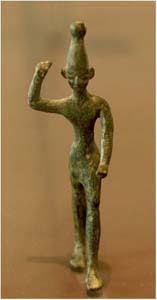
Generally a thing of the past, we should not be fooled that idolatry continues to be practiced by much of the world today.
Indeed, for the most part, idols have been relegated to museums and photographs in textbooks. However, I submit to you that the enemy is extremely cunning. For idolatry continues in the hearts, minds and consciences of most non-believing peoples of the world today. Sadly, most do not realize they are worshiping false gods:
So important was the abolition of idolatry to the early Body of Messiah that James, the Brother of our Master Yahoshua established 4-basic requirements for new converts to be received into the Body of Messiah. Consequently, those 4-basic requirements came straight out of Torah. James stated to those gathered in the Jerusalem Council:
“Therefore, I conclude (this after receiving Paul’s, Barnabas’ and Peter’s testimony before the Council) that we shouldn’t create problems for Gentiles who turn to God. Instead, we should write a letter, telling them to avoid the pollution associated with idols, sexual immorality, eating meat from strangled animals and consuming blood…refuse food offered to idols, blood, the meat from strangled animals, and sexual immorality. You will do well to avoid such things” (Act. 15.19, 20, 29–Jerusalem Council; CEB).
Paul recognized the existential danger to those who held to idolatrous ways:
“Don’t you know that people who are unjust won’t inherit God’s kingdom? Don’t be deceived. Those who are sexually immoral, those who worship false gods, adulterers, both participants in same-sex intercourse…” (1 Cor. 6.9; CEB) .
Paul discussed the wisdom of avoiding foods that were offered to idols in order to not present a stumbling block to others of the Faith–(1 Cor. 8:1-13). In so doing Paul acknowledges that idols in and of themselves are not gods, but simply graven images. However, it’s what they represent that is the problem. For these represent actual, true and living demigods who rule the earth and the heavens.
Thus, Paul instructs the Corinthians–once a hotbed of rampant, unbridled idolatry to: “…flee from idolatry.” He admonishes the Corinthians to set themselves apart from the common social and dietary practices of their community. For in continuing to partake in such anti-Torah behavior, the Corinthian disciples would be giving themselves over to communion with demons (1 Cor. 10.14, 20-22).
Even the Apostle John wrote to His disciples that they guard themselves from idolatry (1 Joh. 5.21).
“But the hour cometh, and now is, when the true worshippers shall worship the Father in spirit and in truth: for the Father seeketh such to worship him. God is a Spirit: and they that worship Him must worship Him in spirit and in truth” (Joh. 4:23, 24; KJV).
Today, our worship of YHVH is vastly different from that of those that went before us. We no longer engage in animal sacrifices. Our offerings are no longer burnt offerings. Instead, our offerings are that of the fruit of our lips as we offer praise and adoration for our God. The writer of Hebrews described it this way:
“Through Him then let us continually offer up a sacrifice of praise to God, that is, the fruit of lips that acknowledge His Name” (Heb. 13:15; ESV).
The Apostle Peter described our worship as “spiritual sacrifices, acceptable to Yah, by Yahoshua Messiah” (1 Pet. 2:5). We render petitions unto YHVH in personal and communal prayers—either in our very own prayer closets or within our group gatherings. Paul described our worship to the Ephesian Assembly Members as “speaking to themselves in psalms and hymns and spiritual songs, singing and making melody in their heart to YHVH; giving thanks always for all things unto YHVH and the Father in the Name of our Master Yeshua Messiah” (Eph. 5:19, 20).
With the sacrifice of Yahoshua haMashiyach and the destruction of the Temple, we no longer are required to journey to Jerusalem to keep the Feasts nor to render unto Him sacrifices. In fact, our set-apart bodies have replaced the Temple and it is our bodies where the Spirit of YHVH resides. Of this, Paul wrote:
“Don’t you know that your body is a temple for the Ruach HaKodesh who lives inside you, whom you received from God? The fact is, you don’t belong to yourselves…” (1 Cor. 6:19; CJB).
The other thing we do besides worshiping our Creator in Spirit and in Truth is that we keep His 7-mandated Feasts, also in Spirit and in Truth. We don’t as I mentioned just a second ago, have to go on over to Jerusalem 3-times a year to keep the Feasts—I guess standing in front of Wailing Wall, which is really a part of a Roman Fort and not Herod’s Temple—as some in our Faith Community shame the unknowing of our Community into doing. If you are led, however, to conduct pilgrimages to Jerusalem to keep the Feasts each year, you should follow the leading of the Ruach in your lives. However, that becomes your specific calling, but it is not a commandment for the Body of Messiah. We keep that of Torah, which we can keep, and we do it to the best of our ability to do so under the guidance of the Ruach HaKodesh. Nevertheless, our Temple is where we stand and who we are in Y’shua Messiah today.
This brings us to the next point.
“And in all things that I have said to you take care; and make no mention of the name of other gods, nor let them be heard out of your mouth” (Exo. 23:13).
In fact in our preparation to take possession of the Land, Yah commanded us:
“And ye shall overthrow their altars (speaking about the idols of the Amorites that were devoted for destruction by us) , and break their pillars, and burn their groves with fire; and ye shall hew down the graven images of their gods, and destroy the names of them out of that place” (Deu. 12:3).
As tempting and especially interesting as inquiring and discovering the things pertaining to the worship of ancient pagan peoples, we are commanded to not do so. I think it is important to know about such things, but we must be cognizant that such studies must have a reasonable limit and not consume our thoughts and attention.
What we have in these seven or so preparatory elements in my opinion was a foretaste—a rudimentary sketch if you will—of the coming Kingdom of YHVH. Although we cannot keep all these elements as they were originally passed down to us, it becomes our responsibility to keep them as our Master described our present day worship practices, in Spirit and in Truth. We examine and sort out those things that we must keep—those normative elements of Torah that directly apply to us as they did to our forefathers—from those that are restrictive—those elements that for whatever reason we can’t keep as originally passed down—and consider how we should live those elements out in the spirit in which they were given.
When we do these things—when we walk out our Faith in such a way—our Faith Community is guaranteed to prosper and we stand as lights to a dark world. Non-believers will be drawn to us and inquire why we are so blessed and why we do what we do. Our Jewish cousins will be moved to jealousy and inquire why we do what we do and ultimately come to accept Yahoshua as their Messiah and establish a true and substantive relationship with the Creator of the Universe.
Our cousins in Judaism and our forefathers in the Hebrew Faith failed to carry through with the original plan because their hearts were not in to bringing about the Kingdom of God here on earth. Torah was not in their hearts nor was it written on their minds (Heb. 10:16). We, on the other hand, have received the initial down payment of the renewed covenant and we have Torah thriving within us—we have the example of Yahoshua to guide us in our walk—we have the Ruach HaKodesh to aid us in living and walking out Torah in grand style, despite living in an evil and depraved world. All that is necessary for us to be successful in our journey is to be “shama” His Word—love YHVH and follow the example and teachings of Yahoshua His Son—and give ourselves over the guidance of Yah’s precious Holy Spirit. In so doing, Yah promises to do the rest.
Let’s us crossover and possess the Land—the Spiritual Land of Promise—as we await the return of our Master.
Faithfully
The page you requested could not be found. Try refining your search, or use the navigation above to locate the post.
We find this week’s Torah Portion/Reading, entitled, “’Ekev,” in Deuteronomy 7:12-11:25.
‘Ekev
The term ‘Ekev, used as the title of our reading this week, is interpreted by Jewish Torah scholars as “because.”
So why do we also have names or titles given to each week’s Torah Portion?
The Rabbis, in their apportionment of Torah into 54-weekly sections, also gave each parshah (ie. weekly portion or reading) a name “the first distinctive word in the Hebrew text of the portion in question, often from the first verse” of that week’s reading (Wikipedia).
The English rendering of the Hebrew term ‘Ekev is “because.” Because is used in the JPS translation of the Tanakh, as well as by the ESV, CJB and the RSV translations.
In the KJV, however, the translators chose to use “if ye.” I find the translation differences interesting: the JPS’ (and the other cited translations) use of “because” in my mind presumes that we have and continue to “hearken to these ordinances and keep and do them, that the LORD thy God shall keep with thee the covenant and the mercy which He swore unto thy father.” Conversely, the KJV, along with other prominent English translations state “if we hearken…” then we would receive mercy and fulfillment of the covenant that YHVH made with our ancestors. The “if ye hearken” to me suggests that we still have to prove ourselves, whereas the “because you did…” suggests to me that we’ve already proved ourselves. Personally, I much prefer the “if ye hearken…” than “because,” but one should not think too deeply on this. I just found it interesting is all.
A Content Rich Portion
Of the five books of Torah, I have to say that Deuteronomy is my favorite. It is my favorite because it offers us a 30,000-foot overview of the previous four-books of Torah. Moreover, Moshe does a phenomenal job rehashing YHVH’s indescribable exploits. He also describes how He brought us through many arduous experiences in our wilderness journey. As well as Moshe reminds us repeatedly of the benefits of keeping Yah’s Torah and the consequences of not keeping Torah.
Moshe writes Deuteronomy at the time of the great “Conquest of the Promised Land.” Moshe does not let us forget, he—Moshe—having put up with the people’s shenanigans for 40-years would, as punishment for his denying YHVH the glory He so just deserved, be denied the opportunity to enter the Promised Land. In addition, in some passages of Deuteronomy Moshe opens up to the reader and describes his anguish and broken-heart, denied the opportunity to enter the Land.
Moshe’s punishment stems from the “Waters of Meribah” incident, found in Numbers 20:7-12. It reads as follows:
“Then YHVH spoke to Moses: ‘Take the staff and assemble the community, you and Aaron your brother, and then speak to the rock before their eyes. It will pour forth its water, and you will bring water out of the rock for them, and so you will give the community and their beasts water to drink.’ So Moses took the staff from before YHVH, just as He commanded him. Then Moses and Aaron gathered the community together in front of the rock, and he said to them, ‘Listen, you rebels, must we bring water out of this rock for you?’ Then Moses raised his hand, and struck the rock twice with his staff. Moreover, water came out abundantly. Therefore, the community drank, and their beasts drank too. Then YHVH spoke to Moses and Aaron, ‘Because you did not trust me enough to show me as holy before the Israelites, therefore you will not bring this community into the land I have given them” (Num. 20:7-12; NET).
Thus Moshe’s punishment should serve as a stark reminder to each of us that YHVH is a jealous God who is sovereign, and most importantly, He is righteous and holy in all His ways. Furthermore, He will not share His glory with anything or any being. In fact, Abba stated through the writing of the Prophet Isaiah: “I am Yehovah, that is my name; and my glory will I not give to another…” (Isa. 42:8; ASV).
Abba is very serious about this. Moreover, I am afraid that too many of us take this aspect of YHVH’s character for granted. For I contend that many of us may be going through some bad stuff in our lives (be it of a financial, health, or relational nature) in part because we take Yah for granted. In essence, this is what Moshe did at the rock at Meriba. Father instructed Moshe to “speak” to the rock and it would then yield forth water. However, Moshe, in his ire toward the complaining people, struck the rock with his staff—not once, but twice. In addition, despite Moshe changing the script unannounced on YHVH, Father still kept His promise and provided the nation their much-needed water. Nevertheless, Father miraculously carrying through with bringing forth water from the rock did not dismiss the fact that Moshe failed to do as Abba instructed Him to do—which was to “speak to the rock.”
Why is this important to Father? Well, for one, Father requires of His chosen ones complete and utter obedience without compromise. And when we choose to go beyond that which Abba commands and do things our way—regardless how genuine and pure our intentions may be—we run the risk of invoking Yah’s wrath. For Father knows exactly what He is doing when He gives us commands and instructions. He is the Creator of all things of course. Moreover, if things are to go as they are supposed to go—according to YHVH’s purpose and timing—then they must go according to Yah’s implicit instructions.
Allow me to take you back to the Nadab and Abihu incident. Recall that these were two of Aaron’s sons. This incident took place at the time of the ceremonial installation of Aaron and his sons into what we refer to as the Levitical Priesthood (Lev. 9). During that solemn ceremony, specifically ordered and arranged by YHVH, Nadab and Abihu for whatever reason, elected to offer “unauthorized fire before YHVH.” Some translations famously refer to Nadab’s and Abihu’s actions as “offering strange fire before the LORD” (KJV). Regardless, Nadab’s and Abihu’s unauthorized act led to their cataclysmic, summary execution by YHVH’s consuming fire.
In the immediate aftermath of Nadab’s and Abihu’s death, Moshe tells Aaron, in the midst of Aaron’s obvious shocked grief:
“Among the ones close to Me I will show myself holy, and in the presence of all the people I will be honored” (Lev. 10:3; NET).
In other words, things are going to have to be done My Way, or they are going to have to be done My Way by those that are His elect. For in the end Yah will get the glory and honor that justly belongs to Him.
I love how J. H. Hertz, in his commentary of this passage puts it:
“…the greater a man’s knowledge or position, the stricter the standard by which he is to be judged, and the greater the consequent guilt and punishment, if there is a falling away from that standard. With the righteous, God is exacting, even to a hair’s breath” (Penteteuch and Haftorahs).
Sadly, the same sentiment applies to Moshe’s case, although Moshe was not subject to the horrendous death that Nadab and Abihu experienced. In Moshe’s case, at Meribah, Moshe, no doubt acting out of righteous indignation toward the rebellious people, struck the rock as opposed to speaking to it. This act of striking the rock denied YHVH the honor that belonged to Him and Him alone. For if Moshe would have simply done exactly what Father instructed him to do—speak to the rock which follows Father’s prescription of speaking into existence all that exists in the universe—Yah would have fully own that miracle. Moshe, through his selfish act, stole, in my opinion, Father’s miracle; and consequently unwittingly drew honor unto him.
How many times in our lives have we pulled a Moshe or an Abihu and Nadab, instead of doing things YHVH’s Way? When we do things our way and they run contrary to the way YHVH wants them to be, we stand a good chance of reaping the consequences of our selfish actions.
Paul wrote:
“Do not be deceived. God will not be made a fool. For a person will reap what he sows, because the person who sows to his own flesh will reap corruption from the flesh, but the one who sows to the Spirit will reap eternal life from the Spirit. So we must not grow weary in doing good, for in due time we will reap, if we do not give up.” (Gal. 6:7-9; NET).
Circling back to our discussion of ‘Ekev, we find in this reading a brief rehashing of the many miraculous and often tumultuous events leading up to our conquest of Canaan. In addition, the theme that is played out repeatedly throughout this entire reading is that of obedience—uncompromising obedience to Yah’s instructions—leading to things going well for our families and us. Repeatedly Moshe instructs us to remember what YHVH did for us individually and for our nation. And he drills into our conscience the wisdom of keeping Yah’s commandments; fearing (yare) YHVH; constantly dwelling upon Yah’s Torah; and to not delude ourselves into thinking that we’ve done anything to deserve the blessings of the Land that was coming to us. Indeed, it is a circuitous read, but these repeated themes and admonishments serve as a reminder to us even today of how important obedience to Yah and His Word is to our well-being, and that our obedience leads to fulfillment of the covenant Yah has made with us.
(Now, I am not talking necessarily about fulfilling the “Land Covenant” as is the case in our reading of ‘Ekev. Yes, that covenant continues to exist to this day as Paul taught in Galatians 3:17. We, engrafted into the commonwealth of Israel, are eligible to enjoy that same covenant that Yah made with the Patriarchs. However, our focus is must be on the renewed covenant described in the books of the prophets and is fully summarized in Hebrews 8, 9 and 10. We’ll touch briefly upon covenant a little later on in this post, but suffice to say that discussion of covenant as it relates to us today is something I’m looking forward to discussing with you sometime in the near future.)
Highlighting “Ekev.”
Therefore, what I wish to do for the remainder of this post is to simply highlight the areas of the reading that stood out most for me in ‘Ekev, and apply those principles to our walk with Messiah today.
Obedience to YHVH’s Torah
We find in Deuteronomy 7:12-8:10—the very first section of our ‘Ekev reading this week—where Moshe extols the blessings derived through obedience to YHVH’s instructions:
“And because you listen (i.e., shema—hear-keep-obey) to these rules and keep and do them, YHVH your God will keep with you the covenant and the steadfast love that He swore to your fathers” (Deu. 7:12; ESV).
Moshe is essentially communicating to us in this section of the reading that when we keep covenant with YHVH, He blesses us in the here and now of our lives. In addition, that blessing places us in Yah’s favor above all other peoples of the earth. Thus, our lives would be secure and blessed. And all the terrible things of life—the things that happen to so many of the non-believing peoples of the world—well (eg., poverty; sickness; hopelessness, fear, etc.), such things will not be known among us (Deu. 7:12-15).
Then in 7:16-26, Moshe instructs us that we were to destroy those nations YHVH would hand over to us in the process of taking possession of the Land of Promise. These nations, interestingly enough, were “marked or devoted for destruction” because of their many abominations.
Now, some have marginalized or outright ignored the significance of what Moshe was telling the Israelites regarding the nations that were “marked (or devoted) for destruction.” The common understanding of these nations being “marked/devoted for destruction” is that these 7-nations (the list can be found in Deu. 7:1) had for centuries engaged in idolatry; and that sin alone earned them the punishment of being destroyed—i.e., marked for destruction–by Israel. However, truth be told, the abominations these nations committed went well beyond their worshiping idols. Remember, Israel would have been the only nation on the face of the planet at that time that was not worshiping false gods—Egypt being one of the most notable of the lot.
However, so heinous were the sins of these 7-nations—which Father deemed as abominable (Deu. 7:25)–that Father required us to render unto them absolutely no pity and completely obliterate them from the face of the planet: every man, woman and child. As was done to Bashan and Heshbon before, Father, through Moshe recorded:
“And we devoted them to destruction…devoting to destruction every city, men, women and children” (Deu. 3:6; ESV).
That destruction of these cities (ie., Heshbon and Bashan) took place east of the Jordan River. So a short time later, as we prepared to cross the Jordan and conquer the Land, Abba reiterated the same strong punishment be rendered unto the 7-nations that were in possession of Canaan at that time:
“…and when the Lord your God delivers them up before you, and you defeat them, then you must totally destroy them. You shall make no treaty with them, nor show mercy to them. You shall not intermarry with them; you shall not give your daughters to their sons, nor shall you take their daughters for your sons. For they will turn your sons away from following Me so that he may serve other gods; thus the anger of the Lord your God will be kindled against you, and He will destroy you quickly. But this is how you must deal with them: you shall break down their altars, dash their pillars into pieces, cut down their Asherim, and burn their graven images with fire” (Deu. 7:2-4; QBE).
There was no provision in Yah’s grace plan for the abominable nations that would be dispossessed of their land and destroyed. We, Yah’s chosen people—His set-apart people (as flawed as we may have been) would be acting on Yah’s behalf as His “righteous arm” (e.g., strong hand) in this earthly-physical plain. We would physically destroy these abominable nations, although YHVH would be doing the fighting for us in the spiritual realm. Three times in Deuteronomy Moshe told us “YHVH shall fight for you” (1:30; 3:22; 20:4). For Moshe revealed that Father would send ahead of our onslaught “terror” in the form of a hornet infestation (either literally or figuratively, although most sources I consulted support a literal attack of some species or form of hornets or bees) that would drive the enemy from their various hiding-places and systematically reduce their ability to wage war and resist our attack (Deu. 7:20; ref. J. H. Hertz). And one-by-one, in YHVH’s perfect timing and plan, these nations would fall. The leaders of these nations would most notably be destroyed and their names—their reputations—their notoriety—would be wiped out of all memory.
YHVH devoted or marked the peoples of these nations for destruction in part because these were descendants of Anak. Apart from their idolatrous activities, it is almost impossible to understand why Father had such disdain for these nations using just biblical references. Why would Father have such disdain for the descendants of Anak—or more so the Amorite peoples, in general terms? The Anakim were a race of giants descended from Anak, according to the Tanakh, who lived in the southern part of the Land of Canaan—Gen. 23:2; Jos. 15:13.) And because these were descended from the Nephilim—the products of the union between the Watchers (Genesis 6 and 1 Enoch–the angels that kept not their first estate, but left their own habitation, whose destinies were everlasting chains under darkness unto the judgment of the Great Day—Jude 1:6) and the “fair daughters of men” (Gen. 6:1), Father devoted or marked these races and nations for destruction.
Again, the progeny of the union between the watchers and the human women described in Genesis 6 were giants; the most notable of these races in biblical history being Og of Bashan and Goliath. Because these were products of a terribly corrupted natural order, YHVH required that they be marked or devoted for destruction. In addition, this is information that few people in churchianity actually understand. Unfortunately, the general absence of this knowledge and history among, not just people of Faith, but also the non-believing peoples of the world, makes it easy for the average person to view YHVH as a terrible, mean, and unforgiving God or tyrant. However, with such information in the back of our minds when we read these passages, we understand why Abba required no mercy to these nations. If Father were to ever fully restore paradise to this world and mankind to the place he/she was originally designed to be at, the corruption of Yah’s natural order and the worship of fallen angels as gods had to be harshly dealt with.
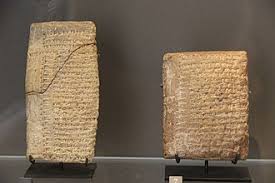
YHVH devoted the Amorite nations for destruction because their sin was deemed by Him to be abominable.
In fact, few people realize that Y’shua Messiah came not only to atone for the sins of the world, but to also dispossess or remove the legal hold that the enemy—the fallen ones—had over the nations of the world. That legal hold in part goes back to the “Tower of Babel” incident (Gen. 11). Moshe cryptically rehashes what appears to have been Father giving to certain angels oversight of the nations of the world at that time. We read in Deuteronomy 32:8:
“When God Most high divided up the nations—when He divided up humankind-He decided the people’s boundaries based on the number of the gods” (CEB).
Now, most of the authorized, highly respected English translations erroneously render this verse as “…He (i.e., YHVH) set the borders of the peoples according to the number of the children of Israel” (ASV, CJB,HCSB, NASB, KJV, JPS, and others). But this rendering of “according to the number of the children of Israel” makes no sense given that Israel had not become a nation at the time to which this verses is referring. However, when we look at the rendering of the LXX and the Qumran Deuteronomy Scrolls of this verse, we get what appears to be a more contextually accurate rendering of the verse, whereby the apportionment of the nations of men by YHVH was based upon a set number of divine beings or “sons of God;” sons of God being a general Old Testament reference to angelic beings. Why the difference? It appears that possibly Hebrew scribes around the time of Rabbi Akiba (2nd century A.D.) were responsible for replacing what could only be the original wording of “bene YHVH” with “bene Yisra’el.” Was this an intentional or an innocent scribal error? Or could this be something even bigger? I have my ideas on why, but I do not want to slide down that rabbit hole in this post and take us away from our focus passage. This is certainly something for another day’s discussion.
Anyway, at the Tower of Babel incident, Yah entrusted these angels to oversee the pagan nations of the world. Father eventually separated unto Himself out of these nations a people that would be wholly devoted to Him as their God and who would serve Him as His priests to the unbelieving nations of the world. He of course started off with Abraham of Ur, who Father established a covenant with (i.e., the Abrahamic Covenant), and the rest is history. Moreover, in case you did not know, Father called Abraham out of Ur, a pagan nation. He was neither a Hebrew nor a Jew at the time of his calling. He descended from a family that worshiped these angelic-based false gods. But Father saw something special in Abraham; called Him out of his father’s home; led him away from His family’s pagan nation; and sent him on an amazing journey, replete with covenantal promises and most importantly, a deep and abiding relationship with the Creator of the Universe:
“And the Scripture was fulfilled that says, ‘Abraham believed God, and it was counted to him as righteousness’ and he was called a friend of God” (Jas. 2:23; ESV).
YHVH’s War Against Idolatry
But getting back to these angels who were tasked with overseeing the nations by YHVH: it appears that those angels ultimately betrayed Yah’s trust. They enslaved the nation peoples by requiring them to worship them as gods.
What are idols? They are nothing more than carved images of the perceived forms of some of these fallen angels who took over the imaginations of the ancients. Thus the idols of these 7-abominable nations who were devoted or marked for destructions were to be completely destroyed as well (7:25), regardless the idol’s apparent value in gold and silver. For according to YHVH through Moshe, if one were to salvage an idol for its perceived monetary value, it is a certainty that he or she would succumb to the idol’s inherent evil. The whole thing, regardless of its material value, was abhorrent to YHVH. In fact, these idols brought with them curses; for curses inherently rested upon them (7:26). Thus, we must detest—loathe these articles as Yah does. These too were “marked or devoted for destruction” (7:26).
Idols Also Marked For Destructions
This issue of destroying the idols of the Amoritish nations and those idols having no place in the lives of the ancients, would of course equally apply to us as Netzarim today. How many of us, in many cases unknowingly, have had or currently have in our possession things like Buddhas, Native American articles, or any other articles that have some connection or link to pagan worship? These things, although they are not gods—they’re really just wood, metal, plastic or stone objects designed for the purpose of worshiping these fallen angelic beings–bring with them curses. Thus having them in our lives will ultimately bring curses upon our lives. Additionally, Father just outright hates them with extreme prejudice. Moreover, being a member of Yah’s elect, we must understand the things our Father loves and those things He loathes, such as idols, regardless how innocent they may appear to us. Father has little tolerance whatsoever for such things and neither should we.
Israel As An Arm of the Father
Thus, Israel would fulfill a few things in dispossessing the Amoritish nations of the Land: (1) We would destroy the last vestiges of the Nephilim—the Rephaim—the descendants of the Genesis 6 Watchers and their human wives. Their forbidden act perverted YHVH’s natural order and threatened to interfere in Yah’s Great Plan of Redemption and Salvation. (2) We would end, in part, the legal hold some of these angels, turned gods, held over nations of that region. In addition (3) our conquest of the Land would fulfill the Land Covenant YHVH made with the Patriarchs.
Later on, Y’shua our Messiah would finish the job during His earthly ministry and sacrifice.
Oh by the way, Moshe made it a point to let us know that our taking possession of the Land of Promise was in no way a reward for our righteousness. Our taking possession of the Land, in a great sense, was an historical example of Yah’s grace and love towards us and towards all mankind.
Father Was Tough On Us For a Reason
Moshe went on to remind us how Father miraculously carried us along our 40-year wilderness sojourn, all the while humbling and testing us (i.e., examining our hearts in the process). YHVH subjected us to hunger, thirst for purposes of building our trust in Him so that we would learn to recognize that everything we have comes from YHVH, and that we learn not to be slaves to our physical needs and desires (8:3). For Abba provided for our every need during those 40-years, despite our disobedience and lack of trust in Him, even after witnessing some of the greatest miraculous feats any human has ever seen with their own eyes (cf. Mat. 4:4; Luk. 4:4; 12:29, 30; Heb. 13:5, 6). Thus, we are to obey Yah’s Torah: living as He directs us, and fearing (yare) Him (8:6).
A Covenant Written on Stone and Hearts
In Deuteronomy 10:1-11, we find where Moshe rehashes the story of his receiving the 10-Commandments the first time on 2-stone-tables. YHVH provided the stone tables and wrote His commandments on them at that first go-round. When Moshe descended Mt. Sinai with those 2-tables, he found that the people had turned to the worship of the Golden Calf (a terrible throwback to their time of Egyptian bondage no doubt). In disgust and fierce anger towards the people, Moshe threw down to the ground and destroyed those 2-tablets that contained Yah’s commandments. He then destroyed and ground into dust the golden calf, which he threw into a nearby stream, the mixture of which he made the people to drink thereof (Exo. 32:20). It was Moshe’s intense mediation on behalf the people and his reaction to the peoples’ iniquity—their sin—that ultimately spared the nation from complete and total annihilation at the hands of an angry and jealous God (Exo. 32:9-14).
Later, YHVH called Moshe back up Mount Sinai to receive His 10-Words: this time, however, instead of YHVH cutting out stone tables and inscribing His Word upon them, Yah required Moshe to cut the 2-stone tables and bring them to YHVH where He inscribed His Word upon them.
This act obviously foreshadows the renewed covenant whereby we—House of Israel–bring YHVH our stony hearts and He inscribes upon them His Words—His Ways:
“Behold, the days come, saith YHVH, that I will make a new covenant with the house of Israel, and with the house of Judah: not according to the covenant that I made with their fathers in the day that I took them by the hand to bring them out of the land of Egypt; which my covenant they brake, although I was an husband unto them, saith YHVH: But this shall be the covenant that I will make with the house of Israel: After those days, saith YHVH, I will put my law in their inward parts, and write it in their hearts; and will be their God, and they shall be my people. And they shall teach no more every man his neighbor and every man his brother saying, Know YHVH: for they shall all know me, from the least of them unto the greatest of them, saith YHVH: for I will forgive their iniquity, and I will remember their sin no more” (Jer. 31:31-34; KJV).
Many contend that the renewed covenant has not taken place yet. And to a great extent I most certainly agree with them. However, I do believe in my heart of hearts that a down payment of that new covenant—a foretaste has already been realized by us: those who are Yah’s elect, saved by the blood of the Lamb, who possess His testimony and His Holy Spirit. Indeed, Yah writes His Torah upon our hearts and on our minds, even today. Soon, physical Israel—both houses of Judah and Israel—will realize this same covenant. Yah will restore paradise lost.
Phylacteries—Truth or Tradition?
In Deuteronomy 11:13-21, we come upon a rather challenging portion of Torah. I say this portion of Torah is challenging because the rabbis have instituted, as a result of their literal reading of the text, traditions and practices that when this passage is read, may cause us to wonder if God really requires us to wear “phylacteries,” otherwise known as “tefillin. “
The highlights of this section of our passage reads as such:
“And it shall come to pass, if ye shall hearken diligently unto my commandments which I command you this day, to love YHVH your Elohim, and to serve Him with all your heart and with all your soul…Therefore shall ye lay up these my words in your heart and in your soul, and bind them for a sign upon your hand, that they may be as frontlets between your eyes…And thou shalt write them upon the door posts of thine house, and upon thy gates that your days may be multiplied, and the days of your children, in the land which YHVH sware unto your fathers to give them, as the days of heaven upon the earth” (KJV).
As mentioned, the rabbis have taken this critical piece of scripture, which is also a brilliant piece of prose, and made it into yet another set of traditions and practices that are based upon an erroneous reading and understanding of this passage.
Tefillin or phylacteries are a set of small leather boxes containing scrolls of parchment inscribed with verses from Torah. Tefillin are worn by orthodox Rabbinic Jewish males during daily morning prayers, excluding Sabbaths.
The laws governing phylactery composition and use was developed by Rabbis and are contained in the Talmud (Sanh. 88b). These Rabbinic laws are literal interpretations of Deuteronomy 6.8; 11.18; Exodus 13.9,16.
Each leather box contains 4 scriptural passages: Exodus 13.1-10, 11-16; Deuteronomy 6.4-9; 11.13-21. According to the Rabbis, these passages must be written in black ink, in Hebrew square lettering, on parchment (reference Shab. 79b; Men. 32a), from the skin of a clean animal (Shab. 108a).
Talmud explicitly directs how the Torah verses are to be arranged on the parchment, the mode of writing (ie., rules on how the scribe is to draft the passages onto the parchment), how one is to put on the tefillin (ie., the order in which the phylacteries are to be donned and its exact placement on the body), when the implements may be worn, and the exact blessings to be recited while wearing them.
Let’s step back now into reality—spiritual reality that is–and understand the true meaning of this passage in Spirit and in Truth.
Contextually speaking, we find in our ‘Ekev Reading that Father was so insistent that we keep His Torah, that He gave to us examples of just how much we are to honor and keep His Word. These examples are essentially metaphors for the depths of Torah keeping we are expected to keep as Yah’s elect. Essentially, Father was saying to us that our commitment to Torah must be manifested in our labor—the works of our hands—thus the binding of His Word as a sign upon our hand. Furthermore, Father’s Torah must be ever on our minds—in our every thought so to speak–likened unto frontlets between our eyes (i.e., the frontlets representing the fulcrum of our thoughts). Additionally, the boundaries of our homes should reflect the pervasiveness of Yah’s Word in our lives, such that it appears as if Yah wrote His Word upon the doorposts and gates of our homes. Remember, in the ancient world, the gates and doorposts of the home was sacred and some have deemed these places as the most important places bar-none of a man’s home. It is a place where covenants were established and deep abiding relationships were made. Back in the day, not just anyone would go into another’s home. One had to be welcomed and then invited through a man’s gate and past the doorpost of his home. Any who would attempt to come into another man’s home absent such a welcome or invitation was customarily viewed as an intruder and they would be dealt with appropriately.
Thus, for the Hebrew, Yah’s Word must become the first line of defense over a man’s home. For every member of that man’s family would have to fear YHVH; every child must be taught YHVH’s Torah perpetually; the governing of the home would be under the auspices of Torah; the protection of the home and every member’s safety and wellbeing therein would be under that of Yah’s eternal Torah and the blessings derived from keeping Torah therein.
To limit Torah to a verse or two on a piece of parchment that is to be contained in a small box that is to be tied to one’s head and forearms, or that is encased in a mezuzah that is nailed to the doorpost of one’s home, does not in any way fulfill the instruction that Moshe is giving here, nor does it fulfill the context of the passage.
Moshe, before getting to the part where he talks about frontlets, bindings and mezuzahs, instructs us to “…lay up these my words in your heart and in your soul.” Therefore, to think that one can simplify the importance of keeping the whole of Torah by wearing phylacteries and nailing mezuzahs to our homes is ludicrous. Our entire life must be occupied by YHVH’s Word; His Ways; His Spirit. And it becomes our responsibility to teach His Words and Ways to our children and so forth. In so doing, we will prosper and live long in the Land that our Elohim gave us (11:13-21).
Is it wrong to done tefillin or phylacteries or install mezuzahs on the doorposts of our homes? Yes and no. The answer to that question is dependent upon whose instructions you are going to follow in carrying out these activities. Tefillin or phylacteries are rabbinic inventions and traditions. The rules that govern phylactery use is regulated to the extreme point of being overly complex and difficult to carry out and be compliant with Rabbinic specifications.
Remember how Y’shua our Master denounced the traditions and practices of the rabbis:
13 But woe unto you, scribes and Pharisees, hypocrites! for ye shut up the kingdom of heaven against men: for ye neither go in yourselves, neither suffer ye them that are entering to go in.
14 Woe unto you, scribes and Pharisees, hypocrites! for ye devour widows’ houses, and for a pretence make long prayer: therefore ye shall receive the greater damnation.
15 Woe unto you, scribes and Pharisees, hypocrites! for ye compass sea and land to make one proselyte, and when he is made, ye make him twofold more the child of hell than yourselves.
(Mat 23:13-15 KJV)
By implementing the traditions of phylactery use, the Rabbis have added to Torah, which in and of itself is a violation of Torah:
“Ye shall not add unto the Word which I command you, neither shall ye diminish ought from it, that ye may keep the commandment of YHVH your Elohim which I command you” (Deu. 4:2; KJV).
Thus I would say that the use of phylacteries is not advisable.
The traditions and laws of the Rabbis also govern mezuzah use. But I can also see how one may bring glory to Yah and respect to the Faith that is practiced by the household that maintains a mezuzah by following the Spirit of the tradition and this mitzvot. We have a mezuzah on the doorframe of our home, but we do not adhere to the rules of the Rabbis that govern its use. For us it is purely symbolic and ornamental, and it serves as a means by which to attract inquiries into what it is we believe and practice. So, if one is considering installing a mezuzah who is a member of our Faith community, I would only advise him or her to seriously consider under whose authority you would be installing and using the thing, and then do accordingly.
Well, that concludes our reflection of ‘Ekev. I pray that it provided you food for thought and that it encourages you to conduct your own read and study of this beautiful and thought-provoking passage.
Abba willing, we will be back next week with another installment of the Messianic Torah Observer. Until then, may you be most blessed fellow saint in training. Shalom and take care.
Faithfully.
The page you requested could not be found. Try refining your search, or use the navigation above to locate the post.
1 Timothy—The Properly Attired Praying Woman—Part 12 of the Paul and Hebrew Roots Series
Review of Last Two Posts
As promised, we’re going to finally get into an examination of 1 Timothy 2:9-15 and today’s focus will be that of the properly attired praying woman according to Paul.
But to quickly bring us up to speed, recall that over the last two installments to this series, in preparation for our examination of 1 Timothy 2:9-15, we discussed the following (https://www.themessianictorahobserver.org/2019/08/09/first-timothy-pauls-war-strategy-against-gnosticism-part-11-paul-hebrew-roots-series/):
Important Considerations
So today, we will look at the properly attired, praying Ephesian woman from a couple perspectives:
(a) From the perspective of women leading prayers in the assemblies of Messiah.
(b) From the perspective of prayer being one of the standards by which the Faith is displayed by Yah’s people and the first weapon of choice for combating false teachers and their teachings.
So without further ado, let’s dive headlong into today’s study: 1 Timothy—The Properly Attired Praying Woman—Part 12 of the Paul and Hebrew Roots Series.
Verses 9 & 10
“I desire then that in every place the men should pray, lifting holy hands without anger or quarreling; likewise also that women should adorn themselves in respectable apparel, with modesty and self-control, not with braided hair and gold or pearls or costly attire, but with what is proper for women who profess godliness—with good works” (ESV).
In the same way…
In order for us to fully comprehend what Paul is communicating to Timothy in this instruction, I believe at the very least we must fall back to verse 1 of this chapter. And what we find is Paul, having already established the basis for this letter (ie., addressing the Gnostic onslaught that had overtaken the Ephesian Assemblies of YHVH), Paul begins to lay out the strategy for combating the problems. And the first thing Paul instructs is that:
“…supplications, prayers, intercessions and thanksgivings be made for all people, for kings and all who are in high positions, that we may lead a peaceful and quiet life, godly and dignified in every way” (2:1,2; ESV).
Prayer—Paul’s First Tactic to Defeat Gnosticism in the Ephesian Assemblies
So Paul’s first tactic for defeating the Gnostic onslaught against the Ephesian Assemblies was “prayer.” In this case, we’re not just talking about personal, in your prayer-closet—daily prayers, but more so, public prayers. Paul instructs Timothy to ensure that the assembly members publicly pray for “all people,” including world leaders. And the aim of such public prayers was to ensure that members of the Body of Messiah lead a peaceful, godly, and dignified life.
And then in verse 8 of chapter 2, after certifying the wisdom of such an instruction, his calling and the God who the prayers would be directed towards, Paul adds something very interesting to his instructions regarding public prayers—singling out the men of the assemblies:
“I desire then that in every place the men should pray, lifting holy hands without anger or quarreling…” (2:8; ESV).
Considerations
Two things I would have you take note of here:
(1) Paul’s instruction that “men should pray in every place” is a direct call to the mature, set-apart men of the assemblies (”en topos”) when and wherever they gathered to engage in public prayer. Some may interpret the reference to men in this verse to mean “people,” “humans,” “man-kind,” which if that were the case, the Greek word Paul would have likely used would have been “anthropos.” In fact, this Greek term was used in verse 1 of this chapter where Paul calls for public prayers on behalf of all men (ie., “anthropos”). However, the term Paul uses here for men in verse 8 is “aner.” “Aner” generally refers to an adult male. So what about the women participating in this public prayer for all people? Is this a prohibition against women engaging in public prayer within the assembly gatherings? Absolutely not. In fact, we will see that Paul does indeed include women in his call to public prayer in verse 9, in just a second.
(2) The men, having gathered in their assemblies and engaged in petitions, supplications and intercessions on behalf of all people, as is part and parcel of such prayers, these were to lift up set-apart hands (ie., holy hands) unto the Creator, devoid of any anger or argument.
The Lifting Up of Holy Hands
What’s this “lifting up holy hands?” Well, it appears to be a common posture for prayer among the ancient peoples of Faith and the bible supports this.
Exodus 9:29—”Moses said to him, “As soon as I’ve left the city, I’ll spread out my hands to YHVH. Then the thunder and the hail will stop and won’t return so that you will know that the earth belongs to YHVH”” (CEB).
1 Kings 8:22—”Solomon stood before YHVH’s altar in front of the entire Israelite assembly and, spreading out his hands toward the sky…”(CEB).
Psalms 28:2—”Listen to my request for mercy when I cry out to you, when I lift up my hands to your holy inner sanctuary” (CEB).
Psalms 63:4—”So I will bless you as long as I’m alive; I will lift up my hands in your name” (CEB).
Isaiah 1:15—”When you extend your hands, I’ll hide my eyes from you. Even when you pray for a long time, I won’t listen. Your hands are stained with blood” (CEB).
The stipulation for those who would lift-up hands unto YHVH on behalf of all people is that those petitioners would be individuals who lived holy lives and the symbolism of the lifting of hands during worship and prayer would need be devoid of evil.
Prayer As Paul’s Number One Tactic Against Gnosticism
Thus corporate prayer was one of Paul’s first spiritual war tactics to combat the Jewish Gnosticism that’d gripped the Ephesian Assemblies. Because Paul, under the influence of the Ruach haKodesh (ie., the Holy Spirit), knew that the battle for the soul of the Ephesian life. This cannot be overlooked: not every member of the assembly would be prime petitioners. Those who would be considered prime prayer warriors would be those who lived a set-apart life.
The Vital Importance of Corporate Prayer to the Assemblies
Now why do you suppose that Paul would make as his first tactic against the Ephesian Gnostic infiltration of the assemblies of Messiah public prayer? (Recall dear friend that in the last installment to this series—Part-11—I likened 1 Timothy to that of a war strategy; essentially Paul and Timothy’s fight was not against those pesky flesh and blood Jewish Gnostic false teachers he mentions throughout his letter. Instead, Paul’s first tactic in his overall war strategy against false teaching in the Ephesian Assembly was by way of the spiritual. And how does one engage in spiritual warfare? Through prayer my friend. Through prayer—intercessions—petitions.
In fact, it was the same Paul who, writing to the very same set of Ephesian Assemblies, that the war for the souls of the assembly members was against spiritual entitles. For Paul writes:
“For we wrestle not against flesh and blood, but against principalities, against powers, against the rulers of the darkness of this world, against spiritual wickedness in high places” (Eph. 6:12; ESV).
But suffice to say that Paul comes right out of the gate requiring the assembly members engage in public petitions unto YHVH. No doubt, Paul’s secret weapon for launching the initial attack was to take the fight to the enemy’s own battle field: the spirit-realm.
And interestingly, Paul sets out to turn the tables on the chaos that had started to overtake the assemblies—anger and argument over stupid stuff; over fables; over endless genealogies. These would be replaced by a simple act of raised, set-apart hands petitioning and interceding on behalf all people.
The other thing that we must keep in mind here, which is vitally important to our understanding of the significance of what Paul is saying in these verses regarding corporate prayer is that corporate prayer as passed down by Paul and the other Apostles, when properly practiced, brought light to false teachings.
Women Appearance—Social-Cultural-Economic Impacts–The Hetairai Revisited
Recall we discussed the “hetairai” in previous installments of this series and that they were of “the professional courtesan or prostitution vocation” of Ephesus, Corinth and surrounding Greek cities (Donna Howell; pg. 128). In other words, these were temple prostitutes who held prominent standing in these Greek cities. And it was these women who made the adorning of cosmetics and fashion an art. The cosmetics and fashion were of course designed to elicit the immediate attention of “potential patrons” or clients (Donna Howell, “The Handmaiden Conspiracy;” pg. 128).
Now, none of this is to imply that the women of the Messianic Assemblies in Ephesus were hetairai. There’s no evidence to support such thinking. However, like today, fashion trends, regardless from whence they come, can have a tremendous impact on the day-to-day citizen of a society. In the case of the women of the Messianic Assembly in Ephesus, vanity was still a trait among assembly members that probably needed to be weeded out if Paul was to bring complete order to assemblies. So I believe there stands a better chance than not that pagan traits such as the adorning of alluring attire, hair styles, expensive jewelry, and such likely influenced some of the women of the assembly who “began to imitate this form of adornment simply because it looked feminine and pretty” (ibn, pg. 128). Again, I doubt the women of the Ephesian Assemblies were active temple of Artemis prostitute, but they instead “looked the part” for the sake of being trendy or appearing feminine or pretty as Howell suggests in her book.
Expectations of the Ephesian Women in Dress and Behavior (Torah and Pauline Expectations)
We find, when read in context, 1 Timothy 2:9 instructs Timothy “Likewise also the women” should pray in the same manner as the men in the assembly. Although extremely insightful, this verse also serves as sort of a transition verse to verse 8. Recall that in verse 8 Paul wrote of his desire that the men of Ephesus, wherever they would gather to worship, pray lifting up holy hands that would be devoid of anger or quarrels. Then Paul writes at the beginning of verse 9:
“ In like manner also (”hosautos [kai]”)…” (KJV).
Sadly, far too many students of the bible overlook this key transition and focus solely on what comes next in verse 9—that being a discussion on proper women attire and deportment when participating and or leading in public or corporate prayer.
In short, Paul writes that he desires the men of the Ephesian Assembly to pray within the guidelines of what he outlined for Timothy in verses 1-8. Then he writes, oh, by the way, I want the women of the Ephesian Assembly to do exactly what I’ve just instructed the men of the assembly to do regarding prayer.
The Negative Influence of Koine Greek’s Lack of Punctuation and Sentence Structure to Understanding
So why do so many people miss this crucial element to verse 9—in like manner? Well, in Koine Greek manuscripts, there are no punctuations: no periods; no commas; no semi-colons; no colons; no exclamation points; no quotation marks; no brackets; no paragraph starts and ends or indentations. In fact, if you simply pull up an image of a Koine Greek manuscript online, you’ll see that even the individual Greek words aren’t really separated by spaces. Thus, when New Testament translators and transcribers set out to articulate the ancient text into English, punctuation is often left to their discretion. And if you know anything about English grammar, punctuation can influence the meaning of an entire text. And when the author of the original Greek text leaves out clarifying words, translators can add to or subtract meaning to the verse in question, which we all know has the capability of leading to erroneous doctrines and traditions.
Let’s take, for instance verse 9, and see how various English translators rendered it from a punctuation perspective:
The KJV: “In like manner also, that women adorn themselves in modest apparel…” Notice here the comma that follows after “also.” And then the sentence continues with Paul’s discussion on women’s apparel. And if one were not careful, one would naturally think that Paul is telling Timothy that women should dress like who, the men, and not like the common women of Ephesus? It doesn’t make sense when you really look at this absent the previous verses to verse 9. Regardless, the “In like manner also” does cause one to ask: like what?
The same convention of sentence structure is followed in the ASV, the CEB, the ROT, and the ERV.
Other translations simply throw in the word “likewise [comma]” or “also [comma]” such as the CJB, the HCSB, the NASB. Still others such as the NET render “likewise” and leave off the comma entirely, forcing the reader to conclude that women are to dress like the men? Again, it doesn’t make sense.
Oh, and in case that wasn’t confusing enough, some translations such as the NLT and the NRS left off the transition words altogether and take the reader immediately into Paul’s discussion of women apparel and appearance.
Whether any of this is intentional in terms of forcing the reader to overlook Paul telling Timothy that women should participate in leading corporate prayers in the assemblies is speculative, but I would not rule it out. Let us never forget that the editors and translators and transcribers of our bibles have a tendency to filter their work through the lenses of their denomination and religious worldview. So if these believed as their churches or denominations or sects that women are prohibited from leading public or corporate prayer, they will force a translation in the English that will read according to their beliefs and understandings. Sad, but true.
Bringing The Women Into Leading Corporate Prayer
So Paul wants to make it clear to Timothy that the women of the Ephesian Assemblies, who met the same criteria as the men for leading the corporate prayers, also be devoid of anger and desputations; living set-apart lives, lifting up their hands in prayer unto YHVH our Elohim in supplications, petitions, intercessions and thanksgivings.
However, Paul throws in elements to the leading in public prayer that is germane to the women of the Ephesian Assemblies. And those elements involved the womens’ personal appearance and deportment, which seem to have been negatively impacted by the common fashion styles of the Ephesian culture. (We touched upon this just a moment ago actually.)
The Properly Attired Ephesian Woman of Prayer
Paul required that the women be arrayed modestly and appear before the assembly in a Godly manner (1 Tim. 2:9):
“I want women to enhance their appearance with clothing that is modest and sensible, not with elaborate hairstyles, gold, pearls, or expensive clothes” (CEB).
Ancient Greek culture viewed braids as “seductive.” In fact, the hairstyles worn by the hetairai for instance, required a professional to style and arrange. Juvenal, a Roman poet of the late first and early second century C.E., noted that such women who wore those types of hairstyle typically employed a slave to arrange their hair as well as a second slave to stand by with a whip to “lash the unfortunate beautician in case a cowlick proved stubborn” (Howell; pg. 75).
It should go without saying that “ostentatious” hairstyles were clear signs of “promiscuity” in the Ancient Near East. Paul instructed that such things as ostentatious hairstyles, as costly as they tended to be, was not an appropriate expenditure of money nor was it a suitable thing for one who professed Godliness to possess and display. As far as Paul was concerned, instead of adorning herself with costly common styles of the day, it was far better for a Godly woman to adorn herself with “good works” (1 Tim. 2:10).
And let’s now throw in verse 10 to round off Paul’s observations here:
“…that women adorn themselves in modest apparel, with shamefacedness (ie., “aidos,” modesty) and sobriety (ie., “sophrosune,”; self-control) not with broided hair (ie., “plegma,” braided hair), or gold, or pearls, or costly array. But (which becometh women professing godliness) with good works” (KJV).
Interestingly, regarding arraying themselves with good works, the CEB expresses it this way:
“They (ie., women) should make themselves attractive by doing good…”
In summarizing this key, revelatory passage, researcher Donna Howell wrote:
“His (ie., Paul) was with a woman attending church in modesty and humility, and in making sure that her appearance in a place of worship would be for the right reasons (to worship, not to attract the attention of surrounding men). Paul was aware that women were weaving gold into their braids , which was a common practice for prostitutes who wanted to wear an ongoing advertisement in public that they were ‘available for hire.’ These women knew that the culture around them considered their hair to be an extension of the body’s most intimate fluids, so they drew even more attention to it with gold, fine metals, and gemstones” (Handmaiden’s Conspiracy; pgs. 127, 128).
The Importance of Prayer to the Assemblies of Messiah
Let’s look at prayer in the early Assemblies of Messiah.
When we think about corporate prayer today, especially in the so-called Church, we picture a church leader standing up before a congregation who rattles off a series of words—reverential as it may seem—in rather quick order, directed to God or in many congregations, Jesus Christ. And upon quickly dispensing of their acknowledgment of God or Jesus, the church leaders launch right into whatever it was they are set to do: preach—teach—admonish—sell—whatever.
But corporate prayer in the first-century assemblies of Messiah was actually a big thing. It was a huge part of worship each Sabbath. And when the assemblies engaged in corporate prayer, they prayed together and listened to prayers said on their behalf, which when ended, the assembly would respond in agreement: “Amen. So be it.”
According to Scot McKnight, in his article entitled “Prayer in the Earliest Church,” corporate prayers in the Assemblies of Messiah occurred at least 3-times each day (https://www.patheos.com/blogs/jesuscreed/2015/10/13/prayer-in-the-earliest-church/). This practice obviously stemmed from orthodox Jewish customs.
In fact it was an early “Christian” document that some claim was written by first-century apostles, called “The Didache,” stipulated prayer in the Body of Messiah take place 3-times daily, and the article actually recites the Lord’s Prayer. So, we’re not talking about free-will, free-form prayers uttered by a church leader during any given worship service or gathering. We’re talking about the recitation of the “Lord’s Prayer.”
According to Patristic Church Father Tertullian, the assemblies (ie., the churches) devoted themselves to the “Lord’s Prayer” and the Psalms for their prayer practices. And Tertullian is believed to have taught his followers to pray in the morning and evening and “then also at the three designated hours of 9 AM, noon, and 3 pm, and this was customary for early Christian prayer practices.
According to Scot McKnight, “Christians seemed to have prayed with the whole body: standing, kneeling, prostration, or more commonly standing with hands and head raised (cross-like). Hence, too, the sign of the cross.”
The raising and extending of the hands and or arms sound familiar?
It was under Roman Emperor Constantine that prayer became more public and pervasive to the cities: “The bishop is to urge the people to come constantly to church morning and evening every day, and by no means to forsake it on any account, but to assemble together continually…Assemble yourselves together every day, morning and evening, singing psalms and praying in the Lord’s house: in the morning saying the sixty-second Psalm, and in the evening the hundred and fortieth, but principally on the Sabbath day” (Ap. Const. 2.59).
Churchianity at it best huh?
According to Philip Kosloski, in his article entitled “4 Ancient Prayers From the Earliest Christians,” Christians prayed “the Psalms in a similar fashion to the Jews at the time, but developed their own prayers that they clung on to in their times of need” (https://aleteia.org/2017/09/23/4-ancient-prayers-from-the-earliest-christians/).
Of the first 3,000 members of the Way Movement in Jerusalem days after the outpouring of the Holy Spirit on the Great Day of Pentecost, Luke wrote:
“And they devoted themselves to the apostles’ teaching and the fellowship, to the breaking of bread and the prayers” (Act. 2:42; ESV).
According to Steven D. Bruns, in his article entitled “How the Early Church Used Prayer to Make Disciples, this insightful verse reveals how the first 3,000 believers were acclimated into the Faith. These learned “the prayers.” These were not simply spontaneous prayers. These “were certain prayers that were specifically taught to the new converts” (https://www.seedbed.com/early-church-using-prayer-make-disciples-2/).
Bruns contends that these prayers “served in an instructive and corrective role” for the disciples of Messiah. And as Gnosticism began to take a foothold in the early years of the Faith, “one of the main criteria for determining this fact (ie., which writings were genuine, apostolic writings) was whether or not the writings or sect’s beliefs conformed to how the Christians were taught to pray.”
Of course the major prayer that was taught would have been the “Lord’s Prayer.” Thus Bruns describes the “Lord’s Prayer” as the “paradigmatic prayer for the Church.” In the Didache (c. 50-120 AD), there are only 2-prayers mentioned: The Lord’s Prayer and the prayer during the Eucharist (ie., the Lord’s Supper), of which the Lord’s Supper was to be prayed 3-times/day. The prayers were spoken or sung.
Justin Maryr, in his “Apology,” (c. 155 AD), wrote that “the president of the service would offer prayers and thanksgivings according to his ability.”
In a composition of various writings ranging in dates from 215 to 400 AD, entitled “Apostolic Tradition,” one writer wrote: “It is not altogether necessary for the bishop to recite the very same words which we gave before as though studying to say them by heart in his thanksgiving to God; but let each one pray according to his own ability. If indeed he is able to pray suitably with a grand and elevated prayer, this is a good thing. But if on the other hand he should pray and recite a prayer according to a brief form, no one shall prevent him. Only let his prayer be correct and orthodox.”
Thus it appears that over time the rote prayers, especially the Lord’s Prayer, were not necessarily read, but became more guidelines to spontaneous, heartfelt petitions and intercessions.
The other thing that I believe is essential information to have regarding prayer in the early Church is that prayer was, according to Bruns, one of the ways the Faith “discipled its people and encouraged them in their spiritual life and growth. Correct prayer, taught by Christians to new Christians, was among the most important means of ensuring the correct faith that was once for all delivered to the saints” (Jude 1:3).
So the concern regarding prayer in the early church—in particular for Ephesus who was battling significant Jewish Gnosticism infiltration in the assemblies–was to ensure the one who prays had a proper relationship with God and that the individual “was addressing the correct God and using correct theology when they did speak to that God” (Brun).
According to Dr. D. W. Ekstrand, in his article entitled: “Worship in the Early Church:” “The most basic acts of worship in the early church were the reading and exposition of Scripture, prayer, the singing of psalms, hymns and spiritual songs, and the observance of the sacraments; all of these were derived from the example and command of Jesus Himself.” (Can you detect a little Catholicism in this statement?) (http://www.thetransformedsoul.com/additional-studies/miscellaneous-studies/-worship-in-the-early-church)
What Constituted Scriptures in the First Century Body of Messiah?
In the early years of the Way Movement in Palestine and throughout the various realms of the Roman Empire where home assemblies were established, the scriptures were the books of the Tanakh. Remember, the New Testament did NOT exist in the first century A.D. And the letters that were written and disseminated to the various assemblies by the apostles were at that time in the early stages of being copied and read throughout the whole of the Faith Community—first to the assembly members of which the letter was originally addressed; and then later the copies were shared with all the other assemblies of Messiah that were strewn throughout the Roman Empire. It would be many years before the powers that be of the so-called Church Triumph would codify and canonize these books as inspired and scripture. Nevertheless, as these letters—like 1 Timothy—were introduced to the assemblies, they were read publicly as part of the worship service.
The earliest members of the Way Movement were Jewish. Thus, these accepted the Tanakh as the “Word of God.” And we know that these also continued worshiping at the Temple and in their local synagogues alongside their countrymen/countrywomen each Shabbat for several decades, especially in Palestine. Of course the difference between the orthodox Jews and the Jews of the Way Movement was that the members of the Way Community were devoted to Y’shua as their “promised Messiah and that salvation was found in Him alone.” Nevertheless, these continued to worship “in a basically Jewish fashion but added the Lord’s Supper (cf. Acts 2:42, 46) and prayers in the Name of Jesus to their worship regimen (cf. Acts 4:24-30). Furthermore, it appears that the members of the Way Movement, according to Dr. Ekstrand, “gathered daily for prayer, fellowship, preaching, and teaching (cf. Acts 2:46; 5:42), the ‘chief day’ for services of worship in the church was changed from the Jewish Sabbath to the first day of the week almost from the beginning, because it was the day of resurrection.”
Sabbath Versus Sunday Worship in the Early Assemblies of Messiah
My sources differ from that of Dr. Ekstrand as it relates to the early church worshiping exclusively on Sundays. My understanding is that the early members of the Way Movement worshiped primarily on the Sabbaths, and their fellowship continued on through the following day with worship and study of the scriptures. All indications are that as long as the Apostles were standing watch over the Body of Messiah, the keeping of Shabbat would have been non-negotiable. Furthermore, Sunday worship did not become a requirement of the so-called Church until Emperor Constantine, circa early 4th century AD made it so. For it was on the 7th of March, 321 A.D., that Emperor Constantine decreed that “dies Solis,” or “the day of the sun,” would be observed as a universal day of rest.
And of course the sacraments mentioned in Ekstrand’s article no doubt refer to the 7-sacraments of the Catholic Church, but for our purposes, the sacraments would be limited to just the Lord’s Supper and baptism.
So with the exception of the Lord’s Supper, the other forms of worship really did not originate with the teachings and example of Y’shua Messiah. These “were derived from the Synagogue worship of the Jews” (Ekstrand).
Corporate Prayer in the Early Church Derived Primarily From Synagogal Worship Regimen
Synagogue worship came on to the Jewish cultural-religious-social scene around the 6th century BC, about the time of the Babylonian Exile. With the destruction of Solomon’s Temple around 586 BC and many of the Jews of Palestine taken into Babylonian Captivity, synagogues provided for the needs of public worship, absent sacrifices which according to Torah could only be performed at the Temple.
Synagogues continued throughout the Land of Palestine (ie., Israel) after the Babylonian Captivity and it was the synagogue that provided for the basic teaching of Torah to the new Jewish and Gentile converts to the Way Movement:
“For Moses from ancient generations has in every city those who preach him, since he is read in the synagogues every Sabbath” (Act. 15:21).
Torah Taught to First Century Assemblies Via Local Synagogues
Note I said Jews and Gentiles received Torah training from the synagogues throughout the Roman Empire. As we can clearly see in James’ Jerusalem Council edict to the assemblies of Messiah (reference Acts 15), Gentiles were supposed to receive training in Torah through their attendance of Sabbath worship services at the various synagogues strewn throughout the Roman Empire. And this is a crucial fact that so many people of Faith either take for granted or simply remain ignorant of. For we’ve all be erroneously taught by churchianity over the years that Jesus Christ brought forth a brand new Faith, totally disconnected from Judaism. Thus, according to churchianity, after Pentecost, the Church Triumphant ran entirely independent of Judaism, neither the two to ever again meet. Unfortunately, this lie from the pit of hades has contributed, in great part, to the hellacious teaching that Torah was done away with by the sacrifice of Jesus Christ on the cross, and the false understanding that any disciple of Y’shua who would even think of keeping any part of Torah has fallen from grace and shipwrecked his or her chances for eternal life.
Continuing on: Upon the destruction of Herod’s Temple, the synagogue “replaced Jewish Temple ritual sacrifices with Torah readings, prayer and teaching.” Furthermore, the synagogue served as “houses of prayer” and “houses of study” (ie., of Torah) and for “social gatherings.” It became the epi-center of Jewish life in every town and city where Jews had a presence. And because of these facts, synagogues were generally the first places Paul would go to deliver the Gospel. Sometimes this protocol worked out well for Paul and his evangelistic team, while in others it proved less than fruitful.
Recall that it was in Ephesus that Paul and His Gospel message was rejected by the synagogal leaders. Thus he was kicked out of the Ephesian synagogue. Paul ended up taking his disciples with him from the synagogue and setting up shop in Tyrannus’ Yeshivah (ie., a Jewish school for religious studies). And thus Paul evangelized and taught from Tyrannus’ Yeshivah for 2-years, drawing unto himself and his teachings Jew and Greek alike from over Asia Minor (Act. 19:9,10). And if you read further along in Acts 19, you’ll see that mighty works were manifested through Paul’s ministry there in Ephesus, leading up to the 7-sons of Sceva incident, the burning of magic scrolls by Jews and Greeks, and the Demetrius uprising.
Dr. Eckstrand in his article goes on to mention that first-century synagogues generally had a hall for prayer, which would constitute the main sanctuary; and smaller rooms for religious studies and other synagogal business.
According to Dr. Eckstrand, at some point in the latter-half of the first-century A.D.—generally after the destruction of Herod’s Temple in 70 A.D.—members of the Way Movement were prohibited from worshiping in the synagogues. Regardless, members of the Way continued with the “same rite as their Jewish counterparts with added Christian developments and themes. Thus their meeting strongly resembled synagogal worship.” And synagogal worship included the weekly Torah and Haftorah Readings; the chanting of Psalms; intercessory prayers; and teachings.
Is Paul’s Instructions Regarding Women Leading Corporate Prayer and Appropriate Attire Be That of a Normative or Restrictive Nature?
Would I mess you up to say both?
Indeed, in my mind at least, Paul’s stance on women leading corporate prayer in worship gathering situations and the instructions he gave regarding appropriate attire and deportment are both normative and restrictive instructions to the Body of Messiah.
Allow me to break it down for you.
Leading corporate or public prayer in the midst of Yah’s elect is a very special privilege that none of us should ever take for granted.
Verse 9 clearly makes normative (ie., universal; applicable for us even today) the practice of women leading congregants in prayer during all forms of gatherings. But as it relates to Paul’s instructions on appropriate womens’ attire and general appearance and deportment in such gatherings and during their leading of corporate prayers, the apostle’s instructions are both normative and restrictive (ie., meant only for the women of the 1st-century Ephesian Assemblies). The instructions regarding womens’ general appearance, attire and deportment is restrictive to the women of the first-century Ephesian Assemblies simply because the wearing of expensive clothes, braided hair, gold jewelry and pearls today in our 21st-century, western culture are not necessarily provocative or alluring. However, Paul’s instructions become restrictive when womens’ attire, appearance and deportment become a distraction to the other members of the assembly.
I’m sure that you, like me, have had the experience of attending some type of worship service where certain women (and this would also apply to men for sure) would come into the service, wearing certain attire or who carried themselves in such a way that they drew attention to themselves, especially from the wandering eyes of the young men of the gathering who should have their minds focused on worship of the Almighty. In such situations, Paul’s instructions against women wearing provocative attire and carrying themselves in a common way would still apply today, especially for those women who find themselves in leadership positions in the Body and Assemblies of Messiah.
The Realities of Women Leading Public Prayers or of Women Fulfilling Leadership Roles in the Body of Messiah
Sadly, I have seen first hand many congregations and assemblies of Messiah where women are not permitted to lead corporate or public prayers. But growing up in the Southern Baptist Church of the 70’s and early 80’s, women were permitted only limited public or corporate prayer opportunities. I witnessed the same thing as I moved into the non-denominational sector of churchianity in the 90’s, although I did run into several congregations where women actually did lead congregational prayers.
And throughout all this time, I never fully understood why women were generally excluded from leading prayer in church. I knew, erroneously so, that the bible essentially prohibited women from teaching and preaching, and thus I figured this extended over to leading prayer in church as well.
Women Are Free In Messiah—Just Like Their Male Counterparts
However, it should be common knowledge that just like their male counterparts, women have freedom in Messiah (Gal. 5:1; 2 Cor. 3:17). Not the freedom that churchianity erroneously teaches that pertains to freedom to live life however one chooses (ie., a Torah-less life). But freedom to serve YHVH our Elohim in the beauty of holiness, Truth and Spirit: whether you’re a Jew or a Gentile; male or female; slave or free, we’ve all been freed to serve YHVH as He directs and leads; not controlled by religion and man-made traditions and doctrines (Gal. 3:28).
In Torah pass-down days, the time of the Judges and during our time in the Land and the prophets, corporate prayers were conducted exclusively by the Levitical Priests. Indeed, Hebrews commonly prayed on individual bases as their faith and personal situations dictated. Generally, these rote prayers. But the bible provides us a number of stories where women of Faith prayed privately during various situations. But corporate prayers were the exclusive domain of the Levitical Priests.
But when Y’shua came, things started to change in terms of women participation and leadership in the Faith. Women became an integral part of the Master’s ministry. For it was through Y’shua Messiah that women were finally “loosed” or freed from the oppression of religion and men. And under the leadership of the Apostle to the Gentiles, Paul, under the auspices of the renewed covenant, women, contrary to the false teachings of so many in churchianity, realized the full extent of the freedom women had in Y’shua haMashiyach. And as we clearly saw played out in previous installments to this series, the bible clearly suggests that women led home assemblies, preached, taught, led corporate prayers, counseled, prophesied, and even served as apostles.
Despite scriptural proofs to the freedoms that women were afforded in Mashiyach in terms of leadership in the Faith, male leaders in churchianity have erred on the side of misogynistic practices and mindsets of Greek culture and Judaism. And the thing that kills me about the continued denial of women to fulfill their call in Messiah by certain sects of churchianity and even our Faith Community, is that despite obvious proofs that run contrary to their misogynistic views and understanding, they choose to continue to operate, live and lead in error—much to the chagrin of their precious female members.
Nevertheless, our focus passage here—1 Timothy 2:9-15—serves as proof that women have every right, and dare I say every responsibility to serve the Body of Mashiyach—of Messiah—as leaders in congregational prayer. And we will find in Part 13 of this series, that womens’ leadership in the assemblies of Messiah is not limited to corporate prayer, but also extends over into learning and teaching. I pray you join me.
Faithfully.
The page you requested could not be found. Try refining your search, or use the navigation above to locate the post.
“As I counseled you when I was leaving Macedonia, stay on in Ephesus, so that you may order certain people who are teaching a different doctrine to stop. Have them stop devoting their attention to myths and never-ending genealogies; these divert people to speculating instead of doing God’s work, which requires trust. The purpose of this order is to promote love from a clean heart, from a good conscience and from sincere trust. Some, by aiming amiss, have wandered off into fruitless discussion. They want to be teachers of Torah, but they understand neither their own words nor the matters about which they make such emphatic pronouncements” (1 Tim. 1:3-7; CJB).
In this 11th episode to our Paul and Hebrew Roots Series, we pick up where we left off last week and prepare for a full-blown study of 1 Timothy 2:9-15. But before we can fully unravel the mysteries of this controversial passage, we must first gain an understanding of why Paul wrote this controversial passage in the first place. And what we’ll find out in this installment of The Messianic Torah Observer is that 1 Timothy was in a sense Paul’s war strategy against Gnosticism.
This is content you likely won’t find anywhere anywhere else; so you don’t want to miss this discussion.
Shalom and welcome.
Last episode to this series, part-10, I introduced you to our controversial focus passage of 1 Timothy 2:9-15 . In that post I attempted to shed some light upon some of the many historic, religious, grammatical, and cultural difficulties associated with it. And those difficulties are unfortunately experienced both within and without our faith community.
In anticipation of really getting into the nuts and bolts of 1 Timothy 2:9-15, we first have to do some preparatory groundwork.
Of course, our ultimate goal in examining 1 Timothy 2:9-15 is to gain as accurate an understanding of the passage as we possibly can. Additionally, we we also look to correct as many popular misinterpretations, misrepresentations and false-teachings which have, as you know, spawned hellacious misogynistic doctrines throughout Christianity, Catholicism, Judaism, and certain elements of the Messianic Community. Combined, these have contributed in one form or another to effectively silencing women of faith by denying them the ability to do that which they’ve been called by the Holy Spirit to do.
So today I’m going to cover just two-major areas in preparation for our next episode, part-12, where we’ll actually break down and closely examine our focus passage. Those two-areas will be:
(A) Gaining a basic understanding of Ephesus—her socio-cultural-religious existence at the time Paul wrote his first letter to Timothy.
(B) We’ll conduct a modest survey of 1 Timothy so as to lay a contextual foundation upon which we may build an accurate understanding of our focus passage.
The City
Ephesus was a port-city that was once considered the most important Greek city and the most important trading center in the Mediterranean region (reference: https://www.history.com/topics/ancient-greece/ephesus).
It has been described as a thriving city where men and women enjoyed equal opportunities.
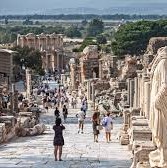
Ephesus was a large, affluent Greek city in the Roman Empire and was home to a few Messianic Assemblies of which Timothy was appointed as General Overseer.
It is surmised by certain scholars that Ephesus was home to some 250,000 people. She was a planned city of Greek architecture, possessing advanced public amenities such as an extensive sewage system and aqueducts. Fountains adorned her streets and public squares and convenient public baths and toilets were accessible to the populace.
For all intents and purposes, Ephesus was an affluent city. Many of the Ephesian homes were large in terms of square-footage. These possessed luxurious appointments and were richly decorated with art throughout.
The Socio-Politico Environment of Ephesus
Roman Ephesus was known as a leading political and intellectual center. She boasted an impressive library and a school of philosophy ( https://www.ancient.eu/ephesos/).
(This is important information to keep in the back of your head, because the Ephesian love for intellectual pursuits played a pivotal role in the overarching problems that plagued the Ephesian Assemblies.
Because of heavy silt deposits, the coastline has shifted 3-miles out from where it was in Paul’s day.
Biblical Perspective of Ephesus
From a biblical historic perspective, the Apostle John and Mariam (Y’shua’s mother) visited the city. Legend has it that Mariam spent her last years in Ephesus with John and her house and John’s tomb can still be visited there in Ephesus today.
The Religio-Economic State of Ephesus
The production of Artemis statutes was a major source of revenue for the city.
This fun fact is supported by Luke’s account of the great riot that erupted in Ephesus proper over Paul’s perceived threat to the city’s Artemis statute making trade (Acts 19).
Recall, if you will, a Demetrius: a well-to-do Ephesian silversmith, who made his wealth crafting silver statutes of Artemis (aka Diana) which his company no doubt peddled, not only to the citizens of Ephesus, but also the 1,000’s of pilgrims who visited the Temple of Artemis each year. Luke records how Demetrius incited the city’s statute makers to riot over the perceived threat Paul and his evangelistic work in the city posed to their lucrative trade.
Fortunately, only a couple of Paul’s disciples were ruffed up and no one was seriously harmed; the uprising fizzled out. Paul quickly departed the city, leaving behind a few members of his evangelistic team to continue the work he’d begun.
The Temple of Artemis
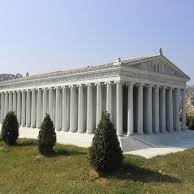
The Temple of Artemis has been deemed as one of the 7-Wonders of the World and was the headquarters of the Artemis cult.
Regarding the Temple of Artemis Antipater of Sidon—an ancient Greek poet of the 2nd century BC–wrote:
“I have seen the walls and Hanging Gardens of ancient Babylon, the statue of Olympian Zeus, the Colossus of Rhodes, the mighty work of the high Pyramids and the tomb of Mausolus. But when I saw the temple of Ephesus rising to the clouds, all these other wonders were put in the shade.”
The Temple of Artemis was located in the city of Ephesus which is present day Turkey. It was built sometime around 323 BC. The structure was primarily of marble construction, measuring some 425 ft. in length. It was said to have consisted of some 126 giant marble columns. Interestingly, the Ephesus Temple or Shrine of Artemis is said to have been 4-times the size of the Greek Parthenon.
It was destroyed in 262 AD by the Goths. Unfortunately, there’s little left—archaeologically speaking—of the structure today. Regardless the lack of physical evidence to its former grandness, the Temple of Artemis earned a coveted spot as one of the “7-Wonders of the Ancient World.”
Who Was Artemis?
According to ancient Greek mythology, Artemis was the daughter of Leto and Zeus and the twin sister of Apollo. She has been referred to as the goddess of the wilderness; of the hunt; of wild animals; and of fertility. Additionally, she has been described as the helper of midwives for she was the goddess of birth—that is the goddess of life (reference: https://www.ephesus.us/ephesus/mythology_of_artemis.htm).
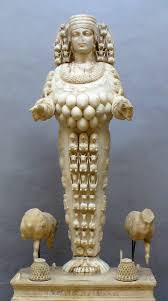
Artemis was the Greek goddess of fertility and she was Ephesus’ primary god of worship.
An interesting fact to the Artemis myth and cult is that Artemis is said to have asked her father, Zeus, to grant her eternal virginity—which apparently he did. Now, can you see any potential link of the concept of perpetual virginity and Catholicism’s portrayal of Mary, the Mother of Jesus, as possessing perpetual virginity? Truly, as you can clearly see, there’s nothing new under the sun as they used to say.
Another thing I need for you to keep in the back of your noggin in preparation for our upcoming exploration of 1 Timothy 2:9-15, is all the stuff that is tied to the worship of Artemis. For we’re going to touch upon concepts of a “mother-goddess” who was essentially over all life. And it would not be too much of a stretch to link the Artemis cult (aka Diana) and the worship of Artemis to some of the false teachers and teachings that were plaguing the Ephesian Assemblies.
Continuing: Although seen by some as a goddess of healing, conversely, she was also thought to be responsible for the spread of diseases such as leprosy, rabies and gout.
Interestingly, Artemis was considered a secondary deity throughout much of first-century AD Roman Empire. But to the Greeks of Asia Minor (ie., Modern Day Turkey), she was the prominent deity. The main attribute given to Artemis was that of fertility for which she was identified alongside Cybele as the mother goddess of eastern lands.
Touching somewhat back onto our earlier discussion of Demetrius—the Ephesian silversmith recorded in Acts 19–who incited a riot among the city’s statute makers over Paul’s work in their city, the cult statutes of Artemis in Ephesus differed greatly from those of mainland Greece. The statutes of her in mainland Greece depicted her as a huntress with her bow and arrows. However, those of her in Ephesus depicted her in the eastern style, standing erect with numerous breast-like appendages adorning her torso (although some scholars reject that the appendages are breasts, but more likely sacrificed bull-testicles). See the image above.
Historical Setting of 1 Timothy
Contrary to churchianity’s popular portrayal of the Church in Ephesus being some massive brick and mortar edifice housing hundreds of gentile Christians attending Sunday worship services each week, the so-called church of Ephesus at the time Paul consisted of “many house churches” that had become corrupted by false teaching” (Eddie Hyatt—Paul-Women-Church; pg. 91).
Who Was Timothy?
Timothy is first mentioned in Acts 16:1-3. He is described here as a talmid (ie., a disciple), the son of a believing Jewish woman who had come to trust in Mashiyach and a Greek father. He was well respected among the brethren of Lystra and Iconium. And it seems that Paul was quickly drawn to him—personally and spiritually—thus adopting him as his spiritual son and a trust member of his evangelistic team.
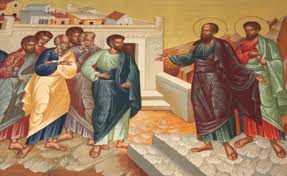
Timothy was Paul’s tool for combating Jewish Gnosticism in the Ephesian Assemblies.
We find recorded in Acts 16:3 that in order for Timothy not to be despised by any potential Jewish converts the ministry would come in contact with, Paul circumcised Timothy.
We later learn from Paul’s own words, the names of the two individuals who most shaped Timothy’s young spiritual life: Lois, Timothy’s grandmother; and Eunice, Timothy’s mother (2 Tim. 1:5).
Additionally, we can gather from various Pauline references that Timothy was timid; in need of self-confidence and boldness (1 Cor. 16:10; 1 Tim. 4:12; 2 Tim. 1:7).
Nikephoros Kallistos Xanthopoulos, the last of the Greek ecclesiastical historians, who lived about 1320 C.E., records that Timothy suffered martyrdom under Roman Emperor Nerva. Tradition asserts that Timothy was bludgeoned to death by an angered, Artemis-worshiping mob who reacted violently to his protests against the mob’s pagan behavior (https://www.britannica.com/biography/Saint-Timothy).
There’s been a lot of debate as to the length of Timothy’s overseeing of the Ephesian Assemblies. At the very least, it is widely accepted that Timothy served 9-months as the Ephesian Assembly’s general overseer. It’s quite conceivable that Timothy’s service in Ephesus ran beyond the 9-months, but the biblical record fails to definitively innumerate otherwise.
The fact that Paul addresses the workings of various so-called church offices in 1 Timothy is indicative that all the pertinent offices of the so-called church were already well established and in operation. The problem was, it appears, that those established offices needed some fine-tuning by Timothy. It’s quite possible those offices had fallen into disrepair or were in poor operation and Paul needed to ensure that the right people were placed into and given the opportunity to serve in those key positions.
So the churchianity-based convention that Timothy was sent to establish church organization or structure from scratch in Ephesus is not accurate.
The Nature of the Letter Paul Wrote to Timothy
It should be abundantly clear at the start that 1 Timothy was written by Paul and was (1) written to a specific person (ie., Timothy) who happened to be very close to Paul; and (2) it was written in response to a specific situation within the “beloved congregation” (John Temple Bristow-What Paul Said About Women; pg. 69).
The fact that the letter was of a personal nature, addressed to someone Paul dearly loved, the situation on the ground, so to speak, needed not be fully fleshed out in the letter. In this case, Timothy was quite aware of the situation on the ground in Ephesus. So it wasn’t necessary for Paul to elaborate on such commonly held knowledge. Recall that we touched upon this in the previous episode—part 10.
Background on 1 Timothy
The early assemblies of Messiah accepted 1 and 2 Timothy, along with Titus as being genuine (ie., canonical)–written of course by Paul.
The 2nd-century Peshita-Syriac canon as well as Muratori’s “Fragment on the Canon of Scripture” (ie., the earliest list of the books to form our present day canon, composed in the 2nd century C.E.) included these letters. As well as the so-called Patristic Church Fathers all acknowledged the genuineness of these letters.
The Jewish Connection to Gnosticism in Ephesus
Interestingly, and as we’ve discussed in modest detail so far in this series, ascetic Judaism seems to be at ground zero as it relates to the formation of heresies in the assemblies. We’ve come to accept these Judaistic heresies as an early form of Gnosticism or pre- or proto-Gnosticism.
I was at first taken aback by this understanding—that certain elements of first-century Judaism would have been behind some of the Gnostic infiltration of the Ephesian Assemblies. However, when one considers a great many of the early Gnostic stories coming out of first-century Asia, as well as the history of Ephesus that included a wide Jewish participation in magic and the pervasiveness of Jewish folklore (ie., tales) in Ephesus—as recorded in Acts 19, Judaism’s contribution to early Gnosticism simply cannot be overlooked.
In many ways this whole Jewish basis for a lot of what we’ve come to understand as early-Gnosticism in the Ephesian Assemblies can still be seen in many sects of Judaism today. I will tell you, I’ve come to find that more than a few respected Jewish scholars and rabbis vociferously reject the veracity (ie., the Truth) of many of the stories contained in Torah and the Tanakh. These offer instead idealistic principles and alternative accounts of the stories and Truths of the bible. And this was made very evident to me as I watched Timothy Mahoney’s “Pattern of Evidence” movies where the filmmaker interviewed several, highly regarded Jewish scholars and rabbis, who without apology stated that the Exodus story was a fabrication of some fanciful Jewish writers back in Babylonian Exile days.
When asked to explain what these stories meant to them, given that they saw them as fabrications, these Jewish experts came up with off-the-wall, contrived ideologies that seemed more humanistic in nature than God-given revelation.
Y’shua’s Perspective on Jewish-Gnosticism
Y’shua called out such individuals in His Revelation to the Apostle John regarding the many tribulations and impoverished nature of the Assembly at Smyrna:
“I know your affliction and poverty, yet you are rich. I know the slander of those who say they are Jews and are not, but are a synagogue of Satan” (Rev. 2:9; HCSB).
And again these were identified by Y’shua to John when He addressed the Assembly of Philadelphia:
“Take note! I will make those from the synagogue of Satan, who claim to be Jews and are not, but are lying–note this–I will make them come and bow down at your feet, and they will know that I have loved you” (Rev. 3:9; HCSB).
Origins-Reasons-Purpose When Studying Paul
And this is the type of stuff we must keep in the back of minds when we are studying the writings and teachings of Paul: origins; reasons; purpose. Can you imagine how Paul must have felt having to contend with the opposing works and teachings of his fellow Jews (granted Jews by birth only) who had taken the Faith he once held so dear, and made it to be nothing short of a shipwreck (1 Tim. 1:19). And here in 1 Timothy Paul gives us at least two-clues that Jewish-based Gnosticism was at the heart of the false teachings ongoing in Ephesus at the time he drafted his letter to Timothy:
1 Timothy 1:7–“They (ie., the false teachers) want to be teachers of the law, although they don’t understand what they are saying or what they are insisting on” (HCSB).
1 Timothy 4:3–“They (ie., the Jewish-based Gnostics) forbid marriage and demand abstinence from foods that God created to be received with gratitude by those who believe and know the Truth” (HCSB).
Crete-Another Ground Zero For Jewish Gnosticism
And this same stuff was happening in Crete. For we find clearly laid out by Paul in his letter to the Cretan assembly leader and Paul’s frequent companion, Titus, that certain Jews were behind much of the Gnostic heresies plaguing the Assembly of Crete:
Titus 1:10-14-“For there are also many rebellious people, full of empty talk and deception, especially those from Judaism. It is necessary to silence (ie.; epistomizo; that is to bridle or stop up the mouth) them; they overthrow whole households by teaching what they shouldn’t, in order to get money dishonestly (and we certainly see that this was occurring in Ephesus as well). One of their very own prophets said, Cretans are always liars, evil beasts, lazy gluttons (thus the dubious title given to certain vulgar individuals in our somewhat modern vernacular as Cretans). This testimony is true. So, rebuke them sharply, that they may be sound in the Faith and may not pay attention to Jewish myths and the commands of men who reject the Truth“ (HCSB).
Titus 3:9–“But avoid stupid controversies, genealogies, quarrels and fights about the Torah, because they are worthless and futile” (CJB).
Sorting Out the Differences Between the Judaizers and Jewish Gnostics
My point here is not to come against Judaism. For the vast majority of orthodox Jews in Paul’s day, especially Palestinian Jews (ie., Israeli-Jerusalem-based Jews) kept a great deal of the Hebrew Faith. The problem with first-century Palestinian Judaism was that the people were being influenced and ultimately misled in many areas of their lives by rabbinic and proto-Talmudic teachings, designed, according to the Pharisees, to place a so-called “fence” or “hedge” around Torah so as to prevent violations of Torah. And this has of course carried on through today where the Talmud holds more of a preeminent place in orthodox, rabbinic Jewish life, than Torah. Add to this reality the whole Kabala paradigm that is infused in a great many areas of the religion today and viola: You have a form of Gnosticism disguised as Judaism.
However, the form of Judaism that Paul and Timothy were confronting in Ephesus was NOT that of the “Judaizers,” as described by Paul in his letter to the Galatians in 2:4. That form of Judaism, of course, vigorously sought to require members of the Body of Messiah to convert to Judaism before they could be accepted into the Body and assemblies of Mashiyach (ie., Messiah). However, over time, as documented throughout the apostolic records, we can see a gradual movement away from the religiosity that defined the Judaism that Y’shua personally had to contend with, over to the mystical and eastern esoteric form that is somewhat similar to what we’ve come to identify as kabala today.
The Jamieson-Fausset-Brown Commentary on the Whole Bible referred to this gradual transformation that Judaism took as an “immoral practice that accompanied false doctrine (cf. 2 Tim. 2:18; 1 Cor. 15:12, 32, 33)…a descent from legality to superstition, and from superstition to godlessness” (Commentary on the Whole Bible; pg. 1349). So by the time we get to 1 Timothy, which many scholars believed was sometime in the mid-50’s AD, the movement leading to Jewish, proto-Gnosticism had somewhat matured. And certain members of the assemblies in Ephesus and Crete had fallen sway to its influence, and accepted it as a replacement for the True Faith once delivered.
Ephesus’ Form of Gnosticism
I want you to bear in mind dear friend that the Gnosticism that Timothy is being tasked by Paul to confront is not the mature Gnosticism that we find in the Nag Hammadi scrolls (Egyptian) and the Gnosticism that the so-called Church Fathers argued against in their writings. The Jewish Gnosticism we’re seeing evidence of here is again more of an early form of that Gnosticism.
Survey of 1 Timothy
There’s a lot more to be said about the impact that the Artemis cult, Jewish-Gnosticism and other Greek socio-cultural influences had on the Faith in Ephesus. But we’ll speak more to these influences in part-12 when we drill down on 1 Timothy 2:9-15.
For the remainder of this installment, however, we’re going to conduct a survey of 1 Timothy for the purpose of establishing context so that in part-12 we can jump right into accurately interpreting our focus passage.
Chapter 1
Verse 3—”Remain in Ephesus so that you may instruct certain people not to teach false doctrine.” We are not privy to what the false doctrine actually consisted of, but we are given a number of clues throughout this and the other two-Pauline pastoral letters.
Verse 4—”Or pay attention to myths (aka fables) and endless genealogies which promote empty speculations rather than God’s plan which operates by faith.” The myths seem to be legendary tales that formed the basis of the false teachings that were challenging the sanctity of both the Ephesian and Cretan assemblies (1 Tim. 4:7; 2 Tim. 4:4; Tit. 1:14). It seems pretty evident from the studies I’ve conducted on this verse that these myths and genealogies formed the basis of Jewish Gnosticism which ties so nicely into verses 6 and 7 where Paul states that many of these individuals desire to be Torah teachers but have departed from orthodoxy and are teaching things that are just not even close to Truth. Regarding “endless genealogies, Paul was obviously addressing a common practice of people debating over certain stories tied to genealogies. I know today, there is an immense interest in both Christian and Messianic circles regarding Shem and his descendants as well as the validity of Israeli Jews today who claim to be descendants of Abraham, but are alleged by some to be frauds and impostors and Khazarians and the like. And all this does is create division and contention within the assemblies.
Verse 5—”The goal of our instruction is love that comes from a pure heart, a good conscience, and a sincere faith.”
Verse 6, 7–Some, desiring to be Torah teachers, have departed from orthodoxy, and they do not understand even that which they are teaching.
Verse 8–Torah is good as long as it is properly handled.
Verse 9-11-Torah was not meant for a righteous person, but for the lawless and rebellious–and Paul provides a large list of offenses.
Verses 12-17-Paul provides Timothy his personal testimony of which He testifies to the mercy and grace of YHVH in his life.
Verses 18-19-Paul is piggy-backing on a prophecy that was pronounced upon Timothy sometime prior to the writing of this letter. We aren’t privy to when and where, but Paul clearly wants Timothy to know that he is the best man for the job of cleaning up Ephesus (1 Tim. 1:3-7). And of course this goes back to that which Paul mentioned to Timothy regarding his upbringing and how his scriptural knowledge and understanding was the basis of his spiritual strength. Those prophecies spoken over Timothy appear to have taken place at his ordination (1 Tim. 4:14). It no doubt had something to do with the great work that would come about through Timothy’s ministry. And as long as Timothy holds firmly to the Faith, he would be successful in the fight.
Verse 20–Paul mentions Hymenaeus and Alexander who made a shipwreck of their faith through their overt, unapologetic mishandling of the Word of God. As a result, Paul hands the two over to hasatan for discipline so they learn not to blaspheme anymore.
Chapter 2
Verses 1-8–Paul entreats Ephesus to enter into a time of prayer, supplication, intercessions and thanksgiving on behalf of everyday people, kings, magistrates, such that all dwell in tranquility with one another and reverence Elohim with purity. The goal is to have all people converted to the knowledge of the truth of the One True God-Elohim and His mediator Y’shua the Mashiyach. And Paul’s sincerest desire was for the people of Yah to pray everywhere, lifting their hands up to YHVH in purity as opposed to wrath and disputation. So Paul’s very first suggestion for getting the assemblies back to some semblance of order is to instill a mindset and practice of universal, public prayer among members of the assembly. And we must take full note that Paul does not limit this admonishment to males; but to every member of the assemblies.
Verses 9-15–Our focus passage which we will examine in detail in part-12 of this series.
Chapter 3
The KJV, ASV, DRA, NAB and others use the title of bishop (episkope) in verse 1, while other translations use a variety of titles including: supervisor; congregation leader; overseer; exercise oversight and elder. I believe the use of bishop here, given our modern perceptions of what a bishop is, is somewhat misleading. The better translation of “episkope” seems to be “overseer.” Paul is obviously responding to a concern or issue related to individuals who aspired to such a leadership office. The fact that he has to put a positive spin on the office of overseer is suggestive that others within the assemblies took issue with not only the office of overseer, but any who would aspire to such an office.
Chapter 4
Verses 1-6–Paul receives prophetic word that in latter times many would fall away from Faith, enticed and drawn to deceiving/seducing spirits and demonic teachings (4:1). Here, as in other times during his ministry, Paul receives instruction and teaching from the Holy Spirit (cf. Joh. 16:13; Act. 13:2). And it seems clear that the emergence of these false and seducing doctrines/teachings of demons had already manifested in Ephesus by the time Paul wrote 1 Timothy. Many scholars, and I agree with these, believe much of the false teaching that Paul was combating in Ephesus was a nascent Gnostic movement (ie., Jewish-Gnosticism; proto-Gnosticism) that would really start to come to its own in the 2nd and 3rd centuries AD. And this proto-Gnosticism twisted the Truth of Scripture to such a degree that people in the assemblies didn’t know whether they were coming or going: it was a no-no to marry over here; you couldn’t eat meat over there; and the like.
Those that hold to 1 Timothy being a church organization manual would have us believe that Paul was simply putting together the organizational structure of the “church” when he wrote this letter. But let us not forget that the so-called “church” structure had already been in place at the time Paul wrote his letter to Timothy. Paul was not introducing anything new to Timothy nor to the assemblies. Instead, Paul was trying to restore order to the assemblies that had by the handy works of the false teachers begun to cause the Faith to become “shipwrecked.”
The other thing to keep in mind when we read these latter-day prophesies of Paul and the other apostles is that the apostles all believed that the end was imminent in their day. And my guess is that Paul, in hearing about the many terrible things that were transpiring in the Corinthian, Ephesian and Cretan assemblies, felt that the prophesies rendered unto him by the Spirit regarding the end times were imminently coming to fruition.
Another elephant in our spiritual room that should raise eyebrows is the reality of Paul having to certify the obvious understanding that marriage was still a valid institution. Yet it seems pretty obvious that certain sects were teaching against marriage, which is eerily similar to certain Gnostic teachings that prohibited marriage, and as we progress further along in this series we will find that these groups even forbid the bearing of children (in at least one writing requiring abortions of those in their sect who happened to become pregnant). We know that later on as Catholicism replaced the True Faith once delivered, Catholic Priests were prohibited from marrying and of course having children. This stands in stark contrast to what we know of the Levitical Priesthood in which the priests were encouraged to marry and raise a family. But we know that hasatan’s aim is always to destroy the family unit. And the best way to do that, of course, is to forbid marriage and childbearing in the first place.
Verses-7-11–Paul directs Timothy to not involve himself with the myths/tales disseminated by old women. Instead, Timothy’s focus would be that of righteousness and to keep his eyes on the prize. Righteousness, according to Paul, is profitable in every aspect of a disciple’s life. And this Truth remains just as faithful as it was in Paul’s day. This will of course remain so even going in to the world tomorrow.
Verses 12-16–Paul writes specifically to Timothy’s personal and spiritual skills.
Paul first encourages Timothy to not allow concerns of his youth get in the way of his work. Generally, respect in ministry tends to smile more favorably upon the aged as opposed to the youth.
Interestingly, Luke records that a contingent of elders (ie., overseers) from the Ephesian Assemblies traveled to Troas upon being summoned there by Paul. These individuals—these overseers or elders—would certainly have been senior—senior in age—to Timothy. And I can’t but help wonder if there may have been a degree of animosity towards Timothy being so much these elders’ junior. Add this to Timothy being an outsider in terms of a non-resident of Ephesus, it would not be surprising to me if these gentlemen weren’t a bit put off by Timothy being installed as the General Overseer to the Ephesian assemblies. Yet Paul counsels Timothy not to concern himself with age when discharging his duties (1 Tim. 4:12).
The natural tendency is to trust age over youth when it comes to things of Faith, simply because wisdom is believed to be bestowed more abundantly upon the aged over that of the young. And indeed, I believe there’s something to be said about that. But Paul aptly points out to Timothy that his situation is a little different than the normal disparity that tends to exist between youth and the aged. He was special. Prophecies were spoken over him by the elders of the Faith. Hands were laid upon him by elders of the Faith. And Paul encouraged Timothy to not be intimidated by concerns of youth when confronting his task, but to meditate on the things related to his call; give himself fully to his call; persevere despite resistance and opposition. And the end result would be a crown of life for himself and those who would follow his example, lead and teachings.
Chapter 5
In this chapter Paul expounds upon the duties of members of the Body and Assemblies and how the Assembly proper is supposed to deal or administrate the various classes of individuals–the mature men and women of the assembly; the youth; the widows; the preaching/teaching elder (who should receive compensation for their work in the assemblies). Paul personally instructs Timothy to not be preoccupied with anything other than that which he is tasked; that he not favor one person over another; be not quick to lay hands on people; and keep himself pure. Essentially the very same qualities that would be required of a Levitical Priest, but elevated even higher under the Melchizedekian Priesthood. Paul also encourages Timothy, who we learned earlier in the letter was not all that excited about the job that was set before him, to self-medicate his intestinal issues and other “unspecified infirmities” with a little wine.
Chapter 6
Verses 1-2–Here Paul encourages slaves and slave owners to respect one another and both to live according to their call as disciples of Mashiyach. Now, many who view this passage from a 21st century western mindset may be somewhat put off by Paul not using his apostolic office to condemn the practice of slavery. We in the 21st century west, of course, view slavery as a hideous crime against humanity. And given the innate evil and deprave nature of man, slavery has been used over the centuries to mistreat and destroy human dignity and free will. However, Father in His Torah recognized the reality of slavery in the human experience and He sought out in His Word to ensure that human dignity would be spared and even uplifted and that love would be shared between both slave and slave owner. Paul continues this Torah-based understanding and reality in these 2-verses by having Timothy remind the Ephesian Assembly members who are either slaves or slave owners to be Torah observant in their dealings with one another.
Verses 3-Then Paul returns to the issue of false teachings and false teachers, citing that any who would oppose (or teach doctrines that are contrary to) the foundational Words of Y’shua Mashiyach AND the Doctrine of the Fear of Elohim (which in the KJV is simply, the doctrine of godliness), he or she “exalts himself/herself while knowing nothing. These purveyors of false doctrine create within the Body of Mashiyach envy, contention, railings and ungodly suspicions. Paul counsels a few times throughout this writing that Timothy avoid engaging in such pointless debates. The people who make it their primary purpose in life to teach that which is not the Truth of Torah or that of the teachings of Y’shua Mashiyach, more times than not make those teachings and doctrines about themselves. And when these are challenged about their selfish false teachings and doctrines in relation to what the bible actually has to say on the matter at hand, it turns out that they know absolutely nothing about the Truth of the Word (vs. 4).
In verse 3 Paul addresses those who would oppose “The foundational Words of Y’shua Mashiyach” which is easily understood and is of course recorded in the Gospel records. But Paul also writes about a “Doctrine of the Fear of Elohim.” What is Paul talking about here?
According to AENT author, Andrew Gabriel Roth, “The Doctrine of the Fear of Elohim” is: “a Spirit of YHVH; it is a vital spiritual quality for Life in Mashiyach. The fear of YHVH is a personal guide.”
The Aramaic term for fear is “yirah,” which: fear/awesome;terrifying. Sadly, churchianity has taken it upon herself to alter the understanding of this crucial term and made it into a simple reference to piety, love; reverence and respect. But as we should do with most New Testament spiritual concepts, we must filter it through a Hebraic perspective if we are to receive an accurate understanding of what Paul is trying to convey to Timothy.
Torah commands the following:
“Now this is the commandment, the statutes, and the ordinances, which YHVH your God commanded to teach you, that ye might do them in the land whither ye go over to possess it; that thou mightest fear (yare/yirah) YHVH thy God, to keep all His statutes and His commandments, which I command thee, thou, and thy son, and thy son’s son, all the days of thy life; and that thy days may be prolonged” (Deu. 6:1,2; ASV).
In Deuteronomy 6:13 Moshe instructs:
“Thou shalt fear (yirah/yare) Jehovah thy God; and Him shalt thou serve, and shalt swear by His Name” (6:13; 10:20; 31:12, 13; ASV).
And why must we yirah/yare YHVH? We must yirah/yare YHVH for our perpetual good; such that we continue to thrive/live/be well (Deu. 6:24). Moshe rhetorically asked the congregation in the wilderness what was required of them by their Elohim. And Moshe answered with:
“Elohim requires…but to fear YHVH thy God, to walk in all His ways, and to love Him, and to serve YHVH thy God with all thy heart and with all thy soul” (Deu. 10:12; ASV).
Concerning the administration of the Tithe, Moshe taught that it is instituted so that we “mayest learn to fear YHVH our God always” (Deu. 14:23; ASV).
Oh how we’ve lost that understanding today. We’re taught to simply revere and respect YHVH. We are hardly ever taught to yirah/yare YHVH. As Andrew Roth so astutely noted: ” man’s religious theology and tradition has made void the Fear of YHVH” (AENT; pg. 632). And somehow, some way, some of the false teachings in Ephesus which Timothy was tasked with opposing was obviously leading people away from a “fear of YHVH.” And when people turn away or are led away from a true “yirah/yare” of YHVH, they end up developing instead “a fear of man, materialism, relativism and all forms of idols, including their religious leaders” (AENT; Roth; pg. 632).
Thus it is not difficult at all to see why Paul was so concerned about the spiritual well being of Ephesus. For Gnosticism had the terrible potential, if not challenged and tossed out of the assemblies by the proper spiritual authorities, of steering her members towards these other types of fear.
Thus those that oppose the “foundational Words of our Master Y’shua the Mashiyach” and the doctrine of the “Fear of Elohim,” Paul writes, “exalts himself while he knows nothing.” Could Paul be writing about a specific individual? I contend that it is indeed conceivable. For Paul goes on to note that beyond exalting himself/themselves (ie.; he is puffed up or conceited) while existing in utter ignorance to the Truth, such an individual (or this particular individual) has as the NAB translates: “a morbid disposition for arguments and verbal disputes, which lead to envy, rivalry, insults, evil suspicions and mutual friction among people with corrupted minds, and destitute of the Truth” (1 Tim. 6:4,5). And of course, as we see so well played out in many sectors of churchianity today, “these think that godliness is a way to make money” (1 Tim. 6:5b; CEB). And I’m talking about the Joel Olsteens; the Kenneth Copelands; the T.D. Jakes; the Creflo Dollars who teach a Torah-less, godless Gospel for tremendous financial gain.
Instead, Paul counsels Timothy to avoid such individuals. Instead, being content with “Godliness” is of the greatest gain to the man and woman of YHVH (6:6). In fact, Paul counseled that money should be the least of Timothy’s concerns. Materially, food and clothing were to be the only things that should matter to the true assembly overseer. The pursuit of money, as is the focus of some in our Faith, is the root of all evils. Timothy was again admonished to follow after righteousness and the fruits of the Spirit.
Interestingly, at the latter part of the letter, Paul admonishes the rich to not put their trust in their riches. Instead, the rich, Paul advises, should confide in the living Elohim who gives us all things abundantly and that they…be rich in well-doings; and be ready to give and to communicate…laying up a good foundation for that which is future…” (vss. 17-19; AENT).
And Paul closes his letter by directing Timothy:
“…be careful of that which is committed to you; and shun vain words and the oppositions of false science (ie., contradictory claims of so-called ‘knowledge;” or Gnosticism): for they who profess it have strayed from the Faith” (AENT). Yet again, Paul re-certifies the true purpose and intent of his letter to Timothy.
Let us not be fooled: what Timothy was facing under the guidance of Paul was nothing short of a full-on-assault against the Body of Mashiyach in Ephesus by the forces of evil. Yet churchianity would marginalize this reality and downplay the role that hasatan and the powers of evil were inflicting upon the assemblies of Mashiyach. What was truly at stake here in Ephesus was the very souls of the Ephesian Assembly members.
It was the Apostle Paul himself who educated us in the realities of spiritual warfare; that our struggle for holiness, sanctity, peace, truth and righteousness is not really against the Hymenaeus’ and Alexanders of the Body. The true struggle is against “rulers, authorities and cosmic powers governing this darkness; against the spiritual forces of evil in the heavenly realm” (Eph. 6:12; CJB).
Indeed, First Timothy serves as a case against false teachings and the need to guard ourselves against anything that exalts itself against Torah and the teachings of Y’shua Messiah.
So I have to ask you: If the premise of 1 Timothy was to combat the false teachers and their heretical teachings, what are the chances that our focus passage of 2:9-15 is about prohibiting women (some say assigning roles to women) from public speaking and from congregational leadership? I’ll just leave that question with you.
In part-12, we’ll finally tear apart 1 Timothy 2:9-15 and learn what Paul was actually saying to Timothy. You don’t want to miss it. Until then, have a blessed week—Shavu’tov—Shabbat Shalom—be awesomely blessed and in His eternal will. In the Name of our Master Y’shua haMashiyach, take care.
Faithfully, Rod.
The page you requested could not be found. Try refining your search, or use the navigation above to locate the post.