No Results Found
The page you requested could not be found. Try refining your search, or use the navigation above to locate the post.
Most of us who are Torah-keeping disciples of Yeshua Messiah recognize that Pentecost (aka, Shavu’ot) is one of the 7-annual, mandated Feasts of YHVH.
The practicing orthodox Jews of the world recognize the day with night-long Torah-studies, selected readings of the Tanakh (ie., books of the Old Testament), and with family meals and celebratory get-togethers.
Even churchianity recognizes Pentecost as a special day, citing it as the day the Christian and Catholic Church was officially born.
Beyond Pentecost/Shavuot being just another of the 7-annual mandated Feasts of YHVH, as a season and as a day, it is tremendously rich in spiritual meaning and significance for every true disciple of Y’shua Messiah.
Today, we will reveal and explore 5-facts about Pentecost/Shavu’ot we all should be aware of as we head into the day.
Most of you will be observing Pentecost (aka Shavu’ot) this coming S-nday, J-ne 9th. This according to the Calculated Jewish Calendar. Because I keep the observational calendar, Hilary and I will be keeping Pentecost the following S-nday, J-ne 16th.
I mentioned the reason for the disparity in dates in installment 27 of the Messianic Torah Observer. I would humbly refer you to that post for a detailed explanation of the disparity in the dates if you are so led.
As Torah Observant disciples of Y’shua Messiah, we keep Pentecost (aka, Shavu’ot) because Father commanded us in His Torah to keep each Feast in perpetuity. (At the very least we keep the spirit of the Feasts as the Ruach haKodesh/the Holy Spirit directs.) Why?
1. Because it pleases our Heavenly Father when we obey His commands such as keeping His Feasts at their appointed times.
2. The Feasts reminds us of Father’s Great Plan of Redemption and Salvation. They serve as rehearsals for us.
3. Our Master Y’shua and His disciples turned apostles kept these feasts. Their obedience to Torah serves the Body of Messiah as a foundation for righteous and holy living which is pleasing to the Father and is the right and proper thing for us to do.
4. Shavu’ot is the second of the 3-annual pilgrimage feasts. (I covered what a pilgrimage feast is in my post entitled, “Feast Pilgrimages to Israel.” So if you desire a more in-depth discussion on pilgrimage feasts, I would point you to that installment as well.)
Of the 7-annual feasts, the pilgrimage feasts have added importance because they required us to travel to and worship at the Sanctuary/Temple, the place where YHVH established His Name; His presence. Since the Temple no longer exists, under the auspices of the renewed covenant, we have effectively because the place where YHVH establishes His Name and presence. Thus, our keeping of the 3-pilgrimage feasts, which includes Shavu’ot, must be meaningful to us in every way possible.
(As an aside, I also posted an in-depth discussion on Shavuot last year entitled, “Keeping Shavuot—The Feast of Weeks—Pentecost—It’s Importance and Meaning to Messianic Believers Today.” I encourage you to check out that discussion which focused, as the title suggests, on the importance and meaning of the day to Yeshua-focused Torah keepers.)
For purposes of this post, I want to briefly explore Shavu’ot from the perspective of Acts 2:1, which reads:
“And when the day of Pentecost was fully come, they were all with one accord in one place” (KJV).
Now, the AENT (Aramaic English New Testament) places somewhat of a different nuance on this verse. It’s rendering of this critical verse actually takes us in different direction than that of the KJV. Thus, the passage reads,
“And after the (fifty) days of Shavuot (Pentecost) were fulfilled, all were assembled as one” (AENT).
Do you recognize the nuance here? The AENT rendering of Acts 2:1 actually clarifies for the reader what Pentecost actually means in Luke’s accounting of the day just 10-days after the ascension of our Master to His Father in heaven. It speaks to a period of 50-days (which Jewish tradition calls “the counting of the omer”) leading up to the arrival of Pentecost, when all (ie., all of Y’shua’s disciples) were gathered together at a yet-to-be revealed location, in “one accord (ie., “homothumadon” or with one passion and purpose of mind).”
(If you desire a more in-depth discussion on the concept of the Jewish tradition of “The Days of Counting the Omer,” I invite you to listen to the first portion of my installment entitled, “10-Things You Must Do to Improve Your Understanding of the Bible.”)
The Aramaic term used in this verse is “Pentaqostia,” which Andrew Gabriel Roth, author of the AENT says is a “loanword” meaning 50th-day. Pentaqostia is not a common Aramaic term. The AENT presumes that Luke wrote his account in Aramaic, effectively borrowing from Greek terminology (such as Pentecost) that is found throughout his work. Thus, Pentaqostia is derived from the Greek term “Pentecoste.” Roth contends that Luke, a Syrian-Antioch native, used the term Pentaquostia to appeal to his primarily Gentile, Aramaic-Greek reading audience.
Luke was a unique historian. Like his traveling partner the Apostle Paul, Luke was able to operate in both semitic and gentile worlds with the greatest of ease.
The AENT rendering of Acts 2:1 actually highlights the relevance of the 50-day “season” leading up to the feast day. And the relevance of those 50-days is recorded in Luke 24 and Acts 1. Thus the AENT defines Pentecost as a Feast composed of 50-days leading up to the mandated pilgrimage feast day.
Thus, Pentacostia is: (1) the Feast Day itself; and (2) it serves as a time marker (ie., the period of time leading up to the actual day of Pentecost).
As you may (or for that matter may not) know, Pentecost (ie., Shavu’ot) does NOT fall on the same day of the biblical calendar month each year.
When Father gave us instructions for Shavu’ot and Yom HaBikkurim (aka, Wave Sheaf Offering), He also gave us very strict instructions on how to determine the exact dates on which these two calendar events fall.
Now, there is a slight trick to nailing down when Shavu’ot falls. In order to determine the day when Shavu’ot falls, one must first nail down when Yom HaBikkurim (ie., Wave Sheaf) occurs. And this nailing down of the exact date of Wave Sheaf is a point of contention in our Faith Community. This is because the date of Wave Sheaf is not universally understood or agreed upon by members of our Faith Community.
(For a more detailed explanation of the Wave Sheaf Offering Day, I humbly invite you to listen/read my post entitled: “The Day of First Fruits or the Wave Sheaf Offering.”)
The crucial element of this thing is determining exactly when Wave Sheaf falls during any given biblical calendar year. Accurately determining what day Wave Sheaf falls directly affects the date when Shavu’ot takes place each biblical calendar year.
Torah tells us when Wave Sheaf is to fall in each biblical calendar year:
“You are to count seven complete weeks starting from the day after the Sabbath, the day you brought the sheaf of the presentation offering” (Lev. 23:15; CSB).
In order to understand this instruction, we must take in context of the overall chapter. Wave Sheaf takes place only during the pilgrimage feast of Passover/Unleavened Bread. Wave Sheaf is easily marked by the weekly Sabbath that falls during the Week of Passover/Unleavened Bread. So when that weekly Sabbath hits, we know that the very next day (ie., S-nday) will be Wave Sheaf. That day MUST fall within the Passover/Unleavened Bread week. It cannot fall outside it. And lastly, Wave Sheaf always falls on a S-nday (ie., the first day of the week after the weekly Sabbath that falls during the Passover/Unleavened Bread Week.
It is on Wave Sheaf that we begin our 50-day count (ie., 7-week count) leading to the Day of Shavu’ot (Lev. 23:16).
When we as a community follow this basic instruction of Leviticus 23:15, we by default keep Shavu’ot at its appointed time (Num. 9:2-13).
One of the greatest challenges facing a new convert to our Faith has to do with learning the language of our Faith. Most of us came from some sect of churchianity. The common vernacular of churchianity is pretty easy to understand as it generally matches our western, secular language. However, when individuals move into Faith (ie., Hebrew Roots/Messianic Faith), most are met with a whole other set of names and terminologies that is totally foreign to them.
The learning curve just for the language (ie., individual words and phrases as opposed to the entire Hebrew language) often associated with our Faith can be daunting to some. But learning key terms, phrases, and names is essential to one’s ability to understand the things of YHVH as recorded in the bible.
Important elements of our Faith such as the designation of the Feasts of YHVH can be especially challenging to the new convert. Not only does the convert have to learn what the Feasts are, when and where they fall during the biblical calendar year and their significance to their walk in Messiah, he or she must also be able to recognize the various references, names and titles given to each Feast by the various writers of the bible.
Like the other annual feasts of Yah, Shavu’ot is referenced in scripture by at least 4-distinct English names or titles:
1. Feast of Weeks—Exodus 34:22; Deuteronomy 16:10.
2. Feast of Harvest—Exodus 23:16.
3. Day of First Fruits—Numbers 28:26.
4. Day of Pentecost—Acts 2:1; 20:16; 1 Corinthians 16:8.
Then of course there’s the name or term “Shavuot,” which is an Ashkenazi (one of two fundamental Jewish sects) Hebrew term. Sephardic Jews (the second Jewish sect) refer to the Day as Shavu’oth. Consequently you will not find Shavu’ot in most, if any, English translation of scripture.
In their rawest form (ie., as they were literally prescribed and practiced in Torah and the Tanakh), the feasts served as annual reminders to us of Yah’s goodness, grace, mercy and sovereignty.
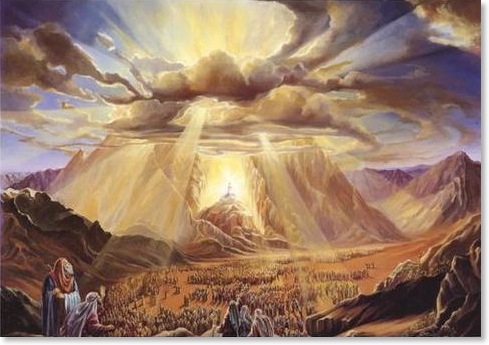
The first Shavuot was likely the day Israel received the Commandments of YHVH.
The feasts also served as key historical markers in the life of ancient Israel: not only embodying our exodus from Egyptian bondage, but also the life and atoning sacrifice of our Master Yahoshua.
The 50-day/7-week period leading up to Shavu’ot matches the amount of time it would have taken us to depart Egyptian territory; trek across the Red Sea and the desert on the other side; enter into Arabia; assemble at the foot of Mount Sinai; and receive Father’s covenant and Torah (Exo. 12-20:1-17).
For the disciple of Yeshua Messiah, the 50-day/7-week period leading up to Shavu’ot is the same, allotted time frame that existed between Yeshua’s resurrection and the giving of the gift of the Holy Spirit as recorded in Acts 2.
During this critical 50-day/7-week period:
The disciples, by means of a makeshift lottery, selected Mathias to replace the trader Judas Iscariot. After this incident, we read nothing more about Mathias. Some in our Faith contend that the disciples acted prematurely and ignorantly, not realizing (or not having it revealed to them) that Judas’ replacement was to be Paul the Apostle. I tend to agree with that assertion.
Furthermore, the Feasts of YHVH have been described as “a shadow of the good things to come, [but] not the very image of the things” (Heb. 10:1; ESV).
I mentioned just a moment ago that I believed, along with many scholars and teachings in our Faith Community, that Torah was passed down to us by YHVH on Shavu’ot Day. Well, it would stand to reason in addition, that Shavu’ot foreshadowed the teachings, modeling and person of our Master Yahoshua our Messiah. Indeed, it goes without saying that Yeshua is the walking-talking Torah. He came down to earth from His Father above to teach us how to live and walk out Torah the way our Creator always intended us to live and walk out Torah.
The Day of the Wave Sheaf Offering serves as the marker day to commence our 50-day count and lead us to Shavuot.
And of course, Shavu’ot foreshadowed and even marked the giving of the Holy Spirit to Yah’s elect. For the Holy Spirit empowers us to live and walk out Torah the way Yeshua taught and modeled for us during His earthly ministry. The Holy Spirit (ie., the Ruach haKodesh):
Believe it or not, fake news surrounding Pentecost/Shavu’ot has been perpetrated upon churchianity as well as certain sectors of our Faith Community.
“Fake news” has to do with what some have termed the “Upper Room Conspiracy,” which I believe to be a very apt moniker for it.
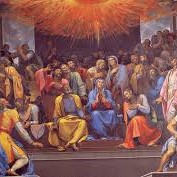
Pentecost/shavuot, one of the annual, mandated Feasts of YHVH, is filled with spiritual significance that every true disciple of Messiah should be aware of.
Verse 3 of the same 2nd chapter of Acts describes that this audible sound manifested itself visually as to that of “divided tongues and as fire sitting upon every one of the disciples” (AENT).
This of course was the long awaited and prophesied outpouring of the Holy Spirit upon His elect, and the token of the renewed covenant that was mediated by our Master Yeshua Messiah (Joe. 2:28; Act. 1:11-15; 2:17).
However, tradition would have us believe that this amazing miracle took place within the confines of the rented space Yeshua’s disciples procured for themselves the day Master ascended to His Father in heaven. Luke refers to this rented space as an “upper room” (Act. 1:13).
But did the miraculous outpouring of the Holy Spirit upon Yeshua’s 120-disciples take place in that upper room in accordance with traditional teaching?
Contextually and semantically speaking, the answer is NO.
The point of contention here has to do with the English term “house,” or in ancient Greek, “oikos.”
Depending on how “oikos” is used by the biblical writer, it may describe a literal house, abode or structure; all the individuals forming a family; or a race or descendants.
Certainly, the fact that Master’s inner circle of 11-remaining disciples rented a space in Jerusalem in obedience to Yahoshua’s instructions (Act. 1:4), especially when we filter this situation through our western mindset, Luke’s choice of the term “oikos,” translated “house” in English, would naturally lead us to conclude that the Holy Spirit descended upon the disciples as they sat in the upper room on the Day of Shavu’ot.
However, recall that at the beginning of this discussion, I mentioned to you that Luke was apt to borrow Greek terms in various places of his writings to describe uniquely Hebrew concepts. (eg., Pentaqostia for Shavu’ot). Truth be told, Luke’s use of “oikos” here is one of those instances.
Remember also that Luke was very familiar with Hebrew vernacular and terminology. But Luke also knew his Gentile audience. Thus he went out of his way to make his accounting of what had taken place, within a completely Jewish context, as understandable to his Gentile readers as he possibly could.
Unfortunately, Luke’s efforts in making this purely Jewish incident understandable to his Gentile readers was not full-proof. Luke no doubt assumed that His Gentile readers would have at least a modest understanding of Jewish vernacular that he could reasonably frame within Greek/Aramaic terms (eg., “oikos” or house). However, Gentile readers who would come along, let’s say some 2,000-years later, would not have that same understanding of Jewish vernacular as some of the Gentiles of Luke’s day. Thus, we (ie., churchianity and members of our Faith Community) would be at a major disadvantage when attempting to translate and understand this and other similar passages of Scripture.
Contextually speaking, Luke’s use of “oikos” here is in no way referring to the disciples’ rented “upper room,” for a number of reasons which I’ll explain momentarily.
The term “house” or “oikos” in this passage must first be understood from a Hebraic/Jewish perspective.
House in Hebrew is “beit. Beit has the same variety of meaning as its Greek counterpart “oikos.” But like its Greek counterpart, in order to understand exactly what the writer is referring to, one must fully grasp the context in which beit is used. (Again, context, context, context is vital to an accurate understanding of scripture.)
Consider the following points of reason:
Given the context and taking into account the points of reason I just laid out for you, one would logically conclude that the term “house” or “oikos” as used by Luke in Acts 2 is referring to the Temple.
How so? It goes back to looking at this thing from a Hebrew perspective. Matthew, Mark and Luke refer to the Temple as the “House.” More specifically, Yeshua referred to the Temple as “The House of Prayer” and Luke records Stephen as referring to the Temple as “the House that Solomon built” (Mat. 12:4; 21:13; Luk. 2:49; Joh. 2:16,17; Act. 7:47). According to Andrew Gabriel Roth: “The Ruach haKodesh was clearly poured out in full view of those in attendance at the Temple, not in some hidden place” (AENT).
So the true story continues: that the Holy Spirit was shed upon Yahoshua’s 120-disciples in the presence of thousands of international Jews, attending and worshiping at the Temple in Jerusalem on the Temple Mount on Shavu’ot Day. And it was on that historic day that some 3,000-souls were added to the Body of Messiah.
These old and new disciples became one big family in Messiah. These—literally hundreds and thousands who stayed behind in Jerusalem—continued in the Temple daily in prayer, worship and in the breaking of bread from house-to-house.
And of course, the rest is history.
So why the centuries’ old fake news regarding the upper room and the outpouring of the Holy Spirit. Well, apart from simple ignorance of what was going on Hebraically on the Temple Mount that Day, it was probably a case of antisemitism. Indeed, as the years passed, the so-called “Church” attempted to remove every vestige of Hebraism they possibly could in response to their utter hatred of the Jews.
Sadly, this and so many other traditions of the “church” have been passed off as “Gospel Truth” because the church chose to abandon the Hebraic Roots of the True Faith once delivered.
Although today we cannot physically keep Shavu’ot as Torah instructs, as we keep all of Yah’s Word in Spirit and in Truth, I came across 5-basic, nonnegotiable things we must strive to do each Shavu’ot:
1. We are to proclaim a holy convocation (ie., a miqra or a sacred assembly) on the Day of Shavu’ot (Lev. 23:21; Num. 28:26). One can pretty much determine what a holy convocation (ie., a sacred assembly) looked like in ancient Israel under the auspices of the old covenant. But for us today, enjoying the tremendous benefits of the renewed covenant, it means that we must strive to assemble ourselves with other like-minded disciples of Y’shua Messiah when reasonably possible (Heb. 10:25). In convening a holy convocation on Shavu’ot, we might sing songs of praise and worship unto YHVH. We might engage in heartfelt prayer unto YHVH. Furthermore, we might engage in the reading of YHVH’s Word of Truth or receive teachings from Yah’s anointed teachers and leaders. All such activities are ordered by the leading of the Holy Spirit (aka, the Ruach haKodesh) and the needs and desires of the assembly (1 Cor. 12:27; Eph. 4:12).
2. We are prohibited from doing any servile work on Shavu’ot Day (Lev. 23:21; Num. 28:26).
3. The keeping of Shavu’ot is to be a perpetual regulation (ie., an everlasting statute) down through every generation (Lev. 23:21). In other words, we are compelled by this instruction to teach our children and those who we are assigned to disciple to keep Shavu’ot each year. And these in turn must teach their children and their assigned disciples.
4. We are to rejoice on Shavu’ot Day before YHVH our Elohim (Deu. 16:11). In other words, we must view the day as a time of celebration and worship before YHVH. This may take the form of spirit-filled praise and worship activities: singing and dancing before YHVH. It may also take the form of breaking bread with our fellow-feast goers.
5. Lastly, We are to bring general and freewill offerings to our sacred assemblies as a form of worship unto YHVH (Lev. 23:26-31; Deu. 16:10). For us today, it can be in the form of financial and material gifts to ministries that feed us. As well as it may be the “fruit of our lips” uttering praise and worship unto YHVH(Heb. 13:15). Additionally, it may entail doing good deeds on Shavu’ot such as assisting those in need of our help; visiting the sick and shut-in of one’ assembly; or lending one’s physical or knowledge expertise to address a brother or sister’s nagging matter or concern. How we serve others and YHVH on Shavu’ot is only limited by our own imagination and our willingness to follow the leading of the Holy Spirit.
Until next time, stay well and blessed fellow saints of the Most High. Shalom. Take care.
The page you requested could not be found. Try refining your search, or use the navigation above to locate the post.
Recent surge in antisemitic type posts on social media involving folks within and without our Faith Community. Also lots of talk in government about physical Israel—the nation state of Israel—which, among so many other things, is polarizing our nation. The other thing has to do with the spiritual awakening we see going on in Israel of late:
Those who are Jews by birth. Paul confirms this in his writings (eg., Rom. 11:13-14; Phi. 3:4,5). For this discussion specifically, I include the citizens of the modern state of Israel who claim Jewish ancestry.
The diaspora of the House of Israel (3,000-years ago) and House of Judah (2,000-years ago) has resulted in a multi-cultural mix:
Some have latched onto teachings that portray physical Israel (specifically the modern nation of Israel)as impostors. Most notable is the assertion that the Jews today, both in and outside the land of Israel, are not descendants of Judah. These assert that Jews today (especially those living in the modern state of Israel) are really Khazarians (ie., descendants of the Khazars). Others assert that the modern nation of Israelites are Zionists. And Zionists are of the Illuminati and the Rothschilds.
The Tanakh suggests that Physical Israel has NOT been lost and forever forgotten by YHVH:
14 For I will be unto Ephraim as a lion, and as a young lion to the house of Judah: I, even I, will tear and go away; I will take away, and none shall rescue him.
15 I will go and return to my place, till they acknowledge their offence, and seek my face: in their affliction they will seek me early.KJV Hosea 6:1 Come, and let us return unto the LORD: for he hath torn, and he will heal us; he hath smitten, and he will bind us up.
2 After two days will he revive us: in the third day he will raise us up, and we shall live in his sight.
3 Then shall we know, if we follow on to know the LORD: his going forth is prepared as the morning; and he shall come unto us as the rain, as the latter and former rain unto the earth.
4 O Ephraim, what shall I do unto thee? O Judah, what shall I do unto thee? for your goodness is as a morning cloud, and as the early dew it goeth away. (Hos 5:14-6:4 KJV)
Contextually speaking, Hosea is prophesying of the return of the House of Israel to the Land of Promise here. To date however, House of Israel has not returned to the Land. (Could be some of us.)
5 Therefore have I hewed them by the prophets; I have slain them by the words of my mouth: and thy judgments are as the light that goeth forth.
6 For I desired mercy, and not sacrifice; and the knowledge of God more than burnt offerings.
7 But they like men have transgressed the covenant: there have they dealt treacherously against me.
8 Gilead is a city of them that work iniquity, and is polluted with blood.
9 And as troops of robbers wait for a man, so the company of priests murder in the way by consent: for they commit lewdness.
10 I have seen an horrible thing in the house of Israel: there is the whoredom of Ephraim, Israel is defiled.
11 Also, O Judah, he hath set an harvest for thee, when I returned the captivity of my people. (Hos 6:5-11 KJV)
Could be speaking to Judah’s return to the Land after Babylonian Captivity, but since it’s grouped here with a return of House of Israel, Judah’s prophetic return to the land could be a dual prophecy.
Many contend that Judah forfeited her place as a chosen people of Yah when they crucified our Master, Yeshua Messiah (ie., the leaders of Judaism) and the nation’s rejection of Yeshua as their Messiah. Yet that which the Jewish leaders meant for evil (ie., in the crucifixion of our Master), Yah used for good to fulfill His eternal purpose:
28 And we know that all things work together for good to them that love God, to them who are the called according to his purpose. (Rom 8:28 KJV)
Indeed, Yah is not finished with Judah. As we see in Zechariah, Father will bring Judah back to Himself both physically and spiritually:
7 The LORD also shall save the tents of Judah first, that the glory of the house of David and the glory of the inhabitants of Jerusalem do not magnify themselves against Judah.
8 In that day shall the LORD defend the inhabitants of Jerusalem; and he that is feeble among them at that day shall be as David; and the house of David shall be as God, as the angel of the LORD before them.
9 And it shall come to pass in that day, that I will seek to destroy all the nations that come against Jerusalem.
10 And I will pour upon the house of David, and upon the inhabitants of Jerusalem, the spirit of grace and of supplications: and they shall look upon me whom they have pierced, and they shall mourn for him, as one mourneth for his only son, and shall be in bitterness for him, as one that is in bitterness for his firstborn.
11 In that day shall there be a great mourning in Jerusalem, as the mourning of Hadadrimmon in the valley of Megiddon.
12 And the land shall mourn, every family apart; the family of the house of David apart, and their wives apart; the family of the house of Nathan apart, and their wives apart;
13 The family of the house of Levi apart, and their wives apart; the family of Shimei apart, and their wives apart;
14 All the families that remain, every family apart, and their wives apart. (Zec 12:7-14 KJV)
As maddening as this may sound, the Jew’s selling out of Y’shua to the Romans was ultimately good for the Jew. This concept of intended evils being used by Yah to achieve His purpose was clearly seen in Joseph revealing to his brothers that what happened to him by his brothers’ selling him into slavery ultimately served to save their entire family from the famine (Jasher 54:69):
“And Joseph observed all their acts (his brothers’) and said unto them, ‘Why do you look here and there? I am Joseph whom you sold to Egypt. Now, therefore, let it not grieve you that you sold me. For as a support during the famine did God send me before you’” (cf. Gen. 37:23).
Despite what many contend, physical Israel will play a pivotal role in the End of Days as this dual purpose prophecy seems to suggest:
Search as one may, the title or descriptor “Spiritual Israel” is not found in Scripture. I believe it was born out of the antisemitic-based doctrine of “Replacement Theology.”
Failure to adopt a universal understanding of who and what is physical Israel (to include the modern nation of Israel).
In failing to adopt a universal understanding of the significance (or insignificance) physical Israel currently plays and will play in our lives relative to biblical prophecy.
People of Faith have a nasty habit of boxing YHVH (and His Word and Work) to fit into preconceived boxes that they’ve constructed for themselves.
Those boxes are often built upon personal biases; fear; hatred; misplaced adoration; personal preferences; ignorance; bigotry; blind obedience.
1. The hatred towards the citizens and inhabitants of the nation state of Israel, as well as towards Jews worldwide, suggests that we may need a healing of our hearts. A softening of our hearts and souls. To love and care about others as our heavenly Father loves and cares for us. (Antisemitism)
2. Supersessionism, or as more popularly known to scholars as “Replacement Theology,” among so many other things, focus on Paul’s concerns about physical Israel and where they fit in Yah’s plan of salvation, and created a false doctrine that replaces physical Israel with Christians. These call themselves “spiritual Israel.”
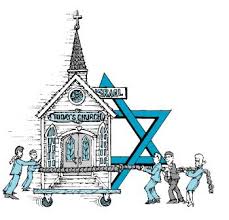
Replacement Theology is at the heart of a great deal of the negative rhetoric we hear regarding physical Israel within Christian and Hebrew Roots circles today.
KJV Romans 9:1 I say the truth in Christ, I lie not, my conscience also bearing me witness in the Holy Ghost,
2 That I have great heaviness and continual sorrow in my heart.
3 For I could wish that myself were accursed from Christ for my brethren, my kinsmen according to the flesh:
4 Who are Israelites; to whom pertaineth the adoption, and the glory, and the covenants, and the giving of the law, and the service of God, and the promises;
5 Whose are the fathers, and of whom as concerning the flesh Christ came, who is over all, God blessed for ever. Amen.
6 Not as though the word of God hath taken none effect. For they are not all Israel, which are of Israel:
7 Neither, because they are the seed of Abraham, are they all children: but, In Isaac shall thy seed be called.
8 That is, They which are the children of the flesh, these are not the children of God: but the children of the promise are counted for the seed. (Rom 9:1-8 KJV)
28 There is neither Jew nor Greek, there is neither bond nor free, there is neither male nor female: for ye are all one in Christ Jesus.
29 And if ye be Christ’s, then are ye Abraham’s seed, and heirs according to the promise.
(Gal 3:28-29 KJV)
When looking at the Supersessionists’ replacement theology from a biblical perspective, and for the moment resist spiritualizing the topic of physical Israel, I believe we must keep two things in mind:
Regarding the seed of Abraham: Abraham became the father of/to many nations—not just the Father of the Jews (I.e., House of Judah or the Jews) (Gen. 17:5). So why do we feel we have to replace physical Israel as a so-called “spiritual Israel?” The Bible nowhere suggests such a thing.
Case in point: Abraham had 8 sons according to Scripture (although churchianity teaches that he had just Isaac and the illegitimate Ismael):
I. Isaac
II. Ishmael
III. Zimran
IV. Jokshan
V. Medan
VI. Midian
VII. Isbak
VIII. Shuah
In using agricultural terminology, Paul put the issue of the “physical” Jew and Gentiles coming into Faith. He likened the Gentile coming into Faith as that of a “wild olive branch” that is grafted into a cultured olive tree. That cultured olive tree is true physical Israel—the commonwealth of Israel—those who keep the commandments of YHVH and have the testimony of Y’shua Messiah. (Rev. 12:17).
But Paul warned that we are NOT at all the tree nor have we become a replacement for the tree. We are branches (Rom. 11:17).
As branches being grafted to the tree, we become partakers of the tree, receiving the fatness (ie., the necessary nutrients) of the tree’s root system.
Paul further taught that it was unbelief (ie., blindness of the Jew) that led to our plum spot in YHVH’s Plan of Salvation. (If Judah would have recognized the visitation of her Messiah, those branches would have remained in place. Some physical Israelites, however, recognized and accepted the visitation of their Messiah, as have so many today who have come to a saving knowledge of Y’shua Messiah. These have been grafted back into the tree or the commonwealth of Israel.
And as we closer to the End, more and more of those purged branches (rebellious physical Israelites) will have the scales dropped form their eyes; the veil over the minds removed; and the callouses over their hearts broken off, and they will be grafted back into the tree along with us (Rom. 11:23,24).
9 And on that day I will seek to destroy all the nations that come against Jerusalem.
10 “And I will pour out on the house of David and the inhabitants of Jerusalem a spirit of grace and pleas for mercy, so that, when they look on me, on him whom they have pierced, they shall mourn for him, as one mourns for an only child, and weep bitterly over him, as one weeps over a firstborn. (Zec 12:9-10 ESV)
As grafted branches, we must be very careful in adopting such attitudes as the “Supersessionists” have done: casting dispersions and hate toward those who are physical Israelites or Jews in general.
In fact, Paul warned about this very thing, which we see happening today, even in our own Faith Community. Paul warned that we must come at this question of being grafted in to the commonwealth of physical Israel, not from a place of arrogance, but from a place of fear (respect). In other words, be fearful (actually terrified) of losing your place. Paul wrote:
18 Boast not against the branches. But if thou boast, thou bearest not the root, but the root thee.
19 Thou wilt say then, The branches were broken off, that I might be graffed in.
20 Well; because of unbelief they were broken off, and thou standest by faith. Be not highminded, but fear:
21 For if God spared not the natural branches, take heed lest he also spare not thee.
22 Behold therefore the goodness and severity of God: on them which fell, severity; but toward thee, goodness, if thou continue in his goodness: otherwise thou also shalt be cut off. (Rom 11:18-22 KJV)
It should go without saying that supersessionists, in making such claims that they have replaced physical Israel, and are now THE chosen people of YHVH, that they best walk carefully as Paul so warned above. For the mantle of being Israel carries with it great responsibility. And they best be ready to fulfill that mantle or else.
We will pick this up in our next installment.
Faithfully
The page you requested could not be found. Try refining your search, or use the navigation above to locate the post.
The Shemitah and Jubilee regulations contained in this week’s Torah Portion embody the principle elements of rest, freedom and redemption. These three principle elements are intricately linked to the mission of our Master Y’shua Messiah.
Although we were commanded in Father’s Torah to observe Shemitah (ie., the Sabbatical Year) and Jubilee (Year of Release and Freedom), these two calendar events are Torah instructions that do not directly apply to us who are living outside the Land of Israel (Lev. 25:2). The commands related to the Shemitah and Jubilee were only applicable to the Hebrews residing in the Land of Israel.
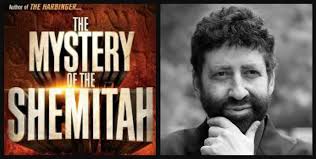
Johnathan Cahn and others were instrumental in introducing Shemitah to mainstream Christianity and Hebrew Roots communities.
Other members of our Faith Community have misapplied the regulations tied to Shemitah and Jubilee to their personal vocations and businesses. The members who have misrepresented and misapplied Shemitah and Jubilee have generally been Hebrew Roots and Messianic congregation and fellowship leaders. They teach false doctrine surrounding Shemitah and Jubilee that prompt their members to give resources and moneys to their organizations.
The exact date when the last Shemitah and Jubilee occurred in Israel has been long lost and forgotten.
However, the Rabbis did take it upon themselves to establish the first Shemitah in the modern State of Israel in 1951-52. The last rabbinic-directed Shemitah on record was 2014-15. Consequently, many farmers in the land of Israel observe the Shemitah, although the commandments surrounding Shemitah and Jubilee are not universally accepted by the Jews of the modern state of Israel.
Now, none of what of this is to say that Shemitah and Jubilee hold no significance to the Yeshua-focused Torah Observant disciple of Messiah today. There is indeed tremendous spiritual and prophetic symbolism embodied in both calendar events that we must be aware of.
There are key principle elements of Shemitah and Jubilee that are intricately linked to our identity and redemptive status in Y’shua Messiah.
The elements of Shemitah and Jubilee I’m referencing are (1) rest, (2) redemption, and (3) freedom.
I believe the reason we have so many physically and spiritually oppressed people in our Faith Community today is because they have not truly embraced their royal and priestly identities nor have they recognized their redemptive status in Messiah. These do not walk in the power and might of the Creator’s precious Holy Spirit. Thus, they’re chronically ill; have never-ending financial problems; undergo continuous turmoil in their lives; are miserable individuals; and I could go on forever.
Our Torah Portion for this week is contained in Leviticus 25:1-26:2 with its Haftarah reading in Jeremiah 32:6-27 .
The reading begins with Father commanding us to give the land a “Shabbat Rest” every 7th year. During that year, there was to be no planting/sowing of crops and no pruning of fruit trees and grape vines. Whatever the land produced on its own during this Sabbath Rest period would be our food.
This year is also referred to as “The Sabbath” (or Sabbatical) Year. It has become more popularly referred to as the Shemitah or Shemitah Year.
Shemittah offered us the opportunity to exercise our faith for that year. If we were faithful in keeping the Sabbatical Year regulation, Father promised an abundant harvest that would cover us from the 6th year’s harvest (ie., the very last possible planting season before Shemittah began) and last us up the time that the 8th year’s harvest came in (25:20-22). This was not only faith in action, but also Father’s miraculous provision manifested.
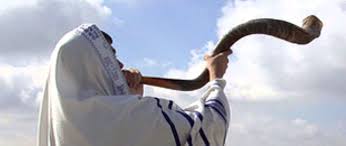
The Year of Jubilee was a year of redemption. Slaves released and returned to their land. It was a year of property reverting back to their original owner. All symbolic of the work of our Master Y’shua Messiah.
YHVH commanded us to keep Jubilee every 50th-year. It was to begin in year 49 on Yom Kippur (ie., the Day of Atonement). On that day, we were commanded to blow shofars the entire day.
Father described the time as a year of freedom (aka, liberty). In the Jubilee, all land property must revert back to its original owner. Beyond land property, slaves and servants were to be released or freed from their servitude and obligation. Any outstanding debts were to be eliminated and treated as having been paid in full by the creditor.
Keeping the provisions and regulations of Shemittah and Jubilee guaranteed our security and wellbeing in the land. Father promised that our harvests would be bountiful and our safety in the land would be guaranteed (25:18,19).
No land property would be sold to another on a permanent basis. There would always be included in the sale a “right of redemption” clause.
Now, this is a principle that puts the whole issue of land ownership into proper perspective for us. A fundamental law of property ownership is that no human ever truly owns land. All the land belongs to YHVH (25:23,24).
We read of this principle throughout Scripture:
Psalm 24:1—The earth is YHVH’s and the fullness thereof; the world, and they that dwell therein” (cf. 1 Cor. 10:26-28; KJV).
The “Right of Redemption” provided for that at anytime after someone sells their property to a buyer, they or their next-of-kin could redeem the sold property at an amortized price (25:25-28). Otherwise, the property automatically reverted back to the original owner in the Jubilee Year without cost to the owner.
As I previously mentioned, there are three fundamental themes or shadow pictures embodied in these two calendar events:
Many Messianic Jewish congregations throughout the world incorporate into their Torah—Haftarah readings on Shabbat, related readings from the New Testament (aka, the Brit H’dashah). For this week’s Torah Reading, Luke’s account of the events surrounding Y’shua reading from Isaiah 61 in a Nazareth synagogue seems most fitting for our discussion.
As the story goes, it was Master’s practice during His earthly ministry to attend synagogue service every Shabbat. Thus, it was at the very start of His ministry that he attended a synagogue service in his hometown of Nazareth on one particular weekly Sabbath day.
Luke records that Master was invited to read the Haftarah Reading for that particular Sabbath. The passage for that Sabbath happened to be out of Yeshayahu (specifically Isaiah 61:1,2a). What Y’shua read was as follows:
“The Spirit of the Lord is upon me, because He anointed me to preach good tidings to the poor. He hath sent me to proclaim release to the captives, and recovering of sight to the blind; to set at liberty them that are bruised. To proclaim the acceptable year of the Lord” (ESV).
Can you see the Shemitah and Jubilee themes and shadows contained in Y’shua’s declaration that He is the fulfillment of Isaiah 61:1, 2: rest; release; liberty; the acceptable year of YHVH?
Rest
The first Shemitah principle is “rest.”
Master taught us the following:
Come to me all who labor are heavy laden and I will give you rest. Take my yoke upon you and learn from me, for I am gentle and lowly in heart: and ye shall find rest unto your souls (Mat. 11:28,29; ESV).
When we were truly obedient to Father’s Torah, we prospered and existed in restful security in the Land He promised us and our forefathers. Of Father’s instructions, the Prophet Jeremiah wrote:
Thus saith YHVH, stand ye in the ways and see, and ask for the old paths, where is the good way and walk therein, and ye shall find rest for your souls. But they said, we will not walk therein (Jer. 6:16; KJV).
So it is: when we give ourselves over to the teachings of our Master and follow Father’s Torah the way Master taught and modeled, we prosper and flourish. In that prospering and flourishing, we find rest. For we no longer are jostled about by the rigors of this uncertain life.
The next principle that is beautifully illustrated in the Jubilee is that of “freedom” (aka referred to as liberty in most English translations of the New Testament).
Among a number of things, freedom in Messiah means freedom from the restraints and miseries of our earthly frailties to be manifested in the glorious condition of our future life:
“For I consider that the sufferings of this present time are not worth comparing with the glory that is going to be revealed to us. For the creation eagerly waits with anticipation for God’s sons to be revealed. For the creation was subjected to futility (frustration)—not willingly, but because of Him who subjected it—in the hope that the creation itself will also be set free from the bondage of corruption into the glorious freedom of God’s children” (Rom. 8:18-21; CSB).
There is a freedom that naturally comes to those who become disciples of Y’shua Messiah. Paul wrote to the Assembly of Messianic believers:
“Now the Lord is the Spirit and where the Spirit of the Lord is, there is freedom” (2 Cor. 3:17; ESV).
We have liberty from the yoke of the ceremonial law and the servitude of corruption. We have direct access to YHVH 24/7 and we no longer require a human mediator.
We have freedom of speech through the agency of prayer/petitions/worship that are put forth to our Heavenly Father in spirit and in truth. Our hearts and the Holy Spirit direct our walk in Messiah, just as the Creator always intended us to live.
The “Spirit-empowered” message brought to the world by Messiah brought about a true nation of Israelites who would be freed from the entanglements of this world and the bonds of hasatan.
For us today, this is the “Spirit-empowered” message we must grab hold to and walk in it. We have been freed from the evils of this world and we have the power to do great things in Messiah if we just take that step of Faith and live in that freedom.
Unfortunately, too many of us are reluctant to embrace the freedom and rest that comes with being a true disciple of Y’shua Messiah. We’re too busy getting into other things that we’re not supposed to be getting into.
Master’s “Spirit-empowered” message brought with it freedom from the enslavement of religion. Paul touched upon this when he addressed the problems that were being caused by Judaizers in the Galatian Assembly:
Yet because of false brothers secretly brought in, who slipped in to spy out our freedom that we have in Christ Jesus, so that they might bring us into slavery (Gal. 2:4; ESV).
For ye have not received the spirit of bondage again to fear; but ye have received the spirit of adoption, whereby we cry Abba, Father. The Spirit itself beareth witness with our spirit, that we are the children of God (Rom. 8:15,16; KJV; cf. Gal. 4:6).
Religion, secularism, and sin are all forms of bondage which Master came to deliver us from. We have received liberty—freedom and rest from these life influences.
Before coming to true Faith, when we were in the world or in religion, the things of this world, our flesh and religion served as our fathers—and by default our captors.
We’ve been freed from all that because we’ve been redeemed and adopted as children of the Most High God. Thus we can honestly refer to YHVH as Father. This is reality that we must fully understand and walk in if we are to live victorious lives as Torah observant disciples of Y’shua Messiah.
When speaking to some of the religious leaders who believed in Him, Y’shua taught:
“If you continue in my word, then you are my disciples indeed. You shall know the truth, and the truth shall set you free. Then some of the Prushim retored, ‘We are Avraham’s seed! We were never in bondage to any man, so how can you say, ‘You shall be set free?’’ Y’shua answered them, ‘Truth, I say to you, whoever willfully commits sin is the slave of sin. The servant does not abide in the house forever, but the Son abides forever. Therefore, if the Son sets you free from sin, you shall indeed be free to abide in the house” (John 8:31-36; Rood’s Chronology).
In being freed from the bondage of sin, it becomes our responsibility to not sin. For once we willingly submit ourselves to the tug and pull of sin, we become slaves to sin. Y’shua’s work has alerted us to this danger and has provided us the wherewithal to resist and overcome our sinful nature. It is the gift of the Holy Spirit that works within us to help us overcome our sinful nature. In living a life absent of sin, we abide with the Father in wonderful harmony; freedom; and rest.
Paul wrote to the Messianic Assembly of Believers in Galatia:
Christ has liberated us to be free. Stand firm then and don’t submit again to a yoke of slavery (Ga. 5:1; CSB).
Redemption
And the last shadow element of Jubilee to discuss is redemption.
On the subject of redemption Paul wrote to Titus:
That He might redeem us from all iniquity and purify unto Himself a peculiar people (Tit. 2:14; KJV).
We’ve been bought with a price (1 Cor. 6:20; 7:23). In so being purchased by YHVH—effectively being redeemed from hasatan who is the god of this earth through Y’shua’s sacrifice—we are obligated to walk in the ways of our redeemer.
Again, Paul wrote on redemption in the following two letters:
In whom (speaking of Y’shua Messiah) we have redemption through His blood, even the forgiveness of sins (Col. 1:14; KJV).
To redeem them that were under the law, that we might receive the adoption of sons (Gal. 4:5; KJV).
1. Our focus must be Torah-living that is based in Spirit and in Truth.
2. As Yeshua-focused Torah-keepers, our focus should not be rote, mechanical obedience to man-made traditions that some claim are based on Torah. This does not mean we abandon the fundamentals of Torah. Torah serves as our baseline for living in accordance to the way Father would have us live as His beloved children. It is Father’s house-rules for acceptable Godly living.
3. We must walk in the freedom and redemption that Y’shua’s ministry and sacrifice purchased for us.
4. As Yeshua-focused Torah-keepers, we find rest and peace in Father’s and Master’s teachings. We don’t worry or fret about the things going on around us in this crazy world of ours. We live as people of Faith and trust Father to provide and guide and deliver us from problems when necessary. Just as was portrayed in our letting the land rest every 7th year, Father provided, prospered and protected us in the land.
5. Embrace the reality and walk in the rest, redemption and freedom that comes with being a disciple of Messiah. We are a royal kingdom of priests and children of the Most High God (ie., Elohim).
Until next time, may you, your families and fellowships be most blessed, fellow saints of the Most High. Shalom. Take care.
The page you requested could not be found. Try refining your search, or use the navigation above to locate the post.
It is the glory of God to conceal a thing: but the honor of kings is to search out a matter” (Pro. 25:2; KJV).
How’s your Bible Study life going these days? Good? Could be better? Bad? Non-existent?
Well, in today’s installment of the Messianic Torah Observer, I’m going to give you 10-things you can do (beginning today) that I guarantee will dramatically improve your understanding of the Bible; the things of YHVH and of His Torah; the teachings of Y’shua our Messiah; and even Paul’s writings and teachings.
There’s no way around it: we have to actually read our bibles in order for us to understand the things of YHVH our God (Elohim). And we must read our bibles on a frequent basis.
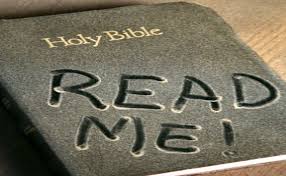
Abba communicates with us primarily through His Word. When we don’t properly read and study the Bible, we miss that which Father has to tell us.
Additionally, do not settle for just one bible teacher. Most bible teachers tend to limit their focus and understanding of the bible to just one or two main topic areas. Those who tie themselves to just one teacher run the risk of becoming myopic in their biblical understanding and perspectives.
Lastly, invest in your education. Identify those extra-biblical books that will help you in your studies and when you can afford it, buy it. Do not fear the author(s) denomination per se. If you are grounded in the essentials of the Faith you should be capable of separating the meat from the bones (ie., truth from error).
[I invite you to read or listen to my post entitled “Understanding the Bible Part-2-Why Believers Should Read Their Bibles” for a more in-depth examination on the importance of bible study.]
If possible, read the entire book that contains your target passage or verse. (A passage generally consists of two or more verses.)
Context is one of the most important elements to sound bible study. In fact, context is vital to any true understanding of Paul’s writings and teachings.
When we attempt to circumvent context in our studies, we run the risk of misinterpreting and misunderstanding our focus texts.
There are many options available to you as it relates to having access to multiple English bible translations. Some are free of charge online resources such as BibleHub. Others are paid resources that contain multiple English translations such as Logos Bible Study Software and WordSearch Bible Software.
I would recommend, however, using a sound English Bible translation as your main reference bible such as the ESV, CSB, NASB or the NET. I personally favor the ESV.
Resources such as Hebrew and Greek lexicons, bible dictionaries, geographical references, online biblical resource sites and a general internet search engine can be vital to your understanding of Scripture.
We must never overlook the fact that the bible is a book containing ancient texts, written over roughly a 2-millennia period, covering some 3,500-years of Hebrew history. Given the antiquated nature of the bible, many of the ancient Hebrew, Greek and Aramaic words used by the authors of the original writings are extremely difficult to translate into modern English.
For instance: most of us living in 21st-century western society are ignorant of the geography of the Middle East and Palestine. So many of the places the authors recorded in their writings will be foreign to us. Additionally, many of the customs, cultures and practices of the ancient peoples of Palestine would be foreign to us as well. Thus, the aforementioned resources serve to inform us of the ancient people, their practices, culture, society, etc. that would not otherwise be revealed in the bible.
It is a widely held understanding in our western society that the most precious commodity any of us possess today is time. Unfortunately for many of us, time is so precious that any time we would conceivably have for study of Yah’s Word is reduced or eliminated by the cares of life.
When asked by His disciples to explain to them the meaning of the Parable of the Sower (ref. Luk. 8:4-8) that described how some seed–seed illustrative of God’s Word–fell upon thorny soil. Y’shua explained seed falling on thorny soil as would-be believers who fail to receive or implement Truth in their lives because they are hampered by the cares and riches and pleasures of this life (Luk. 8:14).
Our eternal security—our relationship with the Most High—the health of our relationships with others—our service to the Kingdom of YHVH are detailed in the pages of the Bible. We have little hope of ever realizing our true destiny as Children of YHVH unless we get our noses into our Bibles on a frequent basis. Sadly, finding the time to do so for many of us is not an easy thing to do.
Nevertheless, finding the time to do so is something we must work out.
I vividly recall having to find time to study the Word when I was working. Well, determined to fit study into my busy schedule, I started getting up earlier than I was normally used to. I was successful in getting my studies in. And I was tremendously blessed by that effort.
At the very least, I would devote most of my Sabbath to the study of Yah’s Word.
Seek Father for ways to carve out time to meet with Him in prayer and study of His Word.
Prayer and fasting are vital elements of our Faith walk. When we deny ourselves sustenance (ie., food) in exchange for seeking Yah’s Face in fervent and meaningful prayer, by default we focus our entire attention on Father. In focusing our attention onto Father, He is then able, through His Holy Spirit, to teach us and reveal things about Himself and His Word that you would not otherwise receive going through a normal day (reference: Psm. 35:13; Dan. 9:3; Mat. 17:21; Mar. 9:29; 1 Cor. 7:5).
Biblical meditation, as it relates to the Torah Observant Believer in Y’shua Messiah, is a “pondering for a proper answer (Prov. 15:28); talking about wise things or Yah’s righteousness (Psm. 37:30; 35:28; 71:24).
It is upon Abba’s Word that we are to ponder “day and night” (Jos. 1:8; Psm. 1:2).
Biblical meditation may involve indiscernible mutterings (often described as whispering) and musings on our part throughout the day as it relates to Yah’s Word. The writer of Psalms 63:6 and 77:12 wrote about meditation/pondering upon YHVH and His works.
Each of us needs someone who is really grounded in the Faith we can trust to discuss the things of the Faith with. I call such people “accountability partners.”
When we are without an accountability partner and we are walking out this Faith alone, open ourselves to negative doctrinal influences. A good accountability partner helps keep us centered on the fundamental elements of the Faith and helps us resist falling for false teachings and doctrines.
In order to be good students of the bible, each of us must be willing to dispel old and even present religious, cultural and experiential mindsets and understandings about biblical concepts we may have brought over with us from our past lives. We must be willing and unafraid to question all that we’ve ever believed or even currently believe that is not supported by Scripture.
Of those Ephesian women who were delving into false teachings (which Paul described as myths and fables), Paul commented that they were “always learning and never able to arrive at a knowledge of the truth” (2 Tim. 3:7; ESV). What Paul was getting at in this verse was that there were individuals in the Ephesian Assembly of Messianic Believers who were constantly latching on to the latest and greatest false teachings. These women (and we’ll talk more in-depth about this in part-10 of our Paul and Hebrew Roots series) refused to give themselves over to sound teaching of Torah and the Gospel. These grabbed just enough truth to get themselves into spiritual trouble while they held on to their old ways. In so doing, they attached the little new truth they acquired in the assemblies to their original religious beliefs and practices. In so doing, they created myths and fables, and a false understanding of the True Faith.
This remains a real danger even today when we fail to give ourselves over to sound teaching of the Word.
[For a more in-depth discussion on the importance of getting rid of the old way of thinking and following sound, biblically sound doctrine, I invite you to read or listen to my post entitle “Endure Sound Doctrine I will Not.”]
We are called by our Master to share that which we learn with others. (This is apart from discussing it with your accountability partner(s)).
Accumulating head knowledge related to the things of our Faith without sharing it with others is, quite frankly, deplorable and in some cases even sinful.
It was during Master’s first “Sermon on the Mount” that He declared to the attendees (and by default to us living today):
“You are the salt of the earth; but if the salt has lost its flavor, how shall the earth be salted? The salt is then good for nothing, but to be cast out, and to be trodden under foot of men. You are the light of the world. A city that is set on an hill cannot be hid. Men do not light a lamp and put it under a basket, but on a lampstand; and it gives light to all who are in the house. Let your light so shine before men, that they may see your good works, and glorify your Father who is in heaven” (Rood, Mat. 5:13-16).
Unlike a dear Brother in our Faith who I totally admire and respect is famous for telling his listeners to “go home and read your bibles,” I say go home and be one with your Bible. Allow your Bible to become real to you. Allow YHVH to reveal Himself to you through the pages of His eternal Word. When we do this, we allow the Word to take us to the greatest heights and deepest depths than ever before.
Until next time, may you, your families and fellowships be blessed in Y’shua Messiah. Take care. Shalom.
The page you requested could not be found. Try refining your search, or use the navigation above to locate the post.
I came up with today’s teaching from this week’s Torah Portion/Reading which is entitled Kodoshim (Holy People). It is found in Leviticus 19:1-20:27. It is a delineation of behaviors that YHVH gave to us for purposes of setting us apart as a people from the other nations of the region. YHVH was calling us to be a holy people.
As I was reading and meditating on this Torah Portion, I was reminded of the horrific times we are currently living in this country of ours (ie., the United States). I believe you would agree with me that we are living in “perilous times” as Paul described to Timothy (2 Tim. 3:1).
For us, this is a time when our nation’s leaders and the citizens of our country now call that which is evil good and that which is good evil. They seek to change darkness into light and light into darkness. These go even farther, seeking to change bitter into sweet and sweet into bitter (Isa. 5:20).
And the irony in all this is that most of the people in our western society know better (i.e., they know the difference between good and evil). For we have touted ourselves over the years as a “God-fearing” and a “Judaeo-Christian” nation. In so classifying ourselves as such, it has been become somewhat interwoven into the moral fabric of our nation the clear understanding of the difference between that which is good and that which is evil. The ironic tragedy in this is that we as a nation, in knowing better but failing to do better, will be held accountable for our sinful, rebellious lifestyles that oppose YHVH’s Torah.
This week’s Torah Reading, Kodoshim—Holy People—outlined for us behavior that Father deemed as abhorrent and unacceptable to Him. As well as He outlined righteous behavior that would distinguish us from the other nations of the world.
Throughout the two chapters of this reading, Father over and over inserted His demand that we “be holy as He, our Elohim, is holy” (Lev. 19:2; etc.).
Holy as a term and concept simply means “to be set apart.”
The list of prohibitions and sanctioned-prescribed behavior is significant. Father does not expend any extra writing space in delivering his prescribed ordinances and commandments for holy living.
Many have complained that the Old Testament was too difficult to understand. These complain that there are too many genealogies, or that the prescribed worship ceremonies are too complicated to understand.
However, in this portion, Father’s instructions regarding that which was acceptable versus what was not acceptable behavior was precise and succinct. He was quite clear in revealing to us the behaviors that were acceptable and the behaviors that were not.
So let’s take a look at a few of these prohibitions and sanctioned behaviors.
These prohibited behaviors, and so many others from this Torah Portion, were actually being practiced by the nations dwelling in the land of Canaan.
The horrifically sinful practices of these people nauseated Father to the point that He instructed us not to follow their example. These people were ultimately wiped out from the Land.
In Leviticus 20:23, Father is recorded as commanding us:
“And walk ye not in the customs of the nations which I drive out from before you; for they have done all these things, and I have abhorred (ie., detested) them” (LXX).
Thus it was the sins of the inhabitants of Canaan, in great part, that caused Father to expel them from the Land. And the land would be turned over to Israel as originally promised (Exo. 3:8, 17; 13:5; 33:3).
Father gave us these holiness instructions so that we may be set apart from all other peoples of the world (20:26).
 In His love for us, Father selected us from all the people nations of the world. His love for us was of such a degree that He instructed us to be holy as He is holy.
On this issue, the Apostle Peter wrote:
“As obedient children, do not be conformed to the passions of your former ignorance, but as He who called you is holy, you also be holy in all your conduct, since it is written, ‘You shall be holy, for I am holy” (1 Pet. 1:14-16; ESV).
Yet today, Christian pastors and preacher (and dare I say some Hebrew Roots teachers) are teaching the false doctrine that Torah has been done away with. Or that Torah is only for the Jews.
Such doctrine is of course a lie from the pit of hell. Even secular, non-Hebrew Rooters, anti-Torah advocates, fundamental/charismatic/traditional Christians inherently recognize that it is wrong to lie, kill, steal, commit adultery, condone and or practice homosexuality, have and or support the practice of abortions, etc. Yet there is a movement afoot in many segments of our society—be they secular or religious—that is promoting rebellion against the God that gave us the Bible as His instruction manual for proper, Godly living.
The Land Will Vomit Us Out
Father warned us:
“And keep ye all my ordinances and my judgments; and ye shall do them and the land shall not be aggrieved with you, into which I bring you to dwell upon it” (Lev. 20:22; LXX).
The ESV is a bit more graphic:
“You shall therefore keep all my statutes and all my rules and do them, that the land where I am bringing you to live may not vomit you out” (ESV).
It is clear that Israel violated YHVH’s Torah over and over throughout her history. And it is no secret that she was vomited out of the Land on at least three-occasions, just as the previous occupants were.
Now, many will reject that any of this applies to the citizens of the U.S. and that this only applied to Israel. Well, I used to think that way. But lately, given all the terrible things we are witnessing in our government and in our society today, I have a sinking suspicion that at some point, our nation is going to have to “pay the piper.”
In other words, we as a so-called “Judaeo-Christian” nation that knows right from wrong, are going to have to answer for our rebellion against God and His Torah. As well as we will have to answer for this nation’s unrepentant sins. It’s not a question of if, but of when.
Indeed, unless we as a nation humble ourselves , pray, and seek the face of our heavenly Father, and turn from our wicked ways, we may face the same punishment that Israel faced at least three-times in her history.
YHVH has given us in this Torah Reading–these holiness instructions– so that we may be set-apart from all other peoples of the world (20:26).
So with all the sinful rebellion we currently see going on around us, I believe we have a few responsibilities set before us:
Father has graciously given us His Torah that instructs us in righteous, holy living. Failure to live holy lives may result in our being rejected by our Master when He comes to judge the world.
Did not Master warn us of the following:
“Many will say to me in that day, Lord, Lord, have we not prophesied in thy name? And in thy name have cast out devils? And in thy name done many wonderful works? And then will I profess unto them, I never knew you: depart from me, ye that work iniquity. Therefore whosoever heareth these sayings of mine and doeth them, I will liken him unto a wise man, which built his house upon a rock: and the rain descended and the floods came, and winds blew and beat upon that house; and it fell not: for it was founded upon a rock. And every one that heareth these sayings of mine and doeth them not, shall be likened unto a foolish man, which built his house upon the sand: And the rain descended, and floods came, and the winds blew, and beat upon that house; and it fell: and great was the fall of it” (Mat. 7:22-27; KJV).
Have we not, for instance, witnessed of late those who profess to be true, dyed-in-the-wool believers in Jesus Christ (ie., Christians and such), doing God’s work, but are admitted homosexuals or even adulterers?
We currently have a former mayor of an Iowa town-a presidential candidate-who professes to be a practicing Christian. This individual also proudly professes to be a gay-man married to another gay-man. He had the nerve recently to criticize and condemn any self-professing Christian who would reject his sinful lifestyle.
The message that is being spread by this individual throughout the whole of this nation is one of rebellion. His message encourages the rejection of the Truth of the Bible, to be replaced by a false-biblical truth made up to justify one’s sinful lifestyle.
He is spreading the lie that the Bible does not speak out against homosexuality. Others like him are spreading a twisted Truth that God and Jesus loves everyone, regardless who and what you are.
It is, of course, a horrendous twisting of Scripture for purposes of justifying their rebellious, sinful lifestyle. And sadly, untold numbers of foolish citizens are buying into this satanically founded twisting of Biblical Truth. As we saw earlier, homosexuality IS seen by Father as an abomination, punishable by death. Case closed. No if and’s or buts.
And then we have, of late, the abortionists who have sought to turn the entire nation, including Christians, to their side. These have been putting forth a message that it’s better for the unborn, aborted child that they not be subject to whatever terrible life they may have to endure in their unfortunate future. And of course, the other popular stance perpetrated by the abortionists is that a woman must have full control over what happens to her body and that the unborn are NOT people.
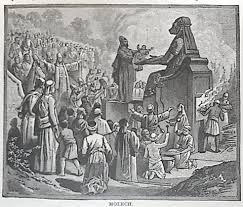
The prohibition against Molech worship is manifested today in our nation through the abortion of unborn babies.
Yet preachers, ministers, and pastors throughout western society remain silent on both these issues. Everyone of them seems afraid to speak out against either of these issues. And as watchmen, is it not their job to speak out against such abominations—at least teach their congregants and assembly members that these behaviors are abhorrent to God?
Indeed, many will argue that none of what I’m saying matters to believers in Jesus Christ. Some of these will contend that there is only one commandment given to us by Jesus Christ that we are to follow: we love one another.
Yet these same individuals fail to take into account that Master when asked by a Torah scholar which of the commandments was the greatest of all, responded with:
“Thou shalt love the Lord thy God with all thy heart and with all thy soul, and with all thy mind…and that the second is like unto it: Thou shalt love thy neighbor as thyself. And that on these two commandments the whole law hangeth, and the prophets” (Mat. 22:38-40; ESV).
So regardless how these false believers in Messiah choose to twist the Scriptures to justify their sinful, rebellious lives, in the end, it is the keepers of Torah—the commandments of our Father and of our Master, who also possess the testimony of Messiah, that separates and calls out from all the so-called self-professing Christians, who the true children of the Most High are. These will be the very ones that will receive eternal life and reign with our Messiah forever and ever (Rev 6:9; 12:17).
Friends, let me be clear on this. Contrary to conventional wisdom, holiness is not a simple thing to achieve. It’s downright hard at times. Some in our Faith Community actually believe all it takes to be holy is blind obedience to the set of principles, ordinances and commandments found in Torah. These could not be further from the Truth.
Holiness is a lifestyle and a mindset. It is a heart-centered love for the Creator and for one’s fellow-man. Holiness is looking at the example that was set before us by our master Y’shua Messiah and following it. And it should be no shocker that following Master’s example is no “walk in the park.” That old, carnal nature has a disappointingly bad habit of showing up and getting in the way of our walk from time to time. However, if we are true disciple of Y’shua Messiah, we have been given a helper in the Holy Spirit. It is the Holy Spirit that helps us readily walk circumspectly before YHVH our Elohim, not as fools, but as wise; and to walk in the ways of YHVH as His holy people (Eph. 5:15; Deu. 28:9: KJV).
We don’t keep Torah to be saved for Torah cannot save us. We keep Torah (ie., those instructions that still apply and the spirit of those Torah commandments that no longer apply) because we have elected, as children of the Most High Elohim, to please our heavenly Father. We choose to keep Torah because our Master Yeshua Messiah kept Torah and He admonished us to imitate Him and do the works that He did. Master taught:
“Verily, verily, I say unto you, he that believeth on me, the works that I do shall he do also; and greater works than these shall he do…” (Joh. 14:12; KJV).
Now, this is a tough one for me. For there are some, primarily in the charismatic, fundamental side of Christianity, that believe we as disciples of Jesus Christ must through a public display of protest, stand against the rebellion we are now seeing take place in this nation. Some of these individuals propose doing extreme things like standing outside abortion clinics and creating a scene during those clinic’s hours of operations, with the express intent of dissuading any woman who would seek an abortion to turn away and not abort her child. These same groups believe disciples of Jesus Christ should confront gay and lesbians wherever they may be (eg., their rallies and other events) and cause a disturbance to disrupt their various activities.
I personally am not convinced this is what Master would have us do.
The other side of this equation involves those believers who choose instead to oppose the rebellion and sin via tweets and facebook posts; and other online mediums in order to express their outrage over these individual’s activities and lifestyles.
Others, of course, choose to do nothing at all. These simply stay cloistered away in their own little groups, churches, fellowships, congregations, or even in their own homes, and act as though nothing is going on around them. These tend to be focused solely on their relationship with the Almighty and are not concerned about anyone outside their little Faith Communities.
For me, being fully cognizant of all that is going on around us these days, I am primarily (maybe exclusively) concerned with doing that which our Master instructed us to do as His disciples:
“Go into all the world and proclaim the gospel to the whole creation” (Mar. 16:15; ESV).
“Go. Teach all nations to carry out all the things that I have commanded you” (Mat. 28:19,20; Rood’s Chronology).
And as much as I get really worked up at times when I see and hear of the rebellious and sinful things going on in our society these day, I have to force myself to come back to center and do that which our Master commanded us to do. For I do not see anywhere in Scripture where Master instructed us to stand out in front of abortion clinics and yell and scream at those women who come to those facilities seeking abortions. Nor do I see anywhere in Scripture where Master instructed us to confront gays and lesbians and all the others at their various activities about their lifestyles. I do not see anywhere in Scripture where we are to be political activists and publicly stand in opposition against one political party or another, or even vice-versa.
Paul counseled Timothy:
“No soldier on duty gets involved with civilian affairs, since he has to please his commanding officer” (2 Tim. 2:4; CJB).
Now, I’m not opposed to those who believe they’ve been called to be social and political activists and decry the present day woes of our society. If these truly believe they’ve been called to do such things, well I believe that’s between them and Master.
However, as far as I’m concerned, I believe we have been called to be a holy people and to do that which our Master Y’shua Messiah commanded us to do.
I fear that when we exchange the basics of our call as disciples of Messiah with that of being social and political activists, we run the risk of sullying our holy reputation and fail at being good witnesses for Messiah.
A great burden has been placed upon us and we cannot fail in fulfilling the tenets of that call. We must walk out our Faith in fear and trembling (Phi. 2:12) and we must live holy and righteous lives. In addition, we must do some form of evangelism. This is the heart of our calling as disciples of Messiah—that being to make for Master disciples—and teach them all that He has taught us.
The world around us is going to do what it’s going to do. However, I believe that we must set our sights on being a Holy People unto our Father. Now, none of this which I am saying is to allow for sinners—those who willfully violate any of the ordinances outlined in this week’s Torah Portion—to take up residence in our homes and fellowships. We as a holy people cannot have fellowship with the rebellious violators of Torah. For Paul wrote to the Corinthian and Ephesian Assembly of Messianic disciples:
“Do not yoke yourselves together in a team with unbelievers. For how can righteousness and lawlessness be partners? What fellowship does light have with darkness…Have no fellowship with the unfruitful works of darkness, but rather reprove them” (2 Cor. 6:14; Eph. 5:11; KJV).
Otherwise, whatever role the Holy Spirit has placed you in the Body to perform, do it with all your heart and strength. If you have been placed in the Body in a teaching role, it is incumbent upon you to teach that which our Master taught us as well as teach those who are unfamiliar with the commandments of YHVH, YHVH’s Torah.
Paul instructed his young apprentice at the time, the evangelist Timothy:
“I charge thee therefore before God, and the Lord Jesus Christ, who shall judge the quick and the dead at His appearing and His kingdom: Preach the word; be instant in season, out of season; reprove, rebuke, exhort with all longsuffering and doctrine. For the time is coming when they will not endure sound doctrine; but after their own lusts shall they heap to themselves teachers, having itching ears; and they shall turn away their ears from the truth and shall be turned unto fables” (2 Tim. 4:1-4; KJV). [If you are so led and wish to hear more on members of the Body not enduring sound doctrine, I invite you to read/listen to my post entitled: “Endure Sound Doctrine I Will Not.”]
If we have been placed into a leadership position over an assembly or fellowship, for instance, we must safeguard against violations of these holiness commands taking hold within our groups. This was in great part what the evangelist Timothy had to contend with when he was placed over the Ephesian Assemblies as an overseer by Paul. Many members of the assemblies in Ephesus had departed from the true Faith and had given themselves over to false teachings—what Paul referred to as “fables and myths” (1 Tim. 1:4; 4:7; 2 Tim. 4:4). This in great part was Timothy’s charge/assignment:
“To stay on in Ephesus so that you may instruct certain people not to teach different doctrine or to pay attention to myths and endless genealogies. These promote empty speculations rather than God’s plan, which operates by faith” (1 Tim. 1:2-4; CSB).
And lastly, if we have any voice within or without the Faith Community—such as a blog, podcast, social media presence, etc.—we must warn the people of the world of the consequences of their rebellion and sin and invite them to repent, seek YHVH’s forgiveness, be baptized and become a true disciple of Y’shua Messiah. This is NOT political or social activism I’m talking about. It’s pure and simple evangelism as the Spirit of YHVH directs.
So I encourage you today to stay the course, keep the Faith, and let us through our righteous, holy living, glorify our Father which is in heaven.
Shalom and Blessings to you, your family and your fellowships.
The page you requested could not be found. Try refining your search, or use the navigation above to locate the post.