No Results Found
The page you requested could not be found. Try refining your search, or use the navigation above to locate the post.

This week’s Torah Portion entitled “Korah” is found in Numbers 16:1-18:32. I’ve chosen to entitle my reflections on this reading as “Rebels in the Congregation” for reasons that will become readily apparent as we move through the discussion.
In this post, among a great many other things, we will examine the arch-antagonist of the story: Korah. Who was Korah and what was he all about? Why did he foment and lead a rebellion against God, Moses and Aaron? And what lessons are we, as disciples of Yeshua Messiah, to take away from this very compelling Torah Reading?
_____________________________________________________
In our last study entitled “One Law For All—Reflections on Torah Portion Shelach Lekha” (“One Law For All“) we learned of a fear-based uprising that developed among the people against Moshe and Aharon as a result of the spies’ report on the Promised Land.
The people were condemned to 40-years of wandering in the wilderness as a result of their seditious murmuring. But suffice to say, the seditious murmuring did not end there with the people. For we find on the heels of that uprising, as detailed in this week’s study, a second, and dare I say even a third uprising develops among the people against Moshe and Aharon.
Recall that the uprising as detailed in Shelach Lekha (last week’s reading) was a general, nationwide uprising among the people. There were no specific instigators mentioned, with the exception of the returning spies (minus Caleb and Joshua) who framed their report on the Land in such a way that it caused the people to fear the inhabitants of the Land.
This week’s reading entitled Korah (ie., Korach in certain Hebrew-based texts) identifies three-men as the instigators of a second and ultimately a third uprising. These men are identified as Korah, Dathan and Abiram.
We find that Korah gets the most press in this story. For whatever reason, Korah’s fame (or infamy if you will) and leadership complicity in this uprising not only elicits more questions than received answers to the question of why he would lead an insurrection against the Creator’s chosen leaders; he also has become the focus of a small handful of writings by apostles of Yahoshua and of a great many extra-biblical traditions and side-stories by renown rabbinic writers.
We find in all existing writings related to the person of Korah that his seditious actions threatened the theocratic unity of the nation. [Expound]
As much as the biblical and extra-biblical account seems to place the focus of Korah’s insurrection against Moshe’s leadership of the nation and Aharon’s Priestly position, when we step-back and really consider his role in the uprising he led, we quickly find that his and his followers’ rebellious actions were really against YHVH. [Moshe and Aharon just happened to be convenient, tangent human targets upon whom the rebels could place their displeasure.]
According to J. H. Hertz:
“Korah was a demagogue, and recoiled from no weapon that would discredit Moshe” (pg. 638; Sontoro’s Pentateuch and Haftorah).
Biblically speaking, Korah was a direct descendant of Levi, one the 12-sons of Ya’achov (ie., Jacob). And interestingly enough, he was a first-cousin to Moshe and Aharon. Obviously, the challenge that Korah posed to Moshe and Aharon was intensified by his close, biological relationship to them. (Who says that blood is thicker than water, huh?)
As I just mentioned, the person of Korah has been the inspiration of a great deal of rabbinic mythology. Rabbinic tradition asserts that Korah was “extremely wealthy, clever and astute” (Article: Korah the Rebel of the Bible).
As a Levite of the Kohathite clan (ie., Kohath was one of Levi’s sons who entered Mitsrayim (ie., Egypt) along with Jacob and Levi’s ten-brothers and their families as recorded in Genesis 46), Korah was privileged to serve in the Mishkan (ie., Tabernacle—his clan was responsible for care, transport and set-up of the Tabernacle), although he seemed to view his position as less of a privilege, and more of a slight against his side of the Levitical line. Of course, Korah seemed to hold Moshe responsible for his self-deluded lack of privilege, as evident in his statement to Moshe:
“You take too much on yourselves! After all, the entire community is holy, every one of them, and Adonai is among them. So why do you lift yourselves up above Adonai’s assembly” (Num. 16:3; CJB)?
The leaders of this second-rebellion were Korah (who among so many other things was also Moshe’s and Aharon’s cousin), Dathan (some translations express his name as Datan), Abiram and On. Now, Dathan, Abiram and On were Reubenites.
It should be mentioned that On is mentioned only once in the story, although there are, of course, rabbinic traditions as to why this is so. I’ll touch upon this interesting tradition a little latter on in this discussion.
Korah, Dathan, Abiram and On were described as princes of the congregation. These, along with 250 “princes” (KJV) (ie., “naw-see,” meaning leaders or chiefs), assembled to challenge Moshe’s and Aharon’s authority (16:2,3).
As mentioned earlier, the gathered group stated to Moshe and Aharon (although most believe that it was really Korah who made the statement) that the whole congregation was holy (specifically every member of the congregation was holy) and that YHVH was among (ie., “taw-vek,” meaning in the midst of) the congregation. So the question posed was:
“How then are you lifted above the assembly of YHVH (ie., “Why then do you exalt yourselves above the assembly of the LORD”-ESV)” (16:3; KJV).
Interestingly, the LXX (ie., the Septuagint) words the group’s question or challenge somewhat differently. It reads:
“Why do ye set up yourselves against the congregation of the Lord?”
Now, the Septuagint’s rendering of the question is somewhat contradictory to the Masoretic text’s rendering (ie., the text upon which most of our English translations of the Tanakh are based). And this contradictory wording certainly plays into or suggests a connection to last week’s Torah Reading that included the account of the spies’ report and the subsequent denial of the people to possess the Promised Land.
If you will recall, YHVH’s judgment that was imposed upon the nation of Israel as a result of peoples’ murmuring and threats against Moshe and Aharon resulted in the people being denied possession of the Land of Promise and 40-years of wandering in the wilderness. And it certainly makes sense that this week’s reading detailing yet another uprising would have been a carry-over from last week’s reading.
Now, we’ve already touched upon Korah’s lack of privilege issues being a likely contributor to his role in this uprising. However, rabbinic tradition ascribes some tribal complexities as being likely contributors to Dathan’s, Abiram’s and On’s challenge to Moshe and Aharon.
To begin with, Dathan, Abiram and On were of the tribe of Reuben. As you may or may not know, Reuben was the eldest of Jacob’s 12-sons. However, we find documented in Genesis 35 that Reuben slept with one of his father’s (ie., Jacob’s) concubines (vs. 22). Turns out that Reuben’s father heard about that transgression. Later on, we find documented in Genesis 49 that upon Jacob’s calling together his 12-sons to give them his last words before his death, Jacob revealed that he knew of Reuben’s indiscretion. And as a result of that indiscretion Reuben lost his birthright and preeminence among the other 11-Tribes (vss. 1-4).
The rabbinic tradition that there existed tribal complexities involves the descendants of Reuben believing they should rule the nation because Reuben was the eldest son of Jacob. This belief supposedly remained embedded in the minds of the Reubenites despite their Patriarch (ie., Reuben) having lost his birthright.
Then to add insult to injury, when the nation journeyed from one destination to the next during their sojourn in the wilderness, the Tribe of Reuben would proceed the Levites who were transporting the Tent of Meeting and the Ark of the Covenant (Num. 2:16, 17; 10:18, 21). This tribal processional order placed the tribes of Reuben and Levi in close proximity to one another. Thus, the thinking is that there was a great degree of ongoing tribal rivalry and bickering between the two.
Despite the text stating that the group consisting of Korah, Dathan, Abiram, On, and some 250-other princes of Israel posed the challenge to Moshe’s and Aharon’s authority, it would seem that the speaker for this group of malcontents and rebels was Korah, for he is personally mentioned in Moshe’s response to the group’s challenge (verse 5).
This confrontation sent Moshe down to the ground on his face before YHVH (vs. 4). It is unclear here whether Moshe’s act of contrition was for purposes of assuaging YHVH’s soon to come wrath and judgment upon the malcontents, or to seek YHVH’s direction on how He wanted Moshe and Aharon to handle the confrontation.
_________________________________________________________________________________________
We know that YHVH chooses who or what tribe(s) He desires to be near Him (ie., what tribe(s) will be permitted to serve Him and the capacities in which those tribes would serve Him, as well as who He appoints as the nation’s human leader) (vs. 5). In this specific case, the point is who did God choose and appoint as the nation’s human leader and priest?
In order that this be fully and undeniably understood by these rebels, Moshe subjects the rebels to a “species of ordeal” (according to J. H. Hertz on vs. 6). A “species of ordeal” is “a means of obtaining evidence by trials, through which, by the direct interposition of God, the guilt or innocence of an accused person is firmly established, in the event that the truth could not be proved by ordinary means” (The New Advent Catholic Encyclopedia; Ordeals).
In simpler words, Moshe was led to put the question of his and Aharon’s leadership to a God-sanctioned test.
Thus, according to Hertz, some of the naysayers would:
“Assume for once the functions of priesthood and God would show whether or not He approved of such assumption” (Pentateuch and Haftorah; pg. 639).
And the specific function alluded to here is the taking up of censers (ie., firepans) by Korah, Dathan, Abiram and conceivably On. Those censers would hold burning coals from the brazen altar (ie., the Altar of Burnt Offerings). Those burning coals would be topped with sacred incense that was used exclusively for the Altar of Incense that stood just outside the Holy of Holies within the Tent of Meeting (Exo. 30:1-10).
It must be absolutely clear in our minds that only a Levitical Priest would be permitted to perform such a function. Indeed, this was an exceptional test that Moshe was subjecting the rebels to. But the end result of that test would leave no question in anyone’s mind as to who YHVH had appointed as his leader and high priest over the nation.
In putting the rebel through this so-called “species of ordeal,” Moshe retorts indignantly to the group:
“Ye take too much upon you” (vs. 7).
In other words, you’re crossing the line here with this insurrection you’re leading. And your sins are in the end going to find you out!
And then he asks them (in what I believe to be one last attempt to get the rebels to think clearly about what they were doing before it was too late):
“Do you value the privilege to serve that YHVH has given you from among the tribes of the nation? You and all thy company gathered together against YHVH…” (vss. 8-11)?
_____________________________________________________________
Turns out that Dathan and Abiram would refuse to participate in Moshe’s “ordeal of species.” Their response to Moshe’s challenge seems to nicely agree with the Septuagint’s rendering that the rebels saw Moshe’s leadership as a challenge to the wellbeing of the congregation as opposed to Moshe unilaterally taking on leadership over a nation of holy people. (That is, the allegations against Moshe and Aharon was that they took on leadership of the nation without any agreement or consensus of the people or from God; that Moshe was simply abusing and lauding his self-imposed power over the people.) For Dathan and Abiram charged Moshe with misleading the nation by not delivering to them that illusive Promised Land. Again, this hearkens back to last week’s Torah Reading and the people being condemned to 40-years of wandering for their refusal to take possession of the Land after hearing the spies report (Num. 14:45).
Thus, Dathan and Abiram blamed Moshe for the nation’s failure to possess the Land.
_____________________________________________________________
Korah and company (absent Dathan and Abiram) stupidly accepted Moshe’s “species of ordeal” that would go down the next day (vss. 16-19). Dathan and Abiram on the other hand refused to participate in the test, for when time for the test came the next day they remained in their dwellings along with members of their families. YHVH instructed Moshe to clear members of the nation away from the general area of Dathan’s and Abiram’s dwellings.
Thus YHVH permitted Moshe to “dress the table of judgment” (if you will) that would befall Dathan and Abiram before the actual sentence would be carried out. Basically, Moshe stipulated, if Dathan and Abiram were to die natural deaths—that is nothing untoward would happen to them as a result of their rebellion–then it would be evident that he, Moshe, was NOT YHVH’s chosen leader. If, on the other hand, Dathan and Abiram were to die a violent and abrupt death in connection to their rebellious actions, then, well, it would be evident that Moshe was Yah’s obvious chosen leader.
J.H. Hertz summed it accordingly:
“Their guilt would be apparent and Moses’ authority vindicated” (Pentateuch and Haftorah; pg. 642).
As the story goes, Dathan and Abiram, as well as their entire households were swallowed up by the earth beneath their dwellings.
Concurrently, the 250-chiefs who gathered against Moshe and Aharon at the Tabernacle with their censers at the ready, were horrendously consumed or devoured by fire that came from the presence of YHVH.
The summary judgment that was meted out on Korah, Dathan and Abiram was obviously reminiscent of the instantaneous judgment that was rendered unto Nadab and Abihu when they offered “strange fire before YHVH (Lev. 10).
Some place Korah with Dathan and Abiram in being swallowed up by the earth beneath their dwellings. Others (and I’m included in this group) place Korah with the 250 chiefs who were consumed by fire from YHVH (vs. 19).
The reason I believe Korah was consumed by the fire of YHVH is because Dathan and Abiram refused to participate in the “species of ordeal,” while all indications were that Korah agreed to participate in the challenge. Also in verse 27 the narrative documented only Dathan and Abiram (ie., absent Korah), who came out and stood in front of the door of their dwellings prior to being swallowed by the earth beneath them.
Another interesting element to this story is the strange omitting of On from the list of persons who were destroyed by the wrath and judgment of YHVH. Rabbinic tradition offers that the whole insurrection was instigated by Korah’s wife. (Sound like something we’ve heard before? Woman being made the cause of problems in the world according to some rabbinic thinking.) Well, according to these same rabbis, it was On’s wife that talked him out of further participation in the rebellion, thus saving his and her family’s lives.
The story goes that On, upon separating himself from the rest of the rebels at the behest of his wife, was internally conflicted. So he confided to his wife that he feared being singled out and persecuted by the other rebels if he chickened out. On’s wife told him not to worry himself with the details and that she would take care of everything. So she gets him drunk and he falls asleep. After putting On to bed, she makes her appearance seem as though she had been engaged in intimacy with On and she then positioned herself at the entrance of their dwelling so that any who would come inquiring as to whereabouts of On, would see her. So when the rebels came to fetch On to carry out the challenge, they noticed the immodest appearance of On’s wife, turn away and go about their business.
Cute little story right? Is it true? Hehehehehe. Again, cute story.
__________________________________________________________________
Rabbinic Tradition holds that Korah, Dathan and Abiram, along with all their belongings and their families, upon being swallowed by the earth beneath their dwellings, YHVH had condemned them to Sheol. Sheol in a direct sense refers to the grave. However, in the mystical sense, sheol is often considered to be the realm of the underworld where not just human souls are often condemned awaiting their final judgment, but also where fallen divine beings await their judgment.
Along this same line of thinking, some contend in our Faith that Yeshua, during His 3-days in “the grave,” went down to the underworld to preach to the captives therein.
All this is a fascinating study that I believe has little in the way of solid biblical evidence to support such mystical thinking. Do I believe that such a realm exists? I do. But do I believe this realm was the destination of the rebels in our story or that Yeshua went down to Sheol to preach to the captives therein, I can’t say.
I will contend, at least for the time being, that at death, the human body returns to the earth from which it was made, and the spirit of the deceased goes to YHVH who gave it. Both await the return of Yahoshua to transform the degraded body into a glorified one, that will reunite with its spirit that was kept under Yah’s eternal care.
_______________________________________________________________________
The brazen censers of the 250-men who were consumed by YHVH’s fire were collected and hammered into plates to cover the Altar of Burnt Offering.
YHVH asserted that the rebels’ brazen censers had become holy unto YHVH. For they contained the burning coals of the Altar of Burnt Offerings and the sacred incense that is used on the Altar of Incense. Thus re-purposing of these censers served as a reminder of this tragedy; a memorial and warning that the burning of incense unto YHVH was sacred and confined to Aharon’s priestly line (16:36-40).
It should be warned that depending on which English translation you read this account from, your chapters and verses may differ at this juncture of the story. Texts based on the Jewish Publication Society record this portion of the story in starting with the first verse of chapter 17. All other translations that are based upon the authorized or received text proceed chapter and verse as I am providing here.
_____________________________________________________________________
One would think that the deaths of Korah, Dathan, Abiram, and the 250 princes of Israel would have been so horrendous that anyone else who would even think to challenge Moshe’s and Aharon’s leadership and authority would be permanently discouraged from doing so. Interestingly, however, the tragedy that befell these men DID NOT put an end to the murmuring and challenges to Moshe’s and Aharon’s leadership.
Rebellious attitudes continued to linger in the minds and hearts of the people immediately after the deaths of Korah, Dathan, Abiram and their followers. Thus, a third-uprising was born. These disillusioned and bitterly impassioned individuals blamed Moshe for all the tragedy that had befallen the nation up to this point (vss. 41, 42).
The people had become disillusioned, believing that the rebels were “YHVH’s [elect] people.” So a congregation (ie., in Hebrew an “edah” or a group of individuals) gathered yet again to confront Moshe and Aharon. (Truly, some people never learn, do they?)
And yet again, Moshe and Aharon come before YHVH for instructions on how to deal with this [now] 3rd insurrection, or in an attempt to stave off YHVH’s “certain to come” wrath and judgment against the rebels” (vs. 43).
To make this already long story a little shorter, as a result of this 3rd rebellion some 14,700 souls were overtaken by a sudden plague outbreak (vs. 49). Most, if not all, the nation would have succumbed (ie., died) from this plague outbreak had it not been for Aharon who quickly grabbed his censer, placed burning coals from the Altar of Burnt Offerings, the coals overlaid with sacred incense, and came between the dead and the living. (In other words, the deadly plague seemed to rapidly spread from a central point within the assembled group of rebels, moving outwardly.)
Hertz describes an interesting personification of the plague in this story whereby the wrath of YHVH is seen as a divine entity. It is viewed even as a messenger who executes YHVH’s punishment upon the wicked and guilty. (Similar to the death angel that went throughout Egypt, slaying the firstborn of Egypt on the very first Passover evening.)
Thus, Aharon’s actions created a line of defense, separating the living from the dead and causing the personified wrath of YHVH to leave the people.
_______________________________________________________________________
The remainder of this Torah Reading deals with the certification that indeed Aharon was YHVH’s chosen man to be High Priest (ie., the Cohen Gadol) through the miraculous budding of his staff in comparison to the other 11-tribal leaders’ staffs that did not bud.
From there, Father delineates the duties and emoluments of the Priests and Levite workers to ensure that there was no confusion as to what each was supposed to do in the service of the Tabernacle and of YHVH.
_____________________________________________________________________
We find in this reading Samuel (ie., a mighty prophet and final Judge over Israel) giving his parting message to the nation. The message Samuel gives comes at the time of the coronation and ascension of Shaul (ie., King Saul) to his kingship over the nation.
Samuel reminded the people that they had taken their eyes off of YHVH. They sinned in their “belief that they could trust only in a visible king, whereas their trust should have been complete in God. The danger was that now they would put their trust still less in God” (Hertz, Pentateuch and Haftorah; pg. 651).
Although the people sinned, Samuel instructs them to sin no more (12:21, 22).
And despite the corrective tenor of Samuel’s parting message, he reminded the people that YHVH would not forsake them for His Namesake. For Israel would remain a people unto Himself.
____________________________________________________________________
The one question that seems to be asked by most bible students as it relates to this story, especially Jewish rabbis and scholars, is why did Korah rebel?
I’ve found in my research that there seems to be universal agreement that Korah did in fact rebel. But the question generally ends there without much in the way of a true biblically based understanding of why he rebelled. Instead, rabbinic teachings have taken great liberties with conjuring up stories and tales of why he rebelled.
Elizabeth Bolton, in her article entitled “Why Did Korah Rebel?” presumes that Korah’s rebellion was over “concerns with Aaron and his levitical/priestly privileges” (Why Did Korah Rebel).
Bolton then summons up for her reader rabbinic back-stories that were designed to offer an explanation as to why Korah did what he did. The one story she highlights in her article details what appears to have been an ongoing contentious debate between Moshe and Korah over the efficacies of tzitzit wearing and the burdensome ritual purity laws. She reports that rabbinic literature records Korah as ultimately declaring, “The Torah is not from Heaven; Moses is not His prophet nor Aaron his priest” (PT San 10:27d-28a).
One Midrashic writing proposes the following dialogue between Moshe and Korah as it relates to the wearing of tzitzits, with Korah referring to some 250 garments (possibly worn by the 250 co-conspirators of Korah) that he made without tzitzits, but had a ribbon of blue fashioned into the fabric. Korah asks Moshe:
“Do these cloaks require tzitzits?”
Moshe responds:
“Yes, they do.”
The group retorts to Moshe:
“For a garment of another color one dyed wool string is sufficient, yet when an entire garment is dyed, its very color is not sufficient.”
The rabbinic story continues the discussion:
“Does a house filled with Torah scrolls require a mezuzah?”
Moshe responds:
“Yes, it does.”
Korah responds:
“How can a single paragraph be enough? You did not receive these commandments from God; you devised them on your own” (Bamidbar Rabbah 18:3; cf. Rashi to Num. 16:1).
And then Bolton takes her assessment of Korah to a very strange place that I find a little difficult to swallow.
Most folks who are on the side of God and of His Torah would basically see Korah as a “bad” person; or even a villain of sorts. Bolton however, frames Korah as a “whistle-blower” oF sorts, whose challenging existence in the camp served as a “prod at complacency” and to “call attention to issues…and call the authorities to account.” And then she wraps up her article with a positive spin on the Korah story, suggesting that it “offers a simple teaching about our basic freedom to challenge authority and redress injustice wherever we may find it.”
Can you say, whaaaat?
Interestingly enough, the craziness surrounding Korah and why he did what he did does not end with Elizabeth Bolton.
Other rabbinic sources frame Korah’s story from the perspective of a tribal struggle. These see Korah and his people as washed up, one-time “priests” and “singers” who were reduced to nothing more than “doorkeepers” (Who Was Korah?).
Still other rabbinic sources highlight the Dathan and Abiram end of the story, framing these two gentlemen in a similar, once great, now washed up light as Korah.
W. Gunther Plaut, in his article entitled “Who Was Korah?” does detour somewhat away from rabbinic speculation and attempts to look at the Korah story from more of a biblical perspective. He correctly identifies the Korah-Dathan-Abiram uprising as being more a rebellion against God than against Moshe and Aharon.
I did find Plaut’s assessment of God’s judgment against Korah and his ilk very engaging, pointing out the fact that God could have simply pulled the plug on the rebels’ lives causing them to die unceremoniously. Instead, since their insurrection was aimed at God indirectly (ie., “undermining His [God’s] chosen human representatives”), the judgment and wrath they faced took on an extremely “memorable form” (Plaut).
Obviously, the “memorable form” in which the wrath and judgment of YHVH was meted out upon the rebels had a dual purpose of (1) punishing the rebels; and (2) sending a clear and pointed message to the entire nation that they not make the same foolish mistake that Korah, Dathan and Abiram made.
There is a very interesting observation that Plaut makes in his article that I must share with you. And that observation has to do with how the rabbis hijacked and used the story of Korah to their religious and political advantage. For Plaut reports that certain mishnaic and talmudic writings use this story as a warning against any who would “challenge the divine sanctity of rabbinic teaching.”
This makes sense since the rabbis assert that they received their authority directly from Moshe in the form of the “Oral Tradition” (aka the “Oral Law”).
The fly in the ointment as it relates to the rabbis’ deluded understanding of their role in Judaism, as Plaut astutely points out, is that rabbis do not have the undeniable miracles from God to support their claims of unchallenged authority that Moshe had at his disposal. The only thing that the rabbis had access to in order to defend that rule over the people is spiritual threats of eternal damnation to any who would challenge their authority. Since they have no proof that they have the authority to condemn anyone to hell, they have only the people’s ignorance and fear as the foundation upon which to put forth their threats (cf., Sanhedrin 109b).
And Plaut also identifies another aspect of the story that I believe is important to consider.
Korah’s argument challenging Moshe and Aharon’s authority rests on the premise that the entire congregation of Israel was indeed “holy.” Thus, if the whole of the congregation was holy, there was really no need for Moshe to instruct them, nor would there be a need for Moshe to pass down commandments and laws to the people.
Like so many other would be demagogues throughout history, the premise of Korah’s argument against Moshe and Aharon was horribly flawed. If you recall, the group led by Korah asserted to Moshe in no uncertain terms that the entire nation was holy, which of course would prompt questions as to Moshe’s and Aharon’s legitimacy as the nation’s leaders.
From a biblical standpoint, true holiness is in a sense a destination for the people of God to aspire to. And I agree with Plaut to a great extent in his statement:
“…holiness can never be fully realized within history, yet the people are to act as if it can be or even as if it has been realized.”
Indeed, the Creator on numerous occasions throughout His Torah demanded that the people be holy as He is holy (Lev. 11:44, 45; 19:2; 20:7). Thus, holiness as it pertains to the people of God requires that they follow in the Ways of YHVH (who Himself is Holy) in all areas of their lives (1 Pet. 1:15). Unlike the implements of the Tabernacle which YHVH through fiat declared to be holy, when it comes to people, they must actively take on the standards of holiness that God has given to them in His Word.
Yah and His Son Yahoshua are the true examples of what holiness looks like. Torah is the means by which one works toward achieving a semblance of that holiness. The Holy Spirit aids in that endeavor of working towards a holy state of being by empowering and enlightening the one seeking to live a holy life.
In my opinion Korah was incorrect in his assessment that the children of Israel were holy. Certainly the people were far from being holy. If they were holy, they would not have fallen into the predicament they found themselves in during the three-uprisings against YHVH and His appointed leaders over the nation.
I believe more accurately that the people were (and continue to remain) special unto YHVH. Yet they refuse to do that which (ie., obey YHVH and His Torah) would bring them to a state of holiness that would be wholly and acceptable to YHVH.
Could Israel (or for that matter any one of us) truly reach a place of true holiness as outlined by YHVH in His Torah? I believe it is possible; even more so today under the renewed covenant.
My last word on this issue of holiness, however, is that we must discern the difference between imputed holiness (which a true child of God receives upon accepting the sacrifice of Yahoshua for their lives) and living and walking in a state of holiness (which we are commanded to do as God’s elect, through obedience to His Torah and the teachings of Yahoshua Messiah). Far too many people rely exclusively on imputed holiness (which is vitally important to every believer), while living substantially less than holy and righteous lives, disappointingly different from the lives that Father clearly requires of His elect).
For me, THE question to be asked here is not so much a question of why Korah rebelled, but more so, what lessons should the true people of God learn from Korah’s rebellion?
Certainly, this Torah Reading does not go into the psychology of why Korah, Dathan and Abiram did what they did. For Moshe simply details the events of the insurrection and the outcome therein.
But for us today, it’s passages like Jude 1:10, 11 that actually puts Korah’s insurrection into a proper and very relevant perspective for the disciple of Yahoshua Messiah. The passage reads as follows:
“Now I want to remind you, though you know all these things: The Lord first saved a people out of Egypt and later destroyed those who did not believe; and He has kept, with eternal chains in darkness for the judgment of the great day, the angels who did not keep their own position but deserted their proper dwelling. In the same way, Sodom and Gomorrah and the cities around them committed sexual immorality and practiced perversions, just as angels did, and serve as an example by undergoing the punishment of eternal fire. Nevertheless, these dreamers likewise defile their flesh, reject authority, and blaspheme glorious ones. Yet Michael the archangel, when he was disputing with the Devil in a debate about Moses’ body, did not dare bring an abusive condemnation against him but said, ‘The Lord rebuke you!’ But these people blaspheme anything they don’t understand. What they know by instinct like unreasoning animals they destroy themselves with these things. Woe to them! For they have traveled in the way of Cain, have abandoned themselves to the error of Balaam for profit, and have perished in Korah’s rebellion. These are the ones who are like dangerous reefs at your love feasts. They feast with you, nurturing only themselves without fear. They are waterless clouds carried along by winds; trees in late autumn-fruitless, twice dead, pulled out by the roots; and wild waves of the sea, foaming up their shameful deeds; wandering stars for whom the blackness of darkness is reserved forever” (Jud. 5-12; HCSB).
Contextually, Jude is speaking to the heretical false teachers that were making their ways in and around the Assemblies of Messiah during his day. And he saw the insidious danger that such rebellious individuals were posing upon the first-century C.E. Body of Messiah. These individuals, according to Jude, were acting out of ignorance and animalistic instincts. Thus it could certainly be said that these had within and upon them the spirits of Cain, Balaam and Korah.
Sandy Simpson, in her article entitled “Korah’s Rebellion—Is It Still Happening Today,” suggests that these false teachers may have been Nicolaitans or precursors of the Gnostics that Paul and Timothy were having to contend with in Ephesus in their day (Deception in the Church-Korah’s Rebellion).
Indeed, I have spoken to the subject of false Torah teachers and their teachings that are pervasive in many areas of our faith community today. And the damage that these teachers and their teachings wreak upon the Body is unforgivable. And the only method for dealing with these is to (1) rebuke them; (2) pray that they repent from their evil works—ie., straighten-up and fly right; and (3), until they get their acts together, refrain from having fellowship with them.
Apart from guarding against false teachers and their heretical teachings, we need to guard against what I like to call a “spirit of Korah.”
I see the “spirit of Korah,” not just embodied in the persons of those who are false teachers, who deny and speak out against the true elements of the Faith, but also that is potentially manifested within each of us.
We all have the tendency to rebel against YHVH: especially against His Ways; against the teachings and instructions of Yeshua; and against Yah’s Will for our lives. And it is that spirit of Korah-like rebellion that we are all capable of fostering or manifesting in our lives that can, if left unchecked and unrepented of, results in our being judged and incurring the wrath of Yah in our lives.
You know, so many of us, especially those who have any substantive ties to churchianity, feel that because we’re saved (recall Korah telling Moshe that the whole nation of Israel was holy, so we don’t need you?), that we don’t need to live holy and righteous lives. And that erroneous thinking is further exacerbated by the thinking that because we’re saved, we can simply ignore and even get away with ongoing, unrepentant sins in our lives; that we can live any way we choose to live; interpret Scripture to fit whatever life we choose to live.
I recall one sister Hilary and I came to know in the Faith a few years ago. She was new to the Faith at the time. Yet she was adamant that as much as she loved her new-found Faith, she would not give up Christmas. She said that Christmas held so many wonderful and beautiful memories for her that she saw no need to give it up. For Christmas made her happy. Besides, God knew her heart. (Sound familiar?)
And God knows, she’s not the only one who has taken on such a rebellious attitude toward YHVH and their Faith.
What is going on in the hearts and minds of such rebellious individuals?
Well, there’s a hard and fast refusal to submit to Yah’s ways. For some, it’s a refusal to give up Christmas. For others, its a refusal to keep the Feasts and or the weekly Sabbaths. Still, for others of us, it’s a refusal to give up sausage and bacon and shellfish or even read our bibles on a regular basis.
It’s defiance; rebellion against YHVH in the most blatant and honest sense. And sadly, it is the same spirit that Korah possessed.
Did not Jude touch upon this somewhat? There’s an unreasoning animalistic side to us that when left unchecked or un-removed from our lives by the work of the Holy Spirit, will lead to our being cut off from YHVH and even to our ultimate destruction.
Peter described such a rebellious mindset and behavior as that of “walking after the flesh in the lust of uncleanness and in spite of government (ie., the government of YHVH)” (2 Pet. 2:10a). And like Korah, these are self-willed and are not afraid to speak evil of dignities—ie., speak evil of divine beings (2 Pet. 2:10b). And just 2 verses down, Peter reveals that these individuals shall “utterly perish in their own corruption” (2 Pet. 2:12b).
Look, Father despises the spirit of Korah. That spirit of Korah, which is really a spirit of rebellion, originated with hasatan. And the ramifications of that spirit that was manifested in hasatan has sealed his eternal fate.
This is detailed in Isaiah 14, which reads:
“How are thou fallen from heaven, O Lucifer, son of the morning! How art thou cut down to the ground, which didst weaken the nations! For thou hast said in thine heart, I will ascend into heaven, I will exalt my throne above the stars of God: I will sit also upon the mount of the congregation, in the sides of the north: I will ascend above the heights of the clouds; I will be like the most High. Yet thou shalt be brought down to hell, to the sides of the pit” (Isa. 14:12-15; KJV).
When you think this whole thing through, it’s really all about the heart. The tragedy that is Korah’s story is actually founded upon Korah having a really “messed-up heart.” You see, it wasn’t enough for him to have the distinct privilege of serving YHVH by working as a “prince” among his Levite brethren in the Mishkan (ie., Tabernacle). It wasn’t enough that he and his close and extended family would have all their needs provided for by YHVH. Nor was it enough that he and his brethren had been separated from the other tribes and exalted in the eyes of YHVH, even beyond that of the firstborn of Israel. In fact, I’d go out on a limb and state that nothing would satisfy Korah’s lust for power and authority. For he had a dark and lustful heart that led to his rebellion against YHVH. He indeed was a little shadow of (ie., a type of) Lucifer who sought to exalt his already privileged position above his peers and be like the most High.
Such a spirit must be broken and eliminated.
And frankly, if the rabbis are truly searching for a reason why Korah did what he did, I just provided the answer to their question.
Friend, our hearts are the places in our souls that require the greatest make-over. Our hearts must be given fully, completely, without reservation, entirely over to Yahoshua so that He may use us in the work of the Kingdom. For it is through the sanctification process, fueled by the work of the Holy Spirit, that the stony nature of our hearts is ultimately transformed into that of flesh.
YHVH revealed to the Prophet Ezekiel:
“And I will give them one heart, and I will put a new spirit within you; and I will take the stony heart out of their flesh, and will give them a heart of flesh…” (Eze. 11:19; KJV).
Our hearts have to change if we are to be God’s elect. There’s no way around it. And we must not delude ourselves into thinking that we can hide the true nature of our evil hearts from YHVH.
It was David who passed down to his son Shlomo (ie., Solomon) the following:
“And thou, Solomon my son, know thou the God of thy father, and serve Him with a perfect heart, and with a willing mind: for the LORD searcheth all hearts, and understandeth all the imaginations of the thoughts: if thou seek Him, He will be found of thee; but if thou forsake Him, He will cast thee off forever” (1 Chr. 28:9; KJV).
So how do we then get to that point of having a pure heart so that we may be used of YHVH?
I offer the following 11-steps, albeit not in any particular order:
1. Obey the Truth and have sincere love for the brethren (1 Pet. 1:22; cf. Joh. 13:34; Rom. 12:9, 10; Heb. 13:1).
2. Draw near unto God so that He may draw near unto us (Jam. 4:8).
3. Run away from youthful lusts, but instead follow righteousness, faith, charity, peace with those of like mind (2 Tim. 2:22).
4. Trust YHVH in all things (Pro. 3:5).
5. Learn to fear YHVH (Jer. 32:40).
6. Become zealous for the things of YHVH (Jer. 20:9).
7. Be joyful (1 Sam. 2:1; Psa. 4:7; 97:11; Isa. 65:14; Zec. 10:7).
8. Walk upright before YHVH (Psa. 97:11; 125:4).
9. Be sincere in all that you do; avoid being presumptive (Luk. 8:15; Act. 2:46; Eph. 6:5; Col. 3:22; Heb. 10:22).
10. Be repentant (Deu. 30:2; Psa. 34:18).
11. Be humble and gentle of heart as our Master was (Mat. 11:29).
Think about it: if Korah would, instead of challenging Moshe’s and Aharon’s authority, sought after just these things, he would have stood the chance of being great (instead of infamous) in the nation and in the eyes of YHVH. Likewise, if we take to heart (literally speaking) these things, we stand the chance of being great in the Kingdom of YHVH and in His eyes (Mat. 5:19).
The page you requested could not be found. Try refining your search, or use the navigation above to locate the post.
The Giver of Torah-YHVH-clearly stated that Torah was for all who would attach themselves to the commonwealth of Israel and live according to the Way He prescribed for men and women to live. Yet many within and without our Faith Community teach otherwise–that Torah was meant exclusively for the Jews. What are we to make of this dichotomy? We discuss this critical issue in “One Law For All-Reflections on Torah Portion Shelach Lekha.
This week’s Torah Portion/Reading is somewhat serendipitous. For it comes on the heels of a very interesting (I call it strange) email I received from a listener after last week’s posting (ie., entitled “Messianics-Modern-Day-Levites-Separated for Service to God”).
Initially I took the tenor of that email to be curt and attacking. However, in light of this week’s Torah Reading (ie., Shelach Lekha), oddly enough, that email turned out to be somewhat revealing.
To begin with, the email was sent by a gentleman who identified himself to me as an Orthodox Jewish Pentecostal pastor and evangelist. (A little outside the norm right?) He wanted to make it clear to me that he DID NOT consider himself a Messianic. Why? Because, according to him, the title is not found in the Bible. He went on to say, however, that the title Christian WAS in the bible. So I guess all things considered, he could be identified as a Jewish Christian.
The second odd thing about this gentleman’s email was that it had absolutely nothing whatsoever to do with any of my posts. Turns out that what he was actually writing me about was my stance on non-Jewish believers (ie., Christians) keeping Torah.
Now, here’s where the story gets somewhat strange.
Most of us are quite familiar with the anti-Torah stance of our cousins in churchianity (ie., protestant Christianity). Churchianity generally holds to the belief that Torah was done away with by Christ’s sacrifice on the cross. Thus, in their view believers in Jesus Christ cannot “come under Torah” for fear of “falling from grace.”
But this gentleman’s concern about my stance on Torah was coming from a different trajectory. He asked me if I was a non-Jew who was violating the Jerusalem Council (ie., referencing Acts 15). And the reason he was asking me this was because (his words): “I speak out against non-Jews putting themselves under Torah because they are in rebellion to the Gospel.”
Turns out that this fellow was not against Torah like his Christian associates are. Instead, he was against people like me, non-Jewish, keeping Torah (or using his vernacular—non-Jews coming under Torah). His contention then was that Hebrew Rooters and certain Messianics are in violation of the Jerusalem Council. And being in violation of Acts 15, we were in rebellion to the Gospel. (Thank God for the Torah police!)
And so I moved on with life. And low and behold comes this week’s Torah Portion entitled Shelach Lekha, which is found in Numbers 13:1-15:41.
The biggest section of the reading deals with the story of the 12-spies who went to check out the situation in Canaan in anticipation of the nation taking possessing the Land.
The spies bring back a rather discouraging report. Tragically, the manner in which ten of the spies put forth their report caused the people to be spooked. And before you know it, the people straight-up told Moshe they weren’t going to participate in any conquest of the Land. They, of course, feared being destroyed by the Canaanites.
And oh, by the way, they gave serious consideration to replacing Moshe with a leader of their choosing. The plan was for the people to high-tail it back to Egypt.
Of course, word of this brewing sedition reached the attention of YHVH. As punishment YHVH condemned the people to 40-years of continued wandering in the desert. In the end, every adult-age individual who left Egypt would out, leaving their children to possess the Land.
As spiritually packed a story as this is, there was another section of this week’s reading that really caught my attention. For I immediately recognized the timeliness of it.
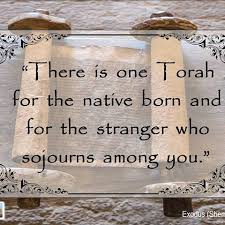
YHVH, giver of Torah, stated that there would be ONE Torah and equal administration of it for the Hebrew and Non-Hebrew alike.
The section I’m referring to is contained in Numbers 15:14-16. And it reads as follows:
“And if a stranger is sojourning with you, or anyone is living permanently among you, and he wishes to offer a food offering, with a pleasing aroma to the LORD, he shall do as you do. For the assembly, there shall be one statute for you and for the stranger who sojourns with you, a statute forever throughout your generations. You and the sojourner shall be alike before the LORD. One law and one rule shall be for you and for the stranger who sojourns with you” (ESV).
Now, I hope you can easily recognize why this section of the reading resonated with me so much. The significance of this section of the reading has connection to the email I described at the start of this discussion.
And as crazy as this gentleman’s position on non-Jewish believers in Messiah keeping Torah may sound, believe it or not, this gentleman’s position is actually a commonly held one; particularly among orthodox Jews.
The main reason I’m focusing on this section of the reading in this post is because we, as a faith community, are subject to persecution by not just Christians, but from Jews as well.
Beloved, as we get nearer to the End, we’re going to have to be prepared to deal with such challenges to our Faith from every conceivable angle. And we’re going to have to be ready to “give every man an answer that asks us for the reason of the hope that is in each of us” (1 Pet. 3:15).
The earthly brother of our Master stated that we must “earnestly contend for the faith which was once delivered” to us (Jud. 1:3).
Thus, we may be required to defend and contend for our Faith from various people in our lives: from family members to the godless; from the godless to the secular; from the secular to the Christian; from the Christian to the Jew; from the Jew to God knows who else. And we’ve got to be ready.
So why are Jews so put off by non-Jews keeping Torah? Well, the reason may surprise you.
It’s actually quite simple: many orthodox Jews, and may I say not too few Christians, believe that the Jews are God’s chosen people.
This is of course nothing new to any who have even the remotest knowledge of Judaism and Churchianity. The Jew has for centuries (albeit while enduring off and on persecution) and the Church for the better part of 2-centuries, have drilled into our skulls that the Jews ARE God’s chosen people.
(Well of late, of course, that trend of thought is undergoing a fundamental change in the minds of many. But that’s a discussion for another day.)
Suffice to say that the belief in the Jew being God’s chosen people is born out of the Creator saying that He chose Israel from the nations of the world TO BE His special treasure/possession. And indeed they are the most unique people to have ever existed by virtue of their unique association with the Almighty. Nevertheless, it’s one thing to be chosen by YHVH to be His special people. But it’s an entirely different thing for the ones that are chosen of God to truly walk out and realize their chosen status.(
In reality, the Jews (more so the Hebrews) were and are slated to be the Creator’s chosen ones. That is if they keep their end of the covenantal bargain. Sadly, however, they’ve not been terribly successful in accomplishing that.
But that’s beside the point when we’re talking about the Jews being a chosen people today.
To certain orthodox Jews, the term “chosen” means “the election of Israel.” They believe in the unique call of the “Jews as Jews.” While at the same time, these same Jews believe “in the universality of Jewish wisdom as a gift for all” (www.myjewishlearning.com/rabbis-without-borders/is-torah-just-for-jews/).
The mindset held by certain Jewish sects (and one or two so-called Christian Jewish sects) that non-Jews are prohibited from being Torah-observant, in great part, is derived from late Rabbinic teaching.
As it relates to this understanding we find in Bamidbar Rabah, section 14 of the Talmud the following:
“God gave Israel two Torahs—the Written Torah and the Oral Torah. God gave them the Written Torah which includes 613 commandments in order to fill them with good deeds and virtues. God gave them the Oral Torah to differentiate them from all other nations. Therefore, it was not given in written form so the other nations will not be able to forge it and claim that they are the (also) Israel.”
In his article entitled, ”Is Torah Just For Jews?,” Tsafi Lev writes of a tension that exists everywhere in Judaism between “particularism” and “universalism.” Lev references two-parts of the “Aleinu (pronounced ah-len-nu) Prayer” (ie., a Jewish prayer found in the Siddur (pronounced sid-dur), the classical Jewish prayerbook) that illustrates this tension beautifully.
It reads as follows:
“God made our lot unlike that of other people, assigning to us a unique destiny.”
This is an excellent example of Judaism’s particularism. It highlights the Jew’s distinction among the people of the earth.
The second part of the prayer goes something like this:
“Reign over all, soon and for all time…On that day the Lord shall be One and God’s name One.”
This is a wonderful example of Judaism’s universal hope. It encourages a hope that the world will someday embrace the God of the Jew and Torah’s timeless truths.
Sadly, Judaism over the centuries developed a deep-seeded suspicion of the outside world. Thus, Jews have for centuries lived in relative isolation. This isolation has made them prime targets for persecution and deadly bigotry.
To protect that isolation, Jewish scholars and leaders put forth a doctrine that would deny Torah to the world. And thus the universal hope that idealistically underscores the “Aleinu Prayer”—that Torah be shared with the people nations of the world—has become tragically foreign and even repugnant to the orthodox Jew today.
Oddly enough, this insane (Torah is only for the Jews) mindset is held by a number of Messianic Jews today. (Not held by all Messianic Jews, however. Thank YHVH!)
One contributor to “Torah Resource” (a website that claims to provide educational resources to Torah Communities within the broader Messianic movement) wrote:
“Torah is the special possession of the Jewish people…many of its stipulations are therefore directed toward Jews, not Gentiles” (https://www.torahresource.com/is-the-torah-only-for-jews/).
These teach their followers that although the moral ideals that are laid out in Torah have universal application for the world, the various practical elements of Torah (ie., the weekly Sabbath; the Feasts; the so-called kosher laws; the wearing of tzitzits; etc.) are meant only for the Jewish people. It is further believed by many of these same ones that the various practical elements of Torah serve as “distinct marks of their (ie., the Jew’s) unique position in the covenant made with Israel” (Tim Hegg; author of “Is the Torah Only for Jews?”).
In his article, Tim Hegg offers up a very interesting observation:
”When non-Jews live out Torah, the lines of distinction between Jew and non-Jew are blurred.”
We can’t have that now, can we?
I have to say that I was shocked to learn that so many members of our Hebrew Roots/Messianic Community hold to the non-biblical belief that Torah-living is only for the Jew.
The gentleman (ie., the one who sent me the email) in question took great pride in pointing out to me that he was a Jewish Christian. (I can only assume that he is a Messianic Jew.) He insisted I know that he was a Jew by birth. I’m guessing that his Christian side came much later in life. And now, he was a preacher of the Gospel on a mission to rid the earth of any believer in “Christ” who dared keep Torah.
I have come across individuals who were born Jewish and who became followers of Christ (or Messiah). I found that some of those individuals tended to believe they were superior to their non-Jewish brethren both biologically and spiritually.
One of those individuals—who fancied himself a ministry coach–comes readily to mind here. The last I heard of this individual, he still carried with him that same arrogant, pompous attitude of superiority over non-Jewish brethren. I’ve since learned, sadly, that he lost the support of just about all his supporters and followers.
As special as the Hebrews were to Father, He never meant for them to feel they were superior to the non-Hebrews that would attach themselves to their Hebrew brothers and sisters. So when Yah passed down His Torah to the nation, He sprinkled reminders throughout His instruction that this very same Torah He was giving to the Hebrew would apply equally to the non-Hebrew born of the nation.
Case in point is found in Numbers 15: 30, 31, which reads:
“Any who would err with a high hand, whether he be home-born or a stranger, the same blasphemeth YHVH; and that soul shall be cut off from among his people” (KJV).
According to J. H. Hertz (Pentateuch and Haftorahs): “’with a high hand’ literally means ‘with a hand raised.’ This is as a sign of presumption. Iserved as a public defiance of His law. No sacrificial atonement is possible for a willful offense. That presumptive soul shall be cut off and his/her iniquity would be upon him/her.”
In other words, it didn’t matter to YHVH who or what you were. If you, being a non-Hebrew, became a member of the commonwealth of Israel, you received all the benefits inherent therein. Thus he/she would be expected to adhere to the law of the Land: Torah.
So when one kept Torah, they would be blessed, just like the native born Hebrew. When one violated Torah, they stood the risk of reaping curses upon themselves, just like the native born Hebrew.
So let’s do a quick verse-by-verse examination of the Torah Reading that forms the basis of this week’s post.
The English term “stranger” in the Hebrew is ”ger” (pronounced “jur”). The HCSB/CJB translates “ger” as “foreigner,” while the LXX/NAB translates “ger” as “alien.”
According to verse 14 of our selected text, the alien or stranger that is highlighted here is one who decides to adopt the tenets of the Hebrew Faith (ie., walk in the ways stipulated by YHVH’s Torah).
According to the Brown, Driver, Briggs, Hebrew and English Lexicon, the Hebrew term “Ger” is generally tied to the concept of being a “proselyte” (BDB Lexicon).
A proselyte is one who converts from one opinion, religion or party to another (Google Dictionary). Thus in this sense, a ger would be considered a proselyte to the Hebrew Faith.
Hertz defines “a stranger” or “ger” as a resident non-Israelite “who becomes a convert to the religion of Israel and who has undertaken to conform to the laws and precepts of the Torah” (J. H. Hertz, The Pentateuch and Haftorahs).
According to this verse of our reading, the “ger” must be permitted to worship in accordance with the tenets of Torah.
What we see sprinkled throughout Torah regarding the Torah-committed “Ger,” is that YHVH was especially careful to provide for the wellbeing and equal treatment of the ger by the Hebrew. For indeed, the “ger” would be a minority in a native-Hebrew dominated land.
Thus, Father required the following conditions be observed by the Hebrews regarding the Ger in their midst:
When understanding the many provisions Father extended to Torah-committed ger living alongside their Hebrew brethren, one is forced to recognize that YHVH never intended His Torah to become the sole property of the Jew. Yes, Father did entrust His Torah to the Hebrews for safekeeping. However, Father never meant for it to be kept stingingly by the Jew in some spiritual lock-box.
So when Jews, or even so-called Christian Jews, come against those of us who have chosen to live a Torah-lifestyle, they have taken a rather presumptive attitude that is in opposition to the will and grace of YHVH. No good can ever come from such prejudiced actions. For their prejudiced actions are, in a funny twist of fate, prodding them to “kick against the prick” (Act. 9:5).
There would be one “ordinance” (KJV); statute (ASV; HCSB; ESV; NASB); regulation (CEB); law (CJB; LXX) for both the “Congregation of Israel” and the “Ger.” As Torah relates to the Hebrew, so shall it equally relate to the ger before YHVH.
So clearly we see here that Yah is no respecter of person.
The Hebrew term for ordinance used here is “chuqqah” (pronounced “kukka’). It means “something prescribed, enacted; or a statute. It is generally used in Hebrew when referring to special ritual laws such as the Feasts of YHVH and other specific Torah elements (BDB Full Lexicon).
So…would it be too much of a stretch to say that the Ger would be expected to also keep the Feasts of YHVH in their appointed times; obey the food laws; and keep the weekly Sabbaths and such? Sure sounds like it doesn’t it?
And, oh, just to make sure this equal application of Torah would not be shoved under the spiritual carpet (so to speak) and forgotten by the Hebrews, Father put into the wording of the verse a little caveat: this is to be “…an ordinance (ie., regulation) forever in your generations…”
Thus YHVH definitively stated: “One law and one rule shall be for you (ie., the Hebrew) and for the stranger (ie., the Ger) who sojourns with you” (Num. 15:16; ESV).
The English term “law” that is used here in this passage is easily identified as “Torah” in the Hebrew. The English term “rule” is a little less obvious. It is “mishpat” in the Hebrew.
Mishpat refers to judgment(s) (ie., the act of deciding a case from a seat of judgment or during some form of litigation before a judge; hearing a case; or the act of sentencing.
As it applies here, Father seems to be saying that there would be one rule of law in the Land as it specifically relates to Torah (ie., the nation’s constitution) and a single or equal application of Torah or law for both Ger and Hebrew. Everyone in Yah’s sight is thus equal as it relates to Torah. In every sense, the law is truly blind, regardless the socio-cultural-economic status of the individual residing alongside the Hebrew.
As in so many other avenues related to Faith, when an orthodox Jew (or a so-called Jewish Christian for that matter) speaks out against non-Jews keeping Torah, they are approaching this thing from a non-Scriptural perspective. These are actually approaching this issue from a rabbinic (religious) perspective. Sadly, they are blind to the True Faith and they are incapable of seeing beyond the teachings of their rabbis and sages. This is part and parcel of the blindness that caused them to miss the great day of their visitation (Luk. 19:44)!
But their blindness will not be a permanent one. Of the temporaneous nature of their blindness Paul wrote:
“For I would not, brethren, that ye should be ignorant of this mystery, lest ye should be wise in your own conceits; that blindness in part is happened to Israel, until the fullness of the Gentiles be come in. And so all Israel shall be saved: as it is written, ‘There shall come out of Sion the Deliverer, and shall turn away ungodliness from Jacob. For this is my covenant unto them, when I shall take away their sins’” (Rom. 11:25-27; KJV).
In addition to their blindness and deceived state, when Jews come against non-Jews keeping Torah, they have been provoked to jealousy just as YHVH prophesied in His Torah and as taught by the Apostle Paul:
“They have made me jealous with what is no-god; they have provoked me to anger with their idols. So I will make them jealous with those who are no people; I will provoke them to anger with a foolish nation” (Deu. 32:21; ESV)
And Paul writes:
“What then? Israel did not obtain that which it looked for: for the election obtained it; and the rest of them were blinded in their heart. As it is written: ‘Elohim gave them a stupid spirit and eyes that do not see and ears that do not hear, to this very day.’ And again, Dawid said: “Let their table become a snare before them; and let their reward be a stumbling block. Let their eyes be darkened that they are blinded; and let their back, at all times, be bowed down.’ But I say: ‘Have they so stumbled as to fall entirely?’ May it never be! Rather, by their stumbling, life has come to the Gentiles for (awakening) their jealousy” (Rom. 11:7-11; AENT).
Oh, and what about the gentleman’s accusation that I was in violation of the Jerusalem Council by my keeping and teaching of Torah?
According to Carmen Welker on her website “The Refiners Fire:”
“Torah plainly states that there is ONE Torah for Israel and the Gentile who dwells with her. Yet, many try to use Acts 15 as “proof” that Christians don’t have to keep Torah. That is because they don’t realize that Acts 15 is referring to Gentiles coming to Torah-not ‘reducing’ the obligation of Torah itself…”
In other words, when read in context, “Acts 15 plainly states that the expectation of the non-Jewish believers was that they would learn Torah as they grow in their relationship with Mashiyach and His people” (Welker: “Acts 15: Does Torah Pertain to Christians?”).
Bottom line saints: Do NOT be fooled or misled by Orthodox and so-called Messianic Jews into thinking or believing that we non-Jews are not to be Torah-observant. Such talk and such thinking is from the pit of hades.
For it came directly from the God that gave Torah to the Hebrews and the mixed multitude coming out of Egypt, that Torah was for every man, woman and child who would commit themselves to the Creator’s way of life for mankind.
For in YHVH, there is ONE Torah and one Ordinance.
The page you requested could not be found. Try refining your search, or use the navigation above to locate the post.
Some in our Faith Community liken Messianics to the Levitical Priests and Levite workers of old. And I personally think there’s some merit to that comparison.
We know that the Levites, who were under Aharon and Sons’ direct oversight, were held to higher standards of living than the rest of the nation (see my post entitled living a life beyond the norm). In fact, Father separated the Levites from the other 12-Hebrew tribes. The Levites as a tribe would be wholly beholden to Him and the service of the Tabernacle. In exchange for their complete service, Yah would be the Levites’ inheritance. For YHVH said unto Aharon:
“Thou shalt have no inheritance in their land, neither shalt thou have any part among them: I AM THY PART AND THINE INHERITANCE AMONG THE CHILDREN OF ISRAEL” (Num. 18:20; KJV).
This set-up/construct was a partial establishing and foreshadowing of the promise that Israel would be a royal, priestly nation:
“And ye shall be to me a royal priesthood and a holy nation” (Exo. 19:6; LXX; cf. Exo. 23:22).
By extension, of course, this passage points to modern day Messianics role in being a light to the nations. The job of Messianics is an extension of the Levites’ original job: that of pointing and guiding the nation-peoples of this world to the Creator of the Universe. Today we are in part a fulfillment of that royal priesthood declaration that Abba Father has set in place for His chosen people.
This week’s Torah Portion entitled “Behaalosecha—When You Set Up“—is found in Numbers 8:1-12:16.
Although this reading touched upon a great many events and issues, for today’s discussion, I want to focus our attention on the dedication and service of the Levites as recorded in Numbers 8:5-26.
Within this fascinating section of Torah, we get a sense of what Father requires of those who have sworn to commit the rest of their lives to serving Him and the Body of Messiah. And what we will find in thday’s discussion is that many of the elements that separated the Levites for service in the Tabernacle were in great part a foreshadowing of the elements that Yeshua and His apostles taught would be necessary for our service to the Kingdom of God.
So let’s unpack this Torah Portion and see what we can see.
__________________________________________________________________________________________
There are two themes that are intricately linked to the story of the Levites dedication. The first theme has to do with the Levites being brought to a place of “Ritual Purity” so that they may serve in the Tabernacle. And the second theme is that of the Levites actually walking in their calling. In other words, the walking in their calling involed the Levites being officially and ceremonially separated from the other tribes of the nation and wholly dedicated to service in the Tabernacle.
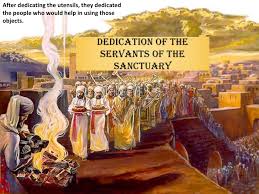
The dedication of the Levites, as depicted in this week’s Torah Portion, foreshadows the spiritual purity and dedication for service that every modern-day Messianic is called to possess.
Ritual purity was a non-negotiable requirement for Levites to serve in the Tabernacle. Failure to be in a state of ritual purity would result in the Levite becoming separated from YHVH (ie., cut off from Yah’s presence) and being denied the opportunity to serve (Lev. 22:3).
As it related to our reading this week, those being dedicated for service in the Tabernacle were the Levites. These were not the Levitical Priests. Instead, these Levites would support the Levitical Priests in their work in the Tabernacle. These could be considered as the work-horses of the Tabernacle. For these physically fascilitated the Tabernacle operation. Their priestly brothers, on the other hand, were holy and served various intermediary-functions between YHVH and the people.
Andn like their Aharonic-priestly brothers, the Levites were expected to always be in a state of ritual purity.
In preparation for service, Moshe was instructed by YHVH to see to it that the Levites were ritually clean. The Hebrew term for “clean” that is used here is “taher” or “tahor.” “Tahor” as used in our Torah reading this week denotes a “ceremonial preparation for sacred duty” (Brown, Driver, Briggs Hebrew-English Lexicon).
We find throughout Torah specific incidents where Abba instructed the Hebrews to conduct ritualistic cleansings in order for individuals and objects to be acceptable unto YHVH:
As it related to their dedication to service in the Tabernacle, Father instructed that the Levites adhere to the following symbolic cleansing ritual:
Ezekiel prophesies of a time in the future—maybe in the Messianic Age—when He will sprinkle clean water upon physical Israel, which will symbolically purge the nation of their uncleannesses and their idols. This act by YHVH will once and for all cleanse the nation for service unto YHVH (Eze. 36:25; LXX).
The writer of Hebrews speaks of the blood of Yeshua replacing such ceremonial rites as the sprinkling of water on those who would serve in the Tabernacle (Heb. 9:10). It is Mashiyach’s (ie., Messiah’s) perfect blood through Yah’s Ruach (ie., His Spirit) that permanently purifies our souls from works that lead to death. Thus, it is Master’s blood that purifies us for serve to the Kingdom of God (Heb. 9:14; CJB).
Indeed, the purification rites that the Levites underwent before YHVH at the Tabernacle foreshadowed the purification we would enjoy through the work and agency of Y’shua haMashiyach.
The idea of every Levite completely shaving his body in preparation for this ceremony, according to Abraham ibn Ezra (ie., an 11th/12th century Spanish Jewish commentator and philosopher), served to symbolize “the most perfect purity, and a removal of all superfluity of haughtiness and excrescence (wild outgrowth of something) of the flesh from them” (Gill’s Bible Commentary).
Levi Ben Gersom Gersonides (ie., a 13th/14th century French Talmudist) looks at the shaving question from the standpoint of a message that is directed to the Levite preparing to serve in the Tabernacle: that “he must forsake material things and employ themselves in the service of God” (Gill’s Bible Commentary).
I personally recall some 36-years ago, my first day of military training in Pensacola, Florida, having my head shaved along with 2-dozen or so fellow naval officer candidates. The process of having our heads shaved according to our Marine Corp Drill Instructor, was to strip us of our identities; our uniqueness; our individuality. In so doing, we as a class of trainees would be equal in every sense, having no individual agendas with the exception of one: obediently serving and accomplishing those tasks given to us by the U.S. Navy as one single body.
And as we saw mentioned in Hebrews 9, the blood of Y’shua cleanses us from all impurity and readies us for service. Needless to say, there is no need for the disciple of Messiah, though he or she is in a sense could be considered a modern day Levite (or for that matter, even a priest of YHVH), with Y’shua as our High Priest, to undergo such a rite as shaving one’s body in preparation for service.
The washing of the clothes and of their bodies seemed to go hand-in-hand .
Recall that when the people arrived at the base of Mount Sinai and agreed to meet with YHVH, Father instructed that the people wash their clothes in anticipation of the meeting (Exo. 19:10). I believe the people washed their bodies as well.
The spiritual application to be drawn from this story are enormous. When meeting with and serving Father—in whatever capacity that may be—He requires that we be in a state of purity: that we be clean or “tahor.” Otherwise, we are no good to Father.
Churchianity would have us ascribe to the mindset that our purity is imputed unto us by the blood of Y’shua haMashiyach. And to a great extent this is true. However, it is incumbent upon each of us to ensure that there is no lingering, chronic, invited, habitual impurity within us. We must have skin in the “purity game so to speak” and deny sin to continue in our lives. Then we must allow the Holy Spirit to purify (ie., cleanse us) from the inside out.
The laying on of hands is a practice to (1) confer a blessing, or (2) impart something from one person to another person or from a person to a creature or thing.
To begin with, when we look at laying on of hands, there must be some form of identification with the object or person upon which the hands are laid.
According to the author of an article I found in wikibooks on this subject:
“The hands become a channel through which something from the Ruach haKodesh is transferred from one to the other” (https://en.wikibooks.org/wiki/hebrew-roots/the_origninal_foundation/laying_hands_hebraic).
One Hebrew variation of laying on of hands is “Samak,” which implies the act of laying one’s hand on someone or something so as to lean heavily upon that person or thing. It conveys the idea of “forcibly pressing down upon, so that the victim was viewed as a support. This conveyed the idea of the pressure or weight of responsibility which was to be borne by the victim as a result of the laying on of hands.” Thus, an obligation of some sort was placed upon the one the hands were placed.
The Hebrew word for hand is “yadh,” which denotes “strength, authority and power.” Thus the laying on of hands implies the hand-layer drawing from a place of “great strength and authority;” the reservoir of authority and strength coming from YHVH, being conferred upon the recipient.
1. Impartation—Whereby an unction of the Ruach haKodesh is passed from the Spirit-filled anointed servant of YHVH onto the recipient. In this sense, the laying on of hands results in the impartation of spiritual blessings, giftings, power and authority onto the recipient.
2. Identification—Generally in terms of a sacrifice, whereby the offerer identifies him/herself with the sacrifice through physical contact (ie., laying on of hands). The act of laying on of hands in this sense makes the offerer one with the offering. In so doing, the offering bears the sins of the offerer (Lev. 1:4; 3:2; 4:15, 24, 29, 33; 16:21,22; Num. 8:12).
3. Confirmation—Dual application as it relates to the laying on of hands: (1) Witnesses laying their hands upon an accused would be making a formal confirmation attesting to the guilt of the accused (Deu. 17:2-7). (2) An overseer or leader of an assembly confirms a member’s giftings and ministry, the purpose of which is to edify the Body and Assembly of Messiah (Act. 14:22; 15:3; 1 Tim. 4:14,15; 1:18; 2 Tim. 1:6, 14).
4. Ministration of Blessings—The act of transferring blessings from YHVH to the recipient. In this example, however, the hands of the anointed servant is not placed upon the individual, but instead, over or toward them. In so doing, there was a sense that the recipient’s situation would improve (eg., Gen. 48:13-20). This is famously illustrated in the Aharonic or Priestly Blessing (Num. 6:23-27; cf. Lev. 9:22).
5. Commissioning for Ministry—This is generally done in the ordination of ministry and commissioning and sending of workers forth to minister. This served as a public acknowledgment that the receiver of the commissioning was (1) ordained; (2) commissioned through established human authority; and (3) equipped to perform the ministerial task(s) that was set before him/her (Act. 6:1-7; 13:3; 1 Tim. 4:14; 2 Tim. 1:6)
Matthew Henry comments that by placing their hands upon the Levites, the Hebrews “transfered their interest in them and in their service to God and to His sanctuary.” Thus, in this sense, the people were not imparting YHVH’s Spirit upon these men. Instead, the people were publicly acknowledging or proclaiming unto YHVH and to the world, symbolically speaking, that the Levites would serve in lieu of them having to do the work of the Tabernacle.
This symbolic gesture also served as a public acknowledgment that the Levites would be separated from the other tribes of the nation to serve the nation and Yah in the Tabernacle. As a rresult these would no longer be part of the nation’s militia or defense force.
Yah most often works through the actions people. Some contend, for example, that Yah being a Spirit that possesses no actual arms or hands, it is the priests’ hands that become Yah’s hands performing God’s necessary work. Thus, the intent of laying on of hands is that God reaches out through the vessel of His chosen ones’ hands to perform His work. Yah’s presence is in a sense invoked and if accepted of Yah, He visits the proceedings and performs the necessary work.
In this case, the people as opposed to the priests laid their hand upon the Levites. Thus it became the people who invited Yah to show-up and do a great work on their behalf.
According to Lawrence A. Hoffman (co-founder of Synagogue 3000 and professor of liturgy, worship and ritual at Hebrew Union College-Jewish Institute of Religion):
“God visits the earth through the magic of human touch, as sacred a thing as there is.”
Hoffman continues:
“But like all things holy also, nothing bestows the certainty of hope and comfort better than the human touch, properly applied, by those we love: a friend at our bedside, their hand on our own; a soft embrace when words cannot assuage our pain…When explanations only make things worse, when words ring hollow, when we just have nothing to say, we can reach out, God-like, feeling hope’s promise flow to those in need. God shows up best in the warming touch where two hands meet.”
In the spirit and likeness of a wave sheaf offering, Aharon “presents” (CEB; DBY; DRA; ERV; ESV; JPS; KJV; NAB; NAU; NIV), “offers” (ASV; CJB; HCSB; NET), “separates” (LXX) the Levites “for a gift before YHVH from the children of Israel” (8:11; LXX). Aharon’s actions insinuated:
“Father, here are the Levites, which the nation is offering/presenting/separating out from the peoples of Israel, to serve You, the Tabernacle and the priests.”
As required with every opportunity the Almighty affords His people to worship, burnt, sin and grain offerings were made on behalf of the newly dedicated Levites.
We find in verse 12 that Abba instructs that the Levites lay their hands upon the heads of the 2-bullocks (LXX has it as calves). One bullock would serve as a sin offering and the other for a burnt offering unto YHVH.
The purpose of laying one’s hands on an animal sacrifice was symbolic in nature. Thus, the sins and impurities of the one offering the animal sacrifice were symbolically transfered onto the animal through this simple act of faith.
In reality, nothing was actually transferred onto the animal? Instead, this act of faith certified the state of the offerers heart unto YHVH.
It was YHVH through Jeremiah’s pen that stated:
“I YHVH search the mind, I try the heart, even to give every man according to his ways, according to the fruit of his doings” (Jer. 17:10; ASV)
And given that our God is a God that judges the heart, He credits the sacrifice of the offerer (in this case the Levite) as atonement for his/her sins when he in faith places his hands upon the head of the sacrifice, looking to YHVH that his sins be atoned for.
Obadiah ben Jacob Sforno (15th/16th century Italian rabbinic bible commentator) suggested that:
“Hand-laying is as central to Temple sacrifices of old as it is to my college’s ordination today. And for the same reason; not that rabbis and cantors are sacrifices, God forbid, but because the touch of human hands is how God’s presence may appear.”
Burnt Offerings (Hebrew=”karbanot) served as a gift brought to YHVH so that the offerer may be accepted by YHVH (Lev. 1:3). Upon the offerer laying his/her hand upon the head of the burnt-offering, it served as an atonement for the offerer (Lev. 1:4) .
Karbanot is derived from the Hebrew root Qof-Resh-Bet, which means “to draw near,” suggesting that the underlying purpose of rendering offerings unto YHVH is to draw near to YHVH. (Reference: https://www.jewishvirtuallibrary.org/sacrifices-and-offerings-karbanot).
One of the biggest symbolic concepts embedded in karbanot is that of substitution. The concept of substitution as it relates to the karbon is that the offering is a substitute for the offerer. That which ultimately happens to the offering is the thing that should happen to the offerer. One can fairly assert then that the offering is being punished on behalf or in the place of the offerer. In a thematic sense, it is this substitutionary element that is embedded in karbanot that underscores the grace and mercy of YHVH.
Another less obvious concept to be understood from karbanot is that of coming near or drawing close to Yah. Apart from the substitutionary element embedded in karbanot, in getting past the need for dealing with the sins and impurities of the offerer, the sacrifice opens up for the offerer the opportunity to draw or come close to the Almighty.
___________________________________________________________________________________
Before going any further on this subject, it should be noted that all sacrifices ceased with the destruction of the Temple in 70 C.E. The greatest (and most biblical) reason sacrifices were not continued beyond the destruction of the temple is that Torah explicitly required all animal sacrifices be performed at the temple proper by a Levitical Priest.
As disciples of Yeshua haMashiyach, we know that Father did away with all animal and meal sacrifices upon Messiah’s ultimate sacrifice on the execution stake. Any resumption of animal sacrifices on the part of God’s elect would serve absolutely no purpose other than needlessly slaughtering animals. For Yahoshua Messiah’s sacrifice addressed the sin issue once and for all:
“For in that He (Yeshua) died, He died unto sin once…” (Rom. 6:10; KJV).
“Who needeth not daily, as those high priests, to offer up sacrifice, first for his own sins, and then for the people’s: for this He did once, when He offered up Himself” (Heb. 7:27; KJV).
_______________________________________________________________________________
1. The Burnt Offering (Heb. Olah). Olah has the same root as the world “aliyah, which is used to describe a pilgrimage or even a relocation to the Land of Israel. Additionally, it represents an ascension to a synagogue podium to read the Torah scroll or say a blessing during Sabbath worship services.
The whole of the Olah was to be burnt. No part of it was to be eaten, either by the priests, Levites or the offerer.
The Olah represents total, and complete submission to YHVH and His will. Thus, the whole of the offering is rendered unto YHVH. In presenting unto YHVH the burnt offering, the offerer shows forth his/her sincere desire to draw close to YHVH.
Indeed, there is an atoning element attached to the burnt offering/Olah. This should make total sense since the offerer’s sin would have to be dealt with in order for him/her to draw close to or commune with the Almighty.
Burnt offerings could be made from cattle, sheep, goats, or birds.
2. Peace Offering (Heb. Zevach Sh’lamim). This is generally a thanksgiving offering. If one pays close attention to the Hebrew title for this offering, one may see a variation of “shalom” embedded in the Sh’lamim. Shalom, of course, means peace.
Most of the peace offering was to be burnt up on the altar. However, a portion of it was to be given to the priests (ie., the Cohenim) and was to be eaten by the offerer and his/her family.
3. Sin Offering (Heb. Chatat). This offering is meant purely for atonement and purging of unintentional sins. The offerer comes to the altar in a state of sorrow because of his/her sin and desires to be restored or reconciled to YHVH.
The Hebrew term “chatat,” by the way, means to “miss the mark.”
There were individual as well as communal (ie., community) sin offerings.
Generally speaking (with a few rare occasions), individual sin offerings were consumed by the Cohenim and Levites.
4. Guilt Offering (Heb. Asham). This was a unique sin offering that addressed sins whereby the offerer believed he or she committed a sin but they weren’t certain as to what sin they actually committed. The guilt offering was also used to address the breaching of trust (ie., inadvertently not fulfilling one’s word or responsibility to someone).
The Asham was consumed by the Cohenim and Levites.
5. Food and Drink Offerings (ie., Meal Offerings). This was a devotional offering representing the fruit of one’s personal labor. Submitting a meal offering required exacting preparations on the part of the offerer. For it represented the offerer’s personal heartfelt gift to YHVH.
A representative portion of the meal offering was consumed on the altar. The rest however, was consumed by the Cohenim and Levites.
Returning back to our story, we receive in verse 17 an explanation as to why Father was separating the Levites from the whole of the community of Israel for service in the Tabernacle.
Father told us back in Exodus 13:2-15 that the firstborn of the Hebrews were to be holy (special; separated) unto Him. Now, in this dedicatory service, Father is saying that the Levites were holy and special unto Him. So what gives?
According to Torah, the firstborn of every Hebrew family would forever remain special to YHVH. However, the Levites were special unto YHVH in that from this point forward (ie., from that dedicatory service forward), their entire existence would be focused on YHVH and serving Him. The firstborn of the nation were not required to attend to the work of YHVH and the Tabernacle. But now, the Levites would attend to the work and service of YHVH.
It should be noted that the firstborn of the nation could own property and have lucrative businesses and the like. The Levites entire sustenance and wellbeing, on the other hand, came from YHVH.
And thus, after being purified and completing the dedication service, the Levites went to work as full-time servants of YHVH; working out of the Tabernacle. They were overseen by Aharon and Aharon’s sons. Consequently, we are spiritually better-off as a result of their example. For as I stated at the outset of this post, their story contains tremendous spiritual significance for us today.
_________________________________________________________________________________________
Whenever I engage in study of Torah I keep at the forefront of my mind the purpose for which I am studying it.
I always ask the Father to reveal to me what it is He wants me to learn from the reading. And I believe that if we are open to the teaching of Father’s Ruach, He will open our eyes to see; our minds to understand; and our souls to embrace that which He intends to reveal to us. All that is left for us to do is to take action on the things Father has taught us.
In Behaalosecha, we learn of the historic dedicatory ceremony that inducted the Levites into a lifetime of service in the Tabernacle.
So, the question to be answered in this case is: So what? Why should I care about what happened to the Levites on that historic day back some 3,500 or so years ago on some dusty plain in a middle east wilderness?
And in answering this crucial question, I always go back to two-key passages of the New Testament that helps put the Torah passage in quiestion into its proper perspective.
“For the Torah has in it a shadow of the good things to come…” (Heb. 10:1a; CJB).
And:
“All Scripture (ie., Torah—the Prophets—and the Writings) is God-breathed and is valuable for teaching the truth, convicting of sin, correcting faults and training in right living, thus anyone who belongs to God may be fully equipped for every good work” (2 Tim. 3:16,17; CJB).
So, when I look at Behaalosecha from the framework of Hebrews 10:1 and 2 Timothy 3:16,17, I quickly get a sense of what Father expects of me as a modern-day Levite. Not a Levite by birth mind you. But a Levite, spiritually speaking, who is dedicated wholly to the service of the Kingdom of God.
The dedication of the Levites for service in the Tabernacle highlights for us a number of essential concepts that we must put into practice when we give ourselves over to service for the Kingdom of Yah.
Behaalosecha gives us a beautiful glimpse into what was required of the Levites in order for them to be of service in the Tabernacle from a ritualistically pure standpoint. But when we talk about being pure as Messianics today, that purity is spiritual in nature.
Sure, being physically pure from the standpoint of being well-groomed, physically clean at all times and in good health are important to our goal of service in the Kingdom of Yah.
But when we transition over to the spiritual, as disciples of Messiah, our search for purity must transcend the physical. We must always keep at the forefront of our thoughts that which Master told the Samaritan woman at Jacob’s Well:
“But the hour cometh, and now is, when the true worshipers shall worship the Father in spirit and truth, for the Father seeketh such to worship Him” (Joh. 4:23; KJV).
So what then does it mean for one to be “spiritually pure” or “clean?”
Well, with the outside being taken care of—that is, our bodies and person being in a state of cleanliness—work must also be done on our insides. In working on our insides, we’re going to require some serious help. Unfortunately, we are incapable of cleaning up our insides on our own. Thus, Master gave us a helper so that we may, in concert with the Holy Spirit’s work, be able to effectively have our insides cleaned.
But in order for the Holy Spirit to begin its work purifying our inner man/inner woman, we’re going to have to allow the Holy Spirit to do its work. Otherwise, if we stand in the Spirit’s way (eg., allow sin to continue in our lives; disobey Father’s commandments; hold on to old carnal and spiritual baggage, etc.), the Spirit’s work will be stymied (ie., impeded) and we’ll remain the old, impure soul we were before we came to Faith.
So from a buy-in standpoint, each of us has a role to play in the clean-up and purification (ie., sanctification process) of our inner man/woman.
Ground-zero for inward purity of course is our hearts. Our hearts have to be right before we can be of true service to the Kingdom. Thus, it behooves us to seek after a heart transplant. For the Psalmist wrote:
Psm. 51:10—”Create in me a clean heart, O God; and renew a right spirit within me” (KJV).
If our hearts aren’t right, there is no hope of being at one with the Father, nor of being permitted to serve in the Kingdom.
It was Master Yeshua who extolled the virtues of having a pure heart to the people who came to hear His Sermon on the Mount:
Blessed are the pure in heart: for they shall see God. (Mat 5:8 KJV)
The Psalmist famously highlighted the state of one’s heart as a requirement for one to truly ascend to the presence of YHVH:
Psm. 24:3-5—”Who shall ascend into the hill of YHVH? Or who shall stand in His holy place? He that hath clean hands, and a pure heart; who hath not lifted up his soul unto vanity, nor sworn deceitfully. He shall receive the blessing from YHVH, and righteousness from the God of his salvation” (KJV)
Therefore, the process of having our hearts purified for service requires that we do the following:
“Lay aside all malice, and all guile, and hypocrisies and envies, and all evil speakings…and desire the sincere milk of the Word that we may grow…” (1 Pet. 2:1; KJV).
If anything, it is the example of the Pharisees and Scribes of the first-century C.E./A.D. that put this whole concept of spiritual purity into perspective for us. These religious leaders were looked upon by the Jewish population of their time as being beyond reproach as it related to their being ritually pure, holy and righteous. But Master called them out on their missing the mark in that respect:
Mat. 23:25-28—”Woe to you, scribes and Pharisees, hypocrites! You clean the outside of the cup and dish, but inside they are full of greed and self-indulgence! Blind Pharisee! First clean the inside of the cup so the outside of it may also become clean. Woe to you scribes and Pharisees, hypocrites! You are like whitewashed tombs, which appear beautiful on the outside, but inside are full of dead men’s bones and every impurity. In the same way, on the outside you seem righteous to people, but inside you are full of hypocrisy and lawlessness” (HCSB).
Thus, as Messianics today, we must endeavor to come into a state of spiritual purity if we are serious about serving the Kingdom of Yah.
Un-addressed sin in a Messianic’s life will disqualify him/her for active service to the Kingdom. The reason un-addressed sin disqualifies us for service in the Kingdom should be obvious.
We have been called to be servants unto YHVH. When we fail or refuse to deal with ongoing sin and disobedience in our lives, we become servants to sin as Yeshua taught:
“Verily, verily, I say unto you, whosoever committeth sin is the servant of sin.” (Joh. 8:34; KJV).
Master expounded upon this principle of dual service (ie., serving sin and Yah) when He taught the “Parable of the Dishonest Manager.” Master taught:
“No servant can serve two masters: for either he will hate the one, and love the other; or else he will hold to the one, and despise the other…” (Luk. 16:13; KJV).
The Apostle Paul also expounded upon this issue when he wrote to the Messianic Assembly in Rome:
“Don’t you know that if you offer yourselves to someone as obedient slaves, you are slaves of that one you obey—either of sin leading to death or of obedience leading to righteousness” (Rom. 6:16; HCSB).
Spiritual purity requires that we not only repent and stop sinning, but that we also obey Yah’s eternal Word of Truth.
The Apostle Peter wrote:
1 Pet. 1:22—(Peter calling the brethren to Holy living)—”By obedience to the truth, having purified yourselves for sincere love of the brothers, love one another earnestly from a pure heart, since you have been born again—not of perishable seed but of imperishable—through the living and enduring word of God” (HCSB).
So in order for us to be of service as modern day Levites, we’re going to have to repent from ongoing sin in our lives; stop sinning; and then earnestly obey YHVH’s and Y’shua’s instructions.
Behaalosecha records that Aharon, the High Priest, waved the Levites before YHVH, offering them unto YHVH for service in the Tabernacle.
Now, did Aharon physically wave them up and down before YHVH? No. He simply presented them to YHVH in a dedicatory manner and YHVH accepted their service accordingly.
In like manner, spiritually speaking, we must present ourselves unto YHVH for service.
Paul wrote that the Messianics of the Roman Assembly do that very thing. He wrote:
“I beseech you therefore, brethren, by the mercies of God, that ye present your bodies a living sacrifice, holy, acceptable unto God, which is your reasonable service” (Rom. 12:1; KJV).
In so offering ourselves up to Yah for service in the Kingdom, we must draw close to Him.
The writer of the Book of Hebrews penned the following:
Heb. 10:22—”let us draw near with a true heart in full assurance of faith, our hearts sprinkled clean from an evil conscience and our bodies washed in pure water” (HCSB).
According to the NET Bible commentary on this passage:
“The OT imagery of the sprinkling with blood to give ritual purity with the emphasis on the interior cleansing provided by the new covenant: it is the heart that is cleansed and the conscience made perfect.”
We’re talking about a heart that is submissive to YHVH. It is the atoning work of Y’shua that activates the provisions of the renewed covenant within us, whereby one’s inner person undergoes a process of purification (ie., sanctification). Father’s Ruach haKodesh does a progressive work within the converted disciple of Mashiyach that causes him/her to begin serving the Kingdom with a purified heart.
Baptism is what is likely meant by the pure water. So it is important that every Messianic be baptized at some point in their journey.
James wrote:
Jam. 4:8—”Draw near to God, and He will draw near to you. Cleanse your hands, sinners, and purify your hearts, double-minded people” (HCSB)!
Thus, when we offer ourselves unto YHVH and we draw close to Him, He will use us to His glory and ultimate purpose.
And once we’ve been purified and dedicated to the service of the Kingdom, we then need to walk in that calling and service. And we must do so with joy and reverence and purity of heart, mind and soul.
Paul wrote about this to the Messianics of the Ephesian Assembly:
“I therefore, the prisoner of the Lord, beseech you that ye walk worthy of the vocation wherewith ye are called, with all lowliness and meekness, with longsuffering, forbearing one another in love; endeavouring to keep the unity of the Spirit in the bond of peace” (Eph. 4:1; KJV).
And unto the Thessalonian Messianics on this same theme Paul wrote:
“…walk worthy of God, who hath called you unto His kingdom and glory” (1 The. 2:12; KJV).
Although the Levites, as depicted in our Torah Reading today, are in a sense a pattern for us to emulate (in reality we’re to emulate our Master Yeshua) in our quest to serve YHVH, we’re actually called to do better than the Levites.
It was Master who made this real to us when He told the following story:
25 And, behold, a certain lawyer stood up, and tempted him, saying, Master, what shall I do to inherit eternal life?
26 He said unto him, What is written in the law? how readest thou?
27 And he answering said, Thou shalt love the Lord thy God with all thy heart, and with all thy soul, and with all thy strength, and with all thy mind; and thy neighbour as thyself.
28 And he said unto him, Thou hast answered right: this do, and thou shalt live.
29 But he, willing to justify himself, said unto Jesus, And who is my neighbour?
30 And Jesus answering said, A certain man went down from Jerusalem to Jericho, and fell among thieves, which stripped him of his raiment, and wounded him, and departed, leaving him half dead.
31 And by chance there came down a certain priest (Levitical) that way: and when he saw him, he passed by on the other side.
32 And likewise a Levite, when he was at the place, came and looked on him, and passed by on the other side.
33 But a certain Samaritan, as he journeyed, came where he was: and when he saw him, he had compassion on him,
34 And went to him, and bound up his wounds, pouring in oil and wine, and set him on his own beast, and brought him to an inn, and took care of him.
35 And on the morrow when he departed, he took out two pence, and gave them to the host, and said unto him, Take care of him; and whatsoever thou spendest more, when I come again, I will repay thee.
36 Which now of these three, thinkest thou, was neighbour unto him that fell among the thieves?
37 And he said, He that shewed mercy on him. Then said Jesus unto him, Go, and do thou likewise.
(Luk 10:25-37 KJV)
And thus, it was Master who gives us the best end to this discussion for today: Let us go and do likewise.
The page you requested could not be found. Try refining your search, or use the navigation above to locate the post.
Indeed, this is becoming more and more a question that every person of Faith is being pushed into answering for themselves and even for their respective Faith Community groups. Although not a salvific issue (ie., not having any bearing on one’s eternal life or service in the Kingdom of Yah), how we view or perceive physical Israel can have an effect upon one’s understanding of covenant relationships between YHVH and His select people. As well as it may directly effect how one understands and will ultimately respond to future events as the End of Days draws closer and closer to us. And I will certainly touch upon why I believe this to be so in this installment of the series.
So, what I aim to do in this series is to examine the issue of physical Israel (to include the modern nation of Israel) as it relates to the Messianic/Hebrew Roots mindset.
In so doing, I am compelled to point out that our Faith Community seems divided into 3-camps, as I pointed out in part 1 of this series:
1. Those who love on physical Israel; some even to the point of worshiping her.
2. Those who despise her for various and sundry reasons; some of those reasons which we will detail in this installment of the series.
And 3. Those who are indifferent to physical Israel, also for various and sundry reasons.
In an attempt to be as transparent as I possibly can on the outset, when considering the question of whether to love or hate Israel, I am of the perspective that physical Israel is important to us for a number of reasons which I will discuss in this and in the final installment of this series, which will be part 3.
But for now, suffice to say that I respect physical Israel as a covenant people who YHVH continues to deal with even today. And I respect her for her biblical and eschatological significance, which I contend every professing disciple of Messiah is responsible for understanding to the best of his/her ability. And I believe that physical Israel plays an integral role in Father’s great plan of redemption and salvation.
So, lets get into the meat of today’s discussion.
In part 1, I began my personal analysis of why some people of faith reject physical Israel with two points of discussion. Allow me to quickly review those two points before continuing on with the 3rd.
What I mean by this is that some members of churchianity and of our Faith Community are simply haters of Jews. This condition is popularly referred to today as anti-semitism.
I contend that regardless one’s understanding of who is a true Jew versus who is not, especially as it pertains to those who currently inhabit the Land of Israel (ie., referencing the Khazarian Controversy and other such pointless debates), Master Yeshua called us to love one another (Joh. 13:34; 15:12,17). Even to love our enemies. For He taught:
“Ye have heard that it hath been said, ‘Thou shalt love thy neighbor, and hate thine enemy.’ But I say unto you, Love your enemies…” (Mat. 5:42,43a; KJV).
Thus, I contend that a softening and healing of some of our hearts and souls may be in order. As disciples of Yeshua Messiah, we are obligated to love and care about others—regardless who they may be–as our heavenly Father loves and cares about us.
In part 1 we went into what supersessionism and replacement theology was all about and determined that there was no biblical basis for its existence in our Faith. We who are the elect of YHVH our Elohim, have not replaced or supplanted physical Israel as His chosen people. We are certainly favored among the nation peoples of the world by YHVH and we have an unbelievable future ahead of us in Yah’s eternal kingdom. But physical Israel still remains a significant entity in Yah’s plan of redemption and salvation, whether we choose to believe or or not.
So picking up where we left off in part 1 of this brief series, we come to my 3rd point of analysis.
So when read and understood out of context in the 2nd chapter of Romans, such individuals arrive at the erroneous conclusion that physical Israel and Jews of the world today cannot possibly be true Jews. They are, according to them, impostors.
Let’s take a look at what Paul actually wrote and see if we can make any true heads or tails of the statement he made to the Messianic Jews of Rome:
28 For he is not a Jew, which is one outwardly; neither is that circumcision, which is outward in the flesh: 29 But he is a Jew, which is one inwardly; and circumcision is that of the heart, in the spirit, and not in the letter; whose praise is not of men, but of God. (Rom 2:28-29 KJV)
Contextually, Paul in this passage was specifically addressing the Messianic Jews of Rome (Rom. 2:17). Some of the Messianic Jews of Rome possessed “superiority complexes.” These saw themselves as better or above the non-Jewish converts of the Roman assembly of disciples. They touted themselves as superior to the non-Jewish converts because of their heritage, understanding of Torah, and because the oracles of Torah was entrusted in the Jew for purposes of bringing light to the lost of the world (Rom. 2:18-20).
Yet these same Messianic Jews were violating the very Torah they were using to control the non-Jewish converts. Paul described their behavior as dishonoring YHVH in their transgression of Torah (2:21-23). Furthermore, Paul asserted that the Gentiles reviled or dishonored YHVH because of the duplicitous behavior of these Judaizers (Rom. 2:24; cf. Isa. 52:5).
In other words, Torah belongs to YHVH. In gifting Torah to the Jew (actually to the Hebrew), it brought honor to the Hebrew nation—that is, when they kept it. When they failed to keep Torah, they brought dishonor upon themselves and the Faith.
Nowhere in Paul’s writings does he ever call Gentile converts Jews. Paul was actually distinguishing who the True Jews were of the Roman Assembly. The Gentiles were never considered Jews by Paul. To view non-Jewish, even Gentile disciples as Jews, or even “spiritual Jews” for that matter, would lend support to the non-biblical doctrine of “Replacement Theology” or “supersessionism.
What Paul was actually getting at here was one of the greatest Torah Truths to be revealed to the people of Yah. For it was Father that said unto Moses regarding the people:
“O that there were such an heart in them, that they would fear me, and keep all my commandments always, that it might be well with them, and with their children for ever” (Deu. 5:29; KJV)!
The Psalmist took it a step further when he wrote:
“For thou desirest not sacrifice; else would I give it: thou delightest not in burnt offering. The sacrifices of God are a broken spirit: a broken and contrite heart, O God, thou wilt not despise” (Psa. 51:16,17; KJV).
Circling back to the Romans 2 passage, we find Paul next mentions something that Christians generally ignore. Touching upon circumcision, he tells the Messianic Jews of the Roman Assembly that circumcision is advantageous (ie., of value) if they keep Torah—that is they are not duplicitous in their living—that they are obedient in every area of Torah in their lives. However, if they were duplicitous in their keeping of Torah, their circumcised status was essentially nullified (Rom. 2:25). In other words, if they rested their entire Faith existence upon their circumcised status, they were simply J-B-N-L: Jews by Name and Lineage (only).
Why? Because true circumcision is of the heart, not of the flesh (Rom. 2:29). Physical circumcision is good (actually a privilege) because Abba instructed the practice be kept by His chosen people. But, if one’s heart isn’t right, their physical circumcision becomes null and void.
Without engaging in a full-on discussion of the Renewed Covenant, suffice to say that the tenets of the renewed/new covenant are recorded in Jeremiah 31:31-34 and Ezekiel 36:26-28. But for the sake of reference, I refer you to the book of Hebrews for a quick overview of the covenant, which reads:
10 For this is the covenant that I will make with the house of Israel after those days, saith the Lord; I will put my laws into their mind, and write them in their hearts: and I will be to them a God, and they shall be to me a people: 11 And they shall not teach every man his neighbour, and every man his brother, saying, Know the Lord: for all shall know me, from the least to the greatest. 12 For I will be merciful to their unrighteousness, and their sins and their iniquities will I remember no more. (Heb 8:10-12 KJV)
Now, many within and without our Faith Community would contend that the renewed covenant has been fulfilled. And this understanding is the basis of much of “replacement theology” or “supersessionism.” Such an understanding supports their worldview that there is no longer a physical Israel—or that physical Israel or physical Jews no longer matter to YHVH and His great plan of redemption.
Why? Because, according to these, the Jew has failed in having Torah placed into their minds and written on their hearts and they have rejected Y’shua as their Messiah.
Instead, many sects of churchianity have, as a result of oppressive ignorance, arrogantly claimed that Christians alone have become and replaced physical Israel. Christians have become THE COVENANT PEOPLE. These collectively believe they are “spiritual Israel.” And now that YHVH is working ONLY with the spiritual elements of the Faith, He will no longer have any dealings with the physical (ie., physical Israel).
And of course these individuals (as well as not a few Messianics) use the Jeremiah, Ezekiel and Hebrew passages on the renewed covenant as their proof-scriptural passages.
But here’s a very interesting passage of Scripture that actually proves that there’s nothing new “under the sun” and that the very things such individuals are speaking against Israel’s importance to YHVH was spoken by some of Israel’s opponents some 2,500+-years ago.
Please consider the following:
“The Word of Yahweh came to Jeremiah as follows, ‘Have you not noticed what these people say, ‘The two families (ie., House of Israel and House of Judah) which Yahweh chose He has now rejected?’ So they despise my people, whom they no longer think of as a nation. Yahweh says this, ‘If I have not created day and night and fixed the laws governing heaven and earth, why, then I shall reject the descendants of Jacob and of David my servant and cease to choose rulers from his descendants for the heirs of Abraham, Isaac and Jacob. For I shall bring back their captives and take pity on them’” (Jer. 33:23-26; NJB).
[The ESV ends this passage a little different, stating “For I will restore their fortunes and will have mercy on them.”]
Indeed, as so many continue to utter these very sentiments, YHVH Himself has emphatically stated to the contrary: “I will never reject nor forsake them (ie., physical Israel)” (1 Kin. 6:13; Psa. 94:14).
The prophet Isaiah wrote:
“Remember these, O Jacob and Israel; for thou art my servant: I have formed thee; thou art my servant: O Israel, thou shalt not be forgotten of me” (Isa. 44:21; KJV).
And then this:
“Can a woman forget her sucking child, that she should not have compassion on the son of her womb? Yea, they may forget, yet will I not forget thee” (Isa. 49:15; KJV).
Okay. No doubt some will contend that there was a shelf-life to YHVH’s covenant with physical Israel. Such would contend that when Israel broke covenant with YHVH over and over again, YHVH eventually got tired of their obstinacy, picked-up His marbles and walked away from the game (ie., He abandoned physical Israel forever).
Well, such thinking is diametrically contrary to the Truth of Scripture. For the Psalmist wrote regarding YHVH and Israel:
“He has remembered His covenant for ever, the word which He commanded for a thousand generations which He established as a covenant to Abraham, and He remembered His oath to Isaac. And He established it to Jacob for an ordinance, and to Israel for an EVERLASTING COVENANT: to thee will I give the land of Canaan, the line of your inheritance when they were few in number, very few, and sojourners in it” (Psm. 105:8-12; LXX).
But I can clearly see how so many would reject physical Israel in churchianity. For I submit to you that most of these reject Israel because they reject YHVH’s tanakh (ie., His Word as contained in the Old Testament).
Think about it: what has churchianity taught over the centuries? That the Old Testament has been done away with, along with YHVH’s laws and instructions.
So let’s be honest about this thing: when one rejects any part of YHVH’s Word, isn’t he/she also rejecting YHVH. Regardless if we’re talking about something in the Old Testament (ie., Tanakh) or in the New Testament (ie., the Brit haDashah), we know that it is the whole of God’s eternal Word that is “true.”
John recorded Master uttering in prayer:
“Sanctify them by the truth; Your Word is Truth” (Joh. 17:17; HCSB).
Let us not forget that at the time Yeshua posed this prayer to His Father, the Word of Truth that He referenced was none other than the Torah, the writings and the prophets as contained in the Tanakh. For the New Testament had not as yet been written.
I’ll say it another way: rejection of Yah’s Word is rejection of YHVH our Elohim. And if we are Yah’s elect, rejection of Scripture (be it the whole or in part) is NOT an option.
And I do get that some will challenge the points I’m making here from the perspective that this is all based on how one interprets the various scriptural passages related to physical Israel. Indeed, I would concede that my understanding of the stated passages may not be another’s understanding of those same passages.
It goes without saying that eschatology is a very tricky animal and understanding the ancient prophets requires understanding of the historical context in which the passages were written; the context in which each verse is written; YHVH’s proper timing along with the revelation of the Holy Spirit in order to fully grasp the true interpretation of some of these passages.
But when YHVH says over and over that He will never forsake Israel and that He will return Israel to the Land; and then on top of that, we see a people miraculously existing in that same land today that is spoken of in all these scriptural passages, then it stands to reason that one’s anti-physical Israel position has no biblical truth attached to it.
Truth be told, the renewed covenant that Christians use as a proof passage certifying their spiritual Jew/spiritual Israel status has only partially been fulfilled. Indeed, we who YHVH has grafted into the commonwealth of Israel, through the work of Yeshua our Messiah, already enjoy the benefits of the renewed covenant several years ahead of physical Israel. However, Scripture tells us that in the last days, the callouses of the unbelieving Jew and of the unrepentant Hebrew will fall from their eyes and they will receive Y’shua as their Messiah. These will miraculously come under the fullness of the renewed covenant alongside us.
Now, I do not presume to be an expert of eschatology or End Times prophecies. Although we have more than a fair number of End Times experts on YouTube and other media platforms, I do not believe any one person truly knows precisely what the End Times looks like. Surely, in every sense of the phrase we look at the End Times through a “glass darkly.”
But I will say that I am familiar with most of the existing models of the End Times that churchianity and Messianics commonly buy into. I personally don’t embrace any one one those models particularly. Yet I do believe that somewhere in the midst of all those variant models will emerge the true End Times event sequence which I also believe will not be anything near what we’d ever imagine the end to be like.
The other thing that I will acknowledge about most of these End Times prophecy models is that physical Israel has a significant role to play in just about all of them. In fact, in some of those models, physical Israel (ie., the nation state of Israel) is brought to the brink of destruction and then saved by the mighty hand of YHVH.
We find in Zechariah the following prophecy that seems to have clear End Times significance attached to it:
“Behold, a day is coming for the LORD, when the spoil shall be divided in the midst of thee. For I will gather all the nations against Jerusalem to battle; and the city shall be taken, and the houses plundered and the women raped. Half of the city shall go out into exile, but the rest of the people shall not be cut off from the city. THEN THE LORD WILL GO OUT AND FIGHT AGAINST THOSE NATIONS AS WHEN HE FIGHTS ON A DAY OF BATTLE. On that day His feet shall stand on the Mount of Olives that lies before Jerusalem on the east, and the Mount of Olives shall be split in two from east to west by a very wide valley, so that one half of the Mount shall move northward, and the other half southward” (Zec. 14:1-4; ESV).
Indeed, in order for this prophecy to occur, physical Israel must be present in the Land.
We also find from Matthew’s, Mark’s and Luke’s accounts of Yeshua’s “Olivet Discourse” the following elements, all of which imply the presence of physical Israel in the Land:
1. Jerusalem will be surrounded by a foreign invasion force that will precede the mysterious “Abomination of Desolation” (Luk. 21:20). Ultimately that invasion force will just about decimate Jerusalem and physical Israel (Luk. 21:21-23).
2. The “Abomination of Desolation” as prophesied in Daniel 9:27 and 12:11 “stands in the Holy Place.” The CJB and HCSB describe this event as “The Abomination That Causes Desolation.” Now, what exactly the “Abomination of Desolation” is, I am not entirely sure. I have some ideas, but to articulate them at this point would be pure conjecture at best.
3. There will follow Great Tribulation never before witnessed on this planet, and Israel will be smack in the middle of this mess (Mat. 24:16-22; cf. Dan. 9:26; 12:1; Joe. 1:2; 2:2). Yeshua says that Abba will have to actually shorten this period of tribulation for the elects’ sake (Mat. 24:22; Mk. 24:22).
4. Then a series of false messiahs and prophets working great signs and wonders with the potential of deceiving Yah’s elect will emerge on the End of Days scene (Mat. 24:26-27; Mk. 13:26,27).
5. Next, the natural elements (ie., the earth and heavens) will be shaken (Mat. 24:29; Mk. 13:24).
6. Finally Yeshua returns to earth to establish His millennial kingdom reign headquartered in Jerusalem, bringing along with Him the elect from the 4-corners of the world (Mat. 24:30,31; Mar. 13:26,27).
So, from where I’m sitting, I can’t understand how anyone who is a bible-trusting, self-professing man or woman of God, can say that physical Israel is irrelevant to the world, the Body of Messiah or to bible-prophecy. The scriptures are simply bursting at the seams with physical Israel relevance throughout its pages, both old and new testament alike.
Let’s define Zionism. According to Wikipedia, Zionism is a nationalist movement that was officially founded by Theodor Herzl in the late 1800’s in central and eastern Europe. Theordore Herzl was an Austro-Hungarian journalist, playwrite, political activist and writer. Herzl and his followers’ vision was the founding of a future independent Jewish state.
Theodr Herzl was one of the founding fathers of Zionism. Zionism is one of the reasons given by some for rejecting physical Israel today
Herzl’s movement stemmed from the wave of anti-smeitism and other nationalist movements spreading across Europe during that time. Those that succeeded Herzl established the specific goal of creating the Jewish State in the then Ottoman Empire controlled Palestine region—specifically Israel.
According to most Zionists, the Jews of the Diaspora (ie., the dispersion of Jews throughout the world as a result of their being exiled from Israel in the latter half of the first-century C.E.) had endured extreme persecution and antisemitic discrimination for centuries. The Zionists’ actions to bring about a Jewish state was born out of a concern for the safety and wellbeing of the world’s Jewish population.
Today, Zionists continue to advocate on behalf of the nation state of Israel. They pay particular attention to the external threats to the state for purposes of guaranteeing its continued existence and security.
It was Ahad Ha’am who put forth a secular vision of the state, different from the vision of Herzl. Herzl’s vision was simply to establish a “State of Jews.” Ha’am’s vision was that of a “Jewish State.”
But were you aware that there are a number of different classifications of Zionism? Well, there are:
Zionism has over the last several years been negatively viewed as a form of illegal colonialism (ie., unfair confiscation of land and violence toward Palestinians who some call the indigenous people of Israel). Others tag Zionists as racists (ie., are hostile toward the indigenous population).
So I ask you: Why would the intervention of the Zionists to bring about a homeland for the Jewish people nullify the significance of physical Israel? How would zionism, either in the modern nation state of Israel or in any other area of the world, negate the significance of Israel to YHVH, to the world or to end times prophecy predictions? Furthermore, why would an ideal such as founding a safe-haven for Jews in the world negate YHVH’s promise to never abandon physical Israel?
Is not our God big enough to use whatever means (be it people, ideals or secular and religious movements) to establish His eternal purpose on the earth? Does it not seem reasonable to consider that YHVH used Zionists to bring His wayward children back into the Land? Since YHVH promised, under the auspices of the renewed covenant, to make a new covenant with physical Israel (ie., both House of Judah and House of Israel), does it not seem reasonable too that Father would bring physical Israel back into the Land to ultimately bring them back into covenant with Him?
The renewed covenant includes all TRUE Gentile converts to Faith. However, the renewed covenant is reestablishing the covenant Father had with House of Israel and House of Judah. Father never established a covenant with the Goyim (ie., the Gentiles). Let’s get that straight. Father established a covenant with only one people according to Scripture. We happen to have been factored into that new covenant as beneficiaries: enjoying all the benefits of the covenant provisions. In other words: we have been adopted by YHVH into His Family.
Many within and without our Faith Community are rabid consumers of conspiracy theories. (I don’t dismiss conspiracy theories. I just put them into proper perspective in my life. They don’t control my relationship with the Almighty nor do they control my life and how I live as a disciple of Y’shua Messiah.)
But many within and without our Faith Community have disqualified physical Israel because of Rothschild involvement in the nation state’s creation and continued existence.
So what’s the deal with the Rothschilds, especially as they relate to physical Israel?
The Rothschilds were a wealthy European Jewish family. They originated out of Germany and made their wealth from the banking business (c. 1760’s). The family’s wealth was passed down the generations and across Europe as the family grew and spread out. The Rothschild banking concerns had presence in London, Paris, Frankfurt, Vienna and Naples.
Walter Rothschild was a Zionist who helped spearhead the creation of the modern nation state of Israel
One of the Rothschild’s direct descendants by the name of Walter Rothschild found himself at the tip of the Zionists’ movement. Walter Rothschild was an influential British banker, politician and zoologist, who in 1917 found himself an addressee of the Balfour Declaration to the Zionist Federation. The Balfour Declaration was a public statement issued by the British government in 1917 during WWI announcing support for the establishment of a “national home for the Jewish people” in Palestine. At that time, Palestine was under the Ottoman Empire, possessing a small Jewish minority population” (www.wikipedia.com).
It can be accurately stated that Walter Rothschild was one of many Zionist leaders of that time. He was named an addressee of the Balfour Declaration, no doubt with the expressed intent of getting his considerable influence and wealth behind a movement to bring about the nation state of Israel.
As an aside here, why would using a person with considerable influence and wealth to bring about a safe haven for the world’s beleaguered Jews be a disqualifying element for the existence and relevance of physical Israel?
Well, interestingly enough, the Rothschilds have become the brunt of conspiracy theories across a wide-range of world events over the course of the last several decades. Why? Because of their ties to Zionism and because the family’s banking interests touches virtually all walks of western life. Unfortunately, most of the negative rhetoric regarding the Rothschilds and the Zionists have horrendous antisemitic overtones.
Personally, I have no position on the Rothschilds because, frankly, they have nothing to do with me and I have nothing to do with them. They may or may not be “bad” people, but what else is new in the world. The world is full of wealthy and powerful, bad people. But YHVH has it all under control. Such debates over concerns of Zionists and the Rothschilds serve only to, as Paul wrote to Timothy, “promote speculations rather than promote the stewardship from God that is by faith” (1 Tim. 1:4; ESV).
In all fairness, however, the Rothschilds as a family have been divided over the issue of Zionism. One side of the family has always supported Zionism, while the other side has opposed the creation of a Jewish State.
Again, conspiracy theories and speculations (eg., flat earth, the Illuminati, the Rothschilds, the Zionists, etc.) have no true place in our Faith. Yet a great many teachers in our Faith Community are peddling conspiracy theories as a means of evangelism and teaching Torah. The Word of YHVH and the teachings of Yeshua Messiah must be our only source of teaching.
The Apostle Peter mentioned that he and His followers avoided such practices when teaching the gospel:
16 For we have not followed cunningly devised fables, when we made known unto you the power and coming of our Lord Jesus Christ, but were eyewitnesses of his majesty. (2Pe 1:16 KJV)
Contrary to so many who have written off physical Israel and who attempt to pass on a false doctrine that YHVH has completely abandoned the Jews of the modern world and replaced them with another, so-called “spiritual Israel,” as I have already shown in part and we will later see as a whole, YHVH does indeed care about physical Israel. He has great plans for physical Israel.
The fact that Father worked many miracles to bring about the nation state of Israel in 1948 and secure her existence even today speaks volumes of the care and concern He has for physical Israel.
For one to ignore, or even deny what has occurred in physical Israel’s favor since 1948 is to willfully give in to religious dogma that is not based at all on the truth of Scripture (eg., replacement theology; anti-semitism; etc.).
I researched some of the reported historical miracles that have surrounded the establishment and continued securing of the modern nation of Israel. By one website’s count, no less than 17-such miracles exists. These include:
Now, those who have an ax to grind with Israel will disavow or deny the miraculous nature of these stated events. And any who would choose to do so, that’s their choice. But, any sane person with even a little understanding of the political and military situations facing Israel over the years, must recognize that Israel has from the very beginning been out-gunned and out-manned by her surrounding adversaries. And being a retired military officer with some War College education under his belt, I can tell you that it’s darn near impossible to defeat overwhelming military force without superior strategy and “luck.” And I can tell you, I don’t believe in luck.
Look, I’ll be the first to concede that physical Israel has a lot of problems—in particular speaking to the modern state of Israel which is made up of physical Jews and Hebrews. She is wholly secular in her day-to-day conduct of life. Like the U.S., she condones liberal secular life practices that more times than not violate Torah. Just like the U.S.
Physical Israel—the modern State of Israel—is not the holy sacred nation some of us (both within and without our Faith Community) have elevated her to be. She’s fraught with problems that no doubt upset, anger and disappoint YHVH. Again, just like the U.S. In her modern history (ie., since 1948), she’s done some terrible things in the name and ideology of Zionism. And she continues to vehemently deny Y’shua as her Messiah. Once again, just like the U.S. and the rest of the so-called civilized world.
But word on the street, which is coming from some very reliable sources, is that there’s movement, revelation and revival emerging in Israel amongst the physical inhabitants of the Land. And I truly believe that we will see in our lifetime physical Israel repent and turn to the God of Abraham, Isaac and Jacob and accept Yeshua as her Messiah.
YHVH is bigger than we could ever imagine Him to be. Sadly, however, our hearts and minds have this nasty tendency of boxing and minimizing Him and not taking Him at His Word. Some of us box YHVH to the point that we imagine YHVH working only within the rules we establish for Him in the box we created for Him in our own minds. That is, YHVH cannot possibly work with physical Israel or the Jews; they are a lost cause; He will never renew the covenant with them; He can only work with us because we are special and dear to Him exclusively. Etc. Etc. Etc.
The facts are there for all to see—both historical and biblically: that YHVH has NOT abandoned physical Israel and His eyes and future intentions include (dare I say feature) the modern nation of Israel. Because YHVH can, in His sovereignty and ominiscience use non-God-fearing Zionists, Rothschilds and secularists to achieve His intended purpose with physical Israel.
Look at each of us. Are we not evidence that Yah can and does work with those that the world has discarded or written off as irrelevant and hopelessly lost? Aren’t we as individuals, somewhat like physical Israel in Yah’s sight? Wayward? Hopeless? Sinful? Obstinate? Covenant breakers? In need of a heart-transplant? In need of a savior?
Do not most of us live in corrupt western communities today. Does such a reality eliminate the likelihood that He can do a great work in that community or that He has saints/His people who are living and working—being salt and light to those corrupt communities? Have we become so holy and high-minded that YHVH has to make an appointment to talk or meet with us?
I argue that far too many of us sit back in the midst of our righteous smugness while we go about condemning an entire nation because they don’t fit our ideas of what YHVH has intended for the world.
Instead of wallowing in that righteous smugness, why don’t we try on a bit of Holy Spirit inspired reflection and consider from whence we’ve come. Indeed, none of us are in any position to judge or condemn anyone but our own selves.
But what we can do is love and pray. That’s what we’ve been tasked to do. Love others and pray for the peace of Jerusalem. And if we can do just those two things, I think maybe Father will do an even greater work in us so that we become the royal nation of priests He is calling for in these last and evil days.
The page you requested could not be found. Try refining your search, or use the navigation above to locate the post.
Service to YHVH as well as bearing necessary burdens for the Kingdom are essential requirements for every Torah Observant Disciple of Yeshua Messiah.
The concepts of burdens and service are addressed in the 4th-chapter of Numbers.
Beginning at verse 21, we learn that the Gershonites (2,630 families descended from the Tribe of Levi) were tasked with carrying or bearing the burden “of the dwellings” (ie., the Tabernacle and Tent of Meeting). This would include the coverings and hangings of the Tabernacle (4:21-28).
So Aaron would give his son Ithamar orders to take up the Tabernacles and Tent of Meeting and the Gershonites would pack up and transport the various coverings and hangings to the next location. Upon arrival at the next location, those coverings and hangings would be re-erected.
Ithamar had full authority over the Gershonites as it related to their service as attendants and bearers of the elements of the Tabernacle.
The Merari (3,200 families) were tasked with bearing the solid parts of the fabric of the Tabernacle and its associated court (4:29-33). Like the Gershonites, Ithamar supervised the Merari.
It should be noted that from a weight and bulk standpoint, the Merari bore the greatest burden of the serving tribes according to J. Hertz (Torah and Haftarah).
So did this fact make the Merari more important than the Gershonites or any of the other serving tribes? Absolutely not. You see, in YHVH’s economy, the burden of transporting the elements of the Tabernacle was indeed a honor and a privilege, regardless how great or small one’s service may have been.
We also learn in this passage that service fell within 30 to 50 years of age. Certainly, the responsibility of taking down, resurrecting and transporting the elements of the Tabernacle was no trivial matter. Thus, such service required training and time for the youth to be assimilated into the work rotation. It was indeed a monumental task requiring precise logistical and physical support from all the attending tribes if it was to be carried out properly. Thus, the aged (ie., those over 50-years old) would be afforded retirement from the arduous service.
(Is not our God a thoughtful God?)
When I reflected upon the significance of this section of the Torah Reading, the concepts of “service” and “bearing burdens” caught my imagination and attention.
Contrary to churchianity convention, disciples of Yeshua Messiah are compelled to “serve” and “bear burdens.” And I believe that what we see embodied in this week’s Torah instruction was a shadow of the service and burden we are to take on as disciples of Messiah and children of Yah.
Now, much of the confusion around service and bearing burdens seems wrapped up in concerns by many (both within and without our Faith Community) that those who commit themselves to such endeavors are doing so to earn their salvation. Consequently, this is the same pathetic accusation that is leveled at our Faith Community by members of churchianity over our keeping of the Feast Days, the weekly Sabbath and the food laws.
And no matter how many times and ways we respond to this “fake news,” the naysayers stay with the same old allegation.
Regardless, we know that it is impossible to earn one’s salvation through deeds, service, the bearing of burdens, or for that matter, even the keeping of Torah. Because salvation is a gift from YHVH our Elohim. Nevertheless, we serve and bear burdens, just like we keep Torah, because we love YHVH, and because it’s simply the Godly thing to do.
Sadly, we see much of nothing happening as it relates to service and burden bearing in churches and fellowships these days. Fewer and fewer members of churchianity, as well as a few members in our Faith Community, are simply refusing to serve and bear burdens.
But when we shirk our service and burden bearing responsibilities, are we not despising or rejecting our Master Yahoshua Messiah? Did He not question a multitude of followers on a plain just outside of Kfar Nahum (aka Capernaum):
“Why do you call Me ‘Lord, Lord,’ and don’t do the things I say” (Luk. 6:46; CSB)?
One of the earliest Gospel mentions of bearing burdens is found in Matthew 11. And it was while addressing yet another multitude of followers that Yeshua declared this essential element of discipleship:
“Come to me all who labor and bear burdens and I will give you rest. Bear my “yoke” (Greek=”zugos”) upon you and learn from me. That I am tranquil and I am meek, and in my heart you will find tranquility in your souls. For my yoke is pleasant and my burden is light” (Mat. 11:28-30; AENT).
[If you would like to hear/read more on Messianic service, I invite you to listen to/read my post entitled, “Messianics Dedicated to Service.“]
This essential passage of the Gospel is an example of Master Yeshua comparing His requirements for true discipleship with those of His counterparts—those pesky Pharisees. Master was essentially saying here that comparatively speaking, his followers had up to now been wrongly treated by members of their religion in that their leaders were foisting upon them unreasonable burdens and service requirements; just so they can be in good standing in their religion. But here Master tells them: ‘Hey guys, know what, I can do infinitely better for you.”

So in using an agricultural analogy, Master likened the requirements and service of discipleship to that of a “yoke.” Now, a yoke is a wooden crosspiece that is fastened over the necks of two animals and attached to the plow or cart that the animals are to pull. The animals could be said, in this situation, to be taking on a burden in the midst of their servitude.
Now, the term “yoke” or “zugos” in ancient Greek is a metaphor referring to any burden or bondage (eg., slavery).
Check out this verse in Acts regarding the concept of bearing yokes and maybe we’ll get some clarification as to what Master was referring in Matthew 11:
“And now, why do you test Elohim so as to place a “yoke” upon the neck of the disciples (ie., the newly converted Gentile believers) that which not even our forefathers nor us were able to carry” (Act. 15:10; AENT)?
Of course, Luke in this passage is actually documenting James’ response to Paul’s report of Gentiles’ coming to Faith through His ministry, defying the conventional wisdom that only Jews were being admitted to Faith. James here, in referring to the “yoke upon the neck of the disciples,” is actually referring to the “oral tradition” (aka, the “oral law” or the “Talmud”).
Now, certain Messianic Jews were defying Paul’s ministry teachings by circling back around to newly converted Gentiles, and demanding that they conform to the Talmud in order to be a part of the Faith Community. And we know James here is referring to the Talmud and not Torah because context confirms this. No true, practicing Jew would ever assert that Torah was “a yoke upon the neck of a Jew.”
The problem with the oral tradition, as alluded to by both Master and James was that it placed additional burden upon the Jew and potentially incoming Gentiles over and above Torah and the teachings of Yeshua. Therefore, those coming into Faith were being burdened with impossible to maintain man-made rules and traditions that, in many cases, superseded and supplanted Torah and the teachings of Yahoshua. And thus every member of the Way was expected to keep the oral tradition if they aspired to be named a member of the Body of Messiah according to the Judaizers.
But Paul referred to the Judaizers’ attaching of the Talmud to the Gospel as subjugation. This subjugation served to force the disciple into a life of servitude (Gal. 5:1; AENT). And servitude in this sense is basically slavery to religion as opposed being servants of Messiah.
And then on the other hand the term “burden” or “phortion” in the Greek, is a metaphor referring to “burdensome rights” (Thayer’s Greek Lexicon). When we think about burdensome rights, we must consider what things Master Yeshua was asking those who would be His disciples to do. That which He was requiring of His disciples, is of course, recorded throughout the gospel accounts. And frankly, those requirements have not changed one jot or tittle.
Essentially, Yahoshua is requiring that we, His disciples, keep Torah as He has taught and modeled for us. Plain and simple. No additional burdens or requirements would ever be placed upon His disciples. This, of course, runs contrary to the burdens that the Pharisees placed upon their disciples. (Yes, pharisees did indeed have disciples.)
Churchianity has falsely described Torah as being burdensome and impossible for anyone to keep. Interestingly, however, Jewish sages believed that Torah did not impose upon the Jew any unreasonable burden whatsoever.
According “Pirke Aboth” (aka, “The Sayings of the Fathers.” A compilation of ethical teachings and maxims supposedly passed down to the rabbis from Moses. These sayings are actually part of didactic Jewish ethical literature known as the Mishnah), service in accordance with Torah was not a burden. Hebraic understanding of taking on the burden or yoke of Torah was truly a symbol of obedience. For when one takes on the “Yoke of Torah,” he or she devotes his or herself to the service of YHVH and Yeshua Messiah.
So when considering this section of this week’s Torah Portion, the take away (at least for me) is not that of carrying across a wilderness physical burdens related to our Faith (which we really don’t have today per se) or having to endure the rigors of keeping Torah perfectly. Granted, as Messianic Torah observers, we are compelled to carry burdens (especially spiritual ones) and keep Torah as best we can. It’s a requirement of being a disciple of Messiah.
Rather, it’s about making ourselves available for service to YHVH and to the Body of Messiah.
Thus, when we make ourselves available to Yah’s service, He assigns us specific tasks that certifies the depth and health of our relationship with Him, as well as it brings glory to YHVH and edifies the Body of Messiah.
Until next time, I bid you boundless blessings and warmest Shalom.
The page you requested could not be found. Try refining your search, or use the navigation above to locate the post.