

Israel and the United States--Best of Friends, Right? This is Sabbath Thoughts and Reflections--Episode 76 By now, anyone who keeps up with world events will know of the most recent United Nations Security Council Resolution. But in case you've been distracted with...
Israel and the U.S.-Best of Friends, Right? Sabbath Thoughts and Reflections-Episode 76
Israel and the United States–Best of Friends, Right?
This is Sabbath Thoughts and Reflections–Episode 76
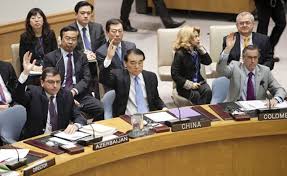
UN Security Council voted on Resolution 2334 requiring Israel to turn over land to the Palestinians
By now, anyone who keeps up with world events will know of the most recent United Nations Security Council Resolution. But in case you’ve been distracted with all the trappings of the holiday season, the U.N. Security Council passed Resolution 2334 which “concerns the Israeli settlements in “Palestinian territories occupied since 1967, including East Jerusalem“. The resolution states that Israel′s settlement activity constitutes a “flagrant violation” of international law and has “no legal validity”, and demands that Israel stop such activity and fulfill its obligation as an occupying power under the Fourth Geneva Convention.” (Wikipedia-UN Resolution 2334) This resolution was adopted on December 23, 2016.
Resolution 2334–A Prescription for Disaster
There are many many horrific problems with this resolution. I am particularly concerned by, what I would consider to be, inflammatory verbiage that only serves to unite the world against the State of Israel. Consider the following incendiary quotes that I pulled directly from the resolution:
- “…the inadmissibility of the acquisition of territory by force…”
- “…Israel, the occupying Power…”
- “Condemning all measures aimed at altering the demographic composition, character and status of the Palestinian Territory occupied since 1967, including East Jerusalem…the construction and expansion of settlements, transfer of Israeli settlers, confiscation of land, demolition of homes and displacement of Palestinian civilian, in violation of international humanitarian law…”
- “…dangerously imperiling the viability of the 2-State solution based on the 1967 lines…”
- “Reiterating its vision of a region where 2-demographic states, Israel and Palestine, live side by side…” (Obviously, this could never happen. Especially when the Palestinians have advocated and even sought the destruction of the State of Israel.)
- “…entrenching a 1-state reality…” (Father gave the land to Israel, none other. Granted, the Jewish State is not the sole owner of the land. It also belongs to the Lost Sheep of Israel who will some day be rejoined to the land.)
- “…the establishment by Israel of settlements in the Palestinian territory occupied since 1967, including East Jerusalem, has no legal validity and constitutes a flagrant violation under international law…”
- “…land for peace…” (This has been tried before and has never worked. The land grab is just another excuse to eradicate the world of the Jewish people, regardless what some of us may choose to believe and think.)
- “…an end to the Israeli occupation that began in 1967…” (Israel was threatened and even attacked by Egypt, Jordan and Syria in a concerted effort to destroy the Jewish State. Father’s providence and protection reigned over the Jewish people and the State of Israel survived the Arab aggression which led to acquisition of land which I will discuss in just a bit.)
Essentially, as Karahite Jewish Scholar Nehemia Gordon described on the December 30th edition of Michael Rood’s “Shabbat Night Live,” the United Nations through this resolution effectively dubbed the State of Israel a “Criminal State” and the people of the nation, “War Criminals.” As bad as Israel is in so many areas, there are many other nations that better qualify for this dubious distinction and moniker. (Just in the last century alone, the United States, China and Russia were each responsible for the deaths of millions of innocent people (non-combatants), throughout the world. Yet we are quick to call ourselves in this country, a Christian nation. Indeed, one could effectively argue that this nation was founded upon Christian-Judaio-principles. Nevertheless, the truth of the matter remains: this nation has throughout its history spilled innocent blood. Some would even go so far as to suggest this nation committed war crimes.

Nehemia Gordon comments on the most recent UN Security Council Resolution 2334
Now some would be severely offended by what I just said. There was a time in my life (my pre-Netsarim days) when I would be outraged at anyone who’d be so bold as to make such a conceivably anti-American statement. However, after coming in to the True Faith once delivered, I decided to begin calling a “spade a spade” and always consider the truth of a matter, regardless how hurtful that airing of the truth might be to anyone. Most every nation on the planet has some degree of blood on their hands and has at some time or another committed evil against humanity and in disobedience to the Creator’s commandments.
The State of Israel is not the Torah Observant, Yahuah-fearing, holy nation that most evangelical and Hebrew Roots people would hold it up to be. I used to see the modern State of Israel, despite her many glaring flaws, as God’s chosen people and nation. I’ve since come to learn and understand differently. However, I still stand with the State of Israel and I find the above cited resolution to be extremely troublesome. I’ll reflect upon this in just a bit.
Identity of Today’s Israelis in Question
Are the inhabitants of the State of Israel real Jews?
In the last several years, questions (which apparently had been posed over a number of decades but were never aired nor answered publicly) regarding the legitimacy of the so-called Jews and or Zionists living in the State of Israel have been posed by various scholars, teachers, and folks of questionable character.
Many of those questions centered around theories that the Hebrews, even the Jews that lived during our Master’s earthly ministry, were black. This thinking has developed into what has been aptly referred to today as Black Israelitism or Black Hebrew Israelites. Needless to say, many non-blacks would have a terrible-time identifying and accepting such thinking. We in the west have been indoctrinated to identify the Lord and Savior and His Jewish benefactors as European White men. And who would argue otherwise. Simply look at the various depictions of Bible-characters in illustrated Bibles throughout the years. All depicted characters are depicted to be Caucasian Frankly, I was raised to accepted a White version of Jesus Christ. I even came to view the Creator of the Universe as a gray-haired, Caucasian masculine Zeus-like being, ala the famous 16th century fresco painting of the Cystine Chapel depicting the creation of Adam.
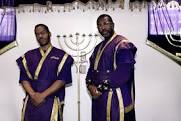
The Black Israelitism Movement contends the Jews and Hebrew were originally black.
I looked into this movement and was quickly turned off. I found those who supported and believed this theory (which I honestly believe has some reasonable merit to it) tended to be extremely militant, angry and did not possess nor display the love of Yahoshua Messiah. Their meetings and various conferences were fraught with profanity and verbal altercations that only made the participants’ positions essentially irrelevant to me. It was impossible to ascertain one person’s position over the other because all the participants were too busy arguing and cussing and posturing to intimidate their opponents. Consequently, no one will ever take their message seriously until they divest themselves of their anger and hatred and turn their hearts and minds and souls to Yahoshua Messiah.
Instead of a focus on what skin-color the original Hebrews and Jews possessed, many have instead turned their focus onto the true identities of Jews today. Are the Jews currently living in the State of Israel, Europe, United States, and all parts of the world, true biological descendants of Avraham? This has been one of the most hotly debated questions ever posed by people of Faith. This issue has begun to divide and polarize the Christian and Hebrew Roots communities–like we need another thing to cause disunity in our community.
The point of contention is whether we as a Faith community should physically, emotionally, financially, and politically support the State of Israel, given this lingering debate on the legitimacy of the people claiming to be Jews in the land.
One prominent Hebrew Roots teacher and overseer of a Hebrew Roots congregation recently concluded a series of teachings that called into question the legitimacy of the people possessing the land of Israel. I actually listened to his series of teachings on this subject and found it well researched and eye opening. However, the spirit in which it was delivered called into question the true motives of the teacher–at least it appeared that way to me. This teaching I felt went a long ways towards further polarizing our community on this divisive issue. (Commentary)
Impostors in the Land?
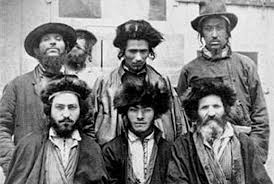
The Khazars–today’s Ashkenazim–are believed to be the forefathers of those inhabiting the land of Israel today.
The basis upon which this Hebrew Roots teacher and other religious scholars and leaders are building their anti-Zionist/anti-State of Israel argument has to do with the dubious origins of the Eastern European Jews that currently inhabit the land of Israel. The majority of Jews inhabiting the land of Israel are Ashkenazim. The Ashkenazim historically hail from Hungary, the Ukraine, the Balkins, southern Russia, the Slavic lands and to a great extent Poland. Now, we were all taught that the Jews of today, especially those currently inhabiting the land of Israel, descended from the Jews of the diaspora. The inhabitants of the land of Israel were expelled from the land in the first and second centuries by the Romans. These Jews, we were told, migrated and settled throughout the world, with the vast majority settling in Europe and Russia.
There is little doubt that the Jewish Diaspora happened. There are numerous ancient writings documenting these historical events, the most prominent being the writings of Josephus. The question, however, arises over the true identity of the Ashkenazim that comprise by far the greatest number of Jews in the world. Some scholars and teachers contend that the Ashkenazim are not the Jews of the Diaspora (that is, the the Ashkenazim are not the biological descendants of Avraham), but instead are descendants of Khazarians.
History reveals (although hazy history at that) the Khazarians to be a semi-nomadic Turkic people that politically and commercially dominated the region of Northern Europe to Southwestern Asia between the 7th and 10th centuries C.E. Sometime during this period of dominance, it is believed the Khazarim converted and adopted Judaism as their state religion, so to speak; sometime around the mid-8th century C.E.
Already adept artisans, middlemen and traders, it is believed that the Khazars fully immersed themselves into Judaism: learning Hebrew, embracing and adhering to the Talmud and the Torah; and seeking the return of the Jewish Messiah (not Yeshua) and the retaking of Jerusalem from the Muslims. Over time, it is believed that the Khazars soon forgot about their Khazarim heritage, but instead truly believed they were the actual biological descendants of Avraham.
Warring tribal hordes, natural migrations and plagues during the period extending from the 13th to the 17th centuries, resulted in well-established Khazarim, by then, Ashkenazim, communities in Hungary, the Ukraine, the Balkans, Southern Russia, the Slavic lands and Poland. It is then believed that these communities ultimately immigrated to Israel and today comprise upwards of 98% of the Jews living in the land.
Is America to be Cursed for Supporting the State of Israel?
Thus, a handful of Christians and even Hebrew Rooters are alleging that the present inhabitants of the State of Israel are impostors that have no true claim to the land. As impostors in the Holy Land, the United States, historically one of the State of Israel’s staunchest supporters and protectors since her inception in 1948, stands to be cursed. Some folks have gone so far as to suggest that the United States has always been cursed as a result of her ties to the impostor State of Israel. (If you are so interested in examining some of these ridiculous claims, they can be found at Biblicism Institute–https://biblicisminstitutewordpress.com/2014/07/17is-america-cursed/; and Texemarrs–“America is Cursed by God because of Israel’–www.texemarrs.com.)
I have news for these two website owners and those like them: America is not cursed because of her support of the State of Israel over the decades. If indeed America is cursed, it’s because of her disobedience and refusal to turn to the God of Avraham, Yitsak and Yacob and embrace and live Torah the way Yahoshua taught us to live it.
What Happened to the True Biological Jews?
With the thinking that the present inhabitants of the State of Israel are descendants of the Khazarim, I became curious to know, what ever happened to the biological descendants of Avraham–specifically the true diaspora Jews? (I realize that there are 10-so-called Lost Tribes of Israel out there that haven’t been accounted for–or have they? I’ll reflect upon that at another time, Father willling.)
Unfortunately, there is little existing evidence to trace exactly what happened to the true biological descendants of Avraham. Some scholars have traced tribes of people living in Africa that they believe possess the genetic markers of descendants of Avraham. These people make up a very small number of Jews however. The remainder are surmised to have migrated from the West to regions inhabited by Khazarim, sometime around the 17th century. With this surmised migration, it would be a fair bet to conclude that these biological Jews intermarried with the Khazarim. There is further circumstantial evidence to suggest that a a good number of biological descendants of Avraham settled in Spain after the Babylonian exodus in the 11th century C.E.
(Background information derived from the article entitled “Who Are The Real Israelites?”, by Alex Chistopher, 1993)
The State of Israel Today
Putting aside for a moment all the speculation related to the identity of the inhabitants of the State of Israel today, I wish to focus just a little on the circumstances leading up to last week’s incendiary U.N. resolution.
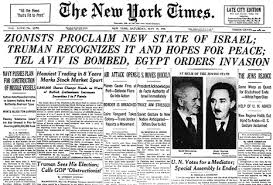
The Day Modern Israel became a nation state.
In my mind, it all can be traced back in great part to modern day Israel’s inception. On May14, 1948, David Ben Gurion, an executive of the Zionist Organization and president of the Jewish Agency for Palestine, decllared “the establishment of a Jewish state in Eretz Israel, to be known as the State of Israel.”” (https://en.wikipedia.org/wiki/israel) This declaration of statehood by Ben Gurion did not specify borders, but a 1947 United Nations General Assembly Partition Plan stipulated borders that would facilitate an Arab and Jewish state and an area of Jerusalem that would be “administered by the UN.” (wikipedia)
Thus, with the May 14th declaration of statehood by Ben Gurion, the State of Israel essentially assumed full control and occupancy of the borders that were stipulated in that 1947 Partition Plan. Needless to say, the nation from that point on faced several military and political challenges to that declaration of statehood.
With that fiat, some 700,000 Palestinian Arabs either fled or were expelled from the land. In contrast, some 700,000 Jewish migrants flooded into the land from various nations of the world as mentioned earlier. This over a 3-year period.
In 1967, between June 5th and 10th, Israel launched a preemptive military strike against Egyptian airfields in response to a build-up of Egyptian forces along the Israeli border in the Sinai Peninsula. Simultaneously, Israel launched a ground offensive into the Gaza Strip and the Sinai Peninsula. Israel proved militarily superior and pushed Egypt out of the Sinai. Syria and Jordan were induced to attack Israel at that time as well, believing Egypt had softened Israel’s military defenses enough for them to handily clean Israel’s clock, so-to-speak. As with Egypt, Israel’s military proved superior to those of Syria and Jordan. Syria lost the Golan Heights and Jordan East Jerusalem and the West Bank. This conflict became famously known as the 6-Day War or the Arab-Israeli War. This war was a defining moment for the State of Israel. It was Israel’s superior military tactics and prowess that earned her “street creds” (so-to-speak) in the Middle East. Despite continued challenges from neighboring states and various Arab attackers over the decades, Israel remains the most powerful force in the region. Politically, the world has demanded that Israel withdraw from what it sees as illegally seized and occupied territory.
Military Prowess or God’s Providence at Work?
Nevertheless, one who would be knowledgeable of Scripture would realize that Israel’s claim to all the land she originally received at her inception in 1948 and land that she seized from the 6-Day War were given to Israel by Yahuah as a covenant promise, originating with Avraham. That covenant promise is described in Genesis 15:18 and and Yahoshua 1:1-4, both of which reads:
In the same day Yahuah made a covenant with Abram, saying, Unto your seed have I given this land, from the river of Egypt unto the great river, the river Euphrates: (Gen 15:18 KJV, corrected by me)Now after the death of Moshe the servant of Yahuah, it came to pass, that Yahuah spake unto Yahoshua the son of Nun, Moshe’s minister, saying, 2 Moshe my servant is dead; now therefore arise, go over this Jordan, you, and all this people, unto the land which I do give to them, even to the children of Yisrael.
3 Every place that the sole of your foot shall tread upon, that have I given unto you, as I said unto Moshe. 4 From the wilderness and this Lebanon even unto the great river, the river Euphrates, all the land of the Hittites, and unto the great sea toward the going down of the sun, shall be your coast. (Jos 1:1-4 KJV, corrected by me)
The secular world would contend that Israel survived her 1948 inception and the 1967 war because she was militarily superior to all those who would challenge her ownership of the Land of Israel. Many would attribute Israel’s survival and successes in the wars she fought against her aggressors because she received significant military and financial assistance from the United States and some of her allies.
Yet many fundamental Christians and Hebrew Rooters–and yes, that would include me–attribute Israel’s successful stand against the unbeatable odds that she would eventually be overrun by her Arab neighbors and by those who would betray her from the west, as nothing short of Father’s promised providence and protection. Certainly, if one but reads and listens to the testimonies of those Israelis who participated in either of these historic events (i.e., 1948 Israel’s declaration of statehood and the wars that followed that declaration and the 6-Day War in 1967), and hears how Israel should have been summarily defeated as a result of a disproportionate number of anti-Israeli fighters, he or she must recognize Father’s involvement in the State of Israel’s survival to this day.
Does the Land Belong to the Current Peoples of the State of Israel?
Does the land as decribed in the passages above belong to the present State of Israel? I would contend it does, regardless if they are impostors (i.e., Khazarim) or true, biological descendants of Avraham. Father obviously gave the land to the current inhabitants of the land. To deny the current residents of Israel the title deed to the land would be as baseless as saying that the United States has no right to the title deed to American soil since the Native Americans were here long before the European Settlers arrived. Did not the United States wrest the land from the hands of the Native Americans in one way or another? In both cases, Israel and America, Father’s hand undeniably played a key role in the formation of these two nation states.
Who are we to say oppose Israel then? If we believe Abba to be sovereign, I don’t see how we can question nor stand against that which Father has clearly ordained and sanctioned. Father revealed this about Himself to us:
9 Remember the former things of old: for I am Yahovah, and there is none else; I am Yahovah, and there is none like me,10 Declaring the end from the beginning, and from ancient times the things that are not yet done, saying, My counsel shall stand, and I will do all my pleasure: (Isa 46:9-10 KJV, corrected by me)
In speaking of Father’s intention to deal with the Assyrians, Isaiah wrote:
Yahuah Sabaoth hath sworn, saying, Surely as I have thought, so shall it come to pass; and as I have purposed, so shall it stand: (Isa 14:24 KJV)
Continuing at verse 26:
26 This is the purpose that is purposed upon the whole earth: and this is the hand that is stretched out upon all the nations. 27 For Yahovah Sabaoth hath purposed, and who shall disannul it? and his hand is stretched out, and who shall turn it back? (Isa 14:26-27 KJV, corrected by me )
Like Shaul wrestling against the Gospel of Yahoshua at his conversion on the famed Road to Damascus, why do we then “kick against the pricks?” (Acts 9:5) So why do some of us rail against that which Father clearly put into place? Arrogance? Narrow mindedness? Liberal influences that seem to always threaten to steer and control our thoughts and perspectives on things of the world? I would contend it is a liberal mindset, which typically is not a Godly mindset, that seeks to sway us against those principles that are clearly contained in our Bibles.
Some have taken it upon themselves to suggest that 98% of the people in the State of Israel (and even in the world) are Khazarian impostors. That would then leave about 2% that are genuine Jews, right? Well, 2% of the 2016 population of the State of Israel comes to about 163,849 people; this based upon a census estimating a population of 8,192,463 souls living in the land of Israel. (reference Wikipedia, Google Search on 2016 population of the State of Israel) That’s a lot of people if you ask me.
So are we then to summarily dismiss 164,000 people living in the State of Israel–that is, throw the baby out with the bathwater–because we think the majority of Israelis living in the land are impostors?
The Land of Israel Belongs to Israel
Apart from the lingering questions related to the biological, Abrahamic descendant issues related to the legitimacy of those would be Jews claiming birthright to the land of Israel, I see broader issues at play here that I believe we must be cognitive of. The land was given to Avraham through a covenant orchestrated by Abba Father. Recorded in the book of Genesis, it reads as follows:
Now Yahweh had said unto Abram, Get out of your country, and from your kindred, and from your father’s house, to a land that I will shew you: (Gen 12:1 KJV, corrected by me)
For all the land which you see, to you will I give it, and to your seed for ever. (Gen 13:15 KJV, corrected by me)
And I will give to you, and to your seed after you, the land wherein you are a stranger, all the land of Canaan, for an everlasting possession; and I will be their God. (Gen 17:8 KJV, corrected by me)
That covenant was passed down to Isaac (Genesis 26:4) and on to Jacob (Genesis 28:14). Ultimately, the covenant extended over to the mixed multitude that came out of Egypt under the leadership of Moshe and the providence of Yahuah:
Elohiym spoke unto Moshe and said unto him, I am Yahuah: And I appeared unto Avraham, unto Yitschaq, and unto Ya’aqov, as El Shaddai, but by my name Yahuah was I not known to them. And I have also established my covenant with them, to give the land of Kena’an, the land of their pilgrimage, wherein they were strangers.” (Exodus 6:1-4, Cepher)
A careful read these and other associated passages clearly reveals that the Land of Canaan was originally given to the whole of the Children of Israel, not just to the tribal descendants of Judah. Yet most of us fail to remember this crucial point. Even those who govern and control the State of Israel have conveniently forgotten this essential truth.
In an article written by Peter Beaumont and posted on The Guardian (https://www.theguardian.com), Israeli Prime Minister Binyamin Netanyahu is recorded as saying:
“…the nation state of one people only (speaking of Israel)–the Jewish people-and of no other people…The State of Israel is a Jewish and democratic state…the State of Israel is the nation state of the Jewish people…it is the nation state of one people only-the Jewish people-and no other people.” (May 4, 2014)
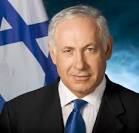
Benjamin Netanyahu-Prime Minister of the State of Israel
Well, what about the other 11-Tribes Mr. Prime Minister?
According to the Jerusalem Center for Public Affairs, the nation defines herself as a Jewish State. (Daniel J. Elazar)
Bottom line folks, Israel belongs to the Children of Israel, not just to the Children of Judah. Many of us who claim hold to the Hebrew Roots of the true Faith once delivered to the first century Saints, identify ourselves as true Israelis. I for one, look to a day when we will Aliyah to the Land of Canaan and be a part of Yahoshua’s Kingdom, headquartered in Jerusalem. If BiBi Netanyahu and others like him were to have their way, we would be excluded from any such claim to the land. I even doubt that Master Yeshua would be allowed to set up shop in Jerusalem given the present mindset of the leaders of the State of Israel. But then, Mr. Netanyahu won’t have much of a say on the matter anyhow, will he?
The State of Israel Often Stands Alone
Looking beyond all of the impediments that cause many of us to stumble over the issues surrounding modern Israel and Israel sovereignty, it is clearly evident that Israel stands alone in the world. Israel’s longtime friend and companion, the United States, this go-round under the Obama Administration, seems to have effectively abandoned her to the pack of wolves that is the United Nations.
U.N. Security Council Resolution 2334 should be of no historical surprise to any of us. The West and East has for decades sought to stymie and marginalize Israel at every conceivable turn. However, throughout the various times the world has seemingly been against the State of Israel, the United States has for the most part been the state’s most consistent and ardent supporter; at least that’s what every administration and the media has fed to us.
However, this most recent U.N. resolution had somewhat of a suspicious character attached to it. Resolution 2334 was not suspicious from the perspective of the validity of the resolution itself, but suspicious in terms of the security council members who backed this resolution. According to the above cited wikipedia article, “the resolution passed with support of 14 of the 15 members of the Council with the U.S. abstaining from [what would be naturally expected of the U.S.] veto of the resolution.” (ibn)
According to the United Nations’ own website, there are 115 members of the U.N. Security Council. Of that 115 members, 5 are permanent members, each of the 5 possessing veto power. The 5-permanent members include: China, France, the Russian Federation, the U.K., and the U.S. The non-permanent members are elected for a 2-year term by the General Assembly. (www.un.org/en/sc/members/)
The cited wikipedia article reported that the passage of resolution 2334 was “met with applause in a packed chamber.” (Wikipedia was referencing an article in The Times of Israel-Choosing not to Veto, Obama Lets Anti-Settlement Resolution Pass at UN Security Council,” 12/23, 2016)
Needless to say, news of the passage of resolution 2334 enraged the Israeli government. Israel’s Prime Minister, Benjamin Netanyahu, “accused the U.S. of colluding with the Palestinians in drafting this resolution.”
To add insult to injury, U.S. Secretary of State John Kerry was set to outline a peace settlement between Israel and the Palestinians. Additionally, in January of 2017, France is set to host an international conference of 70-countries to hammer out a “framework for Mideast peace.” (Daniel Estrin, Associated Press, 12/28/2016)
It is widely known that there is no love lost between the Obama Administration and the State of Israel. Daniel Estrin, in the above cited Associated Press article, notes that “members of Israel’s government believe the Obama Administration to be pro-Palestinian–[even anti-Israel–my words]–and ignorant of how things work in the Middle East.” (Estrin)
Support of Israel a Command or Just a Suggestion
Despite the stance one chooses to take regarding Israel, the fact of the matter is that Israel remains a Jewish State to this day. No one can deny the seemingly miraculous chain of events that has over the course of decades kept this nation viable and even thriving despite the world’s various attempts to marginalize and even destroy the state and her people. Regardless what some may think about the State of Israel (and there are certainly many problems associated with the present State of Israel), it would seem pretty evident that we as a Faith community must respect and even support the State. I’m not saying that we must worship the State of Israel as so many in our community do. Yet the Bible does suggest that we respect Israel as a nation and the land of Israel proper.
The way things are presently arranged in the State of Israel today, I believe, must not be our concern. Daniel spoke concerning world affairs:
21 And he changeth the times and the seasons: he removeth kings, and setteth up kings: he giveth wisdom unto the wise, and knowledge to them that know understanding: 22 He revealeth the deep and secret things: he knoweth what is in the darkness, and the light dwelleth with him. (Dan 2:21-22 KJV)
The way I read this is simply: Abba’s got this and we as His children must learn to trust Him and His perfect wisdom. That is why Shaul (aka Paul) wrote to the Roman Assembly:
Let every soul be subject unto the higher powers. For there is no power but of God: the powers that be are ordained of God. 2 Whosoever therefore resisteth the power, resisteth the ordinance of God: and they that resist shall receive to themselves damnation. 3 For rulers are not a terror to good works, but to the evil. Wilt thou then not be afraid of the power? do that which is good, and thou shalt have praise of the same: 4 For he is the minister of God to thee for good. But if thou do that which is evil, be afraid; for he beareth not the sword in vain: for he is the minister of God, a revenger to execute wrath upon him that doeth evil. 5 Wherefore ye must needs be subject, not only for wrath, but also for conscience sake. (Rom 13:1-5 KJV)
This of course is not to say that we must answer to Israel’s every whim and demand and condone that which they do that is evil. But the broader context of supporting Israel, indeed even the modern State of Israel, is that blessings and curses are tied to the way any people treat the nation. Not only did Abba reveal this truth to Avraham in Genesis 12:3, but the truth was reiterated through the jackleg prophet Balaam when he uttered of Israel:
8 God brought him forth out of Egypt; he hath as it were the strength of an unicorn: he shall eat up the nations his enemies, and shall break their bones, and pierce them through with his arrows. 9 He couched, he lay down as a lion, and as a great lion: who shall stir him up? Blessed is he that blesseth thee, and cursed is he that curseth thee. (Num 24:8-9 KJV)
The writer of Psalm 122 took this principle a little further when he wrote the following:
6 Pray for the peace of Jerusalem: they shall prosper that love thee. 7 Peace be within thy walls, and prosperity within thy palaces. 8 For my brethren and companions’ sakes, I will now say, Peace be within thee. 9 Because of the house of the LORD our God I will seek thy good. (Psa 122:6-9 KJV)
Curses Against the United States
I mentioned a couple articles I came across on the internet in my research for this Thoughts and Reflections episode whereby the writers of those websites put forth a belief that America is a cursed nation BECAUSE of her support of the rogue State of Israel. I think those who believe such a thing are extremely deceived and unaware of the things that go on about them and about this nation they call home. I would guess that these individuals are actually enjoying the blessings of living in a nation like the United States where they can freely share their views to a spiritually blind and ignorant world. These individuals no doubt live better than most of the citizens of this world. They drive nice cars; live in modern, comfortable homes; take wonderful vacations from time to time; and just enjoy life. Yet these same individuals would have us believe that we are a cursed nation living in terrible conditions. Frankly, I don’t believe these folks understand what a curse is. I also wonder what their true agendas are.
Along the lines of articles that outline the set of curses that these folks believe the United States is under, I happened upon an article written by InfoWars’ Michael Snyder on 12/26/2016, that listed disasters that occurred in this country when the United States betrayed the nation state.
- On March 22, 1979, the United States refused to veto UN Resolution 446 which outlined a land give-away by the State of Israel to the Arab people. On March 28, 1979, the historic 3-Mile Island Nuclear Power Plant disaster occurred. That disaster ranked as the worst nuclear power plant disaster on U.S. soil in U.S. history.
- On October 30, 1991, then President George H. W. Bush admonished Israel that “territorial compromise is essential for peace.” That day, a hurricane struck Bush’s hometown of Kennebunkport, Maine. Although some might think this a simple coincidence, it should be noted that that storm traveled 1,000-miles, opposite its established and projected trek, slamming the town with 35-foot waves.
- On August 23, 1992, the United States hosted the Madrid Peace Conference in Washington DC. On August 24, 1992, Hurricane Andrew struck Florida, ranking as the worst natural disaster on record in the United States at that time.
- On January 16, 1994, then President Bill Clinton colluded with Syrian President Assad to work out a plan to coerce Israel to relinquish their hold on the Golan Heights. Then on January 17, 1994, the Northridge Earthquake struck Southern California, ranking as the 2nd worse natural disaster in recorded United States history.
- On May 3, 1999, Palestinian leader Yasser Arafat, supported by the United States, was slated to announce the creation of a Palestinian State with Jerusalem as it capital. That same day, multiple tornadoes, some of the most powerful ever recorded in this country, plowed through Oklahoma and Kansas. One tornado was clocked at some 316 mph.
- On April 30, 2003, the so-called, “Road Map to Peace,” co-authored by the United States, was presented to Israel’s Prime Minister Ariel Sharon by the United States. Seven days later, the United States was plagued by some 412 tornadoes throughout much of the Midwest, ranking as the largest tornado cluster in U.S. history.
- On August 23, 2005, as the very last Jewish settler was forced out of a Gaza settlement by Israel’s government, at the behest of the United States, Hurricane Katrina began forming over the Bahamas. Katrina ultimately slammed into New Orleans. It ranked as the costliest natural disaster in recorded U.S. history to date.
- On May 19, 2011, the Obama Administration urged Israel to return to her pre-1967 borders (oh here we go again). Then on May 22, 2011, a category 5, multi-vortex tornado cut through Joplin, Missouri. That tornado ranked as the costliest tornado disaster in U.S. recorded history.
Now, I’m aware that some will contend that these events–these cited curses sustained by the United States over her betrayal of Israel over the last few decades–will come across as foolish conjecture on both Mr. Snyder’s and my part. And whoever chooses to take such a position is more than welcome to feel that way. I’m simply reporting that which has been provided to me by what I believe to be the leading of the Ruach Kodesh. The only dog I have in this fight is my sincere belief that we do ourselves no favors–as individual Netsarim; as a Hebrew Roots community; as citizens of the United States; as a nation–by turning our backs on the State of Israel.
Concluding Thoughts and Reflections
In conclusion: As I mentioned earlier, the present State of Israel is not the Israel that we’ve come to know from the Bible. She is fraught with many problems. There are lingering concerns that the people of the State of Israel are impostors and thus are robbing the United States of her due blessings because we are allegedly supporting people of hasatan. Yet let us not forget that the people Moshe led out of Israel by the mighty hand of Yahuah, out of Egyptian bondage, were not a genetically pure race of people. In fact, Torah tells us:
38 And a mixed multitude went up also with them; and flocks, and herds, even very much cattle. (Exo 12:38 KJV)
Father was not looking at the biology of this people to justify His extension of the Abrahamic covenant with them. Even in His Torah, Father made provision for those who were not descendants of Avraham:
34 But the stranger that dwells with you shall be unto you as one born among you, and you shall love him as you’d love yourself; for you were strangers in the land of Egypt: I am Yahovah your Elohim. (Lev 19:34 KJV, corrected by me) Corresponding passages of Torah regarding those outside the genetics of Israel are Deuteronomy 10:19; Exodus 22:21; 23:9.
Furthermore, when Father initially established His covenant with Avraham, He told Avraham that he would indeed be the father of a multitude of nations. (Genesis 17:5) I would go so far as to say that this probably applies to the present State of Israel.
But we who have concerns whether one group of people are true Jews versus another group which we believe to be impostors, is in my opinion a moot point. Shaul taught:
28 For he is not a Jew, which is one outwardly; neither is that circumcision, which is outward in the flesh: 29 But he is a Jew, which is one inwardly; and circumcision is that of the heart, in the spirit, and not in the letter; whose praise is not of men, but of God. (Rom 2:28-3:1 KJV)
So one could conceivably argue that the Jews of our Master’s and Shaul’s day were as much impostors as the alleged Ashkenazim living in the State of Israel today. If they are not living Torah and embracing the God of Avraham, Yitzak and Ya’acob as their God, they are not true Jews. Yet their refusal to be obedient to Yahuah does not change the fact that Father is sovereign; that Father maintains his covenant promise to keep Israel; that we should pray for the peace of Jerusalem and that we should continue to bless that nation. If we kick against this prick, I believe, we stand to heap upon ourselves curses as Balaam prophecied to Balac. (Revelation 2:14)
Oh, but the people of Israel are not Torah-observant and they reject Yahoshua as their Messiah, and thus don’t deserve our support. Well, when has Israel ever consistently been Torah Observant? Isn’t that the reason they were thrown out off the land at least two times before? It’s not for us to judge them as a people. Did not Master assign that task to His chosen disciples?
28 And Jesus said unto them, Verily I say unto you, That ye which have followed me, in the regeneration when the Son of man shall sit in the throne of his glory, ye also shall sit upon twelve thrones, judging the twelve tribes of Israel. (Mat 19:28 KJV)
We do well to ensure that we are Torah Observant and that we are setting the example that will ultimately provoke the nation to jealousy. Shaul wrote, alluding to a Deuteronomic passage in Torah:
19 But I say, Did not Israel know? First Moses saith, I will provoke you to jealousy by them that are no people, and by a foolish nation I will anger you. (Rom 10:19 KJV)
Are we to side with the New World Order, an exclusive group of individuals whose express purpose is to destroy the Children of Israel and take over the land that Zachariah predicted would become a burden to the world? Consider this prophecy of Zechariah:
The burden of the word of the LORD for Israel, saith the LORD, which stretcheth forth the heavens, and layeth the foundation of the earth, and formeth the spirit of man within him. 2 Behold, I will make Jerusalem a cup of trembling unto all the people round about, when they shall be in the siege both against Judah and against Jerusalem. 3 And in that day will I make Jerusalem a burdensome stone for all people: all that burden themselves with it shall be cut in pieces, though all the people of the earth be gathered together against it. 4 In that day, saith the LORD, I will smite every horse with astonishment, and his rider with madness: and I will open mine eyes upon the house of Judah, and will smite every horse of the people with blindness. 5 And the governors of Judah shall say in their heart, The inhabitants of Jerusalem (doesn’t stipulate that they are to be biologically pure Jews does it?) shall be my strength in the LORD of hosts their God. 6 In that day will I make the governors of Judah like an hearth of fire among the wood, and like a torch of fire in a sheaf; and they shall devour all the people round about, on the right hand and on the left: and Jerusalem shall be inhabited again in her own place, even in Jerusalem. 7 The LORD also shall save the tents of Judah first, that the glory of the house of David and the glory of the inhabitants of Jerusalem do not magnify themselves against Judah. 8 In that day shall the LORD defend the inhabitants of Jerusalem; and he that is feeble among them at that day shall be as David; and the house of David shall be as God, as the angel of the LORD before them. 9 And it shall come to pass in that day, that I will seek to destroy all the nations that come against Jerusalem. 10 And I will pour upon the house of David, and upon the inhabitants of Jerusalem, the spirit of grace and of supplications: and they shall look upon me whom they have pierced, and they shall mourn for him, as one mourneth for his only son, and shall be in bitterness for him, as one that is in bitterness for his firstborn. 11 In that day shall there be a great mourning in Jerusalem, as the mourning of Hadad-Rimmon in the valley of Megiddo. (Zec 12:1-11 KJV)
Let us not be so naive to believe that the New World Order, if it were successful in destroying the Jewish State Israel, would not eventually turn its sights to us who believe we are Father’s elect, which the Bible clearly predicts will happen. John wrote:
7 And it was given unto him to make war with the saints, and to overcome them: and power was given him over all kindreds, and tongues, and nations. (Rev 13:7 KJV)
I’ve come to the conclusion that it is not up to me to determine whether or not I will support the State of Israel with whatever means is afforded me. Father is sovereign. He has seated the people that currently inhabit the State of Israel in place. It is then up to me, as a Netsarim, to stand in support of the State of Israel, regardless.
That’s just me saying. I guess it comes down to each of us making up our own minds on this matter. May the Ruach guide us on this matter, as it guides us in all matters in our walk with Mashiyach.
May Abba bless you and keep you; may His face shine upon you and be gracious to you, your families and fellowships. May Abba lift up his countenance upon you and grant you Shalom.
Shavuatov. Until next time, may you be most blessed fellow Saints in Training.
Faithfull submitted, I’m Rod Thomas. Shalom.
Music by DanO Music