by Rod Thomas | May 8, 2016 | Podcasts
The World Loves Baal (aka Nimrod)
Sabbath Thoughts and Reflections–Episode 56
In this episode of Sabbath Thoughts and Reflections, I reflect upon the realization that the world loves Baal (aka Nimrod). This comes to mind in light of a couple YouTube videos that I watched by Zachary Bauer and Rob Skiba addressing the recent construction and dedication of an imitation archway from the Temple of Baal in Trafalgar Square, London.
Last week I stumbled upon several articles and YouTube videos addressing a new phenomenon that is taking place in many of the world’s western metropolitan cities and that is the erecting of dozens of Baal Temple entrance-ways or archways. These are imitations of the original Temple of Baal gate or archway that once stood in Palmyra Syria, but that ancient temple was destroyed by ISIS late last year. That destruction, along with a few other ancient archaeological structures over the last couple years, has outraged the Western World, and the world at large has demanded that an end be put to ISIS’ indiscriminate murdering and destruction. Unfortunately, ISIS continues to terrorize much of the world. Now, the West has decided to erect an imitation or model of the famous archway in dozens of their metropolitan cities. The latest ones to be erected and officially dedicated as monuments of some sort was in Trafalgar Square in London England and New York City. There is a viral YouTube video of the ceremony marking the dedication of the archway in Trafalgar Square that suggests these archways are actual portals into a spirit realm that we as a race have no business tapping into.
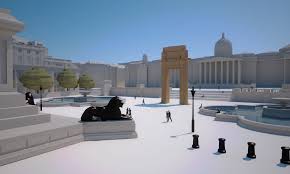
Imitation Archway Temple of Baal in Trafalgar London
The Faith-based conspiracy theorists believe that the construction of these archways is not an innocent venture to honor ancient history and the human spirit. There is a general belief among many (with me included) that maybe this is a contrived endeavor designed to bring Baal worship right-smack into the center of major Western cities as well as point a proverbial finger upwards towards Father, signaling that we humans can choose whom we will worship and our choice is Baal, Moloch, Osiris, Zeus, what have you. These Faith-based conspiracy theorists contend that these archways may be portals into the forbidden demon world which could serve to open the door to evil spirit entities entering into our Western cities. This sounds all well and good, but don’t we already have evil spirit beings dwelling in virtually every segment of our world today?
I believe the construction of these archways is more to offend the Creator and to remind the world at large of the preferred worship of Baal.

Zachary Bauer
Zachary Bauer and Rob Skiba recently did fantastic YouTube videos on this very subject that I would encourage you to take a look at. If you are so inclined, simply click on their names and it will take you to their postings.
Rob Skiba
Skiba focuses more on the return of Nimrod in the last days while Bauer does more of a focus on the Mark of the Beast. Both videos address ancient Babylon and the world religions that have emerged from that ancient culture and peoples. Both tie in the construction of these archways to Baal worship. Rob Skiba believes that the anti-Christ will be some type of Nimrod incarnation.
As it relates to these planned 100-Baal Temple archways being installed around the world, Skiba asks the question: “These are gates, but gates to what? They must be gates to something.” I love what Skiba has to say about such endeavors that aim to unite the “so-called” civilized world with ancient pagan ways which the west seems to be fascinated with of late. There seems to be absolutely no interest in restoring the paths that the Creator of the Universe set before us; of rebuilding the old waste places that Father once anointed; of raising up the foundations of the lost and forgotten generations that He once embraced; of having that breach that was severed, once again repaired (reference Isaiah 58:12).
Rob Skiba says that we in Hebrew Roots are given a list of rules we are to follow–contrary to the beliefs and doctrines of our Christian cousins. I would add to this statement of Skiba, that we in Hebrew Roots signed up for a job–to be disciples of Yahoshua Messiah. That job is a full-time job that doesn’t end at a set time each day or that we are on duty only on the Shabbat. But our ultimate jobs are to be priests to the world and who keep Yah’s laws. And as Skiba rightly says in alignment with Scripture, it is our transformation into that nation of priests that will ultimately cause the world to have the scales drop from their eyes, realize the error of their ways and discern the countless lies that they’ve been told about the Father and His Son and their expectations of us, and to become children of Yahovah (Reference: Exodus 19:6; 1 Peter 2:5, 9; Revelation 1:6; 5:10; 20:6). No greater promise nor purpose has ever been given to men–and once we embrace our role in Yah’s grand plan, we then begin to appreciate what we’re up against in this world as hasatan knows that he has but little time remaining before those archways fall on him–figurative speaking.
I also agree with Bauer’s take on this whole Temple of Baal thing and in his assertion that the world is already worshiping the beast. But Bauer in his video also believes that the Mark of the Beast, prophecied in the Book of Revelation a multitude of times, is actually world currency. In his video, Bauer shows the viewers an Iraqi Dinar, which has printed on it Babylonian symbolism. We know also that our national currency–United States currency that is–has Babylonian symbolism imprinted on it. In ancient times, Caesar’s image was engraved on Roman currency and we know that Caesar was considered and worshiped as a god in his day. What better way is there to propagate Baal worship throughout the world than through the world’s currency. That is hasatan genius, unfortunately.
Some feel that the Mark of the Beast could not possibly be currency since many believe that common currency/hard currency will be done away with in the end times. These same folks believe that the Mark of the Beast will, instead, be biometrics-based, such that to buy or sell, one must have chips implanted in one’s head and arms/appendages. I agree with Bauer that this system is still currency, regardless the physicality of the currency. If the world goes towards biometrics as many believe it will, then the world system, which is essentially Babylonian-based, will be behind that biometrically based currency.
Rob Skiba agrees with Bauer in that the whole world worships the beast and has been doing so for centuries, although the world at large is oblivious to their participation in this worship. The Christian Church, especially Catholicism, has through the centuries, sought to “Christianize” paganism as a means of bringing in more and more adherents into the Universal Church. Protestantism believes that she was successful in escaping the paganism of Catholicism, but to her chagrin, Protestantism never left or abandoned paganism, and to this very day, she continues to worship a Greek God and Jesus through her various traditions and doctrines and practices and teachings. Holidays such as Easter and Christmas remain Christianity’s hallmark symbols of her adoration and worship of the Greek/Babylonian-based god and religion. Many in Churchianity have come to learn and realize that maybe we in Hebrew Roots are correct about the pagan origin of some of their practices and holidays. But the vast majority of churched adherents refuse to abandon Church and the trappings of their religion because it makes them comfortable and happy and content.
I love Skiba’s statement that handsomely sums up the predicament facing the world–that single dividing question and mindset: “Will we be divisive in Truth or united in lies?” And that is the million dollar question my friends. The Truth is out there, and don’t be fooled: today, more folks in the Church realize the Truth than we could ever fathom. But those that know the Truth are willing to hedge their bets, that they will be given a pass by Judge Yahoshua in the last days, because “He knows my heart.” Well, indeed, He does know our hearts and He will judge accordingly. For He knows and the Father has revealed to us: “The heart is deceitful above all things and desperately sick; who can understand it?”
I’ve read some of Rob’s materials as well as we’ve attended a couple of Rob’s lectures and I think he has some very important things to say about our world today and where we may be heading as the human race. Check it out. But Rob treats the viewer of his YouTube video to snippets of his book, “Babylon Rising,” and he reveals, in connection to the Baal Temple archway construction in London and New York, that Nimrod is at the heart of it all. Nimrod, according to Skiba, and a host of other experts on the subject, is none other than Baal; none other than Marduch or Moloch; is none other than Apollo, Gilgamesh, Osiris, Dionysius and a host of other such pagan deities throughout the course of human history. Skiba holds that Nimrod founded Babylon and was the first Global Leader and Babylon was the first superpower, new world order of the post flood era. As time has gone by and the spirit of Nimrod has taken on various entities and deities and religions, there has been a never ending line of men who have kept the candle burning for Nimrod and looking forward to Nimrod’s return to earth to re-establish absolute reign and control over this world. Skiba believes that Nimrod (I believe more, a spirit of Nimrod) is going to be the prophecied anti-Christ in the end times. That being the case, by constructing these various Baal Temple archways throughout the world, which are believed to be portals to the spirit realm (bad spirit realm that is), is the world then “putting out a welcome sign to Baal?”
I pulled up before and after images of the Ancient Syrian Temple of Baal (i.e., before and after ISIS destroyed the edifice) and I have to say that it looks frighteningly similar to proposed images of Solomon’s Temple. We know that hasatan is a consummate counterfeiter and spiritual fraud. The coming anti-Christ will claim to be Yahoshua Messiah and the many signs and wonders that he will do will be so sophisticated that it would potentially deceive Yah’s elect.
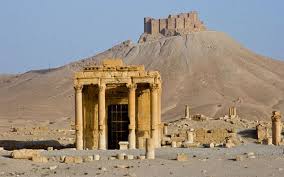
Temple of Baal in Palmyra Syria
Skiba brings up an interesting point related to the erecting and dedication of the Temple of Baal archway in Trafalgar Square in London last week: that this whole thing comes right smack in the middle of the Feast of Baal–which is, again, a counterfeit of the Feasts of Yahovah–a week-long celebration and worship of Baal that generally falls between 4/19 and 5/1. The culmination of this week-long festival is the celebration of Beltane–5/1, which symbolizes the rebirth of Baal. Is it not suspicious that this archway was dedicated in Trafalgar Square London during one of paganism’s holiest holiday seasons? Yet no one in the secular world has protested or rejected the erection of this archway. No one is sounding out an alarm to the world about the 99 or more of these things that are being installed in cities throughout the world. Churchianity is still asleep at the wheel on this thing. Not only are they oblivious as to the True Faith once delivered, they are oblivious as to this serious of portals being constructed around the globe. For what purpose we can only surmise.
At the very least, assuming I’m wrong and I could very well be wrong; at the very least, we were warned by the Almighty to not inquire into the ways of the heathen nations of the world about us. And by erecting and dedicating these archways, we are violating Yahovah’s Torah and in doing so, man is going to at some point, have to pay and pay dearly. I wholeheartedly agree with Skiba: “We can’t erect monuments of the 10-commandments in this country of ours, but we sure as hell can erect a pagan archway in the heart of New York City. Give me a break.
It is interesting indeed that we in the West and in various parts of the East, were outraged over the destruction of the Temple of Baal by ISIS last year. But we as Natsarim know Father’s position on the subject of pagan worship. Father simply abhors any suggestion His people inquiring after false god.
As Natsarim, Deuteronomy 12 is our reference as it relates to how we are to view and react to false gods:
“And these are the statutes and the ordinances which you shall be careful to carry out in the land which the Lord, the God of your ancestors, has given you to possess all the days that you live on the earth. You shall surely destroy all the places where the nations that you dispossess have served their gods: on the high mountains, and on the hills, and under every green tree. And you shall break down their altars, and dash their pillars to pieces and burn their Asherim with fire; you shall hew down the graven images of their gods; you shall obliterate their name from that place. You shall not act like this toward the LORD your God.” (vss. 1-5)
Essentially, Father is telling us directly that we should have nothing whatsoever to do with false gods. Thus, by our inquiring about such things as the Temple of Baal and then seeking to erect a similar monument in dozens of Western cities throughout the world, we are in total and utter violation of Torah. We are thus cutting our own throats by doing this. Father will not tolerate an “in your face” gesture such as this and not exact punishment upon these cities and those that are leading millions down a road of eternal destruction. It is imperative that we pray earnestly for our nations; that Father spare the nations from His coming wrath and that any evil that may come from these structures will be staved. I believe that we must intercede on behalf of the world as long as there is a chance that she may turn from her wicked ways:
“If my people who belong to me, humble themselves; pray, seek to please me; and repudiate their sinful practices–turn from their wicked ways; then I will respond from heaven, forgive their sin, and heal their land.” (2 Chronicles 7:14, ESV)
Thoughts and Reflection on Lew White’s Book–“Nimrod’s Secret Identity–The Greatest Conspiracy on Earth”
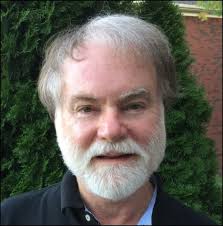
Lew White–Author
I came across Mr. Lew White’s Book, “Nimrod’s Secret Identity,” quite by accident. Most of my reads and even bible-based/related resources have become almost entirely electronic–i.e., Kindle books. If you own a Kindle, you know that whenever you scroll through your books on the carousel and your device is connected to the internet, you will receive notice of books you can purchase from Amazon that fall within the same genre as the book you are scrolling to at the time. So this book popped up as a recommended read. The price was reasonable and after reading the book’s limited reviews by former readers and a description/summary of what the book was about, I elected to download the book and read it.
I have to say at the outset of this review that I’m not entirely a fan of Mr. White’s writing style. Don’t get me wrong, he is a fair writer and his writing is clear and moderately concise. However, what drove me absolutely crazy about Mr. White’s writing is his insipient repeating of a handful of points that he makes throughout the book. And I’m not just talking about restating these handful of points. He actually cuts and pastes these points over and over again throughout the book and that is just annoying to me. But, I can overlook it for the sake of content. So then, what about the content of this book?
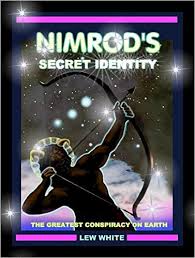
Nimrod’s Secret Identity by Lew White
Well, Mr. White makes some excellent points in his work, especially as it relates to the drawing of lines separating true Hebrew Rooters, who I prefer to refer to as Natsarim or Natsari, and nominal Christians and Catholics. Most of what he wrote as it relates to the pagan origins of every other religion and Faith on the planet is pretty well established in the minds of us Rooters, but he does bring a fresh perspective on the issue which is always nice to read from time to time.
I will also note, however, that there are some areas of this work that I do not agree with or that I take issue with. The major area of disagreement that I have with Mr. White concerns the divinity of the Master, Yahoshua, whom He identifies as the Creator of the Universe, Yahuah. I’ve mentioned on this program a few times that I do not believe that Y’shua is the God of the Old Testament and I’ve given a few reasons why I don’t believe this. But I will save my comments regarding this area of his work for another time as I also read his second book entitled “I Am Yahuah,” where he goes into greater death about this issue. When I review that book, I’ll spend a little time discussing my perspective on the divinity of Y’shua in relation to Mr. White’s book on this subject.
The areas of concern I had with this book is mutli-faceted. First and foremost, I know nothing about Lew White. Is he a Torah scholar or a Bible scholar? Is he a professor or is he educated in ancient history? Is he by chance an ancient Hebrew and or Greek scholar? These questions regarding his pedigree and credentials come into play here because Mr. White does not provide any references to many of his claims, whatsoever. He makes tremendous claims regarding the pronunciation of the Creator’s name, delving into the realm of ancient-paleo-Hebrew. But not knowing his background and by him not providing references to his statements and claims, the reader is left to make unsubstantiated assumptions, which at this stage of my life, I’m not happy at all to do. You see, most of us in Hebrew Roots came out of Churchianity where you were told what to believe and what not to believe and most of us simply saluted and said “yes ma’am, yes sir” and went about our business–dumb fat and happy and never questioning what we were just taught. But we’ve come out of that, have we not? We search out a matter and we compare the matter to what is written in the Holy Writ. We seek input from the leading of the Ruach Kodesh and we go back and study the matter more–all before we make a final decision whether to believe and accept what is being given to us or not. But it would seem that Mr. White did not get that memo.
You see Mr. White, when one writes a book that is advocating that the reader give serious consideration to your claims by using a technical, historical-teaching approach (as you did in this book), you either have to be THE expert holding the appropriate experience and pedigree making the claims; or you better provide sound references to back up what you’re saying. You did neither in this book and because of this serious oversight (whether intentional or unintentional), the content of your book must, in most places, be taken with a grain of salt–especially if you are appealing to the Hebrew Roots community. We know better than to simply take some stranger’s word as fact. That approach got most of us tangled up in religion for many years and most of us simply don’t wish to go back to that lifestyle ever again. Just saying.
But allow me to give you a quick overview of the book and hopefully after I’m done this review, you’ll have a better idea as to whether or not you will purchase this book. My aim here is not to sway you one way or the other. My goal is to target aspects of this book’s content and see if there is anything to what the writer is saying that impacts each of us and our community.
To begin with, Mr. White asserts that Nimrod’s identity is hidden from the world today and that his hidden identity is the greatest conspiracy on earth. He continues that “This conspiracy concerns all faith groups, whatever you believe, this information will change everything.” To me, that’s a pretty pompous statement. Mr. White is essentially saying that this book will expose the truth to everyone who picks it up and reads it, regardless what the reader believes. Well, I have to completely disagree with that statement, for I can tell you Mr. White, most people will not take well to your work. Let’s face it, the vast majority of the world is “big-fat–dumb-and happy” in their lives and their religion and they are not interested in hearing or reading anything that may challenge that happiness and contentment. Most people who come across your book will likely kick it to the curb after reading a few pages. Another thing you should consider Mr. White, is that the content you wrote was mostly written using Hebrew names and Hebrew terms which for the vast majority of people in the world, be they secular or be they Christian, will be turned off by the foreign terms and names. This type of book in my opinion, should have been written with the reader in mind–not you in mind Mr. White. And I must include myself in that grouping as I do not know nor do I read ancient–paleo Hebrew nor Greek. So the read for me from that perspective was a tough one. In addition, neither I nor anyone else, has any way of verifying whether that which you wrote in Hebrew is correct since you provide no references, apart from specific Scriptural passages.
Mr. White supports many, if not most of the claims against the Catholic Church, that were made in Alexander Hislop’s seminal work “The Two Babylons.” For me, that scores some big points for Mr. White. I like Mr. White’s statement: “The papacy claims to be the ‘vicar’ (one in place of) Yahusha, when in reality, he is the vicar of Nirmod.” As I alluded to above, we Natsarim came out of received manmade teaching authority and we receive our teachings directly from Yahovah and His Son Yahoshua, not from one who claims to be the ‘vicar of Christ’–that is, one who stands in place of the Messiah. The reality of the matter is, and I do whole heartedly agree with White on this: “In reality, he (the pope) is the vicar of Nimrod.” (White) Unfortunately, this problem is not found just in Catholicism. It is also found in our very own Hebrew Roots. There is a ministry that seeks to create churches from students that are trained and educated in that church’s Hebrew Roots doctrines and beliefs which is administered by one man. To me, that is simply taking a step back into the muck and mire that most of us just emerged out of.
Mr. White does a pretty good job pointing out to the reader how Nimrod, or as I prefer to refer to him, as the spirit of Nimrod, has permeated virtually every aspect of our day-to-day lives, especially as it relates to our common customs. White contends, as to a great extent Hislop in his book, that all “sun” deities are believed to have originated from Nimrod in some form or fashion. White writes: “all share a common birthday, which more times than not is December 25th–the winter solstice of the ancient world.” (White) These sun gods are not individual gods, coming onto the human scene in some type of succession and ascension of power, but are really one and the same being–that being Nimrod. White claims that Nimrod is Zeus, Gilgamesh, Molok (Moloch), Osiris, Ahura Mazda, Woden (or Odin of Norse legend), and even Santa Claus. Well, I don’t know about Santa Claus. Furthermore, White asserts that the names of the week are tied to pagan gods, specifically the names of Norse pagan deities. I’d never heard of the days of the week being tied to Norse pagan legends until I read Mr. White’s book. I did some loose checking on my own and found on Wikipedia some very loose tie-ins with Norse mythology. However, the greatest link to pagan deities seems to be tied to Greek and Roman gods. According to the Wikipedia article on this subject, the names of the days of the 7-day week in many languages are derived from the names of the classical planets in Hellenistic astrology, which were in turn named after contemporary deities, a system introduced by the Roman Empire during Late Antiquity. In some other languages, the days are named for corresponding deities of the regional culture, either beginning with Sunday or with Monday. Greco-Roman Tradition: The days were named after the planets of Hellenistic astrology, in the order Sun (Sunday), Moon (Monday), Mars (Ares–Tuesday), Mercury (Hermes–Wednesday), Jupiter (Zeus–Thursday), Venus (Aphrodite–Friday) and Saturn (Cronos–Saturday). Again, White’s failure to provide sound references to his content makes it difficult for the reader to determine what is accurate and what is not. In this case, White’s explanation is very loose in terms of a true explanation of the days of the week and their pagan name derivations. But close enough not to argue over.
White spends a great amount of book space addressing what he entitles as The Magisterium, which he defines as “teaching authority,” of Latin derivation. He attaches the term “Didascalia” with Magisterium, which holds the same “teaching authority” meaning, but from a Greek perspective. White does a pretty good job showing a line of false teachings from the Magisterium and the Didascalia, headquartered in Rome at the seat of the Universal Church (aka the Catholic Church)–centralized power and authority to dictate what the masses are to believe. But the teaching authority does not begin and end there. The teaching authority actually has its origins in Babylon where the Nimrodian, one world order, created a religion and doctrine and teaching that has survived to this very day, manifesting in every religion on the planet in one form or another. That line of false teachings, from Babylon (the single, unified teaching authority in the world) to today’s world multi-religion world of ours, has never abated nor been cut for any length of time. It’s a fascinating study if one has the time to look into it. And despite what most would argue against, I still hold that Alexander Hislop’s book, The Two Babylons, is a great resource whereby one may wet his or her appetite and get a sense as to how far the rabbit hole actually goes in this Magisterium–Didascalia machine. (I should insert here that many have contended that Alexander Hislop was a fraud who made up much of the content of his book, The Two Babylons. Much of the reason for this discounting of Hislop as an authority on the Magisterium–Didascalia–Babylon line of teaching authority that has permeated into Christianity even today, is that most of Hislop’s references no longer exists and more recent archaeological findings shed a questionable light upon some of his assertions. I’m sorry. I cannot discount Hislop anymore than I can discount the teachings of some of today’s Hebrew Roots teachers. We all know the adage, where there’s smoke, you can usually find evidence of a fire. Or in my line of work, when you come into a home that has an overpowering fowl odor, you know you’re not far from finding a dead body. The evidence may not be readily apparent folks. But if one simply hearkens to the still small voice in his or her mind and spirit, one can not ignore the fact that the “Catholic Church’s doctrines of purgatory, eternal suffering in fire, relic kissing (which is the veneration of human remains), transubstantiation (which is the transforming of the bread wafer into the body and the wine into the blood of Yahoshua), statue veneration (which is the kneeling before objects), steeples/sun pillars, bells, worship of the host of heaven, prayers to the dead (which is prohibited in Torah), the employment of monks, nuns, popes, priests, celibacy, indulgences, the trinity doctrine, infant baptism, apostolic succession, sacraments, crosses (which turns out to be symbols of the sun deity), replacement of the name of Yahovah to titles such as LORD, God, etc., the adoption of Easter/Ishtar fertility festival and sunrise worship and egg/bunny/fish symbols, Christmas,” and the list goes on. (White) And I agree with White, throughout history, there has always been those who have rejected all these doctrines and teachings and have kept true to the true Faith once delivered. These are our brethren in the Faith that preceded us; who gave their lives to stand up for the true Faith and not bend to the power and evil of Babylon and the Pope. How many lives have been lost because of this creature who we assign culpibility to–Nimrod. But the reality of the matter is, the fault falls at the feet of hasatan and we as Yahovah’s created beings. Yahovah gave us free will and ability to reason and to choose right from wrong. Indeed, many have been misled and raised in false doctrines from their birth and those who have perpetuated this Magisterium-Didascalia-Babylonish line of teachings, knowing the Truth all along, will have a high price to pay in the coming judgment. Those who were taught lies from their fathers and mothers and who were never given the opportunity to come to know the truth and the true Faith once delivered, they will receive an opportunity to hear and receive the truth and decide once and for all whether they will accept it or not. White seems to disagree with my mindset here as he mentions the reapers coming to separate the true followers from the chaff and the tares that will be burned in unquenchable fire in the end. (I will look at doing a thoughts and reflections on this subject in the future, Father permitting.) But Father is just and He is a God of “justice.” He will see to it that every soul receives fair judgment and receives what is due to them. That is an area that we have no say in, for Father is sovereign, but also just and righteous beyond measure. But as it relates to this Magisterium–Didascalia–Babylonian connection of teaching authority, the only teaching authority today is found in Yahoshua Messiah. Praise Yahovah! There is no other. For Father has given our Master authority and power and His name (Psalm 110). Thus, there is none other who has the teaching authority.
Consider:
A Psalm of David. aThe LORD says to my Lord: b “Sit at my right hand, cuntil I make your enemies your dfootstool.”
2 The LORD sends forth afrom Zion byour mighty scepter. cRule in the midst of your enemies!
3 aYour people will boffer themselves freely on the day of your cpower,1 in dholy garments;2 from the womb of the morning, the dew of your youth will be yours.3
4 aThe LORD has bsworn and will cnot change his mind, d“You are ea priest f forever after the order of gMelchizedek.”
5 The Lord is at your aright hand; he will bshatter kings on cthe day of his wrath.
6 He will aexecute judgment among the nations, bfilling them with corpses; he will cshatter chiefs1 over the wide earth.
7 He will adrink from the brook by the way; therefore he will lift up his head.
(Psa 110:1-7 ESV)
Michael Rood does a seminal teaching on true identity of our Master Yeshua Messiah called the
“Messiah Dilemma:” an hour or so long teaching where he fleshes out the true identity of Yeshua based primarily upon this passage of Scripture. If you’ve not seen this teaching, I would absolutely recommend you get your hands on this teaching at your earliest convenience.
Continuing on: White brings up the concept of Natsarim being the “Repairers of the Breach” as famously mentioned in Isaiah 58:12-14. I have to give White his props on hitting this point spot on. Let me quote him as he does a fantastic analysis of the Natsari’s responsibility as it relates to teaching the world: “The 10-Commandments are the ‘eternal’ covenant, and they teach us how to love Yahuah and love our neighbor. They are not difficult; they are our great commission to teach the ‘old paths’ in which to dwell. Natsarim are the repairers of the breach before the reapers come on the Day of Yahuah. The 7th day of each week is also called ‘the set-apart day of Yahuah.'” (White) Indeed, Torah is not difficult. Man has been sold a bill of goods, especially in Churchianity, that says to the world: “Oh, the Law–the Torah–is impossible to keep. Thank God Jesus came and fulfilled (kept) the Law for us so that we don’t have to.” What a bunch of crap. Really? The Law is impossible to keep? Don’t steal land from your neighbor; don’t bear false witness against your neighbor; don’t murder; don’t commit fornication or adultery (don’t cheat on your spouse); keep the Sabbath and Father’s Feasts; don’t eat that which is not considered food; don’t follow after other gods; don’t stray from His Torah? There is nothing difficult or impossible in this prescription that leads to life folks. Churchianity has gone out of its way to distance us from the Hebrew Roots of our Faith. They’ve replaced Yah’s Laws with their own laws that they have determined are more fitting and reasonably easy to keep. Yet we saw quite handily with the Jews of Yeshua’s day where Judaism–that is the religion of Judaism–was and in some respects even today, an absolute impossible religion to keep–man’s laws that is. Yet man is willing to put himself out there and put himself at odds with His Creator by “practicing (obeying, serving, worshiping) tradition, while being told they ‘live by every Word that proceeds from the mouth of Yahuah.’ In fact they observe nothing Yahuah commanded and follow the previous traditions of cultures that worshiped the host of heaven.” (White) Well stated Mr. White. Thank you.
Next, White discusses the origin of the term “Christian” that I sort of disagree with. White asserts that Cretin is derived from Christian or Christianity. But Wikipedia assigns an etymology of the term to describe a person affected by cretinism, but, as with words such as spastic and lunatic, it is now considered derogatory and inappropriate. Cretin became a medical term in the 18th century, and was actually a “tick box” category on Victorian-era census forms in the UK. The term spread more widely in popular English as a markedly derogatory term for a person who behaves stupidly. Because of its pejorative connotations in popular speech, health-care workers have mostly abandoned cretin. The etymology of cretin is uncertain. Several hypotheses exist. The most common derivation provided in English dictionaries is from the Alpine French dialect pronunciation of the word Chretien (a Christian), which was a greeting there. According to the Oxford English Dictionary, the translation of the French term into “human creature” implies that the label “Christian” is a reminder of the humanity of the afflicted, in contrast to brute beasts. Other sources suggest that Christian describes the person’s Christ-like” inability to sin, stemming, in such cases, from an incapacity to distinguish right from wrong.” White’s zeal to denigrate Christians, including the moniker Christian, leads to inaccuracies. His statements of Christians being derived from the word Cretin is word reassigning and is a form of manipulation that serves only to offend and show the world that we are not a Messiah-loving lot. We are not afraid to insult our misguided cousins in churchianity with the most obnoxious terms and descriptors. But according to Wikipedia–The Greek word Xpristianos means “follower of Christ.” It comes from the term Christos which means “anointed one,” with an adjectival ending borrowed from Latin that denotes an “adhering to” or even “belonging to,” as in slave ownership. In the Greek Septuagint,christos was used to define the Hebrew Messiah, meaning “one who is anointed.” In other European languages, equivalent words to Christian are likewise derived from the Greek, such as Chretienin in French and Cristianoin in Spanish.”
White goes on to then discuss the origins of the Natsarim which he places in Acts 24:5. He states that the original followers of Yahusha were called Natsarim. Most of the translations that are out there today use the term Nazarenes as the name assigned to the true followers of Yahoshua. But the CJB does use the term Natzratim and the Aramaic New Testament, Natsroyee. So I would go along with White on the name of the true followers of Yeshua, especially when we understand that a Netzer is an agricultural term that denotes a branch that sprouts out from the ground, a ways away from the original tree or root. It’s a fascinating concept and naturally occurring phenomenon with tremendous spiritual applications associated with it. The descendants of David settled in Nazareth years after David’s reign and that is how Yeshua became known as Jesus of Nazareth–right in alignment with prophetic Scripture, for Yeshua had to be, according to prophecy, the son of David and Nazareth was where His family had settled. Bethlehem was Yeshua’s ancestral home town, but Nazareth was where the descendants of David eventually and permanently settled years after David’s reign.
White writes about how the Natsarim were viewed by the Didascalia and the Magisterium; that they were viewed as heretics because they did not ascribe to their so-called authorized teachings and give homage to their self-proclaimed teaching authority. Certainly White is spot on here and this statement of his pretty much says it all: “We’re trained to obey tradition and disobey Yahuah, just as Nimrod intended from the beginning.” White then goes into history, citing the outlawing of the Sabbath through edicts that came out of the Council of Laodicea in 365 CE. Certainly, this is established history where one can easily find the documents that support the dissolution of the Sabbath and forbidding Christians or anyone else for that matter, having anything to do with the Jews, which of course would mean, anything having to do with the true teachings of our Master, Y’shua Messiah. And I absolutely love this statement of White’s: “Yahusha was the counter-culture of that time. His Natsarim are now the same counter-culture, rejecting and exposing the teaching authority of our time.”
White again goes into the origin and true name of the Creator which I will not go into in this review, but will hopefully consider in my review of his book, “My Name is Yahuah.” He also touches upon the origin of the name of the Son, which I will also look at in my review of “My Name is Yahuah.”
And lastly, White goes into a weird discussion on the end times and how the elements will go into disarray, signaling the return of Yeshua and the establishment of His millennial kingdom here on earth. He talks about how the sun will become a red-dwarf star and how the moon will in turn appear to us here on earth as blood red. All well and good for a table discussion Mr. White, but I felt this was out of place as it related to your book’s primary focus which is Nimrod’s secret identity. But it’s your work and I believe you are sincere in your efforts, although we know nothing about you whatsoever.
So in summary, I would have to say that Mr. White provides the reader an interesting perspective on the identity of Yahovah’s true people and he exposes the lies that are the world’s religions that were all born out of Nimrod worship that goes back to ancient Babylon. I gave this book a 3-star rating on Amazon for the reasons that I’ve stated throughout this review. I would not recommend this book per se. I don’t reject the book nor do I dismiss Mr. Lew White. Again, I know nothing about him. I think he has some really relevant things to say about religion and about our responsibilities as Yahovah’s elect. But at the same time, he goes into things that he does not support with references and his take on the true Name of our Creator I felt was extremely dogmatic and judgmental. No one absolutely knows the true pronunciation of our Father’s name. We can only approximate it based upon the Hebrew and the tetragrammaton. I wholeheartedly agree with my dear brother in the Faith, whom I will refer to as Mike, who said of this subject: “We can only know the true pronunciation of the Father’s name if we grab a mike, fly over to the middle east and interview Mosheh and have him utter the true name of the Creator for us.” Indeed! So we do the best we can with the knowledge that we’ve been given. We don’t stop searching and delving into the boundless Word of our Father. We continue to be obedient to Torah, Yeshua-style. And we do our part in the Great Commission, hoping that the seeds we plant will fall on good soil and that our efforts, through the guiding of the Ruach Kodesh, will bring many sons and daughters into the Kingdom of Yahovah.
Notes:
by Rod Thomas | Apr 30, 2016 | Podcasts
10-Key Teachings of Yeshua Messiah Leading Up To Passover
Sabbath Thoughts and Reflections–Episode 55
The week leading up to His sacrifice on the execution stake, Yeshua Messiah delivered a number of key teachings to us, contained in the Gospel Record. I selected 10 of those teaching upon which to reflect in this posting.
Divorce and Remarriage
1. Divorce and remarriage—
“The Prushim tempted Him, ‘Is it lawful for a man to put away his wife’…For the hardness of your heart he (Moshe) wrote you this precept, but from the beginning of the creation Yahovah made them male and female. For this cause shall a man leave his father and mother and cleave to his wife, and the two shall be one flesh. So then they are no more two, but one flesh. Therefore what Yahovah has joined together let no man put asunder (reference Genesis 2:24)…And I say unto you, whosoever shall put away his woman, except it be for fornication and shall marry another, breaks wedlock: and whoso marries her which is put away breaks wedlock” (Mark 10:2-12)
“When a man has taken a woman and married her and it come to pass that she find no favour in his eyes, because he has found some uncleanness in her: then let him write her a cepher of divorcement and give it in her hand and send her out of his house. And when she is departed out of his house, she may go and be another man’s woman. And if the latter man hate her, and write her a cepher of divorcement and gives it in her hand and sends her out of his house or if the latter man die, which took her to be his woman; her former man, which sent her away, may not take her again to be his woman after that she is defiled; for that is abomination before Yahovah and you shall not cause the land to sin which Yahovah Elohayka gives you for an inheritance” (Deuteronomy 24:1-4–Cepher)
The Renewed Covenant
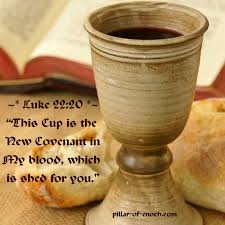
2. The Last Supper occurring the evening before Passover/Pesach Day–The Renewed Covenant Revealed
- The breaking of the bread and the drinking of the wine was a illustration of the renewed covenant that had been rehearsed by the people of Yahovah since Melchizedek brought bread and wine out to Avraham. This ceremony of the breaking of bread represented the healing of the nations and the drinking of wine symbolized the renewed covenant that was brought about through the shedding of innocent blood for remission of sin. (Y’shua did not drink of that wine but stated that He would not do so until the marriage supper of the lamb (Luke 22:20))
- This renewed covenant was prophecied in Yirmeyahu (Jeremiah):
“Behold the days come, says Yahovah, that I will make a Renewed Covenant with the house of Yisra’el and with the house of Yahudah. Not according to the covenant that I made with their fathers in the day that I took them by the hand to bring them out of the land of Mitsrayim (Egypt); which my covenant they broke, although I was a husband unto them, says Yahovah. But this shall be the covenant that I will make with the house of Yisra’el; After those days, says Yahovah, I will put my Torah in their inward parts and write it in their hearts; and will be their Elohiym and they shall be my people. And they shall teach no more every man his neighbor and every man his brother, saying, know Yahovah: for they shall all know me, from the least of them unto the greatest of them, says Yahovah: for I will forgive their iniquity and I will remember their sin no more” (31:31-37)
- The covenant Father made with us at Sinai was a blood covenant that if broken meant death to us. We broke that covenant and the death penalty cannot be annulled. But the covenant could be renewed with either the death of the guilty party or death of a substitute. Y’shua’s sacrifice would serve to pay the death penalty and re-establish the broken covenant. He was the substitute for us as He was the innocent sacrifice the restored the covenant.
The Weightier Matters of the Law
3. The weightier matters of the Law such as judgment, mercy and faith are more important than the minutia of the Law that we tend to capitalize upon in the Faith
“Woe to you, sages and Prushim, you hypocrites! You pay tithe of mint and anise and cumin but you have omitted the weightier matters of the law: judgment, mercy and faith. These tithes you ought to have done, but you should not have left the other undone. You blind guides (that is, a teacher of the ignorant and inexperienced)!” (Matthew 23:23)
Killing the Prophets of Yahovah
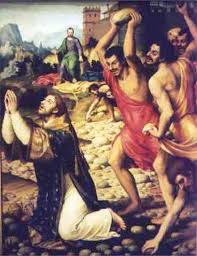
4. The Parable of the vineyard–Y’shua’s indictment against the Jewish religious system–Matthew 21:33-46
“There was a certain landowner who planted a vineyard. He hedged it round about, chiseled a winepress in it, built a tower and then leased it out to sharecroppers and went away into a far country. When the time of the harvest drew near, he sent his servants to the tenants that they might receive his share of the harvest. The tenants took his servants and beat one and killed another and stoned another. He again sent even more servants than he did at the first and they did to them likewise. Last of all he sent his son to them, think, ‘They will respect my son.’ But when the tenants saw the son they said among themselves, ‘This is the heir! Come, let us kill him and seize his inheritance.’ They caught him, dragged him out of the vineyard and slew him. When the owner of the vineyard comes, what do you think that he will do to those tenant farmers? They replied to him, ‘He will utterly destroy those miserably wicked men and will lease out his vineyard to other sharecroppers who will deliver the fruits of their seasons.’ Yeshua said to them, ‘Did you never read in the Scriptures, ‘The stone which the builders rejected, the same has become the head of the corner! This is Yahovah’s doing and it is marvelous in our eyes!'”
- The kingdom of Yahovah is taken from the Jew and given to gentiles who will bring forth the fruits of the kingdom:
“Therefore I say to you, the kingdom of Yahovah shall be taken from you and given to gentiles who bring forth the fruits of the kingdom”–replacement theology? Not quite

Rejecting the True Messiah
5. The blindness and fear of those who choose not to accept
“He has blinded their eyes and hardened their hearts that they would not see with their eyes nor understand with their hearts, nor be converted, lest I should heal them…Nevertheless there were also many among the rulers who did not believe in him but because of the Prushim they did not openly confess him, lest they should be put out of the synagogue; for they loved the praise of men more than the praise of Yahovah. (John 12:40-43)
“Truth I say to you, tax collectors and whores will enter the kingdom of Yahovah before you do. Yochanan ben Zecharyah came to you preaching the way of righteousness and you would not believe him, but violent men and whores believed him. Even after you saw their response, you still refused to repent and believe him” (Matthew 21:31, 32)
Commandment Keeping
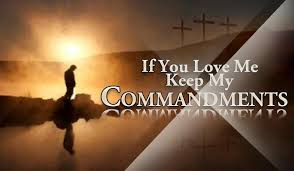
6. The criteria for eternal life–commandment keeping and following Messiah–The Rich Young Pharisee Ruler approaches Y’shua about gaining eternal life (Matthew 19:13-20:16; Mark 10:13-31; Luke 18:15-30)
- A relationship with both the Creator and the Son is absolutely essential to receiving eternal life:
“This is life eternal, that they might know you, the one true Elohim and Y’shua the Messiah, whom you have sent” (John 17:3) In so establishing this unique relationship, we are transformed and we are no longer citizens of this world (John 17:16)
The Economy of the Kingdom of Yahovah
7. Heaven’s economy–first shall be last (Reference Matthew 19:30; Luke 13:30; Mark 10:31)
- A Widow gives 2-mites that Master teaches is more than the wealthy gives (Mark 12:41-44; Luke 21:1-4)
- The prohibition against referencing a fellow believer as Rabbi or Father as we are all brothers and sisters in the Faith.
“Don’t allow anyone to call you Rabbi–because you all have just one Great One–Messiah–and you all are brothers. Do not call any man your Father upon the earth. Only one is your Father and He is in heaven. Do not allow anyone to call you ‘the Teacher’ for there is only one who is the Teacher–Messiah. He that is greatest among you shall be your servant. He who exalts himself shall be abased but he who humbles himself in service to others shall be exalted” (Matthew 23:8-12)
- After dinner Y’shua washes His disciples’ feet to teach them the Kingdom servant’s attitude (Luke 22:24-30; John 13:1-22)
“If I then, your Rabbi and Master, have washed your feet, you also ought to wash one another’s fee. I have just given you an example that you should do as I have done to you. Truth, I say to you, the servant is not greater than His Master; neither he that is sent greater than He that sent Him. If you know these things, happy are you if you do them. I speak not of you all. I know whom I have chosen but that the Scripture may be fulfilled, He that eats bread with me has lifted up his heel against me. Now I tell you before it comes to pass, so that when it does come to pass, you will believe that I am the One” (John 13:14-19)
Sp;iritual Blindness
8. Y’shua inspects the religious leaders and finds them sorely lacking and unworthy–but worthy for destruction for they are unable to identify the true Messiah
- Alludes to Psm 110–proof positive that Y’shua is NOT Yahovah. Yahovah gave Y’shua His name and a title and power and authority.
“While He taught in the Temple, Yeshua asked: “How is it that the sages say that Messiah is the Son of David? David himself said by the Ruach Kodesh, Yahovah said to adoni (meaning Lord), sit though on my right hand till I make your enemies your footstool. But Davidd himself then called Messiah Yahovah? So how is Messiah His son?” (Matthew 12:35-37)
- Rood’s commentary on Matthew 22:45:
“The Aramaic Targumim of the Pharisees actually reads YHVH (by their code yyy) in this very instance. Whether Adonay actually replaced the original reading of the sacred name YHVH or the sages of antiquity collectively understood it, David went from ‘YHVH saying to adoni (my Lord) sit at my right hand’–to–‘YHVH sitting at the right hand of YHVH striking through kings in the day of His wrath’ (speaking of the Master’s advent in the last days and returning to earth to take care of business). This is the enigmatic corner into which the sages found themselves boxed and unable to respond without impugning themselves. In retrospect, we can now see that the YHVH’s anointed (Ps. 2:2)–my king (Ps 2:6)–my Son (Ps. 2:7)–and the Son whose wrath will be kindled but a little’ (Ps. 2:12). It is obvious that the Son is not the Father, but the Father gave the Son his title, his power, and the authority to judge the nations and rule over them with a rod of iron until all is subdued under his reign (I Cor. 15:22028; Zech. 14:16-21; John 20:26-29; Acts 2:29-36). This is not a positive prospect for those who were conspiring to belittle, arrest and quietly dispose of Y’shua.”
- The fact that Master says He does not know the day or hour, but only the Father knows, is clear and definitive proof that Y’shua is NOT Yahovah–this Master made clear throughout His week of teaching at the Temple and the surrounding area

The End Times
9. The End Times will not bode well for us as the True Torah Observant Believers of Y’shua Messiah. Many of us will be ensnared in a great deception. Others of us will be killed by angry and scorned Christians who realize they are not going to be raptured to heaven. Still, others of us will be afforded the opportunity to testify before various peoples of the world and Y’shua will speak through us and deliver us–Matthew 24:3-14; Mark 13:3-13; Luke 21:7-19
- We are warned to not be ensnared by false teachers–thus the importance of learning and understanding this prophecy
- The entire planet will see Y’shua when He returns and has His elect snatched from the 4-corners of this planet by Yahovah’s angels. This will strike the greatest of fear in the hearts of men as well as anger as they are not part of those who are carried away
- The abomination of desolation is the pivotal, key event, when all hell will break lose upon the earth and Israel (the nation) will come within inches of its existence. This is the time when Father fights for Israel and He tribulates against those who tribulated His elect (Roodism)
- The Parable of the Fig Tree is prime fascia that we must stay informed and observe the signs of the times
“Because those who are without Torah will multiply, the love of many will grow cold. But those who endure to the very end <telos> shall indeed be saved”
- He in no way came to destroy the Torah (Matthew 5:17) and His judgment will be based upon compliance to Torah (Matthew 7:13-23). Those found lacking, despite their erroneous perceptions that they were serving Jesus and the Kingdom, these same will be “ejected from the eternal kingdom” (Rood)
- Matthew 24:25-27 describe prophetically that many will seize upon the opportunity to defraud people into going out to remote areas of the world (Petra??) to find Y’shua there waiting. The world will see Y’shua in due time. Therefore, do not fall for that ruse. For many will fall for the ruse, including saints–skandalidzo-such that these will be destroyed by those who are captured therein. Could this portend of a governmental sting to draw Natzariym into a place of capture? This is a teaching and instruction that will save lives if the hearers and readers take heed. The false Messiahs and false prophets will practice signs and wonders that will seduce, if it were possible, even the elect. Indeed, the sun will be darkened and the moon will not give its light; the stars in heaven will fall; the powers of the heaven will be shaken.
- Some believe this portends a massive nuclear war that blackens the skies and prevents the sun’s and moon’s light from shining through the nuclear fallout. Others believe that this will be a natural darkening of the sun and consequently the moon as the sun’s internal engine cools down and the sun begins a process of implosion
- Y’shua will return in the clouds with great power and glory (Mark 13:26) and will dispatch the angels to the 4-corners of the globe to retrieve His elect. Yet everyone on the planet will see Him and His sign in the sky (Mark 13:26). This flies contrary to the secret-rapture teachings of so many in nominal churchianity. Certainly, the world will not be a calm and peaceful place when this happens, as many will likely die simply from fear and overwhelming stress.
- We are thus warned and commanded by Y’shua to be aware, watch and pray for we know not when the time will come (Mark 13:33). This to me is an indictment against those who choose not to stay abreast of world events and to inquire into that which is going on around them. Those who stick their heads in the sands of life and the secular world will be caught unawares when the Master returns.
- The Parable of the Fig Tree is a prime teaching that we must be cognizant of the signs of the times. There is a second abomination of desolation coming that will trigger the telos–the final ending of the time of man. That event some associate with a rebuilding of the Temple in Jerusalem (Temple 3) and the Ark of the Covenant being found and placed into the Holy of Holies where the enemy will desecrate it. Still others have other sundry and various theories. Bottom line, no one really knows how this is going to play out. For now I’m sticking with Temple 3 and the finding of the Ark of the Covenant until such time Father reveals more of these time ahead which I believe He shall as we get closer to this period of history
- These prophetic events are not fairy tales nor are they fictional concepts that won’t really come to light. Master obviously felt these events are vital for His believers of that time to know. Thus He admonishes us to become soberminded in life and not be taken with “frivolity and intoxicated with the cares and pleasures of this temporal life” (Luke 21:34). If we do, we will be completely oblivious when it overtakes us–the Day of Yah that is. In order to be counted worthy to stand before Master, having escaped all that which will come in the end times, we must watch and pray. Our community must wake up as I fear that we are too caught up in things that will not amount to anything in the end–lunar sabbaths; flat earth; illuminati, the minutia of Torah and falling into the traps of Kabbalah and Messianic Judaism
Discipleship
10. The Essence of True Discipleship–something that nominal churchianity and many in Hebrew Roots fail to understand and practice
- Belief in Y’shua and an understanding of who He is, is essential for entering into true discipleship.
“Truth, I say to you, he who believes on me, the works that I do, he will do also; and greater works than these he will do, because I go to my Father. Whatever you ask the Father in my name, that I will do that the Father may be glorified in the Son. If you shall ask anything in my name, I will do it. If you love me, keep my commandments.” (John 14:12-15) “He who has my commandments and keeps them, is one who loves me. He who loves me shall be loved by my Father and I will love him and I will manifest myself to him.” (John 14:21) “If a man loves me, he will keep my Torah and my Father will love him. We will come to him and make our abode in him. He who does not love me does not keep my Torah. The Work which you hear me speaking is not my word, but the Torah of the Father who sent me…But the comforter which is the gift of the Ruach Kodesh, which the Father will send in my name, will teach you all things and will bring all the things that I have spoken to you back to your remembrance” (John 14:23-26)
Reference:
The Chronological Gospels by Michael Rood
The Chronological Gospels by Michael Rood
The Cepher Bible
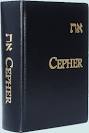
The Cepher Bible
by Rod Thomas | Apr 19, 2016 | Podcasts
Purim–The Providence of God
Sabbath Thoughts and Reflections–Episode 54
In Purim-The Providence of God:
Then Mordekai commanded to answer Hadassah: “Think not with yourself that you shall escape in the king’s house more than all the Yahudiym. For if you altogether hold your peace at this time, then shall there enlargement and deliverance arise to the Yahudiym from another place. But you and your father’s house shall be destroyed. And who knows whether you are come to the kingdom for such a time as this? (Ecter/Esther 4:13, 14-Cepher)
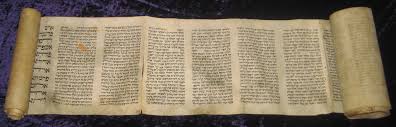
A Scroll of the Megillah of Hadassah
At this juncture of the Purim story, as we’ve been examining it over the course of the last couple months, we have entered a crisis period. The chapters and verses prior to chapter 4 prepped us for the real meat and potatoes of the story that is to come for the remainder of this megillah. In episode 52–we came across Mordekai discovering Haman’s extermination plot for the Jewish nation and Mordekai responding to this royal decree in the most profound manner depicted in Scripture: he wailed in the greatest of sorrow; rent his garment; donned sackcloth and laid in ashes in the midst of Shusan (aka Susa) the city (the capitol of the Medo-Persian Empire). Although chapter 4 of this megillah reveals that the whole of the Empire’s Jews mourned upon learning of the nation’s pending genocide, the focus of this chapter is Mordekia. The writer of this megillah takes us up close and personal with this man and we are exposed to Mordekai’s obvious sorrow. A sorrow so profound that the principle character of our story at this juncture resorted to the most compelling act of mourning described in Scripture: the renting of his garment, the donning of sackcloth and dwelling in ashes. Josephus’ record of this pivotal event is read as follows: “A nation that had been injurious to no man was to be destroyed as he cried throughout the city of Susa.” (Josephus 11.6.7)
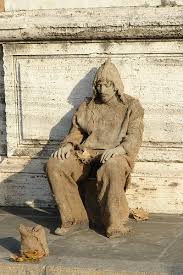
Mordecai mourning in sackcloth and ashes before the palace gates
So let’s put things into a proper perspective at this juncture of the story: We have a posted edict announcing the coming genocide or extermination of the Jewish nation within the coming year. In response to this edict, the nation mourns their pending death, some dressed in sackcloth and laying in ashes—the traditional method of mourning in Hebrew ancient culture. Despite the entirety of the Jewish nation mourning over this edict, the writer of this megillah focused primarily upon Mordecakai. For good reason obviously. For Mordekai held the greatest direct responsibility for Haman’s edict directed against the Jews as he, during Haman’s exaltation throughout the city of Shusan, refused to pay the stipulated homage for the man. We learned that the customary show of homage in the ancient near east towards potentates was to prostrate one’s self before them or somewhere within their presence, especially when that potentate would pass or transit by the subjects. For whatever reason, Mordekai refused to honor Haman as the rest of the city’s subjects freely did. Obviously, as we saw, word of Mordekai’s insubordination reached the ears of Haman, who in turn, actually witnessed Mordecai’s insubordination for himself. Haman’s rage over Mordekai’s lack of respect for him, led him to seek revenge, not just against Mordekai who in all fairness should be the sole focus of Haman’s ire, but hey, what the heck, why not take revenge against every Jew in Achoshverosh’s 127-provinces.
At this juncture of the Purim story, as we’ve been examining it over the course of the last couple months, we have entered a crisis period. The chapters and verses prior to chapter 4 prepped us for the real meat and potatoes of the story that is to come for the remainder of this megillah. In episode 52–we came across Mordekai discovering Haman’s extermination plot for the Jewish nation and Mordekai responding to this royal decree in the most profound manner depicted in Scripture: he wailed in the greatest of sorrow; rent his garment; donned sackcloth and laid in ashes in the midst of Shusan (aka Susa) the city (the capitol of the Medo-Persian Empire). Although chapter 4 of this megillah reveals that the whole of the Empire’s Jews mourned upon learning of the nation’s pending genocide, the focus of this chapter is Mordekia. The writer of this megillah takes us up close and personal with this man and we are exposed to Mordekai’s obvious sorrow. A sorrow so profound that the principle character of our story at this juncture resorted to the most compelling act of mourning described in Scripture: the renting of his garment, the donning of sackcloth and dwelling in ashes. Josephus’ record of this pivotal event is read as follows: “A nation that had been injurious to no man was to be destroyed as he cried throughout the city of Susa.” (Josephus 11.6.7)
Verse 4 reads: “So Hadassah’s maids and her chamberlains (in Hebrew it is written as Eunuch) came and told it her (speaking of Mordekai’s demeanor and mournful behavior). Then was the queen exceedingly grieved; and she sent raiment to clothe Mordekai and to take away his sackcloth from him—but he received it not.”
So word of Mordekai’s state reached the ears of Hadassah through members of her staff. I found it interesting how Hadassah’s love and loyalty for Mordekai never faded, despite Hadassah’s elevated-royal status. To me, it is a lesson and example for us in that we must never see ourselves as having arrived (that is, we are now Hebrew Roots and those of you who are not are not worth my time) and if by chance we take on such a position in life, that we do not neglect those whom Father has placed in our lives—unless, that is, the Ruach leads us to such an end. We must always be responsive and quick to act on behalf of our brothers and sisters, especially those in the Faith. I’ve noticed that we tend to drop family and friends when we come into Hebrew Roots—typically for obvious reasons of estrangement because of our stated Faith and adopted new way of life. But on the flip side of this equation, it would stand to reason that we are to be a light and the salt of the earth as referenced in Matthew 5:13-16 which reads: “Ye are the salt of the earth—but if the salt have lost his savour, wherewith shall it be salted? It is thenceforth good for nothing, but to be cast out and to be trodden under foot of men. Ye are the light of the world. A city that is set on a hill cannot be hid. Neither do men light a candle and put it under a bushel, but on a menorah; and it gives light unto all that are in the house. Let your light so shine before men that they may see your good works, and glorify your Father which is in heaven.” (Cepher)

Hadassah contemplating the situation
Hathak is the intermediary between the queen and Mordekai, since Mordekai could not enter the palace proper and also given that the queen was likely not a public figure, but was more of a “kept” person behind the palace walls. It’s quite possible, however, that the queen liked it this way—being isolated from the public and the common folk. But it certainly gives rise to a reminder and warning of our own personal life situations: we must always avoid being too isolated and “out of touch” with the world around us. If we are called to be disciples of Messiah and lights and salt to the world, we can not accomplish our mission with our proverbial heads in the sand. We must know what is going on around us. And whatever it is that we need to do to stay in touch and in the know, we absolutely should strive to make it happen. One of the problems facing us as a people of faith, especially in this country today, is our isolationist mindset and behavior, that the government and general public sees as suspicious and quite frankly, even dangerous. Some news sources of late have reported that our very own federal government has labeled people of faith as potential terrorists and in some sectors of the federal government, plans have been made to address us as terrorists in the event the United States undergoes some form of national unrest or insurrection. So I believe we’ve got to get out there and not be so isolated. The Apostle Shaul wrote to the Roman Assembly: “Do not be conformed to this world, but be transformed by the renewal of your mind, that by testing you may discern what is the will of Yahuah, what is good and acceptable and perfect (Romans 12:2—ESV)” Then to the Philippian Assembly he wrote: “that you may be blameless and innocent children of Yahuah without blemish in the midst of a crooked and twisted generation, among whom you shine as lights in the world” (Philippians 2:15–ESV). But most of us, as it relates to being aware of that which is going on around us, shy away from knowledge of current events. But Shaul seems to say that we should dwell in this world—for which we have no other choice—but dwell in this world as transformed beings and disciples of Master Yahusha that are not of this world. How can we be of assistance to this world if we avoid understanding what is going on in the world? We become of no earthly good to anyone. Yet, through the leading and indwelling of Father’s precious Ruach HaKodesh, we can function just fine in this world and not compromise our Faith. The clue for success in this effort comes from Yahusha who instructed us to “…be wise as serpents and innocent as doves” (Matthew 10:16—ESV).
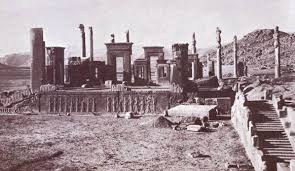
Remnants of Susa Palace in Ancient Babylon
The story begins to become a bit more engaging as we see in the next few verses that the queen’s perceived influences may be somewhat overstated. It reads: “Again Hadassah spoke unto Hathak and gave him commandment unto Mordekai: All the king’s servants and the people of the king’s provinces do know that whosoever, whether man or woman shall come unto the king into the inner court, who is not called, there is one law of his to put him to death, except such to whom the king shall hold out the golden sceptre, that he may live: but I have not been called to come in unto the king these thirty days. And they told to Mordekai Hadassah’s words. Then Mordekai commanded to answer Hadassah: Think not with yourself that you shall escape in the king’s house more than all the Yahudiym. For if you altogether hold your peace at this time, then shall there enlargement and deliverance arise to the Yahudiym from another place, but you and your father’s house shall be destroyed (word of knowledge maybe???). And who knows whether you are come to the kingdom for such a time as this?” (verses 10-14)
So it would seem that Hadassah initially was not inclined to be a “malefactor” over something that in the bigger scheme of things, she likely felt didn’t or wouldn’t directly affect her.
The simple fact that Achoshverosh had not called for Hadassah is highly suggestive that our friend King Achoshverosh was preoccupied with his considerable harem of women. Don’t forget, it had not been too long before this incident that the kingdom held a great beauty contest that Hadassah was forced to participate in. So Achoshverosh was in no way hard-up for female companionship. This subtle, but glaring likelihood stands to remind us that Achoshverosh would always be a paganistic heathen who was consumed with sex, alcohol and his exceeding wealth, power and sense of self-greatness. We tend to ignore or dismiss these human frailties of Achoshverosh because he ultimately sides with Hadassah against Haman and ultimately saves the Jewish nation. But proper perspective and context must never be abandoned by the student of Scripture. For we realize that Father uses whom He so chooses or wills in order to accomplish His purpose. (Reference Romans 8:28; 9:14-18; Isaiah 55:11)
Nevertheless, there was a law in place that prevented Hadassah from entering in to the king’s presence uninvited and unannounced. Such a law is stifling and strict and in keeping with the inflexibility of Persian edicts and protocols. (Reference Jameson Fausett and Brown Commentary) Consequently, this law seems to apply to the queen, which somewhat assaults our western sensibilities, as our concept of marriage and the relationship between the man and woman of that marriage union would naturally supersede such a hindering law. Could you imagine the fallout in the White House if Michelle Obama was unconditionally and altogether restricted from seeing or addressing her husband the president for any length of time? Yet Hadassah was suffering from the severity of this law, especially as it would pertain to this most dire situation. (Reference Jameson Fausett and Brown Commentary) However, pushing aside for discussion sake the conspiratorial theory that Haman was behind this estrangement, we can safely surmise that the primary cause of this estrangement or alienation was a combination of alcoholism, sexual addition and political pandering and manipulation (to a natural and reasonable degree—not insidious).

Purim–A Display of God’s Providence
In these two-verses, we see Mordekai scold Hadassah; that her lofty position of convenience and security was not entirely as it would seem to her at the moment. The fact that she had been distant from Achoshverosh for a month; the fact that former Queen Vashti was so easily disposed of by the king just a short time ago—makes it clear that everyone is expendable in life—that no one is indispensable, including she—Hadassah. Despite her being an exalted queen of the Persian Empire, over 127-provinces, she remained a Jew, vulnerable to the enemy—vulnerable to hasatan, who sought to exterminate the Jew and sever the bloodline leading to the coming Messiah.
Despite Yahuah’s name or any reference to Him at all being in this megillah, it is crystal clear that Father’s hands are all over this thing. Turns out Hadassah was in fact placed into the kingdom as queen to be a vessel for Yah to deliver His people from destruction and to keep intact the blood line that would ultimately lead to the birth of our Master, Yahushua Messiah.
Matthew Henry, a well know bible scholar and commentator, wrote the following: “Because the Lord loved His people, therefore He made Hadassah queen. There is a wise counsel and design in all the providences of God, which is unknown to us till it is accomplished, but it will prove, in the issue that they are all intended for, and centered in, the body–my word in place of church.”
What is the take away from this portion of the Purim story? The take away is that we are all placed in various life situations for some divine purpose. It is our job to realize this—to be cognizant of this—to be on-call and ready in a heartbeat to respond when called–and in the interim we must figure out what our purpose and our responsibilities are in response to that life situation that exists in association to our divinely appointed positions. We must never, however, get too comfortable in our lives and seek to shirk our divinely appointed duties and responsibilities; that our spiritual eyes are clear and open and are capable of seeing and recognizing each and every one of those divinely appointed opportunities whenever they present themselves.
Music by DanOMusic
Faithfully Submitted by Rod Thomas
A Ministry of Qumran Family Church–Encouraging You In Righteous Living While Contending for the Faith Once Delivered to the First Century Saints by Y’shua Messiah. Shalom. Shavu’atov
The Name of our Creator:
Yahovah, Yahuah, Yahweh
The Name of our Saviour and Son of the Most High
Yahshua, Yeshua, Yahoshua, Yahusha
by Rod Thomas | Apr 5, 2016 | Podcasts
Purim–Mourning in Sackcloth and Ashes
Sabbath Thoughts and Reflections 52
Well, we can say that we’re still in the Purim season as we work through the latter half of this Adar Bet—the 13th Month of the Biblical Calendar year—and I would refer you to STAR episodes 49 and 51 where I discussed the issue of the Adar Bet. But as I record and publish this episode, we find ourselves just under a month away from Passover and I wanted to take this opportunity to spend more time on Purim before the Passover season officially begins. As I mentioned in episode 47, Purim is NOT one of the seven mandated Feasts of Yahovah that we find listed in Leviticus 23. Of course the Festival or Holiday of Purim would not be mentioned in Torah because the historical events that formed the basis of the Purim holiday would not occur for another 900-years or so beyond the giving of Torah to Moshe by Yahovah. Purim became a Jewish Festival or holiday on the fiat or by direction of Queen Ecter/Haddash and her cousin Mordecai after the Haman controversy, which we will discuss in future episodes of this Purim series, was resolved through the providence and grace of Yahovah. So no, Father never mandated or instructed us to keep or observe this festival and certainly I would be remiss or possess great hubris to push Purim observance or celebration on any Netzarim or Hebrew Rooter. What I will say, however, is that Father in His infinite wisdom has allowed us the opportunity to have record of these tremendous, spiritually and prophetically significant historical events—such as Hanukkah and Purim—for our edification and development. Although the great Apostle Shaul wrote the following passage concerning the events and associated conflicts that took place in the Exodus and in the Sinai Desert, the premise of this passage certainly applies to the megillah of Ecter and the Jewish Festival of Purim. Shaul wrote:
Now these things happened to them as an example, but athey were written down for our instruction, bon whom the end of the ages has come. (1Co 10:11 ESV)
George Santayana, a mid-19th century Spanish philosopher, poet and novelist, will forever be remembered for his great quote: (paraphrasing)—”Those who cannot remember the past are condemned to repeat it.” I believe this quotation and mindset is certainly befitting of Purim and the story of Ecter. Like Hanukkah, Purim details critical historical events that almost resulted in the extinction of the Jews and if that extinction were to have taken place, the bloodline leading to the birth of our Master Y’shua would have been severed and the redemption plan hindered. Oh, one could certainly argue that the Father, in His infinite wisdom, would have made provisions for His Plan to redeem man to ultimately succeed despite the best laid plans of man and hasatan–and indeed this did happen in both instances of Hanukkah and Purim—for the plans of hasatan and Haman were foiled by Yahovah’s providence and grace. But the point that must not be overlooked in the debate over plans of the Father conceivably being foiled by hasatan or whether Father would ever allow His plans for man to be destroyed by hasatan, is that the enemy is constantly on the prowl and seeking ways to destroy Yahovah’s people. The examples of Hanukkah and Purim provide the people of Yahovah with examples of how we must live and avoid the snares of the enemy; as well as they provide us with invaluable instruction on how we too must live our lives in complete trust and faith in the Creator and thus defeat the works of hasatan as we live out these last days and the end of our present age. So the celebration of Jewish festivals such as Hanukkah and Purim serve to remind us of the acts of faith and obedience that were fulfilled by those who came centuries before us. Those acts of faith and obedience serve as crucial life-lessons for us who are servants and children of the Most High. Again, when we fail to remember the failures and tragedies of the past, we are condemned to repeat it.
Churchianity, through the workings of hasatan, have not only rejected and forgotten the ancillary festivals of Purim and Hanukkah, but they’ve also rejected and forgotten the 7-mandated Feasts of Yahovah. So what has been the fallout from the Christian’s rejections and ignoring of these Feasts and Festivals: an inability to understand the foundational requirements Father places upon His people such as obedience to His laws; how to love Him and how to love one another; what our sole purpose as His servants are in the earth today; and what our ultimate potential as Father’s redeemed creation will be. Purim reminds us each calendar year, as we stop to really re-visit the story, learn the valuable spiritual lessons contained therein. So far, we’ve covered just the first 3-chapters where we gained some understanding of what it takes to become a Bride of the King, or in our case, the Bride of Messiah. Additionally, although we did not specifically discuss it, we saw how alcoholism can have adverse effects upon one’s life and the lives of those who are within that alcoholic’s individual circle of influence. In chapter 1 of Ecter, we saw how unbridled alcohol consumption on the part of Achoshverosh—King of the Medo-Persian Empire–resulted in his embarrassment before the elite of his 127-provinces when Queen Vashti refused to respond to his drunken command to make an appearance before the party attendees. This embarrassing incident resulted in Achoshverosh’s divorce from Vashti and then a few years later, the creation of a beauty contest and development of a harem that would tear apart countless families across the entire Medo-Persian realm. This was the beauty contest that Hadassah found herself forced to participate in. These women would never have families of their own. You will not find very many ministers of Churchianity making the link between alcoholism and the story of Ecter, but rest assured, the link does in fact exist. Furthermore, we find that Achoshverosh’s drinking problem resulted in him blindly agreeing to Haman’s plan to exterminate the Jews. The plan was struck during a bout of drinking between Haman and Achoshverosh. Certainly, alcoholism is a scourge that affects all segments of our secular and Faith-based societies even today. Alcohol is an effective tool of the enemy that he obviously uses to destroy the lives of men and their families, especially the lives of Yahovah’s chosen people. In this case, as we will see, it was Achoshverosh’s drinking problem that nearly led to the extinction of the Jewish nation.
In chapter 4 of the megillah of Ecter, we are exposed to the unimaginable drama that resulted from the posting of the extermination order drafted by Haman, backed by the power and might of King Achoshverosh and his Medo-Persian Army. Although the extermination order would potentially affect every Jew in the Medo-Persian realm, this chapter focused primarily on Mordecai’s reaction to the extermination order. The text reads:
“When Mordekai perceived all that was done, Mordekai rent his clothes and put on sackcloth and ashes, and went out into the midst of the city and cried with a loud voice and a bitter cry; and came even before the king’s gate: for none might enter into the king’s gate clothed with sackcloth. And in every province, whitersoever the king’s commandment and his decree came, there was great mourning among the Yahudiym, and fasting and weeping and wailing; and many lay in sackcloth and ashes.” (vss. 1-3)
Every Jew reading Haman’s edict against them as a nation realized that they had but just one year before their lives would be extinguished under the might and power of the Medo-Persian Empire. This realization spread throughout the Empire like wildfire as Jew after Jew no doubt felt that bitter and nauseating pit form in the core of their stomachs as they either read or had read to them or heard second or third-hand of this execution order. Certainly, this was not the first time, nor would it be the last time, that the nation would face total and utter extermination at the hands of a powerful people and their government. We endured bitter bondage while we sojourned in Egypt, always just an edict away from our nation being exterminated. As we traveled across the Sinai Desert we faced destruction from the Amalekites but by the grace of Yah we were delivered. While we sorjoruned in the Land of Israel we faced extermination at the hands of the Philistines but by the protective hands of Yah and His deliverers, we prevailed. The Assyrians and Babylonians both came close to destroying our people but Yah’s providence and grace would have the final say. Later would come the Greeks and the Romans and then the German Nazis—all agents of hasatan, bent on destroying Yah’s people. Granted, Yah in His sovereignty and wisdom and will would often use these powerful nations to teach us a lesson and bring us back to Himself, there would always be another enemy standing at the door, ready and willing to destroy us, the people of Yahovah. And not just the Jews mind you. The true people of Yahovah have always, throughout the last 2-millennia, been just a heartbeat away from total annihilation at the hands of the crazies of this world, who would ceremoniously use the bible and their twisted understanding of the Person and purpose of the Son of God, to justify their evil against Yah’s chosen.
But for Mordekai and the Jews of the 127 providences of Achoshverosh’s kingdom, upon hearing about or reading the extermination order against them, what can one say when the reality of the matter finally pierces through one’s understanding—that you and everyone you’ve ever loved has but just one year to live—then, one can but only wail as if experiencing the most dire pain and loss one could ever imagine. That wail leads then to the tearing away of one’s garment and collapsing to the ground in an inconsolable heap of weeping humanity. And if that weren’t enough, one is compelled to do the only other thing besides wailing that we’ve ever known to do in such dire situations: to lower ourselves to wearing sackcloth and to lay in ashes. This desperate act of profound and utter mourning was our natural response to seemingly unsolvable life-threatening situations such as this. What other means was there for one to coax the very attention of the Creator of the Universe and provoke Him to act on our behalf because of His unfailing love for us as His people—albeit His prodigal children–than to wail in mourning and to lay in sackcloth and ashes? As Mordekai and his fellow Jews saw it, this was the obvious end to our nation; our people; our way of life. Certainly it was always conceivable that a much stronger nation would someday come along and take advantage of our weakened state throughout various times in our history. Oh, we would always tell ourselves that this would never happen—that Yah would always stay true to His Word to protect and deliver us from all hurt, harm and danger. But we were also cognizant of the fact that we had not been the most loyal and obedient of people and that we’d violated the Creator’s Torah as a nation throughout our history so often that Yah’s Spirit physically left the Temple and we were left defenseless and ripe for utter destruction—reference Ezekiel 10. Yes Yah was true to His word to protect and deliver us throughout our history as a nation, but when we were true to Him and His Torah. We’d gotten away from Torah and had grown fat and obtuse to Yah’s way—Yah’s Torah—so much so that we’d forgotten about Him and His Torah altogether—reference Deuteronomy 32:15—
”But Jesurun (Jacob in the LXX; Israel in the NLT) grew fat and kicked; you grew fat, stout, and sleek (Kasah=sated, gorged); then he forsook Yah who made him and scoffed at the Rock of his salvation.” ESV
Mordekai had the greatest emotional burden to bear over this thing than any other, for it was as a result of His refusal to prostrate himself whenever Haman were to pass by him. But for whatever reason—Mordekai’s knowledge that Haman was a villainous Agagite or that he, Mordekai, remained devout in His Faith towards Yah and would never be found prostrating himself before men—Mordekai would not bow before Haman. And Mordekai knew within his very being that this pending act of genocide against His people was as a result of his insolence. It’s one thing to be responsible for something that gets oneself or one or two other people in hot water with the authorities. It’s an entirely different thing on an entirely different level, to be directly responsible for the pending deaths of all the members of one’s nation. What more can one do beyond mourn and repent and seek Yah’s deliverance from this dire situation?
How often have we found ourselves in situations that have the potential of negatively impacting our own lives and the lives of the people we love? I look back to my younger years and I see times when I made really bad decisions that resulted in problems for my family and I. I recall one incident in particular when I arrogantly ignored that which I knew I should do to avoid the trials and tribulations that were certain to come, but thought and felt that I would somehow, under my own strength and intelligence, come out of the thing smelling like a rose. Unfortunately, I came out of the situation smelling like a land fill and my family and I would face one of the greatest challenges of our family’s existence. The results of my “insolence” if you will, almost tore my family to shreds. Did I go down into deep repentance and seek deliverance and protection for my family and I? I’m so terribly sad to say that I did not. I was so much into myself, carrying around for all to see a misguided self-confidence that I believed that I would be able to escape the penalty of my actions (or inactions) and that my family and I would come out of the situation in better shape than when we entered the situation. Turns out that my stupidity and my refusal to repent and seek the Face of Father resulted in years of hardship for my beloved wife and children and for myself. If anything can be learned from this situation involving Mordekai and the Jewish nation, it is that Mordekai knew which side of the bread his toast was buttered. He knew that the only path that he could enter, with at least some modicum or chance for survival for him and his people, was Yah. Thus Mordekai sought the attention of Father through profound mourning and repentance which is a common characteristic of Yah’s people when they find themselves in troubles.
What is the significance of Mordekai’s sackcloth and ashes emotional display? Well, the use of sackcloth and ashes in the Holy Writ, despite there being no true understanding of the origin of this Hebrew practice, was commonly used as a means of profound mourning by the people of Yahovah as well as a means of supplication and appeal for Father’s help to deal with a matter that could not be dealt with by the one seeking deliverance and help.
The first mention of the use of sackcloth for purposes of mourning is found in Genesis 37:34, where Jacob—Ya’aqov—is presented with tainted evidence of his son, Joseph’s–Yoceph’s, alleged death. It is a symbol of mourning. Sackcloth in Hebrew is “saq” which denotes a mesh sack of some sort. Fausset’s Bible Dictionary defines “sackcloth” as course dark goats’ hair that was used for sacks in the day. Sackcloth was used for close fitting raiment in mourning that was secured by a girdle.
David commanded Joab (i.e., commander of Israel’s army under David, who killed Absalom, and who was son of David’s sister, Zeruiah) and the host of people with him, to don sackcloth and mourn before Abner (commander of Saul’s army, cousin of Saul, who was murdered by Joab)—2 Samuel 3:31
Elijah (Eliyahu) pronounced Yahovah’s judgment upon Ahab (Ach’av), who “sold himself to work evil in the sight of Yahovah” (1 Kings 21:20) and causing Israel to sin (vs. 22), resulting in Ach’av doning sackcloth and fasting—vs. 27.
In fear of Sennacherib’s (King of Assyria’s) invasion of Judah, Judah’s King Hezekiah rent his clothes and covered himself in sackcloth and went into the Temple—2 Kings 19:1.
In mourning over his tribulations, Job sewed and donned sackcloth and laid his pride—laid his strength—in the dust of the earth—Job 16:15.
The people of Nineveh repented of their ways upon receiving Jonah’s call to the people of Nineveh to repent, resulting in the nation’s fasting and wearing of sackcloth—Jonah 3:5, 6.
The two-witnesses will prophecy 1,260-days, clothed in sackcloth, as recorded in Revelation 11:3.
Matthew records our Master as saying:
“Blessed are the poor in spirit for their’s is the kingdom of heaven.”
The average reader of this passage of the Holy Writ would read right over this passage and believe that our Master was speaking about those who are financially destitute and reliant upon the alms of those in society with financial means. However, the true, invested student of Yah’s written word, will not simply read over poor in spirit as being someone who is financially challenged. To the contrary, the poor in spirit is one who is a “spirit begger”: someone so poor they cannot work for spiritual gain. Add to that the concept of being contrite in spirit—a close cousin to being poor in spirit—which we find an example in Isaiah 66:2—ani, refers to one who trembles at Yahovah’s word. The NET Bible refers to the poor in spirit as the “pious poor.”
Of being “poor in spirit,” the great Bible Commentator Matthew Henry wrote:
“…to think meanly of ourselves; of what we are, and have and do…The broken and contrite spirit with which the publican cried for mercy to a poor sinner, is that poverty of spirit. We must call ourselves poor, because always in want of God’s grace, always begging at God’s door, always hanging on in His house…poverty of spirit is put first among the Christian graces…those who are weary and heavy laden, are the poor in spirit,” search for rest in Messiah.
We are primed for destruction because of our sins and our refusal to turn to Yahovah. It’s when we realize that we are deserving of eternal death that those of us who are profoundly knowing of our condemned status as human beings, that we rent/tear our spiritual clothes and we don our spiritual sackclothes and lay in ashes in utter embarrassment and contrition over our situation. We never forget our base situation despite realizing what Y’shua did for us and Father’s acceptance of us as one of His children.
It’s not until we get down to the level of mourning that we see, in Mordekai’s example, that we truly realize that our hope is built on nothing less than our Master’s blood and the right-standing that we can have before Father because of Master’s sacrifice—Romans 5:21; 8:30, 33. But we must first present ourselves to Yahovah with a contrite heart—we must become poor in spirit—before we realize—before we achieve–the Kingdom of Heaven. We must never think ourselves as having arrived, especially as Netzariym. We must always have within us, a sackcloth and ashes mentality as it relates to our redemption. We must never forget from wince we’ve come. Our Father responds positively to such a heart:
“Yahovah is nigh—kaw-robe—near—unto them that are of a broken heart and saves such as be of a contrite ruach—that is a crushed spirit.” (Psalms 34:18; cf. Isa. 66:2)
This is a life lesson that we must learn as the people—as children of the Most High. We can not presume that we can fix every situation we find ourselves through our own means and abilities. Most importantly, we must realize that our salvation—our redemption—draws nigh—Luke 21:28; and thus we must be cognizant of that which gets the Creator of the Universe’s attention and that is profound mourning in response to our depraved state being looked upon and addressed by Yahovah’s perfect grace—through the workings of His Son Y’shua HaMashiyach. I’m not suggesting at all that we exercise some contrived mourning ceremony to get Father’s attention. That would be entirely stupid and disingenuous. On the contrary: I’m suggesting that we each take a close look at our lives and see ourselves as Father sees us—sinful and needful: spiteful, bitter, mean, hateful, lustful, envious, selfish, without law and in opposition to Him and His ways. Yet Father stayed the course and held true to His promise of a redemption plan for all of mankind despite our thumbing our nose up at Him at every turn—even to this very time in human history. Contrary to Charismatic Christianity that teaches one to demand of the Creator’s attention and to claim that which obviously hasn’t been given to us, we are not in any position to demand anything of Father. We deserve death. But we’ve received the free gift of Father’s grace that has been poured out upon us through the sacrifice and work of His Son, Y’shua Messiah. All that is required of us to receive that free gift is to turn from our evil ways, give everything over to Father, and follow our Master and be obedient to Father’s commandments. This scenario does not lend itself to demanding things from the Creator as so many of our cousins in charismatic churchianity are prone to do on a regular basis. This practice is nothing more than a haughty, arrogant practice and exercise that was taught to them by their hell-bound overlords who stand to gain handsomely from their follower’s blind obedience to their teachings. The true servant of Yahovah is one that has freely committed their lives to the Creator of the Universe and obediently fulfilling His purpose in the earth forever. These realize that they are most fortunate to have come to the true knowledge of the Creator and His of ways. These realize that if not for Yah’s perfect grace, they’d be eternally lost; and thus they react to this knowledge from time to time with contrition and yearning for the Creator’s gentle touch and love.
Whether we don spiritual sackcloth and ashes today or not, the world will some day experience this level of spiritual mourning at the coming of the Son of Man:
“And then shall appear the sign of the Son of Adam in heaven: and then shall all the tribes of the earth mourn and they shall see the Son of Adam coming in the clouds of heaven with power and great glory.” (Matthew 24:30)
The earthly, maternal-biological brother of our Master Y’shua, Ya’aqov—James—wrote:
“Submit yourselves therefore to Yahovah. Resist the devil and he will flee from you. Draw nigh to Yahovah and He will draw nigh to you. Cleanse your hands ye sinners and purify your hearts, ye double minded. Be afflicted and mourn and weep—see the Mordekai sackcloth and ashes connection?—be afflicted, mourn and weep: let your laughter be turned to mourning and your joy to heaviness. Humble yourselves in the sight of Yahovah and He shall lift you up.” (Ya’aqov—James 4:7-10)
by Rod Thomas | Mar 22, 2016 | Podcasts
Is the Hebrew Roots of the Christian Faith in a State of Crisis?
Sabbath Thoughts and Reflections Episode 50
Well, I have to tell you, I was hard-pressed and set to continue with the Purim series for this posting when I got tangled up with thoughts on the state, or for that matter, the condition of our beloved Faith, popularly referred to as Hebrew Roots. I became side-tracked with thoughts on the condition of our community and Faith when I asked myself, why do our cousins in Churchianity—that is nominal Christians—fail to see what we see in the bible? Why do they outright reject the greatest truths on the planet having to do with the relationship that must exist between the Creator and human-beings if one has notions of being “saved” and the life of obedience to the Word of Yahovah—contained in His Torah–that we have been tasked to lead? In other words, why do they outright reject Torah and reject us as followers of Y’shua Messiah?
It is evident to me that our cousins in Churchianity are at a severe disadvantage as it relates to not understanding the importance of the Hebrew Roots of the Faith Once Delivered. For when a Hebrew Rooter studies any Megillah (i.e., book or scroll) of the Tanakh, and that includes the Megillah of Ecter, we find whole new levels of truths contained in the sacred Word that our nominal Christian counterparts are, frankly, incapable of seeing. We see these nuances of truths that our Christian counterparts time-after-time fail to see. I believe, besides the simple fact that the greatest proportion of nominal Christians fail to actually take the time to read their bibles, they have been so indoctrinated into Churchianity and have adopted lock-stock and barrel the grace doctrine perversion, that they see us as threats to the security of their religion. I’ve not seen nearly the level of vitriol applied to our community by owners of the various anti-Hebrew Roots sights applied to another religion or Faith. It’s quite fascinating, yet at the same time, quite disappointing and disturbing.
You see, what I’ve found in my handful of years as a Hebrew Rooter, often trying to explain the where, why and what we stand for in our Faith, that the nominal Christian has absolutely no interest whatsoever in looking at the bible and their Faith from a holistic perspective. What do I mean by this? Well, quite simply, the Christian has erected a wall separating the Old and New Testaments and they’ve made it perfectly clear that the titles of these testaments—that is the old and new—are just that: one is the old, done-away documentary of their Faith; while the new is the constitution, the law, the government, the constitutional amendment to the old that is based primarily upon a twisted westernized—Pauline replacement theology—built upon their unsupportable perverted grace theology. Consequently, the only thing that applies to their nominal Christian lives is the manipulated teachings of the Apostle Paul, with maybe a smattering of Jesus Christ here and there. So no, the nominal Christian would be hard-pressed to delve into the Megillahs of Ecter and the other writings of the Tanakh. In eliminating the Tanakh from their spiritual diet, the average Christian is subsisting on spiritual candy and spiritual junk-food that if not halted at some point along the way, will result in their overall spiritual—and even physical—demise.
We, however, are fortunate to have been selected by Father to receive the endless—eternal riches—of His Word. Let’s face reality, we did not arrive to this point of our lives on our own. We were chosen by our Heavenly Father to be His special treasure; His elect. Rav Shaul (i.e., the Apostle Paul) stated this fact throughout his various writings: “Greet Rufus, chosen in the Lord…” (Rom. 16:13, ESV); “But God chose what is foolish in the world to shame the wise; God chose what is weak in the world to shame the strong…” (I Cor. 1:27, ESV); “…even as He chose us in Him before the foundation of the world that we should be holy and blameless before Him…” (Eph. 1:4, ESV); “But we ought always to give thanks to God for you brothers beloved by the Lord because God has chosen you from the beginning for salvation through sanctification by the Spirit and faith in the truth” (II Thes. 2:13, ESV). Not to be left out of this “chosen of Yahovah” thinking, three other apostles spoke on this vitally important fact: “Listen my beloved brothers, has not God chosen those who are poor in the world to be rich in faith and heirs of the kingdom which He promised to those who love Him?” (Jam. 2:5, ESV); “But you are a chosen race, a royal priesthood, a holy nation, a people for His own possession that you may proclaim the excellencies of Him who called you out of darkness into His marvelous light” (I Pet. 2:9, ESV); “They will make war on the Lamb, and the Lamb will conquer them, for He is Lord of lords and King of kings, and those with Him are called and chosen and faithful” (Rev. 17:14, ESV).
So saints, we have something to shout about today. This is the biggest news on the planet right now. With so much stuff and mess going on in the world today, isn’t it a blessing to know within the fibers of our being that we are chosen of the Creator of the Universe to be His unique, special and loved possession? If so, why then do we allow the cares of this life to bog us down? Why do we give in to the pressures of the outside world that influences us at every turn to abandon the life that Father has established for us? Why do we marginalize the Torah and the teachings of our Master Y’shua? Why do we choose relationships with people over the only relationship that matters—the relationship that we must have with our Heavenly Father? Why do we not read His Word on a daily basis? Why do we not rub the frowns from our faces and live and treat others as Y’shua admonished us to do? Why do we who know the truth—we who call ourselves Hebrew Rooters, have to be so angry and smug and full of ourselves to the point that the world finds us unapproachable, weird, crazy, misled, fallen from grace—everything but the witnesses to the world that Master instructed us to become? Our community and our Faith is in flux and I’m sorry to say, is in disarray. I see in our Faith a clear re-iteration of that which the Prophet Isaiah wrote back in the day: “All we like sheep have gone astray; we have turned every one to his own way; and the LORD hath laid on Him (i.e., a prophetic utterance of Y’shua Messiah) the iniquity of us all.” (Isa. 53:6, KJV)
We realize (or better, we should realize), contrary to the nominal Christian’s perspective, that the true constitution of our Faith and community is Torah. We further realize that Father sent His Son, Y’shua HaMashiyach, to us to not just atone for our sins and mend the broken bridge that has existed between the Creator and mankind since the garden tragedy, but He also taught us how to live holy and righteous lives in accordance with the spirit of Torah. Thus, we view the bible from a holistic perspective and having that understanding tucked under our spiritual belts, we are able to see the untold spiritual riches contained in books of the bible.
So we have so much going for us as a community and Faith, yet we’ve not reached our ultimate potential as that chosen and holy community of priests that Father so desires of us to be. We are fragmented and there is no stable understanding as to what we believe and where we’re heading as the true people of God. Our cousins in Churchianity have this whole thing already figured out and thus we are completely at a disadvantage in that respect. That is, they know who they are and they act and live accordingly. But for some reason, we don’t really understand what we are and whom we belong to. In fact, the Hebrew Roots Faith has become more of a closet space for those who are in search of the Hebrew Roots of the Christian Faith. Unfortunately, we’ve not been able to sort out the specifics—the doctrines, the understanding of that Faith that the Brother of our Lord Y’shua described in his general epistle. Not to mention, our Faith seems to me to be in crisis simply because we are all over the place as it relates to what we believe and it appears that we’re at each other’s throats half the time. It’s no wonder that if you do a simple Google search on the topic “Hebrew Roots,” you’ll see, conservatively speaking, that a good 80-90% of the websites that are listed on that search are extremely critical of us and our community. Now, that’s not to say that we should be fearful of persecution. Those that truly belong to Messiah will be persecuted. Y’shua stated to His disciples: “Remember the word I said to you…if they persecuted Me, they will also persecute you…” (Joh. 15:20, ESV) So Master has made it clear that when one embarks upon a true relationship with the Creator of the Universe and with Him, persecution comes with that territory. However, it would seem that our biggest problem is not our relationship with the Father and Y’shua, but more so, our biggest problem seems to be us. We have not done a good job defining our relationship to Torah and grace through the agency of Y’shua Messiah. As it stands, to the Christian world, we reject Christ in lieu of Judaism and the Law. And in some instances, one can see why the persecutors of our Faith feel that way. In the Messianic Jewish sector of our community, seems to show the world that they all but worship Torah. Additionally, we’ve seemed to all have adopted Jewish traditions and customs and in many cases, taken on Hebrew names. These are the ultra-orthodox of our Faith and community if you will. But then we have the extreme opposite who dabble in certain aspects of our Faith, but fail to commit to the Hebrew lifestyle. These individuals like the thought of rebelling against the Christian establishment and experimenting with the Feast Days, the Sabbath and the dietary laws. But these typically show up to the party, but at the first opportunity, they sneak out the back door, often never to be heard from again. I’ve found that these individuals are quick to grab hold to the latest ear-tickling inventions of the more charismatic and imaginative of our community’s lot. I’m talking about the lunar-solar-sabbath, flat earth, black-Israelitism, etc., etc., etc stuff that seems to be taking certain sectors of our community by storm these days. It’s crazy stuff and the people that fall for these schemes are what I’d call Hebrew Roots agnostics. These individuals know there is a God somewhere; they’re just not sure how that God fits into their worldview and lifestyle. So they are constantly in search for new truth and new revelation.
But then, there are all the others that sort of fit into the center of the spectrum along the sliding scale. I’d say I fit somewhere in there, albeit toward the conservative side of the spectrum. I don’t, however, subscribe in the least to Messianic Judaism. I wholly subscribe to honoring and obedience to Torah; the Hebrew names of the Creator and our Master; observance of the weekly Sabbath and the 7-Feasts or Moedim of Yahovah; the belief and understanding that the Gospel that Y’shua brought to us is that of the Kingdom of Yahovah; that He came to show us how to live Torah and that His sacrifice affords us the opportunity to have a true relationship with the Creator of the Universe. Furthermore, we are disciples of Master Y’shua who have been given a unique mission to make disciples of the nations of the world. (Reference: Matt. 28:19) We see this Faith as our life. It’s not a religion. Most of us have completely sold out to the Faith once delivered. To us, there is nothing else that matters. To us, we are led by the Ruach Kodesh in every aspect of our day-to-day lives. The Bible is our life’s instruction manual. We study and we pray and we fast significantly more than our counterparts. We are all about family—be it our home families or our Faith-community—fellowship families. We tend to not be affiliated with brick and mortar church organizations, but flourish in home fellowships. We have one, maybe two or three Hebrew Roots teachers we follow, but we never take what is taught to us by anyone as the end all to be all truth. We revere the example of the Bereans whereby we search the Scriptures daily to determine or ascertain that which is being taught is indeed correct and in alignment to that which is actually codified in our bibles. (Reference: Acts 17)
The rest of our community seems to be into Hebrew Roots Christianity, whereby they ascribe to the Sabbath and the Feast Days—to a greater and lesser extent; maybe dabble in the food Laws unless there’s bacon on the menu. But for the most part, they are still stuck in Churchianity. These refuse to consider the efficacy of using sacred names of our Creator and our Master. In many respects, they hold on to Christmas and Easter celebrations and are attracted to a “Church” mindset whereby the members of these types of congregations are churched and taught what they should believe. I personally spent the first six (6) or so years of my Hebrew Roots journey in this sector of our community and I have to admit, that experience proved to be good grounding—a good foundation for me, if you will. For it was in this sector of our community that I learned the basics of the Hebrew Roots Faith (subject to interpretation of course) and got a feel for the Hebrew Roots lifestyle without all the hardcore elements that one finds typically in, let’s say, the Messianic Jewish sector. In other words, it was introductory and it did not threaten or infringe too much upon my secular life. I could practice my Faith and no one would be any wiser that I was doing so. But what I found was that those who get stuck in Hebrew Roots Christianity tend to be just that: stuck. The teachings and lifestyle are elementary in nature and there is very little to no spiritual growth beyond the fundamental stuff. People tend to get bored and the one thing that bothered Hilary and I during our time in this sector was, that you dare not ask pertinent questions that might challenge the established teachings of that particular Hebrew Roots Christian organization—such as the Churches of God and other similar type organizations. If you did so, you would be seen as a trouble maker, and likely asked to cease and desist, or even leave and not let the front doors of the church hit you in the behind on your way out. When one looks at what I call Hebrew Roots Christianity—dare I say Hebrew Roots Churchianity—closely, one sees very little distinction between traditional/fundamental Christianity and Hebrew Roots Christianity—except maybe the weekly Sabbath worship routine.
So, as you may well see, we are all over the place in our Faith and community. We are divided and often in conflict with one another. Simply look at social media—it’s not uncommon to see us at each other’s throats about the minutest aspects of our Faith. It’s embarrassing. And as I stated earlier in this post, there is certainly good cause for Churchianity to see us as loons. But I do believe that there’s hope for us as a community. We certainly may not agree with one another on certain aspects of the Hebrew Roots Faith, but we can certainly agree on the fundamentals of our Faith. All the rest, we can civilly agree to disagree.
What are those fundamentals? Well, we’ve been called to be kings and priests to the world as well as because of our commitment to the Faith and our relationship with the Father, shame the Jew to jealousy. We can not accomplish this unless we have our collective acts together. Thus I am calling upon our community to agree to follow the example set forth to us by Y’shua Messiah; that we figure out what are the true essentials of our Faith and then live out those essentials in obedience to our Creator, by our Master’s example, the leading of the Ruach Kodesh. We know we are to keep the weekly Sabbath and to honor the mandated Feasts of Yahovah. We know that we are to adhere to Yahovah’s dietary laws. We know that we are to be hardcore—sold-out disciples of Master Y’shua Messiah and to live lives worthy of our elect status. Beyond these things, the rest is between us as individuals and Father. If I choose to wear tzitzits everyday but you don’t feel it’s right for you, so be it. That’s between you and Yah. If I choose to refer to the Creator as Yahovah and you believe it to be Yahuah, so be it. Why can’t we fellowship together and sharpen one another for the times ahead? If you kiss or touch a Torah scroll with your tzitzits but I choose not to, again, that be your business. If you choose to celebrate Christmas, respect me enough not to try to convince me that Christmas is ordained by Father and you and yours go ahead and do what you gotta do. Leave me and everyone else who does not celebrate that day out of the equation; unless, however, I or someone else ask you why, how and when. Then it is all fair game.
Bottom line saints: we do not need to agree on the extra stuff that is not of salvation significance or are not commandments of the Father—such as traditions. Most of us know what those salvation level elements of our Faith are and we generally adhere to those commandments—that is, those of us who are completely committed to the Faith.
So we then can kiss and make-up now, right? Just say’n.
Until next time, may you be most blessed fellow saints in training. Shavu’atov.