What do you Mean the Barley is not Aviv? Sabbath Thoughts and Reflections 49

GUARD the month of Aviyv, and keep the Pecach unto Yahovah your Elohim: for in the month of Aviyv, Yahovah your Elohim brought you forth out of Mitsrayim (that is Egypt) by night. (Deuteronomy 16:1)


as I am publishing this episode, which I believe to be a very important episode for a number of reasons, we happen to be at the 8th day of the 13th Biblical Month. Yes, you heard me correctly: we are in the 13th Month of the Biblical Calendar year; for we’ve entered into an “Adar Bet!” (Chuckles) All kidding aside, this 13th month is something that happens every few years in the confines of the Creator’s reckoning. And let me just say, for those of you who can not endure me talking about the Creator’s Calendar yet again or for whatever reason, I’m sorry to say that, yes, I’m going to be reflecting upon this most contentious of subjects related to our Hebrew Roots Faith. I make no apologies for being a staunch adherent of the Creator’s Calendar. Needless to say it is a huge part of my life. For those of you who too are adherents and fans of the Creator’s Calendar, I’m certain you can identify with my passion and fanatical interest on this, what I consider to be, a key component of our Faith. For we take Torah seriously and Torah defines who we are as disciples of Y’shua Messiah. As bought and paid for servants of Yahovah, we no longer belong to man in any shape, form or fashion. The great apostle Shaul (aka Paul) wrote to the Corinthian Assembly: “For you were bought at a price…do not become slaves of men” (I Corinthians 6:20; 7:23, NET). Thus we are not our own. We are not free to roam and adopt any manner of man-made contrivances put forth with the the expressed purpose of producing a supposed closer relationship with the Creator of the Universe such as the calculated Jewish calendar. Thus, we should not be beholden to the calculated Jewish calendar. Quite frankly, that calendar of Hillel II (established in 359 CE) served its purpose from the 4th century of the common era to the middle of the 20th-century when diaspora Jews were scattered throughout the world and there was no unifying way to communicate the start and end of the calendar year, nor of the dates of the Feasts of the Lord. Once the Jews re-entered and settled the land of Israel in 1948, becoming a nation on May 14th, the calculated Jewish calendar should have been ceremoniously discarded and the Creator’s Calendar re-instituted and re-enacted by the rabbis. That of course did not happen. And here we find ourselves today, some 68-years later, where the world’s practicing Jewish population and many in the Hebrew Roots Faith, are following that same Hillel calendar that frankly is an invention of the pharisaic Sanhedrin and it stands in opposition to Torah. Why has the Jew and most of the Hebrew Rooter community not returned to the Creator’s reckoning of time? Simply put: the calculated Jewish calendar is a calendar of convenience. Because it works and fits in so well with the world’s reckoning of time and the modern-day pagan calendar; and because the Creator requires His people to maintain an obedient trusting relationship with Him, most adherents of either Faith are unwilling to adopt the Father’s primarily faith-based calendar. Simply put: man naturally trusts man more than he trusts the Creator of the Universe. (Psalm 118:8) Just as the test case of the weekly Sabbath separates the true disciples of Y’shua from the nominal believer, I personally believe the Creator’s Calendar is but one more “sifting” mechanism of the “true Faith once delivered.” (Reference: Matthew 13:30—the Parable of the Wheat and the Tares)

Picking Wheat

In pressing the default button on our Faith, we find that Father gave us specific instructions on how we are to reckon time, based upon the atmospheric, celestial and agricultural conditions existing over the land of Israel at certain times of the Biblical Calendar year. Despite what many in Judaism and Hebrew Roots assert about this issue, the Creator’s Calendar is a calendar of trust, obedience and reliance—all ideal character attributes of a child of Yahovah who keeps the commandments of our God and hold to the testimony of Y’shua (Revelation 12:17)

For the Creator’s Calendar to work as He has defined and illustrated in Torah, it is necessary that we somehow have intimate access to the land of Israel for one, and two, that the environmental, the celestial and the agricultural conditions in existence in the land of Israel be observed in concert with one another, especially when we come to the end and beginning of the Biblical calendar year. Thus a number of things must be at play for us to determine the end and start of a Biblical Calendar year: (1) we must have access to the land of Israel; (2) the barley’s maturity must be determined by competent individuals who understand when a barley crop is aviv and when it is not (that’s the agricultural aspect of this equation); (3) we must be at the 29th or 30th day of the 12th Biblical month (that is the celestial aspect of this equation); and lastly, (4) we must have at a minimum 2-people sight the renewed moon over the land of Israel (the environmental aspect). And it is this end and start of the Biblical Calendar year that I am most interested in addressing for just a brief period longer during this episode.
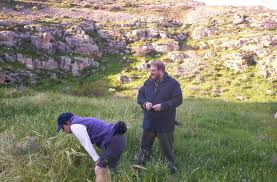
Aviv Researcher Search for Aviv Barley

Last week, as we neared the end of the Biblical Calendar year, crews of well trained and experienced volunteers, combed the land of Israel in search of barley that had reached a state of maturation that the Creator classified or named as Aviv (although some translation go with Abib instead). I won’t go into what criteria barley must meet in order for it to be deemed aviv—for quite frankly, that is certainly not something that I’m at all educated in. But what I do know is that when the barley crop has reached a point of maturation that it is deemed ripe enough for harvest, it is considered aviv. (Reference: Exodus 9:31) The month on the Biblical Calendar when this agricultural occurrence takes place is the latter portion of the 12th month. It was during this very time on the Creator’s Calendar when Father intervened in the affairs of men, revealed Himself to a Hebrew named Moshe (aka Moses), re-established the clock and calendar, and led us out of Egyptian bondage with a mighty hand as He bore us on eagles’ wings and led us unto Himself (Exodus 13:4; 19:4).

So once we’ve recognized that the barley cop is aviv AND we have sighted the renewed moon over the land of Israel—signaling the start of a new month, that we begin to count 14-days to Passover and then the 15th-day of that month begins the 7-days of Unleavened Bread—the first of 7-mandated moedim of Yahovah (Leviticus 23:5-8). For it is these appointed times that Yahovah has ordained and established within His calendar to meet with us and for us to keep and celebrate those appointed times/days before Him (Deuteronomy 16:1-8). I didn’t establish this; Michael Rood didn’t establish this; nor did Arthur Bailey or any other Hebrew Roots teacher establish this method of time keeping. It was Yahovah who established this calendar, despite what many in our community and in our Faith would attempt to convince all of us to disavow. Those individuals who seek to marginalize and bad-mouth those of us who choose to keep the Creator’s reckoning of time, I believe, have agendas that are not consistent with Torah. For we were commanded by Father to “observe the month of Aviv and keep Pesach (i.e., Passover) to Yahovah our God; for in the month of Aviv, Yahovah our God brought us out of Egypt at night” (Deuteronomy 16:1). The term observe, as translated in many of our English Bibles, fails to convey the truest sentiment that the Hebrew text, when properly rendered, does. The term “observe” in the Hebrew text is “shamar” which means “to guard” or “to keep.” Thus, Father has commanded us to keep/to guard the month of Aviv. That being the case, wouldn’t you think that it would behoove us to ensure that we pinpoint with as much accuracy as we possibly can, when the month of Aviv is to occur? Certainly, the calculated Jewish calendar may, from time to time, actually sync up with the barley crop being aviv in the land of Israel as it seems it will do this time around. But from time-to-time, the calculated calendar fails to get it right—and that goes also for the start of many biblical calendar months as well as Feast of Yahovah throughout the Biblical Calendar year. No, we are to keep, to guard, the month of the Aviv: and that means we are to ensure that we are in proper alignment with the criteria the Father established for determining when the calendar year is to begin. That criteria my friends is found in Torah. You see, if we fail to get the start of the Biblical Calendar year right, our reckoning of the remainder of the calendar year will likely be out of sync with the Father’s expressed reckoning of time and His moedim—His appointed times—His festivals and feasts. And quite frankly saints, the very least we can do is fulfill our duty as children of the Most High and that is: to “fear Yahovah and keep his commandments;” and that according to the writer of Ecclesiastes is the fulfillment of “…the whole duty of man” (Ecclesiastes 12:13). Yet for whatever reason—most likely having to do with the cares of life—we find every excuse to skirt the system—Yah’s Torah–and to do that which is more convenient and pleasing to us. His reckoning of time is NOT rocket science, but oh boy, you ask the average Hebrew Rooter if they keep the Creator’s Calendar and His moedim, you’ll get an array of hims and haws that will make you simply shake your head and walk away in total disappointment and befuddlement. And that even goes for the keeping of the Hebrew Roots test commandment: the keeping of Sabbath. So many of us in our community still have no problem working and doing whatever we so please on the weekly Sabbath. Instead, a huge portion of our community intentionally, in most cases, choose not to keep the day holy and sacred and to honor it as a day of rest and fellowship and good works as our Creator commanded and our Master showed us how to do so. It’s a total disgrace how we’ve come into this Faith and this community, accepting the requirements of Torah living as a prerequisite for living out this Faith, only to see come to fruition that in many cases, literally in just a few months or so, simply abandon the weekly Sabbath and the Feasts of Yahovah because of the cares and pleasures of life.

Saints, it’s time. It’s time for us to Teshuvah. It’s time for us to give everything over to our Creator. It’s time to hit the default button on our Faith. You see, the world around us is slowly crumbling in virtually every aspect of Western and Eastern civilization—and that even includes the world’s great religions. Nothing and nowhere is stable and peaceful and honoring of Yahovah and the way of life that He mapped out for all mankind in His Holy Word. It’s a virtual “soup sandwich” with no escape, unless your Faith is built upon a firm foundation—wholly grounded upon the solid rock which is Y’shua Messiah and Torah living. Otherwise, as that old gospel hymn expressed, all other ground—be it economic; spiritual; political; secular; all these segments of our society are as sinking sand. Edward Mote clear got it, for he wrote:

“My hope is built on nothing less than Y’shua’s blood and righteousness. I dare not trust the sweetest frame, but wholly lean on Y’shua’s Name. For it is On Messiah the solid rock I stand, all other ground is sinking sand…all other ground is sinking sand.” (Edward Mote, 1834) And yes, I did insert Y’shua and Messiah into the lyrics in place of Jesus and Christ respectively.

So Mr.and Mrs. Naysayer, whoever you may be, don’t waste your breath trying to explain to me the futileness of following the Creator’s Calendar. Instead, take the time you’d use to bad-mouth those of us who do follow the Creator’s calendar, and seek Yahovah’s will for your life—fasting and praying and seeking His Face and learning what He would have you do in regards to this situation. I’ve said it before and I’ll say it again: this is a lifestyle situation that needs to be hashed out between you and your Creator. It is not my job to convince you to adopt the Biblical Calendar. Unless your heart and mind and soul is behind it; unless you’re convicted by the Ruach Hakodesh that it is the right thing for you to follow, you’ll abandon it as quickly as you would have adopted it. Keeping the Creator’s Calendar is a lifestyle and life commitment that brings with it untold blessings as we learn to trust Yahovah and place Him as the sole ruler over our lives. That other calendar is simply a license for man to have sole ruler-ship over every person who chooses to adopt it.

So quickly getting back to the matter at hand: the barley was NOT found to be Aviv in the land of Israel last week and not being Aviv means that we must allow the barley time to reach Aviv maturation. Thus, we allot for an additional month—an additional 29 or 30-days for the barley to become Aviv. I’ve not been able to find in the Bible where we are instructed to tag on a 13th month when the barley is found to NOT be in an Aviv state at the end of the 12th biblical calendar month. The bible’s silence on this practice certainly troubled me for a brief time as I searched throughout the holy writ, especially in Torah, for Yahovah’s instructions on Adar Bets. But I finally determined that Torah doesn’t need to stipulate the practice of implementing an Adar Bet if the barley is not found to be Aviv. It’s one of those commonsense rules and teachings that we often fail to see because we want Father to instruct us to the gnat’s behind on every commandment that He’s given us: How am I supposed to keep the Sabbath; what can and can I not do on the Sabbath and on the Feast Days; under what conditions can or can I not work on the Sabbath and the high holy days; do I really have to give up eating bacon; is it okay to marry a 4th time; can I shack up with a member of the opposite sex whom I’m not married to; etc., etc., etc. And the fact of the matter is that we are generally NOT stupid beings. We generally know right from wrong; what’s sinful and not; even what of Yahovah’s Torah we’re going to obey and what we’re not. We know before we go before Yahovah on any given subject whether or not we will subject ourselves to His commandment on that issue. More times than not, we’ll rationalize within ourselves reasons why it is okay for us to violate Torah, especially if keeping the commandment(s) in question will to some greater or lesser degree personally inconvenience us or cause some level of stress in our day-to-day lives. In this particular case, we do not require Yahovah to expound for us what we must do if the barely is found not to be Aviv in the land of Israel at the end of the 12-Biblical Month. And the reason why Yahovah shouldn’t have to explain to us what to do when the barley is NOT aviv is that He gave us instructions in Torah as to what we were to do with the aviv barley in the first month of His calendar year. Consequently, it was a commandment that could only be carried out if the barely was aviv. So commonsense would necessitate that we somehow make provisions for the barley to reach aviv maturation so that we could follow-through on Yahovah’s commandments related to the aviv barley in the land. That commandment and ritual has tremendous—powerful—spiritual relevance associated with it that millions on this planet have completely missed or simply have not had their eyes opened to these amazing truths. It is that ritual and commandment, along with its spiritual relevance that we’ll reflect upon in one of future episodes of Sabbath Thoughts and Reflections.


Until then, may you be most blessed, fellow saints in training. Shalom and Shavua tov.

Purim-Haman, the Anti-Christ (aka Anti-Messiah) Cometh–STAR-48

Purim-Haman, the Anti-Christ (aka Anti-Messiah) Cometh

Sabbath Thoughts and Reflections-48

Chapter 3

Verse 1 (cf. 5:11)

  • Haman is advanced by Achashverosh to the rank, according to JFB, of vizier or prime confidential minister

Haman of Esther

  • Achashverosh establishes Haman’s authority in the realm
  • Matthew Henry places the date around 510 BC
  • Haman was an Agagite—an Amalekite so says Josephus—probably of the decedents of Agag—common name of the princes of Amalek (Ref. Num. 24:7—Matthew Henry)
  • Amalek was an Edomite—decedent of Esau
  • Exo. 17—Then Amalek came and fought against Israel at Rephidim (vs. 8, NAS—Stephan Biographical Bible)
  • Joshua and Israel fough Amalek (vss. 9-12) as Moses, Aaron and Hur held up the saff of Moshe
  • Joshua overwhelmed Amalek (vs. 13)
  • Yah had Moshe write in a book for Joshua’s edification—”for I will utterly blot out the remembrance of Amalek from under heaven. (17:14—NET)
  • Num. 24:20—Balaam’s Oracle—And having seen Amalec, he took up his parable (i.e., Balaam) and said, Amalec is the first of the nations; yet his seed shall perish.”
  • Yah will wage war against Amalek from generation to generation (17:16—NET)
  • Deu. 25:17-19—LXX—vs. 19—”…And it shall come to pass whenever the Lord thy God shall have given thee rest from all thine enemies round about thee, in the land which the Lord thy God gives thee to inherit, thou shalt blot out the name of Amalec from under heaven, and shalt not forget to do it.”
  • This was not accomplished to any significant degree until David wipe out the marauding groups of the Amalekites (I Sam. 30:17) and the final vestiges of them at the hands of the decedents of Simeon (I Chr. 4:43)
  • The decisive battle to exterminate the Amalekites is recorded in I Sam. 15. Here Saul is commanded to battle against Amalek—to smite Amalek and to utterly destroy all that they have and not to spare them, be they man, woman, infant, ox and sheep, camel and ass. (vs. 3)
  • Saul spared Agag and the best of the sheep and oxen and fattlings and the lambs and all that was good (vs. 9) Ultimately Samuel the prophet of Yahovah executed Agag, the king of the Amalekites. However, it is a fair bet to conclude that Saul failed in his task to utterly destroy the Amalekites as the remnants of this people continued to harass Israel for years to come until David and the decedents of Simeon completed the annihilation order. Yet Haman emerges as the biggest threat to the survival of Israel as a nation since the Amalekites attacked them in the Sinai desert during the Exodus from Egypt
  • The Amalekites presumably would have been wiped out by Saul in 1 Samuel 15 if he had followed God’s instructions. He did destroy the city of Amalek, but other raiding parties/nomadic bands of Amalekites survived. These were defeated by David in 1 Samuel 30 with the exception of a few hundred who escaped (30:17). The remnant of the Amalekites were finally destroyed by the Israelites many years later (1 Chr 4:43). Thus, while God did blot out the memory of Amalek by wiping out his descendents, he was at war with them for many generations. (www.rationalchristianity.net/amalekites.html)
  • Haman was husband to Zeresh; son to Hammedatha; father to Parshandatha, Dalphon, Aspartha, Poratha, Adalia, Aridatha, Parmashta, Arisai, Aridai and Vaizath (Stephan Biographical Bible)
  • So hated is Haman in Jewish culture, that the mention of his name when the Megillah of Esther is read, one hears boohs and hisses and gears from the listeners and participants. Rabbinic tradition also plays upon Haman’s evil, villainy persona by making him the center of many Talmudic legends—found in Targ. To Esth.; Meg 15)
    • Haman was also an astrologer, and when he was about to fix the time for the massacre of the Jews he first cast lots to ascertain which was the most auspicious day of the week for that purpose. Each day, however, proved to be under some influence favorable to the Jews. He then sought to fix the month, but found that the same was true of each month; thus, Nisan was favorable to the Jews because of the Passover sacrifice; Iyyar, because of the small Passover. But when he arrived at Adar he found that its zodiacal sign was Pisces, and he said, “Now I shall be able to swallow them as fish which swallow one another” (Esth. R. vii.; Targ. Sheni iii.). Haman had 365 counselors, but the advice of none was so good as that of his wife, Zeresh. She it was especially that induced Haman to build a gallows for Mordecai, assuring him that this was the only way in which he would be able to prevail over his enemy, for hitherto the just had always been rescued from every other kind of death. As God foresaw that Haman himself would be hanged on the gallows He asked which tree would volunteer to serve as the instrument of death. Each tree, declaring that it was used for some holy purpose, objected to being soiled by the unclean body of Haman. Only the thorn-tree could find no excuse, and therefore offered itself for a gallows (Esth. R. ix.; Midr. Abba Gorion vii., ed. Buber, Wilna, 1886; in Targum Sheni this is narrated somewhat differently). (Jewish Encyclopedia)
  • Haman’s Agagite-Amalekite heritage is a nagging reminder of the far-reaching consequences to be suffered when we fail to complete the tasks that Yahovah places before us to accomplish
  • Haman was a 6th century BC anti-Messiah for if Haman would have been permitted to succeed in his plot to eradicate the Jew, the Saviour would have not come on scene
  • I find it very interesting how the enemy works within and around the existing world systems to do his bidding. He finds a fitting instrument to wage war against Yahovah’s people and in this story, hasatan finds a most fitting individual in the person of Haman
  • Yah’s providence prevails in spite of hasatan’s seeming brilliant strategies to destroy the plans and oppose the will of Yahovah.
  • Saints, what Hamans do we today have operating within the halls of government-not just in the United States, but throughout the nations and countries of this world? Plotting the demise of Yahovah’s people? Some say members of the ruling elite; others say the leaders of radical Islam; still others say President Barak Hussein Obama. Surely, in every dispensation and in every generation there is a Haman operating and scheming to destroy Yahovah’s people. These individuals receive their marching orders and power and anger and hatred of God’s people from the enemy. The archenemy who’s meddling in the affairs of God’s people begins way back in the garden
  • Achashverosh advances/exalts (LXX)/promotes/lifts—Hebrew “nasa” Haman above any other official in the Persian Kingdom


  • Verse 2—It was Achashverosh’s order that Haman receive homage from every servant of the king whenever Haman would pass by. Mordecai, however, did not bow or pay homage to Haman.
  • The Megillah of Esther does not elaborate as to why Mordecai declined to do obeisance to Haman. It is a fair bet, however, that the most likely reason was that Mordecai knew that Haman was an Agagite—a decedent of the Amalekites, which every Jew knew should be despised for what they attempted to do to Israel in times past (NET Bible)
  • Many might contend that the people of Yahovah are not to render such accolades towards other men and that such accolades should instead be steered towards Yah. But it would be a fair bet that Mordecai did render obeisance towards Achashverosh. Thus I believe it was the mere fact that Haman was a decedent of Agag and an Amalekite that moved Mordecai not to rendered the commanded obeisance.
  • In syriac translations, the obeisance takes on a much grander appearance: one of not just bowing as one would do towards a high official, but of “prostrating oneself on the ground as in worship. According to the TWOT Lexicon, prostration was quite common as an act of submission before a superior. When that same term is translated into the Greek word proskuneo, used some 148 times in the LXX, the term can mean either “prostration” or “worship.” Furthermore, prostration was a common act of self-abasement performed before relatives, strangers, superiors, and especially before royalty. According to the TWOT Lexicon, “it was in open defiance of Persian court etiquette that Mordecai refused to bow or to prostrate himself before Haman. The Targum and Midrash explain Mordecai’s refusal on the basis of an alleged idol on Haman’s robe. Mordecai may have bridled at the thought of bowing before an Amalekite or Agagite.” The JPS does use the prostration term to describe the homage being paid to Haman


  • Verse 3—it became widely known or observed that Mordecai did not pay homage to Haman as the king’s edict mandated. Thus certain officials of the king’s court called Mordecai to task over Mordecai’s refusal to pay the mandated homage to Haman

Purim--Mordecai

  • Verse 4—the LXX contends that these same instigating officials spoke daily to Mordecai about his refusal to follow the kings edict of paying homage to Haman. But Mordecai ignored them. No doubt this enraged those meddling individuals who themselves no doubt to prostrate themselves before Haman every time the man passed by them. Given that it would seem Mordecai could care less about Haman, these individuals approached Haman to see if Mordecai’s Jewish culture would exempt him from paying homage to Haman.
  • Now this is an interesting development here as we see that Mordecai has reversed the practice of keeping silent about his Jewish heritage, as he’d taught Esther/Hadassah in chapter 2. It is impossible to say why Mordecai made such a reversal apart from surmising that maybe he’d just got fed up of having to put up with the daily attacks by those meddling in his affairs over the obeisance towards Haman. For it would certainly explain Mordecai’s reasons for not paying such extreme homage to Haman, especially as it relates to Haman being an Amalekite


  • Verse 5—needless to say, Haman was “full of wrath (KJV);” “greatly enraged (LXX);” “furious (CJB)” when he himself observed that Mordecai did not prostrate himself or pay the commanded homage to him. And this is where Haman’s inflated ego becomes the platform upon which a grand plot to exterminate the entire Jewish race would be launch
  • Josephus reads: “When Haman observed this, he inquired whence he came; and when he understood that he was a Jew, he had indignation at him, and said within himself, that whereas the Persians, who were free men, worshipped him, this man was no better than a slave, does not vouchsafe to do so.” (Antiquities 11.6.5)


  • Verse 6—some translations suggests that Haman was disdained at the thought of striking out solely towards Mordecai (e.g., NAS); other translations use the terms repugnant, scorned and contemptible (e.g., NET, DBY and ESV). But I prefer a more civil rendering such as provided by the NLT which describes Haman’s perpsective towards Mordecai as “seeming a waste to lay hands on Mordekhai alone” or “not enough to lay hands on Mordecais alone.” (CJB and NLT respectively). You see, when something bothers those who are possessed by the enemy, it’s not enough to deal with the problem directly. No, these individuals seek to utterly destroy any and all who are associated with the individual causing the problem in the first place. In this case, Mordecai was a Jew who refused to prostrate himself before him as commanded by Achoshverosh. So instead of just attacking Mordecai, Haman elects to turn his attentions and his anger and hatred towards the whole Jewish race—to use his newly acquired power and influence, through the power and might of the Media-Persian crown, to wipe out the Jews in the known world, which at this time was the Media-Persian empire.
  • Josephus writes: “…he (Haman) thought it too small a thing to request of the king that he alone (speaking of Mordecai) might be punished; he rather determined to ab olish the whole nation, for he ws naturally an enemy to the Jews, because the nation of the Anmalekites, of which he was, had been destroyed by them. (Antiquities 11.6.5)
  • It should be noted that the entirety of the first part of verse 6 is completely absent in the LXX, which reads: “…and took counsel to destroy utterly all the Jews who were under the rule of Artexerxes.”
  • Indeed, Haman’s desire was not only to destroy the Jew in the immediate area of Susa (aka Shusan), but every Jew throughout the known world, including those who had been released to return back to Palestine by the crown

Purim--Achoshverosh or Xerxes

  • Verse 7—the LXX denotes that lots were casts before haman in the 12th year of the reign of Achoshverosh; cast daily and monthly, to slay in one day the race of Mardochaeus; and the lot fell on the fourteenth day of the month which is Adar.
  • The definition of Purin is explained here: meaning “the lot.” (NET) According to TWOT Lexicon, “the word (i.e., Pur) occurs only in the book of Esther and the term is to be distinguished from “goral,” which is the usual word for “lot.” Pur is related to Babylonian “puru” which means “lot” and seconarily “fate.”
  • All other translations, however, denote that the casting of lots began in the first month of the year—the month of Nisan which corresponds to the March-April timeframe of our pagan calendar
  • Thus we see the importance of having a firm understanding of the Biblical Calendar when studying the works of the Old Covenant
  • All indications are that Haman consulted soothsayers to figure out the proper time for the execution of the plot to exterminate the Jews. Thus, lots were casts to determine the date this plot against the Jews would be carried out in one fell swoop. The lot of course, landed upon the 12th month—the month of Adar. What are the chances of this happening—day after day; month after month; to land on the 14th day of the 12th month is beyond the confines of human reasoning and must be attributed to Yahovah
  • It should seem without the slightest reservation that Yahovah’s providence influenced the outcome of this plot in that an entire 12-months was arrived at for the plan to be executed. This extended amount of time would provide for the opportunity on the Jew’s part to lodge a counter-defense against Haman’s plot (Matthew Henry)
  • The casting of lots was a common practice in the ancient near east; even used by the Hebrew to assist in determining or arriving at a time, date or solution to a problem. The point behind casting lots or “pur” was to place the arrival of the solution to the problem at hand to chance and allow providence to determine the outcome. In this case, providence indeed took center stage and providence sided with the Jews. When those who balked at the canonicity of the Megillah of Esther is ever heard or read, let it be known that this single incident alone is proof positive that Yahovah, although not mentioned once by name or title, was all over this story and throughout this book


  • Verse 8—in this verse we can see the spinning of the yarn and the story so as to make the offense propagated only by Mordecai, seem so insidious and widespread among the Jewish nation that Haman takes tremendous liberties to alter the truth when delivering the concern to King Achoshverosh
  • Josephus writes Haman saying to Achashverosh the following: “There is a certain wicked nation, and it is dispersed over all the habitable earth that was under his dominion; a nation separate from others, unsociable, neither admitting the same sort of divine worship that others do, nor using laws like to the laws of others, at enmity with thy people, and with all men, both in their manners and practices. (Antiquities 11.6.5)
  • This is about 4-years into the marriage of Hadassah and Achoshverosh
  • Haman’s articulation of the situation was ever so hasatan like, almost reminiscent of the garden incident—”There is a particular people (the Jews of course) that is dispersed and spread among he inhabitants throughout all the providences of your kingdom.” Here Haman in ensuring that the King is not limiting the scope of his assessment against the Jews to just the Persian capital, but also the Jews scattered throughout the entire Medio-Persian realm—the whole of Achashverosh’s kingdom. “ …whose laws differ from those of all other peoples.” This indeed is true, but the Jews were a people who were under abject subjection and would not have caused any problems against the monarchy. “Furthermore, they do not observe the king’s laws. It is not appropriate for the king to provide a haven for them.” And here is where the hasatan character shows up—furthermore these do not observe the king’s laws…what? There is only one man who has been shown not to obey the king’s edict—that is to prostrate himself before Haman whenever Haman would passed by him. So the question posed to Achoshverosh by Haman is: “it is not appropriate for the king to provide a haven for them.” (NET) The NAS and ESV provide somewhat of a different rendering—”…so it is not in the king’s interest to let them remain or not to the king’s profit to tolerate them.”
  • Thus we see part 2 of the plan to exterminate the Jews through the agency of Haman. Part one was to cast lots and decide upon a day to pull the trigger on the extermination day. Part 2 was to exaggerate the issue to the ears of Achoshverosh as we see here played out


  • Verse 9—Haman says to Ahashverosh, if it pleases you/if you are so inclined/if it seems good to you, let a decree be written/an edict be written that these troublemakers be destroyed. And to sweeten the deal if you will, how ‘bout I add to the king’s coffers/treasury, 10,000 talents of silver, which the NET Bible equates to about 2/3 of the royal income by some estimates; 330-tons of silver according to the CJB.
  • The NET surmises, which I find very interesting and never considered before reading it, that Haman would have naturally figured out this tidy sum of wealth through a calculation of the overall wealth of the Jews in the empire. No doubt the Jews, although in captivity, were in many places still prosperous as Father’s promise to bless His people trickled down to them even in the midst of the recompense they were paying for their abandonment of Torah We saw even during Nazi regime’s attempts to also exterminate the Jews—popularly known as the Holocaust (Hitler being a 20th iteration of the Anti-Messiah/anti-Jew) how many in the nation remained prosperous in spite of their treatment and persecution. It is widely known that the Nazi regime pillaged the wealth of Europe’s Jewish populations and added that wealth to its national coffers which no doubt also helped finance Hitler’s war machine. How can one not see the tremendous similarities between Haman and Hitler here? Both, I submit to you, are Anti-Messiah’s and Anti-Jewish agents of the enemy. Hitler not so much an Anti-Messiah as an Anti-Semite who set out to rid the world of the Jew—something that so many before him set out to do. But Haman and others before him, certainly set out to exterminate the nation and in so doing, if they were successful, would have cut the line of Messiah, preventing the Saviour from coming in to the world. One must wonder how someone like Haman could sway the most powerful man on the planet at that time, to agree to such a plan to wipe out an entire nation of people—to commit pure and unadulterated genocide. Only through the workings and power of hasatan I say
  • Today, we see a similar mindset amongst the people of such terrorist groups as Hamas and the surrounding Islamic nations such as Iran who have vowed to see the nation of Israel wiped from the face of the earth. Sadly, the United Nations, if it had its way, would support the destruction of Israel
  • Josephus goes into the mindset of Haman in that Haman suggests to the King that these miscreants be “utterly, and not leave the least remains of them, nor preserve any of them, either for slaves or for captives.” (Antiquities 11.6.5)
  • Furthermore, Josephus takes the perspective that Haman would pay into the King’s coffers 40,000 talents for which the king “both forgave him the money and granted him the men to do what he would with them (meaning the Jews)” (Antiquities 11.6.6)
  • Verse 10—and certainly Haman’s silver tongue worked it’s supernatural wonders in Achoshverosh, for the King consented to the plan, even giving Haman his ring to “seal the decrees against the Jews” (LXX)
  • The KJV ensures the reader understands that (1) Haman was an Agagite, and (2) that Haman and the Agagites are enemies of the Jews
  • 24 sn Possessing the king’s signet ring would enable Haman to act with full royal authority. The king’s ring would be used to impress the royal seal on edicts, making them as binding as if the king himself had enacted them. (NET)
  • Friends this is power in its purest state and Haman now possessed it. It would seem at this point that there was no stopping the man nor stopping the plot to exterminate the Jew


  • Verse 11—but Achoshverosh, according to the LXX, instructed Haman to “keep the silver and treat the nation (i.e., the Jewish nation) as he saw fit.”
  • Matthew Henry suggests a very astute consideration to this situation, how Achoshverosh did not examine the claims made to him against the Jews by Haman, as he carefully did back when Mordecai exposed the plot against the King by the two chamberlains in chapter 2 of this book.
  • Obviously, Haman was able to appeal to something within Achashverosh’s ego make-up to convince him to move fully over to Haman’s position to eliminate the erroneous threat to his sovereignty as the undisputed potentate, new world order, oligarch


  • Verse 12-14—thus Haman drafted the edict against the Jews on that day using Achashverosh’s scribes/secretaries according to some translations; the mission to anihilate the Jews to take effect on the 13th day of the 12th month or the month of Adar. This message was drafted and Haman signified it with the King’s ring and the letters were to be sent out to all 127 provinces of the kingdom.
  • I find the LXX’s treatment of this scene interesting as it records what is believed to be the actual content of Haman’s letter instructing to the armies of the realm to take out the Jews in every single province of the realm. It reads as follows:

LXE Esther 3:13 <1> And the message was sent by posts throughout the kingdom of Artaxerxes, to destroy utterly the race of the Jews on the first day of the twelfth month, which is Adar, and to plunder their goods. <1> And the following is the copy of the letter; The great king Artaxerxes writes thus to the rulers and inferior governors of a hundred and twenty-seven provinces, from India even to Ethiopia, who hold authority under him. Ruling over many nations, and having obtained dominion over the whole world, I was minded, (not elated by the confidence of power but ever conducting myself with great moderation and with gentleness, ) to make the lives of my subjects continually tranquil, desiring both to maintain the kingdom quite and orderly to its utmost limits, and to restore the peace desired by all men. But when I had enquired of my counsellors how this should be brought to pass, Aman, who excels in soundness of judgment among us, and has been manifestly well inclined without wavering and with unshaken fidelity, and has obtained the second post in the kingdom, informed us that a certain ill-disposed people is mixed up with all the tribes throughout the world, opposed in their laws to every other nation, and continually neglecting the commands of the kings, so that the united government blamelessly administered by us is not quietly established. Having then conceived that this nation alone of all others is continually set in opposition to every man, introducing as a change a foreign code of laws, and injuriously plotting to accomplish the worst of evils against our interests, and against the happy establishment of the monarchy; we have accordingly appointed those who are signified to you the letters written by Aman, who is set over the public affairs and is our second governor, to destroy them all utterly with their wives and children by the swords of the enemies, without pitying or sparing any, on the fourteenth day of the twelfth month Adar, of the present year; that the people aforetime and now ill-disposed to us having been violently consigned to death in one day, may hereafter secure to us continually a well constituted and quiet state of affairs. {1) The portion from here to the end of the verse is not in the Heb. } (Est 3:13 LXE)

  • Josephus pretty much echoes verbatim the LXX’s account of this edict
  • Verse 15—and the chapter ends with Haman sitting down with Achashverosh over some adult beverages in the aftermath of the hurried sending of the edict against the Jews by couriers to all 127 provinces of the realm. Certainly for Haman, something to celebrate. But the city of Susa is described at that point to have been perplexed/troubled/in an uproar/thrown into confusion/in consternation
  • The DRA translation actually narrows down this confused state in the capital Susa by rendering: “…and all the Jews that were in the city weeping”; all this while Haman and the King feasted together


In reality, this chapter should end over in the first part of chapter 4 as it is a most befitting place to conclude our study for today. The passage reads as follows:

(1) When Mordecai perceived all that was done, Mordecai rent his clothes, and put on sackcloth with ashes, and went out into the midst of the city and cried with a loud and a bitter cry; (2) And came even before the king’s gate: for none might enter into the king’s gate clothed with sackcloth. (3) And in every province, whithersoever the king’s commandment and his decree came, there was great mourning among the Yahudiym (i.e., the Jews), and fasting, and weeping, and wailing; and many lay in sackcloth and ashes.

Thoughts and Reflections on Purim–Yahovah’s Providence Over the Will of Man and Satan–Sabbath Thoughts & Reflections 47

Thoughts and Reflections on Purim–Yahovah’s Providence Over the Will of Man and Satan

Sabbath Thoughts & Reflections 47


As I reflect and put together this episode, we find ourselves on the 11th Day of the 12th Biblical Month known to some as Adar. The next event on the calendar is Purim which is just 3-days away, and it is this Jewish festival that I will be reflecting upon for this episode. It should be known, however, that the calculated Jewish calendar factored in an Adar-Bet for this calendar year—meaning for this Jewish calendar year, there are 13-months; so the observance/celebration of Purim for the orthodox Jew and most Messianic Jews and some Hebrew Rooters will be this time next month. Nevertheless, we follow the creator’s calendar whereby the month begins with the sighting of the renewed moon over the land of Israel, which occurred 11-days ago. So we will be looking at Purim in just 3-days. By the time this is actually published, Purim will have come and gone if I am to be totally honest with you. It does take a few days to get this all put together—written up; formatted; recorded; edited and published.

But before I get to Purim, I want you to know that we are just about 6-weeks away from the start of the Spring Feasts of Yahovah—that being Passover—of course that all hinges upon two (2) things: (1) the sighting of the renewed moon over the land of Israel—presumably in about 19-days—AND—(2) a determination that the barley growing in the land of Israel is in a state of maturation known as Aviv. There are Karaite and Messianic Jews in the land of Israel who have made it their life’s mission and ministry to sight these agricultural, atmospheric and celestial events—in accordance to the instructions handed down to us by Yahovah through His Torah–each Biblical year and month and we are so blessed that Father, in His infinite will and purpose, has placed these individuals in the land so that we may be in sync with the Father’s prescribed reckoning of time. And it is this time of the Biblical calendar year that I find most exciting—exhilarating; especially for those of us who adhere to the Creator’s reckoning of time. You see, when we rely upon the Biblical Calendar to guide us in the Creator’s reckoning of time, we place our trust and our obedience in the Creator’s hands as we look to His divine providence and Torah to plan out our lives and to walk out Torah the way Y’shua Messiah taught us to. Halleluyah. The Jewish Calendar is, and I’m not meaning to offend those who adhere to it, is a calendar of practicality and convenience. In other words, one can plan for the feast days and festivals and change of months and years—yes, years in advance. So we place our trust not in the Creator’s reckoning of time but in man’s reckoning of time—unless you’re an astrophysicist who has planned all this out in your own calculated calendar. Most us are not astrophysicists however. But the Creator’s calendar requires us to rely solely upon the Creator’s reckoning of time, which I absolutely love because it causes me to stretch out my faith to Him and to be more in tune with the spiritual and hard history that was passed down to us by Father’s anointed teachers throughout the centuries.

Before I get into Purim, I want to briefly revisit last week’s Reflections and Thoughts, which was primarily on the Cepher Bible. For those of you who have not listened to or read that post—it is episode 46—I would humbly ask you to take a look at that episode at your leisure. But in the briefest of terms, I spoke to the Cepher Bible not living up the the hype that it advertised to our Hebrew Roots community. I became very disappointed with the translators and editors of the Cepher when I learned that they intentionally altered Philippians 2:11 to read differently than what is found in the extant manuscripts they used in the creation of this Bible. When I went to their website to find out if they had a reason for altering the verse, I learned that the translators and editors did so because they held to the belief that Y’shua is Yahovah and they wanted the passage to reflect just that—so they altered the passage to read accordingly. They made no qualms about it on their website I must say. They actually were very open about what they’d done. So I have to give them their props for at least being open and honest about their role in this situation.

Alteration of Philippians 2:11

The Cepher Bible

What I took issue with, however, was not their doctrinal stance on the divinity of Y’shua or their binarian understanding of God, or in Churchianity terms, the God-head; I took issue with the fact that the Cepher people blatantly advertised to our Hebrew Roots community that the Cepher Bible was the most accurate and unbiased translation of the Holy Writ on the market (my paraphrase)—restoring the sacred names of the Creator and Son and the Hebrew names of the people and places contained therein. I could care less about their doctrinal beliefs and I stated as much in my last podcast episode. For me, I just wanted a bible that was accurate and true—as much as it possibly could be accomplished, given the crazy amount of tampering with Yahovah’s Word that has been perpetrated against the Bible throughout the centuries.

It did occur to me after posting my thoughts on the Cepher last episode, that most of our bibles have been to some lesser and some greater degree, altered by man in their attempts to postulate and pass on their personal doctrinal beliefs to their readers. But from the beginning, hasatan has made it his primary mission to sully man’s relationship with Yahovah, and he’s done so by cunningly manipulating the Creator’s Words. In so doing, he realizes that man then becomes confused and begins to doubt that which they originally believed or that which Father originally revealed to them through His original Words. Father told Adam that “of the tree of the knowledge of good and evil, thou shalt not eat of it: for in the day that thou eatest thereof thou shalt surely die.” (Gen. 2:17, KJV) But in the next chapter we find hasatan take the Words of Yahovah and completely alter them before Eve: “…Ye shall not surely die: for Yahovah doth know that in the day ye eat thereof, then your eyes shall be opened, and ye shall be as gods, knowing good and evil.” (Gen. 3:4,5, KJV) And of course, it was from that point on that hasatan has gone out of his way to manipulate and alter the Words of our Creator. Throughout the centuries, man has taken the manuscripts of the Holy Writ and altered them to reflect that which they personally hold as truth. Every time you see words in parentheses in our present day Bibles, for instance, you know that some scribe has inserted his own take or understanding of the passage in question. Oh, those pesky scribes will say that they were helping us better understand what the writer of that particular passage of Scripture was saying. But let’s face reality: it is virtually impossible for men to withhold their own personal biases when working with the Word of the Most High. We believe, erroneously, that the Word of Yahovah belongs to us. So we feel at ease to take liberties with Scripture. The fact of the matter is, the Word of Yahovah belongs to Yahovah.

Moshe taught that we must not add to are subtract from that which Yahovah has given to us. (Deu. 4:2) Yet man can not resist adding to and subtracting from the Word. Take for instance John 5:1 where it is written: “After this there was a feast of the Jews; and Jesus went up to Jerusalem.” (KJV) And look at John 6:4: “And the passover, a feast of the Jews, was nigh.” (KJV) Now bear in mind, the writer of John was a Jew, and John was no doubt writing his documentary on the life of Y’shua Messiah to other Jews and to those who had a clear understanding of what the Feasts of the Lord were. Why would John have written something as elementary and so distant as describing the passover being a feast of the Jews if his intended readers were in fact Jews or at the very least, extremely knowledgeable of the Feasts of Yahovah? It doesn’t make sense. It would be like me writing a letter to my staff saying: have a nice 4th of July, the day that our nation declared it’s Independence. Why would I have to explain what the 4th of July was to my staff? They are all born and raised in America citizens of the United States. In the case of the two (2) Johannine passages, it is clear that the translators and scribes of his documentary took liberties with John’s writings. And those who had opportunity to take such liberties, no doubt did so with a purpose in mind. We know that by the 3rd and 4th century of the common era, the so-called Christian Church had all but rejected anything having to do with the Jewish people and Judaism. Thus, it would behoove the translators and scribes of the Gospel records to attack all things Jewish and to discourage the readers to reject all things Jewish.

As it relates to the Cepher, I realize the translators and editors of this bible had a purpose in mind when they published this product. My only position in regards to this Philippians 2:11 alteration, and God-knows what other areas they’ve tampered with in their translation, is: don’t advertise that you’ve produced a Bible that is second to none (my words) and that is accurate and faithful to the most reliable extant manuscripts out there, if you therefore intend to fix or manipulate areas of the Holy Writ that you feel don’t convey your personal doctrinal positions to your personal liking. It’s just wrong. And that my friends, is my final word on the subject of the Cepher Bible.

Now on to my thoughts and reflections on Purim—Yahovah’s Providence Over the Will of Man and Satan.

The story and book of Esther has tremendous spiritual and prophetic implications associated with it that the casual Christian or even Hebrew Rooter will not realize. In fact, few truly understand the full story of Esther and the history behind it; fewer still realize that there is actually a Jewish Feast or Festival that is attached to it. In this episode of Sabbath Thoughts and Reflections, I hope to shed some light on all aspects of this story and it’s accompanying festival.

The story of Esther takes place during the Babylonian Captivity which was recorded in the prophets and the book of Kings and Chronicles.

Esther’s story begins around the time of 519 BC.

Ahasuerus (aka Achashverosh in certain translations) is likely the great Persian King—Xerxes I. There appears to be some disagreement in classical literature and among ancient scholars as to the exact identity of this Persian King. Josephus and certain Jewish commentaries, as well as the Greek Septuagint, all identify Ahasuerus as either Artexerxes I (465-424 BC) or Artaxerxes II (404-358 BC). However, it would logically appear that these kings would have reigned much later than the time period documented in the Book of Esther, which most scholars have agreed took place in the 6th century BC—around the 500’s BC actually. The story of Esther begins in the 3rd-year of Achashverosh’s reign over the known world. I’ll have a little more commentary on this Xerxes character in just a moment.

The Book of Esther is probably one of the least read books of the Bible by Christians as it contains no overt or direct mention of Yahovah nor of His name. But we will see that despite the Creator’s name not being mentioned at all in the scroll or megillah of Esther, the Creator’s fingerprints are actually all over the Esther story. We will find that one can spend a great amount of time gaining tremendous spiritual meaning and understanding as to how our Father works in, around and through the affairs of men—not just the affairs of the Jews—but also the affairs of the great pagan nations of the world.

It’s interesting to learn that when the canon of the Bible was being worked out in the early days of the Church triumphant, Esther’s canonicity was actually questioned due to the absence of any direct mention of God throughout the scroll or book. There is little doubt, however, that the Jews, to whom the Father committed His oracles (reference Romans 3:2)—that is His inspired written Word—saw the significance of Esther and felt it was definitely canon worthy. In fact, a copy of Esther was found among the hundreds of manuscripts at Qumran—famously known as the Dead Sea Scrolls. Part of the reason why the Jew has kept and revered the book of Esther and the associated Festival of Purim is that Queen Esther and her Parent-Cousin required the Jewish nation to remember and observe the days of Purim. It is written: 26 Therefore they called these days Purim, after the term aPur. Therefore, because of all that was written in dthis letter, and of what they had faced in this matter, and of what had happened to them,

27 the Jews firmly obligated themselves and their offspring and aall who joined them, that without fail they would keep bthese two days according to what was written and at the time appointed every year,

28 that these days should be remembered and kept throughout every generation, in every clan, province, and city, and that these days of Purim should never fall into disuse among the Jews, nor should the commemoration of these days cease among their descendants.

29 ¶ Then Queen Esther, athe daughter of Abihail, and Mordecai the Jew gave full written authority, confirming bthis second letter about Purim.

30 Letters were sent to all the Jews, ato the 127 provinces of the kingdom of Ahasuerus, in words of peace and truth,

31 that these days of Purim should be observed at their appointed seasons, as Mordecai the Jew and Queen Esther obligated them, and as they had obligated themselves and their offspring, with regard to atheir fasts and their lamenting.

32 The command of Queen Esther confirmed these practices of aPurim, and it was recorded in writing. (Est 9:26-32 ESV)

As I’ve mentioned in previous episodes of this program, Purim is NOT one of the 7-mandated Feasts of Yahovah, and thus we are NOT required to observe and keep Purim in the same manner that one would the moedim of our Father. However, as grafted in members of the family of Yahovah, we are compelled to examine our newly adopted heritage and gain as much knowledge of these monumental historical events as we possibly can. The great apostle Shaul (aka Paul) wrote to the Roman Assembly: “For whatever was written in former days was written for our instruction, that through endurance and through the encouragement of the Scriptures we might have hope.” (Romans 15:2) And indeed, there is a lot to be gained through an understanding of this festival that, granted, is a man-made festival—but a festival that has its foundations rooted in the providence and workings of the Almighty. Let’s face it: we have no problem celebrating and keeping any other man-made festival—or as we choose to call them, holidays—for some of us, even keeping the pagan ones. Why would we fight then, against observing and delving into this amazing festival that we will examine in detail over the next few weeks leading up to Passover?

The story of Esther or in her Hebrew name—Hadassah—takes place in the capitol of Persia, at the time known as Susa or Shusan, as found in many English translations. Susa or Shusan was the capitol of the Medo-Persian Empire during the life and ultimate reign of Esther as Queen and the location of Achashverosh’s palace. (Nave’s) During the time of Esther, Achashverosh was the undisputed “One World Leader” over a “New World Order”—I would contend a precursor of what we may be about to witness in the coming years of our present world.

What I have been led to do during this brief series is to read through the Megillah or scroll or book of Esther and examine the riches contained therein. I’m choosing to do this to coincide with the advent of Purim which this year we are observing February 22-24 in accordance with the Creator’s calendar. According to Scripture, the Festival of Purim is to be observed on the 14th day of the 12 Biblical Month known as Adar. If you are a follower of the calculated Jewish calendar, you may or may not know that an Adar-Bet was factored into the calendar for this year and thus there is a 13th month added to the Jewish calendar and the Festival of Purim is being observed or celebrated this time next month or the 23rd of March; which is odd because if the renewed moon is sighted over the land of Israel this year, those of us who follow the Biblical calendar, will be observing and keeping Passover that same week. So we have a disconnect in terms of when Purim and Passover is going to be celebrated this year, which is expected when our Faith follows 2-different calendars. But I don’t want to get into the whole calendar thing anymore than I already have.

As it relates to Purim, however, Jews today observe Purim by reading the Megillah of Esther; dressing up in costums (some have actually insinuated Purim is the Jewish halloween); giving to charity; attending festive parties; and family meals. (Wikipedia) I’m not certain if the Jew of today gets the tremendous spiritual and prophetic implications of the story of Esther with such emphasis on partying and having a great time—one would only hope. But those of us who are taking the time to think and reflect upon this day, let us search out the riches of this story so that our lives may be greatly enriched and our walk with Messiah much more focused and powerful.

  • The story of Esther begins with a description of King Achashverosh’s kingdom in an exposition—a world’s fair of sorts
  • The story begins in the 3rd year of Achoshverosh’s reign
  • So vast was his kingdom that the exposition extended some 180-days—just shy of 6-months
Some believe that this Achoshverosh, also known as Xerxes was the leader of a million-man army—made popular today by the movie “300.” (Rood)
Purim--Achoshverosh or Xerxes
  • No expense was spared
  • There was no doubt that King Achashverosh was the undisputed ruler of the known world
  • 127-provinces that stretched from Turkey, down to Africa, over east to India (Rood)
  • At the end of the 180-day exposition, King Achashverosh hosted a week-long banquet
  • It was a drink-fest where there was no limit—everyone, according to the King’s edict, was to drink as much as he wanted
  • On the last day of the week-long banquet where the drink was heavily flowing and the King was feeling the effects of drinking, he summoned his outrageously beautiful wife, Vashti, to make an appearance before him and his royal court, arrayed in her royal garb and crown
  • It so happened that Queen Vashti had thrown a celebration of her own in the royal house
  • When the summons came for Vashti, she refused to respond
  • Needless to say, Vashti’s refusal to respond to the King’s summons outraged Achashverosh—no doubt embarrassed him to no small degree
  • It was this disrespect that led King Achashverosh to consult his lawyers—the CJB refers to these lawyers as sages. It appears that the King sought to resolve this insubordination legally and in accordance with established Media-Persian law
  • No doubt some on the King’s counsel did not find Vashti’s insubordination funny and looked upon her behavior as having potentially wide-ranging ramification for every noble of Persia and Media
  • The fear was that Vashti’s insubordination would send a signal to all the women in the kingdom that it was okay to show contempt and disrespect towards their husbands
  • The sages or lawyers no doubt had a legal plan in mind way before the king approached them for a legal solution to Vashti’s insubordination. We have no clear understanding as to how much time passed between Vashti’s insubordination and the king consulting the sages
  • The sages’ approach as it related to a solution to Vashti’s insubordination was to point out to the king that Vashti’s offense was not just an offense towards the king, but also an offense to the whole empire. The fear was of course was that if Vashti’s insubordination was not strongly addressed by the king, then word of Vashti’s behavior would embolden every woman of the empire to disrespect their husbands
  • Thus the king’s court sought to legislate respect—is this not what we’re seeing played out in many of the sectors of the world as political correctness is being enforced by legal actions
  • The legislation that emerged from this counseling session was that men would rule over their homes and over their wives and women would respect their husbands
  • This rule filtered over into Rabbinic tradition where Rabban Simeon b. Gamaliel wrote: “…for everyone is king in his own house as it is written in Esther 1:22: That every man should bear rule in his own house.”
  • I love Michael Rood’s teaching on this story whereby Michael puts forth a very simple reality: men have an innate need for respect, especially coming from their wives. Wives, on the other hand, have an innate need for love, especially from their husbands. When love and respect are commonplace in a marriage, that marriage will tend to remain on solid ground. When there is no long from the husband and no respect rendered by the wife, problems are sure to erupt
    • Obviously, something was wrong in King Achashverosh’s and Vashti’s marriage and this insubordination incident simply highlighted the overall problems that existed in that relationship—(Rod)
  • The king embraced his counsel and sent letters out to the whole of his realm requiring that wives respect their husbands and that husbands rule over their own homes

Moving in to Chapter 2, the story of Esther begins to take on flesh and we are introduced to the female star of the story.

  • It would appear that the king still longed for Vashti.
  • Jerome saw this need of Xerxes (aka Achoshverosh)as a fault and an evil such to satisfy his lust, and to reduce the king’s ire, the kings’ handlers enticed the king to go after other maidens. According to Jerome, “one fault cured by another fault and one sin by another sin…”
  • Certainly, King Achashverosh was not without opportunity for female companionship as he no doubt had a sizable concubine. It would be conceivable that Achoshverosh longed for the husband-wife relationship that he possibly shared with Vashti before the fall-out. But it is unclear as to why the king’s people saw a need to conduct a search throughout the realm to find the king a woman among the most attractive virgins of his kingdom. I would guess the purpose was to replace the vacancy Vashti left in the kings’ heart—that is, to replace Vashti


  • The beautiful women of the kingdom were to be gathered and they were to go through a beautification process that many translations refer to as purification—tamrook in Hebrew—denoting the employment of oils and ointments
  • These beautiful virgins would be housed in some part of Sushan’s (aka Susa’s) royal palace or house (Holladay Hebrew & Aramaic Lexicon of the OT)
  • The end purpose was for the king to select a woman from this lot to replace Vashti

Purim--Shusan Palace

  • Here Mordecai—a Benjamite–is introduced
  • A pagan name that reflects the name of the Babylonian deity Marduk
  • It was a common practice for captives of the Persians o be given such names in addition to their birth name—(1) secular use; (2) use in Jewish community
  • Mordecai’s Jewish name, however, is NOT recorded in the Biblical text (NET Bible)

Purim--Mordecai

  • Mordecai was of the lineage of Kish—Sam. 9:1—thus he was almost royalty (Rood)
  • There are differences in opinion among translations and among scholars whether Mordecai resided in the palace or just the city
  • KJV, NET, ESV, DBY, NLT, ASV, YLT, JPS, NIV, NRS—palace; citadel
  • LXX, NAS, CJB, DRA, GNV, LEE, BGT—city; capitol
  • Mordecai was one of the Jewish captives (Nave’s Topical Bible)
  • The captivity of the Jews by the Babylonians was fulfilled and recorded in 2 Kings 20:14-18; Isa. 39:3-7
    • Problems began for Judah as recorded in 2 Kings 20:12-16; Isa. 39:1-8; cf. 2 Chr. 32:31—Berodach-baladan, King of Babylon, seeking to curry favor with the nations of the region in opposition to Assyrian domination of the region. King of Judah—Hezekiah welcomed Berodach-baladan to Jerusalem and showed off the wealth of Judah
    • Isaiah the prophet remonstrated against Hezekiah’s pompous act and prophecies of the future captivity where the nobility of Judah would be taken into captivity and service of the King of Babylon. The riches of Judah was incentive for a return to Jerusalem by Babylonian monarchs (Moody Bible Atlas)
    • 4 campaigns against the Syro-Palestine region ensued between 605-582 BC, lead by Nebuchadnezzar
    • Autumn of 605 BC, Nebuchadnezzar made king Jehoiakim his vassal—2 Kings 24:1; cf. Jer. 25:1,2; thus Jehoiakim became liable to pay tribute to Nebuchadnezzar
    • Certain Judahite citizens, including Daniel, were carried off to Babylon in this campaign—Dan. 1:3-7
    • Dec. 599 BC, Nebuchadnezzar’s troops marched against Jerusalem in response to King Jehoiakim’s refusal to pay the annual tribute
    • Adar 2, 597 BC=March 16, 597 BC, seized Jerusalem and captured King Jehoiakim—3 month seige—Jer. 52:28; 2 Kings 24:8-12; 2 Chr. 36:10
    • Nebuchadnezzar installed Jehoiakim’s uncle—Mattaniah, renamed Zedekiah—on the throne in Jerusalem
    • 10,000 Judahites were deported out of Jerusalem, including Ezekiel—Eze. 4:1
    • Zedekiah’s insubordination and realignment with Egypt resulted in Nebuchadnezzar’s 3rd campaign against Jerusalem—Jan. 587 BC—the city was walled in for a prolonged period resulting in severe famine and pestilence. The city fell July 19, 586 BC
    • Zedekiah was captured and transported to Babylon
    • Aug. 16, 586 BC, Solomon’s Temple was destroyed by fire—its treasures pillaged or carried away to Babylon
    • More Judahite citizens deported into Babylonian captivity
    • Gedeliah was made governor over Judah—2 Kings 25:22; Jer. 40:5-7
    • Final Babylonian assault against Jerusalem occurred 582 BC—Jer. 52:30—in response to Gedeliah’s assassination—2 Kings 25:25; Jer. 41:2, 3
    • 745 Judeans were deported into Babylon (Moody)
  • The history of the Jewish captivity is found in 2 Kings 24; 2 Chr. 36:10; Jer. 24:1; 29:2
  • Nebuchadnezzar was the King of Babylon during those campaigns
  • The head of gold in Daniel’s prophecy Henry)
  • Mordecai had been made a prisoner in Nebuchadnezzar’s 2nd campaign against Jerusalem—Mar 16, 597 BC
  • Here Hadassah—Jewish name—is introduced—daughter of Mordecai’s uncle—Mordecai’s father’s brother—Abihail (Est. 2:15)
  • Hadassah was thus Mordecai’s cousin
  • Hadassah is Jewish for “Myrtle”

Purim--Queen Esther--Hadassah

  • Rabbinic traditions assigns the term “upright” to the name “Myrtle”
  • Esther is Persian for “Star,” but some scholars declare its derivation is from the Babylonian goddess Ishtar—cf. Daniel—Belteshazzar; Hananiah—Shadrach; Mishael—Mishach; Azariah—Abednego
  • Matthew Henry pinpoints the year at about 514 BC
  • Thus she was adopted and raised by Mordecai as tradition suggests that both her parents were deceased sometime during the deportation and captivity
  • Esther, along with other fair maidens of the realm were taken to Susa palace—one of the king’s harems—under the custody and oversight of Hagai—Chamberlain of Achoshverosh
  • These virgins were being stripped from their homes and removed from their families and any future chances of marriages and families of their own
  • This was not a happy occasion as one might think (Rood)
  • Hadassah found favor in Hegai’s eyes and he hastened to provide her all that was fitting and befitting of the top contestant to replace Vashti—including receiving her own attending maidens
  • Food, ointments; perfumes
  • Mordecai charged Esther (Hadassah) not to reveal her nationality to anyone (cf. 2:2)
  • Why? Many speculations. Divine wisdom seems to be the most fitting. Others think it was to spare persecution from anti-Semites.
  • Each day Mordecai would pass by her dwelling to see how she was fairing
  • The women slated for Achashverosh’s pleasure required a 12-month preparation period that some translations refer to as a “purification” period that involved 6-months of oil of myrrh (a fragrant gum found in the land of Canaan) and 6-months of perfume (spices—balsam—juice from the balsam tree—Brown, Driver, Briggs Lexicon) and ointments. A prescribed manner and schedule was adhered to
  • Oil of myrrh is an anti-inflammatory, anti-fungal, pain-killer; oral care; boils; cracked skin; milk-maid’s feet
  • These maidens were soaked in a solution of myrrh
  • Grinding to eliminate callouses and the overall clean up of these virgins took 6-months
  • 6-months of refinement; training in royal etiquette and doused with perfume
  • Eliminate cultural deficiencies—educate them on things of royalty
  • This pagan practice resulted in each woman having her one time in bed with the king, only to be relegated to that of a secondary wife—cloistered away, never to marry or be tied to one man again as Yahovah originally designed marriage to be (Matthew Henry)
  • Compared to the story of “A Thousand and One Arabian Nights” by Michael Rood
  • This period of purification was prescribed before a woman could be taken in to the king (TWOT Lexicon)
  • This process required scraping, rubbing—(TWOT Lexicon); massages and ointments (Holladay Lexicon)
  • This appears to be a strictly adhered to Babylonian/Persian protocol (Holladay Lexicon and BDB Lexicon)
  • 12-months to make a king’s bride
  • Parallel—12-months to make a deputy coroner
  • These were country girls
  • Parallels to us being the Bride of Messiah, which is a figure of speech—whereby we undergo in this life and in our walk with Messiah, training and purification to be His bride
  • The righteous acts of the Saints is what the Bride is adorned in (Rood)
  • After the year-long purification was accomplished, the young maidens/virgins were given whatever they desired and transferred from the initial harem to the primary harem, located in the royal palace in Shushan (Susa)
  • They would be ushered in to spend a night with the king and then they would be housed in a secondary harem where they’d live out the rest of her lives and not go back in to the king unless she was called upon by the king
  • Presumably only if the woman greatly pleased the king
  • These were viewed as secondary wives who were maintained by the king (Matthew Henry)
  • This protocol held the power of law in the Persian kingdom
  • The Babylonian Talmud suggests that the Holy Spirit had to have been upon Hadassah as she found or obtained favour in the sight of them/all that looked upon her. (Babylonian Talmud)

Talmud

  • She was content with that which she was apportioned—and yet “she was most acceptable.” (Matthew Henry)
  • Hadassah relocates to the secondary harem in the king’s palace in the 10th month (aka Taveth/Tabeth) which at that time was the 7th-year of Achoshverosh’s reign
  • The importance of understanding the Creator’s calendar
  • Tabeth is Akkadian
  • Vashti was sent away in Achoshverosh’s 3rd year on the throne—4-years without a queen (Matthew Henry)
  • Differences exist among the various manuscripts as to time—Greek manuscript Codex Alexandrinus and Codex Vaticanus read 12th; while the Syriac Peshitta reads 4th (Harris Theological Workbook OT and Holladay Lexicon OT)
  • Hadassah is most favored by the king and thus she is chosen to be queen and to replace Vashti
  • She is crowned—Hebrew is kether-high turban of Persian kings applied to the queen (Holladay Lexicon)
  • Believed by Matthew Henry to have taken place 514 BC
  • The Banquet of Esther—Achashverosh or Xerxes—made a celebration for the crowning of Esther as queen
  • Hadassah—the king made a holiday of the celebration which involved the giving of rest—a holiday (BDB Lexicon)
  • A release or remission of taxes (Holladay Lexicon)
  • A release or grace for criminal acts (e.g., seen in the example of Pilate in the Gospels (Matthew Henry)
  • LXX—made release to those who were under his dominion
  • Omits the giving of gifts or offerings given at the king’s expense (NET Bible)
  • The Hebrew term “shenit” is popularly translated “a second time” which contextually is difficult to rationalize a true meaning from. But contextually it would appear there was some special or subsequent regathering of the king’s official harem
  • The LXX leaves out this second gathering altogether
  • Mordecai is found sitting at the king’s gate. The passage denotes that he had obtained some high-position or rank in the king’s government
  • The city gate in ancient times was the hub of commerce/business (NET Bible)
  • Esther remained consistent with the principles she had been taught and instructed by Mordecai in her upbringing. Yet she continued, even as a queen, to conceal her Jewish lineage
  • LXX adds that Mordecai commanded her to fear God and perform His commandments
  • The NET Bible commentary reasons that Hadassah, in order to hide her Jewishness, she could not have been obedient to Torah. Could this be anti-Torah gibberish? Why could she not remain obedient to Torah?
  • I tend to side with the LXX rendering—at which the LXX verse ends—”…and Esther changed not her manner of life.”
  • Esther did not reveal her heritage “in obsequiousness to Mordecai” (Matthew Henry)—showing forth her true character of faithfulness to her adopted father
  • Mordecai, while conducting his duties at the king’s gate, overhears of an assassination plot to be carried out by at least 2 of the king’s trusted enuchs—those who protected key entries of the palace
  • 510 BC
  • No reason given as to why these sought to assassinate the king
  • LXX suggests “they were grieved because Mordecai was promoted”
  • The Babylonian Talmud—Vol. 4—denotes these would be assassins were upset over the ascension of Esther to the queen-ship, citing: “Since Esther has come into the court we know no sleep.” The plan then was to poison the king
  • The Rabbis contend that, “The Lord makes the masters wroth against their servants in order to do good to the upright…and He makes slaves wroth against their masters to perform a miracle for the good of the upright
  • The LXX—Est. 1:1: denotes that Mordecai had a dream involving death and destruction that would be brought on by 2-serpents. At some point while residing in the palace, Mordecai overhears of the enuchs’ plot, at which he warns the king. The king launches an investigation. The culprits are arrested. They confess to the plot. They are hung. Mordecai is promoted to a higher rank in the government and is rewarded with great wealth. Haman who was emerging as a key political figure in the king’s government, endeavored to destroy Mordecai for his role in the execution of the 2-chamberlains
  • Mordecai informs Esther of the plot who in turn informs the king—giving Mordecai the credit
  • The text does not reveal how Mordecai came to know of the plot. Jewish tradition, however, contends Mordecai overheard the conspiratorial conversation or an informant brought the information to Mordecai’s attention or it came to Mordecai via divine prompting
  • An investigation was launched and the conspirators were convicted and hanged from a tree
  • Mordecai’s good actions, resulting in the foiling of the plot against the king’s life; were annotated in the king’s royal/official chronicles
Music by Dan O Music

The Cepher Bible–A Violation of Torah? Sabbath Thoughts and Reflections 46

The Cepher Bible–A Violation of Torah?

Sabbath Thoughts and Reflections Episode 46

Therefore let no one pass judgment on you in questions of food and drink, or with regard to a festival or a new moon or a Sabbath. These are a shadow of the things to come, but the substance belongs to Christ (i.e., Messiah). Let no one disqualify you, insisting on asceticism and worship of angels, going on in detail about visions, puffed up without reason by his sensuous mind, and not holding fast to the Head, from whom the whole body, nourished and knit together through its joints and ligaments, grows with a growth that is from God (i.e., Yahovah). (Colossians 2:16-19, ESV)–(cf. Rom. 14:3-5; 14:17; Gal. 4:10)


What I love about our Faith and community, that is Hebrew Roots community and Faith, is our focus on living in accordance with the principles and commandments that Father passed down to us in His Torah and through His prophets; Y’shua Messiah and His Apostles. We believe that Torah is still in effect today for the would-be, discerning disciple of Y’shua Messiah and that it was Master Y’shua who taught us how to live Torah the way Father always intended Torah to be lived. Thus we reject man-made religion that makes up a great majority of Judaism and Christianity today.

Please, don’t misunderstand me: we do not reject those who are blind to this fact; those who are opposed to our Faith; those who are caught up in the lie that is religion; we simply reject that which is not of Yahovah and that which was not taught to us by Y’shua Messiah. In the passage I read in the opening of this episode, Colossians 2, Shaul (i.e., the Apostle Paul), was apparently dealing with the issue of religion within and around the Colossian Assembly. Some refer to this issue as Asceticism which is the adoption of man-made practices and protocols as a means of achieving some greater spiritual power or advantage or some greater degree of revelatory understanding apart and above others. As we can see here in verse 16, Paul admonishes the Colossian Assembly to not be put off by those who would pass judgment upon them in how they consumed food and drink, or how they welcomed the renewed moon each month or how they celebrated the weekly Sabbath and the Feast Days. Those who dared to pass judgment upon the Assembly over such things as the consumption of food, drink; the celebration of the Feasts and observances of the Sabbath and the renewed renewed moon were essentially establishing their own methods of righteousness that they were pompously applying to and demanding of others to follow. Now this is contrary to how Churchianity reads and understands this passage. Churchianity sees this passage as Shaul putting forth the erroneous doctrine that the Torah has been done away with and furthering the false, hijacked doctrine of grace.

Judaism in the first century of the Common Era, as it is today, was full of practices, protocols and traditions, all designed and incorporated into the Hebrew Faith for purposes of exhorting or setting one’s self apart from others—as well as controlling the lives of the masses. This was the embodiment of Judaism and Kabbalahism. Although some might view such an endeavor as noble and admirable, to Father, asceticism and other man-made religious demands that the establishment loves to place upon the people is not what He has ever instructed us to do. He gave us His instructions and commandments and precepts as well as He sent His Son to model for us how we are to live out those commandments, precepts and instructions. Moshe (i.e., Moses) instructed us to “…not add to the word that I command you, nor take from it, that you may keep the commandments of Yahovah your God…” (Deu. 4:2, ESV) Beyond our following the commandments–observing and obeying Torah–and our Master’s instructions, every other man-made concoction and prescription for life that he has with great hubris decided to incorporate into the One True Faith is nothing but a vain attempt to earn one’s salvation and relationship with the Creator of the Universe. You see, when we add to Torah and Y’shua’s teachings and instructions our own prescriptions and practices for whatever reason, we are attempting to establish our own standards for righteousness. Nevertheless, the great prophet Isaiah wrote: “We have all become like one who is unclean, and all our righteous deeds are like a polluted garment (i.e., filthy rags in the KJV). We all fade like a leak, and our iniquities, like the wind, take us away.” (Isa. 64:6, ESV) In this passage of Colossians, Shaul was simply saying to the Colossian Assembly that they need not kowtow or succumb to the pressures and judgment of those who are pushing an ascetic-type religious agenda. Do that which you have learned from Scripture and have been taught by Master Y’shua—that is, we are to do the very best that we can as Shaul instructed Timothy, found in 2 Timothy 2:15-19. For us today, if it ain’t in the Bible, we have no right to demand man-made practices and traditions be followed by our brothers and sisters in the Faith, which would be an attempt on our part to apply our sense of righteousness upon the Body of Messiah. That, my friends, is a prescription for disaster. That’s not to say that if someone in our community—in our midst—wishes to follow ascetic practices for whatever personal reason, they are not permitted to do so. That’s absolutely their business and it is between them and Yahovah. The plumb-line, however, is when these individuals insist that others follow their ascetic ways—follow their religiousness—and then condemn those who refuse to follow suit. That’s where we must draw the line in the sand and say, no, not here—we will not permit such behavior in our midst. Just saying.

Calendar Concerns

As I prayerfully put together this episode of Sabbath Thoughts and Reflections, we find ourselves at the 4th-day of the 12th-Biblical Month. The renewed moon was sighted over the land of Israel this past Tuesday evening, signaling the start of the 12th month, also known as the month of Adar. Looking ahead on the Biblical Calendar, we are at a critical cross-roads in terms of upcoming Feasts and Festivals. In just 10-days the Festival of Purim will be upon us and from there we enter into the holy month of the Aviv–which of course encapsulates Passover and the Feast of Unleavened Bread. Purim of course is not one of the 7-mandated Feasts or moedim of Yahovah, so we are not necessarily compelled to actively observe the day. However, there are tremendous spiritual applications to be gained from looking at this Hebrew Festival that I will be examining in the next Sabbath Thoughts and Reflections episode. I’m looking forward to sharing some thoughts and reflect upon this key point in Israel’s history which became a popular, and unfortunately, secular Jewish festival. Despite the secular bent on this festival, as with Hanukkah, Purim portrays a “Shadow Picture” (Rood phrase) of spiritual elements that are associated with our Faith that we would be remiss to overlook. So let’s discuss next week. As it relates to Passover/Pesach and Unleavened Bread, hey, it is beyond important to our Faith and our community and we will certainly be looking at it in great detail in the coming month. But now is the time for us to start preparing for the Spring Feasts of Yahovah and not wait till the last minute.

Of course, if you follow Michael Rood and the “A Rood Awakening” ministry, you may know that he is planning his annual Passover celebration in Charlotte, NC, commencing Friday, March 25th, through Sunday, March 27th. It promises to be a great time of fellowship and teaching that hopefully if you are so inclined and led, I would highly encourage you consider attending this event. Hilary and I will be attending along—Yahovah willing–with a few others from our Sabbath fellowship. I will put the link to this event in the show-notes for your convenience and reference.

Thoughts on the Cepher Bible—A Violation of Torah?

Allow me to now turn to a rather frustrating issue that you may or may not be able to identify with. This will be the only point of thought and reflection for this episode. This issue has captured my attention this Sabbath and I am compelled to share it with you. I had actually started preparing other content to reflect upon for this episode, but I have been led to table that content for the next sharing opportunity. Thank you in advance for your attention and patience with me as I discuss this issue. As with any other episode of Sabbath Thoughts and Reflections, I welcome your comments and feedback.

Alteration of Philippians 2:11

The Cepher Bible

As some of you may know, over the last few year, our community has been elated of sorts, over the production of a bible called the Cepher. The Cepher was to be the Hebrew Roots’ answer or challenge to the Protestant Bibles that have littered the Bible marketplace for years but those bibles have failed to address the spiritual needs and desires of the community. I had heard about this bible late last year when a couple members of our Sabbath fellowship brought this enormous bible to one of our fellowship sessions. I was awestruck by the size of this thing. When I asked my brother what in the world that thing was, he commented of course that it was the Cepher Bible that restored the sacred names of the Father and Son to the books of the Bible as well as added the apocryphal books to its canon. Upon seeing this for myself, I gave praise for this bible thinking to myself, well it’s about time.

The Cepher Bible can boasts about some relatively important things about it its content and make-up that were once not available to members of our community: (1) an English version of the whole bible based upon the most reliable–available texts in existence; (2) the sacred names of the Creator and the Son; the Hebrew names of the books of the bible; the Hebrew names of every person named in the bible along with the Hebrew names of every place mentioned in the bible. (3) The inclusion of the 66-books of the present-day Christian or Protestant Bible, along with I believe, an additional 10-books added to the Old Testament canon. For those of you who have been avid bible students for any length of time, you will be familiar with the Deuterocanonical (aka the second books) and the Apocryphal books (aka the secret or hidden books) that were originally contained in the 1611 King James Bible, the Oxford Bible and other earlier versions of the Bible. These 10-books over time were purged out of the Protestant Bible by scholars who really gave no true reason as to why they purged them out of the established canon, apart from these apocryphal and deuteronomical books were not “inspired” by God. There were of course other expressed reasons for this purging out of the 10-apocryphal books, but it appears to me that this is just another example of man’s attempt to control the masses through religion. And (4), the books contained therein were now placed in their proper order–the order they are believed to have been written.

Needless to say I had to have this bible and eventually I made connections to secure 2-copies of this bible: one for Hilary and one for myself. I was overly excited to finally receive the bibles.

This thing is so big and voluminous that to get any good use from it you would have to use tabs to mark the start of each book in the bible; otherwise you may spend a great deal of time searching for a single passage–not to mention that the books are not in the order that we are familiar with in our present day Protestant Bibles. So soon after receiving the bibles, I spent a great deal of time affixing book tabs to both bibles. In short order I figured out that this bible would not be as practical a resource as I originally envisioned–it’s size and complexity would necessitate that it be kept at home—not something to take out and use on the move, like say to our Sabbath fellowships or to our Feast Day celebrations. It just wouldn’t work well.

Still I was jazzed to have this resource and I began to reference it in my research and preparations for this program and in my daily Torah studies. Apart from its awkwardness as a usable book—that is its size and complexity–I initially had just two areas of criticism: (1) I would have appreciated having embedded throughout the text, notations that would explain the how’s and why’s and wherefore’s of their translation of the manuscripts they used for the Cepher text—just something I would have appreciated to help me understand why they rendered the text the way they rendered it—that’s all. And (2), the Cepher writers and editors used the name Yahuah and Yahusha to denote or refer to the Father and Son respectively. Of course, if you’ve listened to or read the contents of this ministry and website, you will know that we use the name Yahovah and Yahshua as names for the Father and Son. As it relates to the Cepher using the names Yahuah and Yahusha, I was able to live with that as I realize that no one really has absolute knowledge of how the Father’s name was pronounced—we only have the outline of the tetragrammaton to suggest possible pronunciations, all of which Judaism and Churchianity have outright rejected—choosing instead to use our Father’s title and descriptor and a bastardized transliteration of our Master’s name to refer to the Creator of the Universe and His Son. So for me, the Cepher’s attempt to restore the names of the Father and Son to the Biblical record was acceptable to me, despite my preference to the names Yahovah and Y’shua.

Oh, and the other thing about the Cepher that was sort of an initial annoyance for me was the placement and dispersement throughout the entirety of the Biblical text—I believe it to be 2,400 separate places to be exact–of the Hebrew letters “aleph” and “tav,” followed by the English letters eth—which the writers of the Cepher claim are found throughout the extant manuscripts that they referenced to produce the Cepher Bible. As it relates to “Eth” (i.e., the aleph—tav), the writers and developers of the Cepher offer an interpretation of “divine” and Cepher is Hebrew for “Book.” Thus when put together, Eth-Cepher means—the Divine Book. Now, I’d be alright with this if it actually made sense to the context where it is numerously found throughout the Cepher Bible—mainly, the Eth showing up in hundreds of places throughout the entirety of the Cepher and assuming the Eth means divine, somehow I don’t always get how the term divine works in most of the places the Cepher writers placed it in the body of the text. The writers indicate that the Eth or Aleph and Tav are found in the manuscript text they used to create or develop the Cepher and thus to stay true to the holy aspect of the Scriptural texts, they’ve elected to leave it in place. The problem is that their rationale does not hold true for the entirety of their work—staying true to the best extant manuscripts for their translation, that is. What I mean by this I’ll discuss momentarily. Nevertheless, running across this throughout the text was a bit annoying, but again, I could live with it.

Little did I know that over the last several months, members of our Hebrew Roots community began discovering some interesting things about this Bible that would ultimately lead to my questioning the validity of this Bible for our community. It is these discoveries and questions about the Cepher Bible that I am thinking and reflecting upon as the primary focus of this episode.

Before I go on, let me first say that I’ve not done a thorough examination of this Bible to qualify me as a true expert or witness for or against its validity. I actually have the 2nd Edition of this Bible. Apparently the 1st edition has been out for a number of years, so the Cepher is not a brand new Bible, to say the least.

However, I’ve done a good amount of reading and referencing of the Cepher’s contents over the last few weeks, but I have not critically examined the Cepher itself—which may not be a bad idea at some point in the future. I’ll have to consult Father if this is something that He’d have me do. But suffice to say, I have come across at least two areas of concern regarding this Bible that have given me cause for pause and question: the one area has to do with the Cepher Bible’s Gospel’s accounting of the lineage of Y’shua which one gentleman I found on YouTube took issue with. I still need to finish listening to his concern about the Cepher’s treatment of the lineage of our Master before I say anything further on it. But another area that is of concern to me is Cepher’s apparent rewording of Philippians 2:11, whereby the developers of the Cepher admit to rewording and reworking the passage to fit their specific Christian beliefs in the divinity of Y’shua Messiah. But like one individual I recently came across on a YouTube recording said of the Cepher, if the developers and translators working on the Cepher are willing to alter the Philippians passage to say what they want it to say in order that it match their personal religious beliefs or doctrines, what other passages in the Holy Writ have they taken liberty with? Certainly, given the size of this thing, it may take some time to find the answer to that question. And it is the altering of this Philippians verse where I personally take a great deal of umbrage—that is the intentional altering of a passage of Scripture to match one’s beliefs and doctrinal stance, yet maintain the selling point for this Bible as stated in the following review:

“The Cepher is the most advanced, yet the most correct to antiquity, of any collection of Biblical material available today. If a Disciple of the history of what has been considered “Bible” from 1450 BCE through the Common Era of the First Century were to compile a collection of what they would call Bible, it would include the Cepher. As a disciple and teacher of the Bible, I believe it to have been one of the greatest services to be inclusive of the writings that have shaped the faith of true believers for more than 2400 years – without the exclusions of books and proper Names that have been slanted by Councils, self-serving individuals and Societies for hundreds of years…The scholarship and literary inclusion found in the Cepher is, to my knowledge, the best available in one volume to the Disciple today. I personally recommend the Cepher for study to show oneself approved, properly dividing the Word of Truth.” F. Andy Tryon, Jr., Ph.D., Th.D. Pastor Emeritus, West Valley Fellowship

Assuming this is the case, how would one then explain the rationale behind altering a passage of scripture such as Philippians 2:11, such that it departs from that which is commonly found in all other translations and versions of that passage. The only answer that comes readily to my mind is that the developers and writers and translators of the Cepher intentionally took liberties with their translation of this passage—and God only knows what other passages—for purposes of influencing their readers and advancing their own agenda and doctrinal stance. Is this indeed the case however?

Before proceeding further on this issue, let’s look at the Cepher’s actual rendering of this passage in comparison to other translations of the same passage:

The Cepher says: V.11 ~ “And that every tongue should confess that YAHUAH is YAHUSHA HAMASHIACH, to the glory of YAH the Father.

Now let’s compare it to other translations:

The King James Version reads: “And that every tongue should confess that Jesus Christ is Lord (kurios=master), to the glory of God the Father.”

The New American Standard Version reads: “and that every tongue should confess that Jesus Christ is Lord (kurios=master), to the glory of God the Father.”

The English Standard Version reads: “and every tongue confess that Jesus Christ is Lord, to the glory of God the Father.”

The other translations that I consulted in my BibleWorks software package, with the exception of the Complete Jewish Bible, all refer to Jesus Christ as Lord or Master. The CJB refers to Y’shua as Adonai.

Now don’t misunderstand me fellow saints: I am not here today to debate the divinity of Y’shua Messiah. That is a topic that I have not been led to discuss at this juncture—maybe sometime in the future. The point I’m trying to make here goes beyond the issue and topic of the divinity of Christ. The point is the perceived brazen intentional hubris of the editors and writers and translators of the Cepher Bible to translate Philippians 2:11 and then record and print it in the Bible they claim to be accurate and I would think, unbiased—with the expressed intent to support and further their doctrine of the divinity of Y’shua Messiah. And let me just say that I am not spouting my own personal opinions here as it relates to the Cepher’s staff’s intentions. Allow me to state from their very own website the reason why they’ve taken it upon themselves to alter this passage:

“I will try to summarize our thinking. Let’s begin with the passage that has drawn the ire of those who deny MASHIACH, who deny the divinity of YAHUSHA, and who otherwise have converted to Judaism…” What follows is the editor’s attempt to support their alteration to this verse by the use of various reference or support verses to include I Corinthians 12:1-3 where the term “Lord” (small letters) or “kurios” is translated into Yahuah; John 14:9 whereby our Master said that those that have seen Him have seen the Father; and John 17:14-22 whereby our Master attested to us that He was one with the Father. I will conceded that all of these are fair verses to use when defending one’s position in favor of the divinity of Y’shua—that is if you believe in the divinity or that Y’shua is Yahovah. Interestingly, the Cepher folks did not alter these support verses, but allowed them to remain consistent with other translations. In other words, they chose not to tamper with these verses as they did with Philippians. Not sure why they didn’t. I’d be interested to find out why.

But consider what this same editor says after putting forth these support verses on the Cepher website:

“Now, there are those who are outraged with our generous interpretation of the Greek (and Aramaic, upon which we also relied for this interpretation).” So clearly there was intent on the part of the translators to bend the verse to read in accordance with their beliefs and doctrines on this subject. Suffice to say, from there, the editor expends a great amount of space on the company’s website expounding upon the terms: kurios, Lord and Master, with expert manipulation of the support verses to justify their alteration to Philippians 2:11.

And that my friends borders on the “unforgivable” if not “blasphemous.” Already, at least one fundamental Christian website has referred to the Cepher as heretical (reference: christianresearchnetwork.org). And given the Cepher’s publishers’ self-proclaimed affiliation with the Hebrew Roots community, this same organization—The Christian Research Network—goes on to refer to our community and our Faith as “dangerous.” And no wonder! Granted this Christian-based organization and others like it are more concerned with the Cepher’s use of the sacred names and the inclusion of the apocryphal books to the established Protestant canon of Scripture, but when we add to the mix the Cepher’s translators’ willingness to alter passages of Scripture at will with utter manipulation of support documentation in the way of other Scriptural verses, I believe there’s good reason to harbor concern about this book and how it may erroneously affect and misrepresent our Faith.

As a Faith community, we already have enough credibility problems with the rest of the world. I generally don’t care what the outside world thinks about our Faith. But then, in all fairness, we’ve brought a lot of the outside world’s hatred and disrespect of us upon ourselves. When we consider the unbridled infighting between our various factions and with one another; when we consider our absolute focus on the Torah—almost to the point of Torah worship; and when we consider our rejection of Spirit Living; when we consider the epidemic of Biblical illiteracy that plagues our community; when we consider our stand-offishness; our pompous attitude that we know it all and those Christian folk are just stupid, misguided individuals; when we don’t seek to do our part in the great commission but remain holed up in our homes on the Sabbath and during the Feast Days, there’s no wonder the rest of the world looks down upon us and sees us as the wayward ones. And quite frankly, I personally believe the Cepher will only add to our already existing woes.

Why should we care about all that I’ve just outlined to you? Simply put my friends, the Cepher is problematic and quite conceivably a violation of Torah. Not just because of the divinity issue that they bring up in their blatant support of their intentional translation alteration, which is beside the point. The reason the Cepher is a problem and conceivably a violation of Torah is that the Cepher is adding to and altering that which Father instructed us not to add to His Word, especially adding to His Torah—Deuteronomy 4:2; 12:32; Proverbs 30:6. I will concede that this commandment pertained primarily to the Torah. However, when we look at how all the remaining books of the Bible point back to Torah, we can not take for granted the care that must be taken when transmitting the whole of the Bible. If we are willing to take liberties in our interpretations of passages of the Bible, record them and place them into a Bible; to the point of completely altering the meaning of words and even inserting names where a clear title existed in the manuscript, we are no doubt capable of manipulating and altering even the Father’s Torah. This type of behavior can not stand and we in Hebrew Roots, regardless where we individually stand on this issue of the divinity of our Master, should not; can not; must not support such a publication—we must speak out against it and that is what I am doing here today my friends.

I call upon the publishers and translators and writers of the Cepher Bible to abandon their reckless behavior; stay true to their original calling which was to produce a version of the Bible that would be the most accurate Bible on the market today and that would restore the sacred names of our Father and the Son and the people and places recorded in the Bible. I call upon them to remove their so-called “generous interpretations.” I call upon them to remain unbiased in their work and allow the Father to speak to their readers through an untampered version of the Holy Writ. I would further call upon these same people to fix or correct the 2nd Edition of the Cepher and make the book consistent with the extant manuscripts that they referenced to create the Cepher in the first place. If you really care about your patrons and you want to come clean and explain yourself, I would certainly entertain a response from any representative you select from your organization. The Bible does not belong to you. It does not belong to anyone. Thus, it is not ours to tamper with and to use as a medium to further any one organization’s agenda and doctrinal stance.
Assuming the Cepher folks are not about to do that which I have demanded, I will simply admonish each of you and every Hebrew Rooter out there who has expressed an interest in purchasing a Cepher: use that $100 for something else; do not purchase this Bible; do not be made a mockery of by these people. There are many other excellent Biblical resources that you could put your $100 towards and gain much more insight and blessings from. But then, it ultimately falls upon you to decide where you fall out on this issue. These are just my thoughts and I do not in any way wish to shove my thoughts down your throats. As always, this is part of the overall journey that we as Hebrew Rooters must walk. There is a sifting process going on as we head towards the End Times. How we react and what we learn and adopt from such things is what this journey—this walk with Messiah is all about.
Is the Cepher a violation of Torah? Well, I would say it depends. If the intentions of the Cepher organization was to manipulate their readers and put advance their own agenda and doctrine, then I would say it certainly borders on a violation.

This Sabbath Thoughts and Reflections has by no means pleased me to deliver. I’m essentially speaking out against a group of individuals who are using our community to further their doctrinal agendas and religious purposes—whatever those agendas and purposes may be. As Hebrew Rooters, our entire existence rests upon the purity and accuracy of the Holy Scriptures. We have no time for such liberal and backstabbing behavior as I believe is being perpetrated through the production of the Cepher Bible. So please, before you go out and purchase the Cepher Bible, give the content of this Sabbath Thoughts and Reflections some serious prayerful consideration.

Praying to the Man Upstairs? Really? Torah Living Daily Challenge–Episode 35

Praying to the Man Upstairs? Really?

Torah Living Daily Challenge—Episode 35

As I was driving into the office this morning, I was listening to one of Southern California’s 24-7 news radio stations as I often do to get a sense of what’s happened in the world over night. Of course, the top story that played over and over during my 40+-minute journey to the office was the Super Bowl and one particular segment of the news-cast gave me serious cause to pause. It was a sound-bite whereby the interviewer/announcer asked the winning quarterback of the Denver Broncos, Peyton Manning, if he would be retiring after his epic win in this year’s SuperBowl. In response, I guess one could say that Manning was a gentleman in his answer and of course he politely danced around the question and never gave a definitive answer. But one thing he did say in connection to this question was that he was given sage advice to never make such a huge life-decision based upon emotions. Therefore, he was going to go out on the town and celebrate that evening and have a few beers with some close friends. He concluded by saying that he would talk to his family, especially his wife, and that he would “…say a prayer and a thank you to the man upstairs for this opportunity.”

Peyton Manning and the Man Upstairs

Upon hearing that, I tuned out the remainder of the newscast to reflect on what I’d just heard Peyton Manning say in that recorded sound-bite. He said that he would pray and thank “the man upstairs” for this opportunity. Now, I wasn’t offended or put off by this comment as it is indeed a very common comment made by fellas here in the West for God knows how many years. But I was more taken aback by the enormity of what Mr. Manning was actually saying in his statement. You see, Manning’s comment was so typical that I would imagine most people who heard his statement paid little attention to what he was actually saying and what his statement had to say about our western culture and western sensibilities. But I was. Essentially, what Manning was actually saying in his statement, although I firmly believe he truly meant absolutely no disrespect (be it to God or to Christians), he was relegating the Creator of the universe—or better, he was diminishing the primacy and absolute divinity of our Heavenly Father to the level of man—the Almighty’s creation–who the Bible describes in general terms as wicked and deserving of eternal damnation. The great prophet to the nation of Judah wrote that the heart (of man) is deceitful above all things and desperately sick (or wicked); who can understand or know it? (Jeremiah 17:9) Solomon wrote that “…the heart of the sons of men is full of evil; and madness is in their heart while they live, and after that they go to the dead.” (Ecc. 9:3) Master said that “from within, out of the heart of men, proceed evil thoughts, adulteries, fornications, murders,…” (Mark 7:21) and there are several more verses that paint man in a negative light. Yet it has become very commonplace and even comfortable for many people to refer to Father as “the man upstairs.” I wonder if Manning and others like him who use this vernacular really get a full sense of what they are saying when they use such a turn of phrase?

We know that words are powerful elements, be they spoken by our Creator, or be they spoken by men. Words have moved mountains; extinguished life; saved life; inspired; depressed and hurt; even moved the Father to change the course of human existence. Fringe science has even shown that when we speak in negative terms, molecules in such mediums as water react differently than when we speak positively. Our speech then potentially affects virtually everything around us. Yet we’ve lost track of the power of the spoken word. Thus, many of us will say virtually anything that comes to our minds and not give it a second thought that maybe that which we’ve spoken could adversely affect that small part of the universe that surrounds our immediate environment? But more importantly, when we speak about such eternal things such as prayer and consulting and communing with the Creator of the universe, we tend to become extremely lax and obtuse as to whom we are actually referring to.

prayer

First off, I would presume that Mr. Manning was referring to the Creator—Father—conceivably Yahovah, although I have no idea as to what religion or Faith he claims as his own. But assuming he was referring to our heavenly Father, it should be pretty evident that the Creator of the universe is by no means a man. One can only assume that the Great I Am’s feelings may be somewhat hurt that we, His created beings, would have the audacity to marginalize Him to such a degree and not even blink.

Secondly, when referring to prayer and communication with the Most High, how many of us truly appreciate what this action truly entails? Are we cognizant—is Mr. Manning cognizant—of what it means to communicate and speak to the Creator of the universe via the medium that we call prayer. All one has to do is simply go through the numerous passages in the Book of Psalms that mention or address praying or prayers. One gets an immediately sense that prayer is by no stretch of the imagination a trivial thing. In fact, the writer of these various passages is often pouring out his heart to the Father; seeking refuge; seeking safety and peace; seeking mercy; preservation; forgiveness; connection. The writer states: “My voice shalt though hear in the morning, O Yahovah; in the morning will I direct my prayer unto thee, and will look up.” (Psalm 5:3) The Master references prayer as a means of healing the demon possessed that otherwise could not be accomplished through admonishments or coaxing. (Matthew 17:21) Master instructs that our petitions to the Father can be heard and answered if we have a trusting Faith in the Father. (Matthew 21:22) Our Master, the only begotten Son of the Father, communed with Yahovah ceaselessly throughout His earthly ministry. (Luke 22:45) The great apostle to the Gentiles, Shaul, instructed the Thessalonian assembly to pray without ceasing. (1 Thess. 5:17) Prayer is a serious matter that the writers of the Bible or our Master Y’shua Messiah did not take for granted. Yet we in the last few centuries seem to have trivialized prayer to such a state that prayer is more a symbol; more an acceptable statement of one’s Faith than an actual effort of humanity to connect with the Almighty. Prayer is not something that most people do on any regular basis anyway. That being the sad case, when we pray, what are we really doing? Who are we praying to? The so-called “man upstairs?” What and how are we praying? Do we really understand the seriousness of prayer?

I’m not judging Peyton Manning for his statement. I believe Mr. Manning uttered something that is a common statement in our society that we’ve learned readily to accept as a viable indicator of one’s profession of Christian Faith and thus we’ve taken this statement for granted. It’s a manly thing to say. It allows one to be manly, but also seem religious—but not so religious that it creeps people out. Remember Tebow and how he would knell down in a pose on the football field, reminiscent of someone engaged in fervent prayer, thankful for the touchdown he was instrumental in making happen? At first this exercise was embraced by many as a symbol of conservativeness and welcomed religiosity in sports. But after awhile, people began to criticize this prayer posing behavior of Tebow as being a bit too much for people to handle. Eventually people got a little uncomfortable with the thought that a professional athlete would be so religious—so into God and not as much into himself as we’d expect a professional athlete to display. But Manning’s style is a lot more acceptable in our so-called enlightened society. It leaves room for one’s foibles and the exposing of our human frailties to the world; and of course it does not elicit judgment from the general public nor most Christians. For all intents and purposes, Manning’s form of reference to God through thanksgiving and prayer is comfortably compromising and Americans love it. We simply love it. We can identify with that man!

What would have happened if Manning would have said, in response to the announcer’s question regarding his retirement, that he would spend the next few days fasting, reading the Word and seeking Father’s direction for his life—and that then and only then—when he heard from heaven, would he—Manning—decide whether to retire or not. Do you think there’d be some type of uproar or criticism? Would it make people feel uncomfortable? I would think so. But that’s what Father expects of us, His redeemed—His elect—to pray without ceasing—pushing our hearts, souls and minds to the greatest depth of intercession and communing—searching—waiting to hear from heaven—understanding who it was we were praying to and knowing the potential for great things to come as a result of our petitions and praise and thanksgiving. I’m not the least disappointed at Peyton Manning for his statement. I’m actually grateful. I believe Mr. Manning is a stark example of how we in our society view our Creator and how we view prayer. If anything, Manning reminds me that I must never take prayer for granted. I must never see Father as anything less than who He is: Maker and Supreme Ruler of Heaven and Earth. Inexpressively glorious in holiness and worthy of our confidence, honor and love. He alone is worthy of our praise. He knows the end from the beginning. He holds the power of the universe in His hands. He restores my soul and sets me high upon a mountain. Every facet of His being is holy. He is omniscient, omnipresent and omnipotent. As high as the heavens are above the level plains of the earth, so great is the measure of His love for us. That’s who we must pray to and that’s what prayer is supposed to be about. Let us never lose the zeal to pray at every opportunity and not allow the cares of this world to marginalize the medium of prayer in our lives and how we see our heavenly Father. Shalom.